
Best Amplifiers for Every System, Budget and Listening Priority
From an affordable Cayin tube integrated to T+A’s flagship streaming separates, these amplifiers serve very different systems. Here is how to match each one to your speakers, sources, headphones and budget.
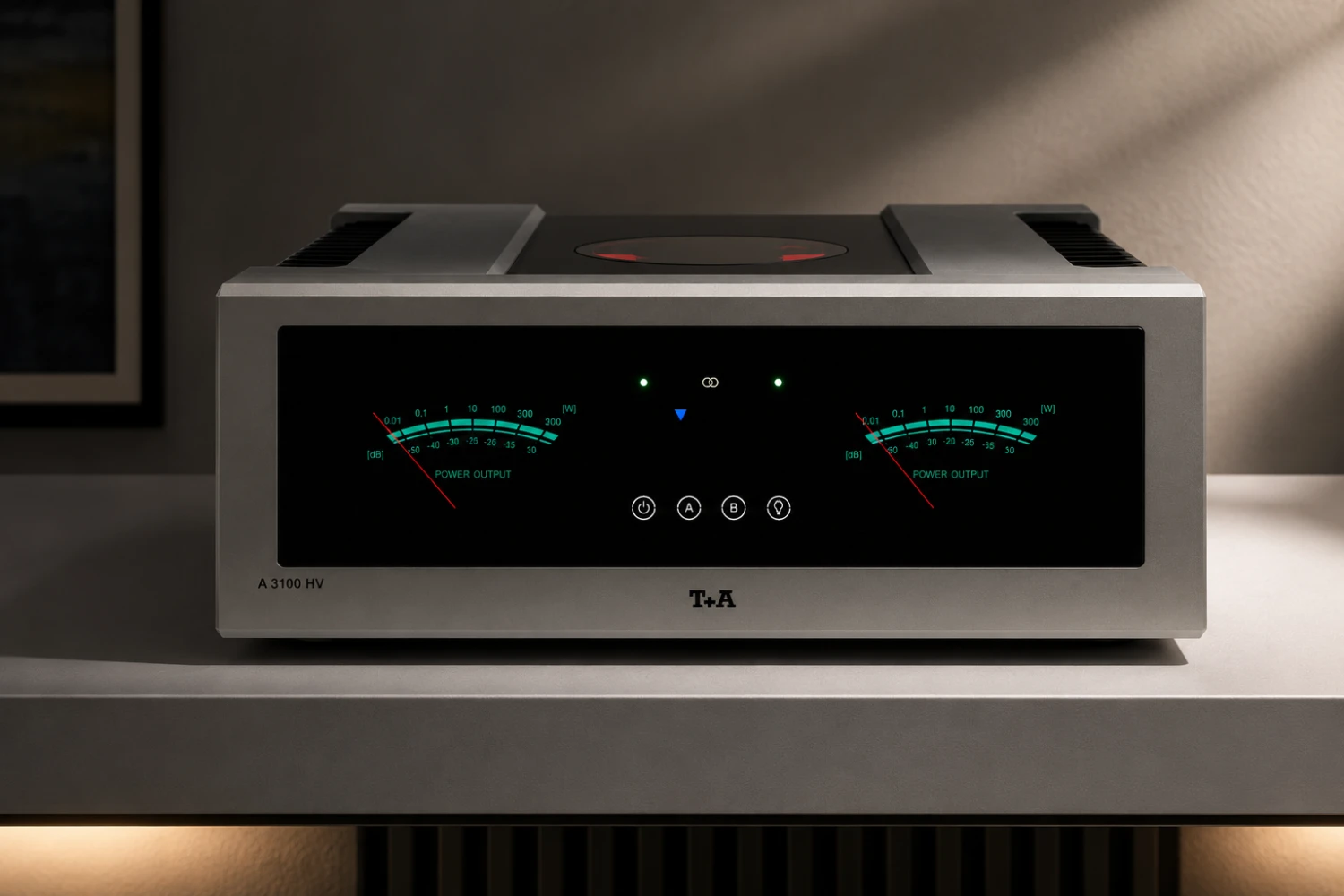
Amplifier shopping is not simply a contest between power ratings. The five source articles considered here cover very different solutions: T+A’s flagship HV separates, a group of affordable-to-high-end tube integrated amplifiers, TAD’s digitally equipped Evolution Series integrated, TIDAL’s power-supply-focused monoblock, and iFi’s unusually flexible headphone amplifier.
That makes direct matching more useful than declaring one universal winner. A speaker-based streaming system, a sensitive pair of headphones, an efficient loudspeaker and a demanding flagship setup need different things. The guide below identifies the strongest choice for each priority, while keeping budget comparisons to the prices actually supplied.
Quick verdict
Best Overall for a mixed digital-and-analog speaker system: TAD-A1000D. It combines the A1000’s analog amplification platform with digital inputs and integrated D/A conversion, making it the most straightforward all-in-one speaker amplifier in this comparison.
Best Value: Cayin CS-55A. At €1,790, it offers switchable KT88 or EL34 operation, 35 watts per channel in ultra-linear mode and 24 watts in triode mode.
Best Features: iFi iCan Phantom 1.5. It is the most versatile headphone choice, supporting sensitive IEMs, dynamic headphones, planar magnetics and compatible electrostatic headphones in one chassis.
Best for a flagship separate system: T+A A 3100 HV and SDX 3100 HV. The pair combines a high-power stereo amplifier with a streaming preamplifier, DAC and extensive network functionality.
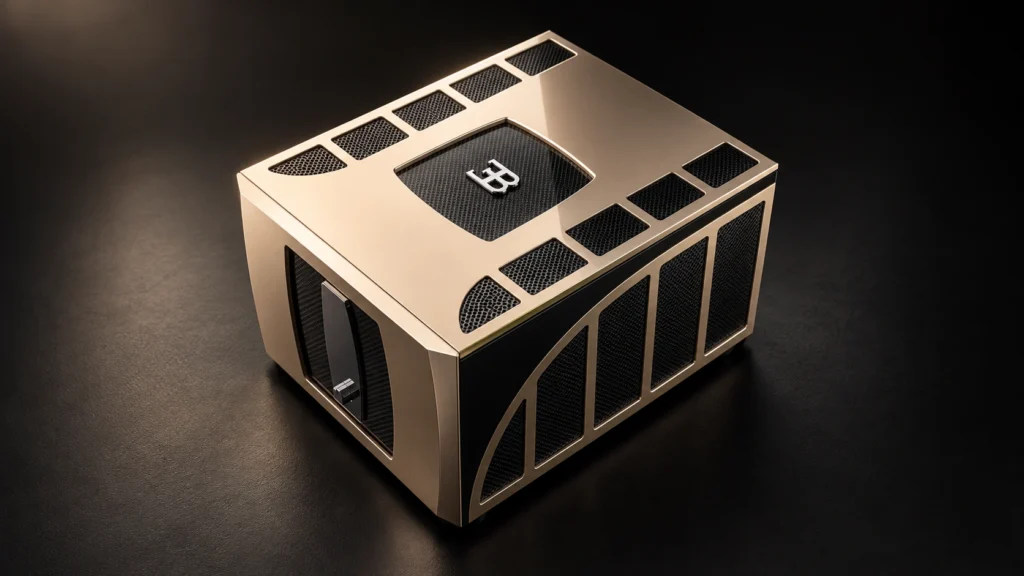
Best for a no-compromise monoblock concept: TIDAL x BUGATTI MA1. Its three shielded and mechanically decoupled 1,000 VA toroidal transformers and 800,000-microfarad capacitance bank make the power supply its defining feature.
| Amplifier or system | Best suited to | Key supported features | Price information supplied |
|---|---|---|---|
| TAD-A1000D | Mixed analog-and-digital speaker systems | Integrated amplifier with digital inputs and D/A conversion; derived from the analog A1000 | Not announced |
| T+A A 3100 HV plus SDX 3100 HV | High-end two-channel systems using streaming, digital and analog sources | 500-watt High Power mode; High Current mode; streaming, DAC, analog preamp and optional phono | Not announced |
| Cayin CS-55A | Entry-level tube systems and efficient loudspeakers | KT88 or EL34 tubes; 35 watts per channel ultra-linear; 24 watts triode | €1,790 |
| Aurorasound HFSA01 | Carefully matched, efficient-speaker systems and vinyl listeners | EL34 push-pull Class A; 14 watts per channel; integrated phono and headphone amplifier | €4,890 |
| Line Magnetic LM-845IA | Listeners seeking a single-ended 845 tube design | 22 watts per channel; pure Class A; integrated 35 kg chassis | €5,199 |
| PrimaLuna EVO 300 | Tube users who prioritise easy ownership and tube rolling | Adaptive AutoBias and support for a wide range of compatible output tubes | €5,600 |
| TIDAL x BUGATTI MA1 | Flagship stereo systems requiring monoblock amplification | Monaural design; three 1,000 VA transformers; 800,000 µF total capacitance | Not announced |
| iFi iCan Phantom 1.5 | Headphone systems using several headphone technologies | 0, 12 and 24 dB gain; IEMatch attenuation; solid-state, tube and Tube+ modes; integrated electrostatic energizer | Not stated |
T+A A 3100 HV and SDX 3100 HV
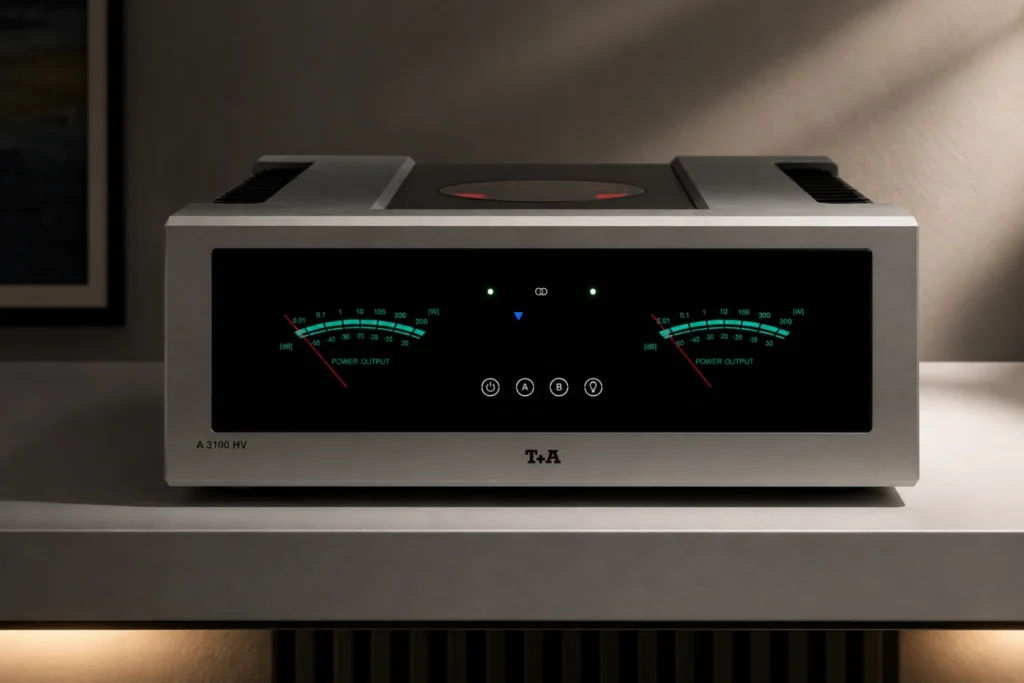
The T+A combination is the most complete high-end source-and-amplification platform in the comparison. The T+A A 3100 HV is a stereo power amplifier, while the SDX 3100 HV adds the control and source functions: preamplification, digital conversion and network streaming.
The A 3100 HV offers two useful operating approaches. Its rear-panel-selectable High Current mode keeps the amplifier continuously biased and extends the real Class A operating range to more than 75 watts, depending on the connected speaker load. High Power mode is rated at 500 watts in Class AB operation. That makes it more adaptable than an amplifier restricted to one operating philosophy, although the source does not provide a single overall power rating for every load.
T+A has also designed the amplifier for mono use, with its outputs operating in parallel rather than through a conventional bridged arrangement. The company says this approach is intended to provide high output in mono use without some typical bridged-amplifier compromises.
The SDX 3100 HV is the reason this pairing is more than a conventional power-amplifier purchase. Its ASA G3 streaming platform supports Amazon Music, Tidal, Qobuz, Deezer and HighRes Audio, alongside Apple AirPlay, Spotify Connect, Qobuz Connect and Tidal Connect. Native DSD playback is supported from a network source or hard drive, while Roon certification is planned rather than confirmed.
Its digital architecture separates DSD and PCM processing. DSD is handled natively up to DSD 1024 using a True 1-Bit converter, while PCM uses a Quadruple PCM converter. The fully symmetrical dual-mono preamplifier also includes analog bass and treble controls, with separate channel adjustment available. Vinyl users can add an optional phono module for moving-magnet or moving-coil cartridges.
This is the strongest choice here for a listener building a reference-level separate system around streaming, digital files and optional vinyl. It is not the budget choice: pricing and detailed delivery information had not been announced in the source.
Tube integrated amplifiers: four different routes into valve sound
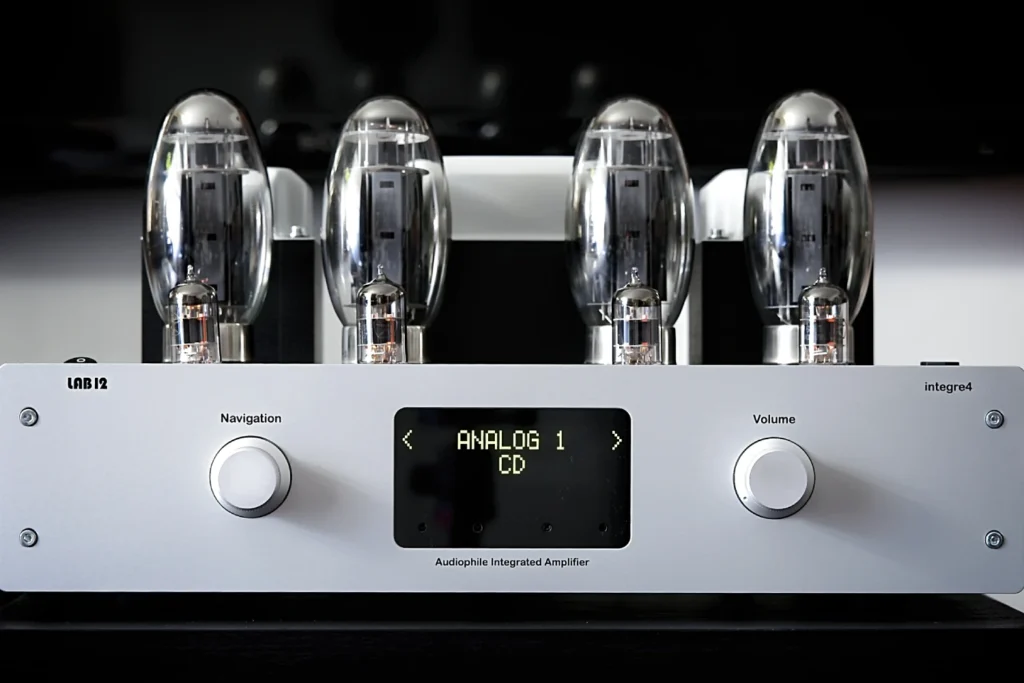
The tube roundup supplies the clearest budget information in this comparison and shows why wattage alone is not enough. Tube amplifiers generally produce less power, generate more heat and require more maintenance than solid-state designs, so loudspeaker matching matters. The source specifically notes that efficient speakers can work very well with modest power, while push-pull designs are typically easier to match than single-ended designs.
Cayin CS-55A — Best Value. At €1,790, this is the accessible recommendation. Its push-pull architecture accepts KT88 and EL34 output tubes, with 35 watts per channel in ultra-linear mode or 24 watts in triode mode. Ultra-linear gives the higher output, while triode gives the lower-power alternative. The source describes rich vocals, body and musical engagement, and identifies manual bias adjustment as its main drawback. It is the most convincing choice for a first tube amplifier when the system uses suitably matched speakers.
Aurorasound HFSA01 — Best for low-power Class A and vinyl. This Japanese-built EL34 push-pull Class A integrated produces 14 watts per channel. That is the lowest stated output among the four named tube models, so speaker matching becomes especially important. In return, the HFSA01 includes an integrated phono stage and dedicated headphone amplifier. Its €4,890 price places it well above the Cayin, but its feature set is more specifically attractive to a listener whose system includes vinyl and headphones.
Line Magnetic LM-845IA — Best for a single-ended 845 design. At €5,199, this is the specialist tube option. Its pure Class A, single-ended 845 topology produces 22 watts per channel. The source highlights its expansive, holographic and textured presentation, as well as heavy-duty Japanese output transformers and a 35 kg chassis. It is the appropriate choice for a listener specifically seeking SET character rather than the broadest possible speaker compatibility.
PrimaLuna EVO 300 — Best for convenience and tube rolling. At €5,600, the EVO 300 addresses one of the practical objections to valve ownership. Its Adaptive AutoBias continuously optimises tube performance, removing manual adjustments and helping extend tube life. It also supports a broad range of compatible output tubes. Compared with the Cayin’s manual bias arrangement, this makes the PrimaLuna the more convenient recommendation for buyers who want to experiment without taking on as much routine setup.
These four tube amplifiers are not direct substitutes for the TAD, T+A or TIDAL products. Their appeal is the choice of tube topology, operating mode and power level. They make the most sense when the buyer is prepared to match the amplifier to the loudspeakers rather than simply choosing the largest output figure.
TAD-A1000D
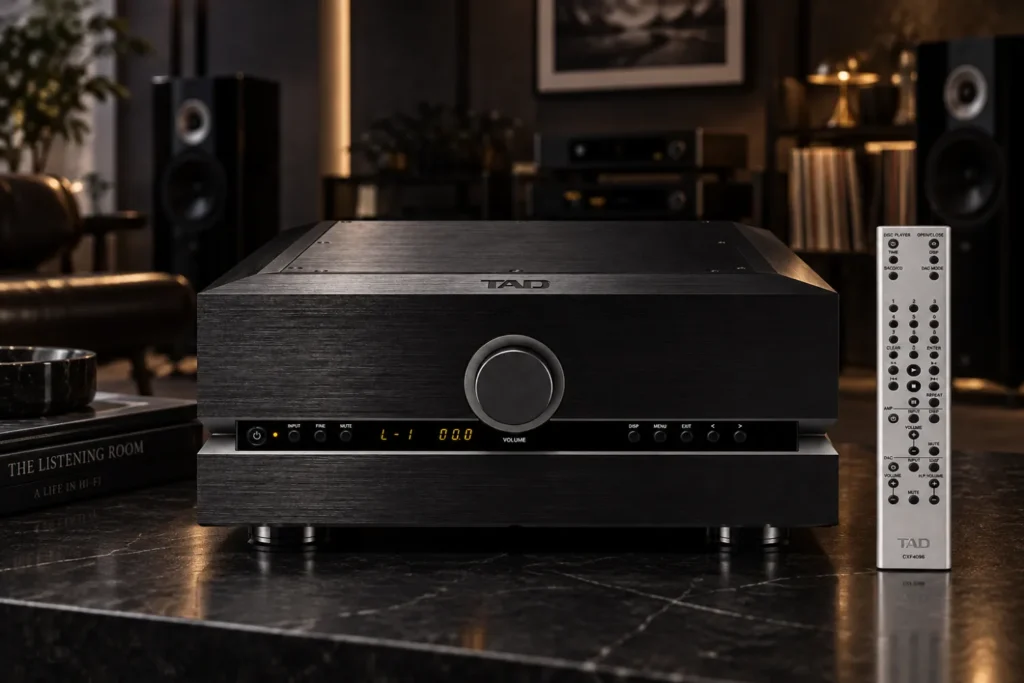
The TAD-A1000D is the clearest all-round speaker-system recommendation because it combines the amplification circuitry of the analog TAD-A1000 with digital inputs and integrated D/A conversion. It is not presented as a replacement for the A1000, but as a digitally equipped companion model.
That distinction matters. The original A1000 remains the more specialised choice for a system built entirely around analog sources or separate digital components. The A1000D is for the listener who wants conventional analog components and digital sources to connect to one integrated amplifier without adding an external DAC to the basic signal chain.
TAD has not supplied output figures, digital formats, the number of digital connections or a USD price in the source announcement. Those omissions prevent a more detailed power or connectivity comparison with the T+A system. Nevertheless, its architecture gives it the strongest balance of simplicity and source flexibility among the speaker amplifiers discussed here. That is why it is the guide’s Best Overall, not because the supplied material proves it has the highest output or the best sound.
TIDAL x BUGATTI MA1
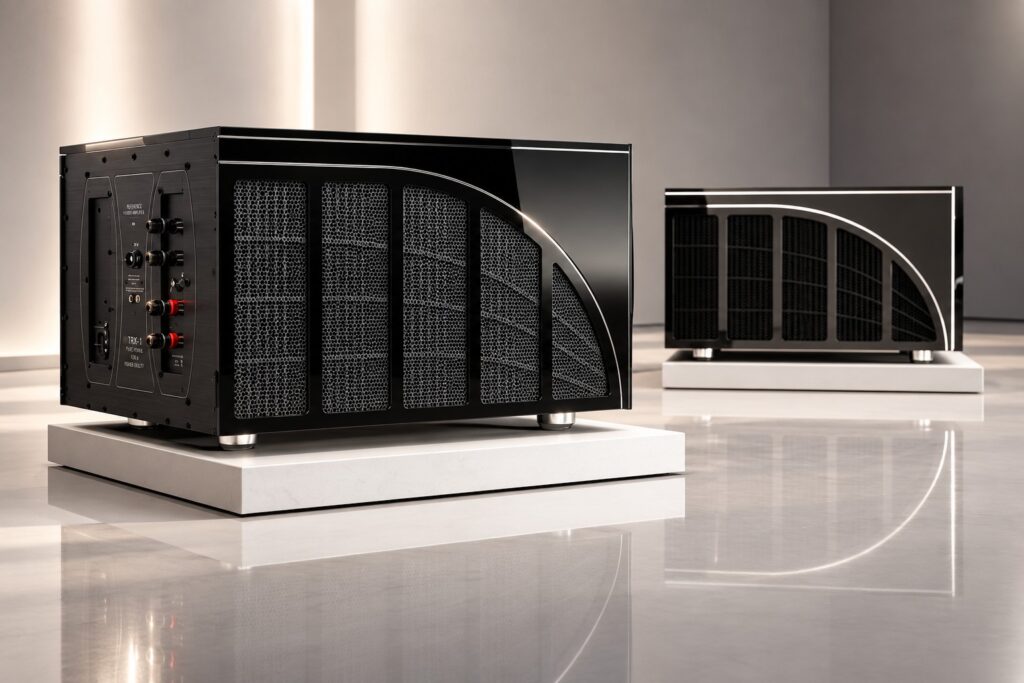
The TIDAL x BUGATTI MA1 is a very different proposition. It is a flagship monaural power amplifier and the successor to the TIDAL Assoluta Monobloc. A stereo system requires a separate amplifier for each channel, so this is a choice for buyers already committed to a high-end monoblock architecture.
Its defining information is about the power supply rather than a headline output rating. Each MA1 uses three 1,000 VA toroidal transformers with magnetic shielding and mechanical decoupling, plus a linear supply for the amplifier modules. Total capacitance is specified at 800,000 microfarads. TIDAL says the arrangement is intended to provide stable power while limiting noise and ripple.
The source does not provide rated output, connections, chassis dimensions, availability or price. That means the MA1 cannot be fairly ranked against the T+A A 3100 HV on wattage or against the tube amplifiers on value. Its justified position is narrower: it is the specialist choice for someone seeking TIDAL’s flagship monoblock format and a particularly elaborate supply architecture.
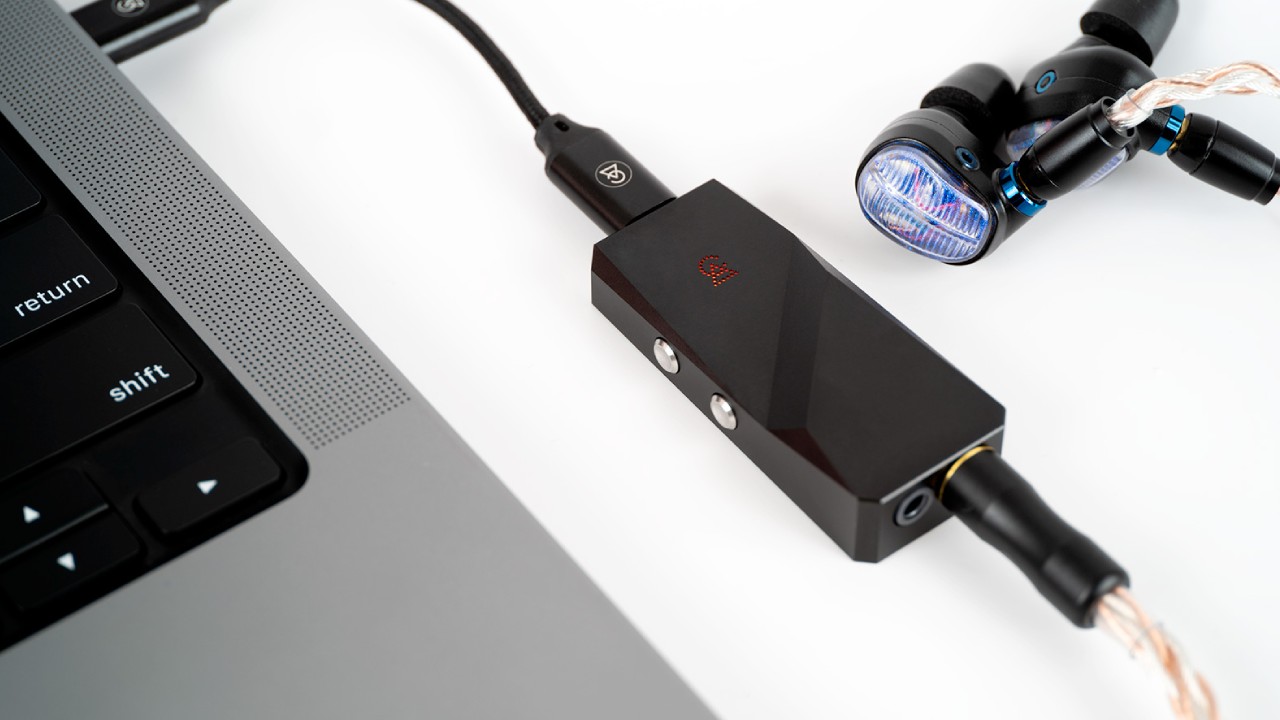
iFi iCan Phantom 1.5
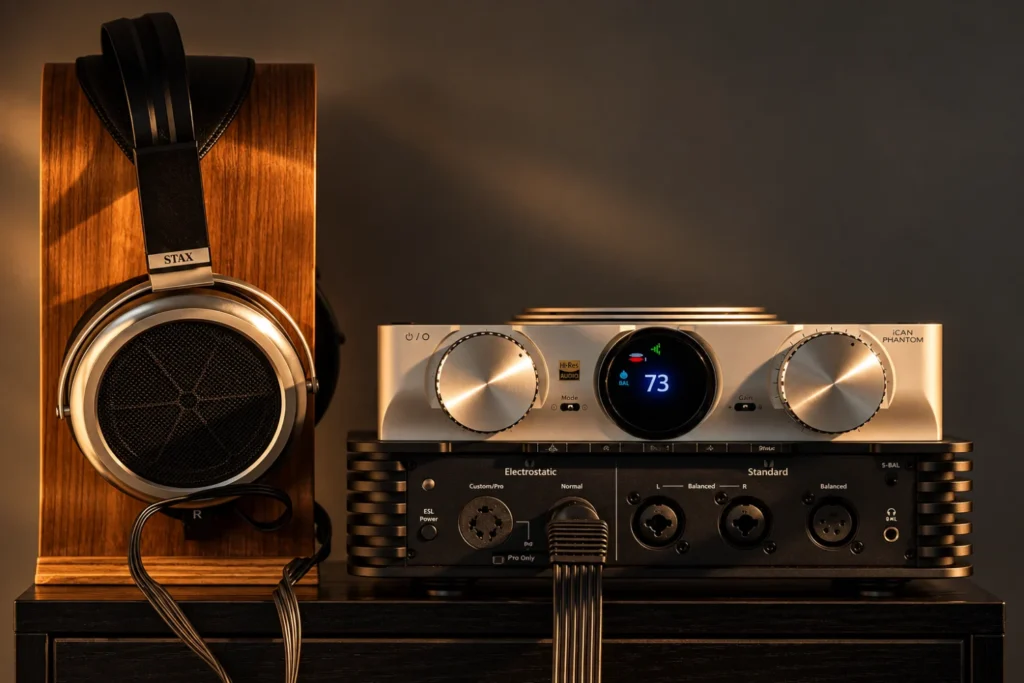
The iFi iCan Phantom 1.5 wins the features contest, but only if your system is headphone-based. It is not an alternative to the TAD or T+A for driving loudspeakers. Its advantage is the number of headphone technologies it can accommodate in one component.
It supports sensitive IEMs, dynamic headphones, low-sensitivity planar magnetics and compatible electrostatic headphones. The integrated iESL energizer can supply up to 640 volts for electrostatic models, avoiding the separate energizer normally required for that headphone type.
The 1.5 revision improves matching at both ends of the sensitivity range. Gain settings are now 0, 12 and 24 dB, replacing the earlier 0, 9 and 18 dB arrangement. IEMatch attenuation provides 12 dB on the unbalanced output and 24 dB on the balanced output. Those changes should make level control easier with sensitive earphones while retaining the ability to drive more demanding headphones.
The amplifier also offers separate solid-state and tube Class A input stages, plus Tube+ mode. XBass provides three levels of low-frequency adjustment, while XSpace changes the perceived openness and width, with separate matrices for headphone and loudspeaker listening. A central VU meter and expanded Nexis app functions, including tube-status monitoring, complete a feature set aimed at users with varied headphones and a taste for adjustment.
How they differ
The first distinction is system type. TAD, T+A, the tube integrated amplifiers and TIDAL are speaker-system products; iFi is a headphone amplifier. Buying the iFi for a conventional stereo loudspeaker system, or choosing a monoblock when you want a simple integrated amplifier, would solve the wrong problem.
The second is architecture. TAD offers the simplest modern speaker solution by combining amplification and DAC functions. T+A separates the power amplifier from the preamplifier, DAC and network player, giving the system a more modular high-end structure. TIDAL goes further toward separates by using monoblocks, with the supply design as its central selling point.
The tube models trade the source flexibility of TAD and T+A for valve-specific operating choices. The Cayin offers the lowest supplied price and switchable tube modes. The Aurorasound focuses on low-power Class A with phono and headphone facilities. The Line Magnetic is the dedicated 845 single-ended choice. PrimaLuna is the easiest recommendation for owners who value automatic bias and tube experimentation.
Finally, the evidence available is not equally detailed. T+A supplies extensive streaming, DAC and amplifier information. iFi gives precise gain and attenuation changes. TAD withholds power and digital-format details, while TIDAL does not provide output figures or connections. Those products should therefore be selected for their clearly stated design and use case, not for specifications the sources do not confirm.
Which one should you buy?
- Choose the TAD-A1000D if you want one integrated speaker amplifier for both analog and digital sources. It is the best general recommendation because its role is clear and its source flexibility is built in.
- Choose the T+A A 3100 HV and SDX 3100 HV if you are building a high-end two-channel system around streaming, network playback, DSD, PCM and optional vinyl. Select it when a separate preamp-and-power-amp architecture is part of the goal.
- Choose the Cayin CS-55A if €1,790 is the relevant budget and your speakers are suitable for a 24-to-35-watt tube integrated. It is the strongest value pick in the supplied material.
- Choose the Aurorasound HFSA01 if you have efficient speakers, want pure Class A operation and value a built-in phono stage and headphone amplifier.
- Choose the Line Magnetic LM-845IA if the specific attraction is a 22-watt, single-ended 845 design and its associated SET presentation.
- Choose the PrimaLuna EVO 300 if you want tube rolling without manual bias adjustment. Its Adaptive AutoBias makes it the practical tube choice.
- Choose the TIDAL x BUGATTI MA1 if you are assembling a flagship stereo system around monoblock power amplifiers and specifically value its large, isolated linear power supply.
- Choose the iFi iCan Phantom 1.5 if you use IEMs, dynamic headphones, planar magnetics and electrostatics and want one amplifier to support them all. Its gain, IEMatch, tube and sound-shaping options are unmatched by the speaker amplifiers here.
Budget buyers should note that only the four named tube amplifiers have prices in the supplied material: €1,790 for the Cayin, €4,890 for the Aurorasound, €5,199 for the Line Magnetic and €5,600 for the PrimaLuna. Prices for the T+A, TAD, TIDAL and iFi products were not provided and should be checked with the relevant dealer or regional representative.
Final verdict: The TAD-A1000D is the Best Overall choice for a mixed-source speaker system because it combines an established analog amplifier platform with digital inputs and integrated conversion. The Cayin is the value choice, T+A is the high-end streaming-and-separates choice, iFi is the feature-rich headphone specialist, and TIDAL is the monoblock option for a flagship system. The tube amplifiers remain compelling when their different power levels and operating demands match the loudspeakers.







 VS
VS VS
VS VS
VS VS
VS VS
VS VS
VS VS
VS VS
VS
Comments 0
Share your experience, questions and perspective with other hi-fi enthusiasts.