
Choosing a DAC is less about finding a universal answer and more about matching the converter to the system around it.
A phone-driven headphone rig, a balanced desktop setup, an active-speaker workstation and a full-scale streaming system all place different demands on inputs, outputs, format support and control features.
This comparison brings together ten DAC-related products and technologies from the supplied source material: compact USB dongles, desktop DAC/headphone amplifiers, balanced converters, network-capable high-end designs and even a standalone DAC chip article that helps explain why implementation matters as much as the silicon itself. Rather than ranking by claimed sound quality, the focus here is practical differentiation. Output types, supported formats, Bluetooth or streaming features, balanced architecture, headphone amplification and upgrade flexibility are the useful markers when deciding which DAC belongs in a particular system.

1. Hidizs SD2: Portable DAC and headphone amplifier with 3.5mm output
The Hidizs SD2 is a pocket-size USB-C DAC and headphone amplifier with a standard 3.5mm output.
The Hidizs SD2 is a very small USB-C portable DAC and headphone amplifier built around the ES9270 decoding chip.
Its appeal is straightforward: it adds a standard 3.5mm headphone output to smartphones, computers, tablets and game consoles while supporting PCM up to 384 kHz and native DSD64/128.
The quoted output of 70 mW + 70 mW at 32 ohms makes it a practical dongle-style choice for wired headphones rather than a desktop hub.
Best for: Simple wired listening from phones, tablets, computers and game consoles
- Compact 34.5 x 20 x 10 mm body
- USB-C connection for multiple device types
- 3.5mm headphone output
- PCM up to 384 kHz and native DSD64/128
Verdict: A compact USB-C DAC/headphone amp for users who want a direct 3.5mm upgrade without desktop complexity.

2. LOXJIE D30: Updated, compact DAC and headphone amplifier
The LOXJIE D30 combines ESS-based digital conversion, Bluetooth connectivity and headphone amplification in a compact chassis.
The LOXJIE D30 is a compact DAC and headphone amplifier using the ESS ES9039Q2M DAC chip, with complete MQA decoding, Bluetooth 5.1 and Qualcomm aptX HD support.
It is also specified with a third-generation XMOS-based processing solution supporting PCM up to 32-bit/768 kHz and DSD512.
Compared with the simplest dongles, the D30 is positioned as a more fully featured desktop unit, adding wireless connectivity and a headphone stage in one compact component.
Best for: Compact desktop systems needing DAC, headphone amp and Bluetooth in one unit
- ESS ES9039Q2M DAC chip
- Bluetooth 5.1 with aptX HD
- PCM up to 32-bit/768 kHz and DSD512
- Complete MQA decoding
Verdict: A feature-rich compact desktop DAC/headphone amplifier with high-resolution format support and wireless convenience.
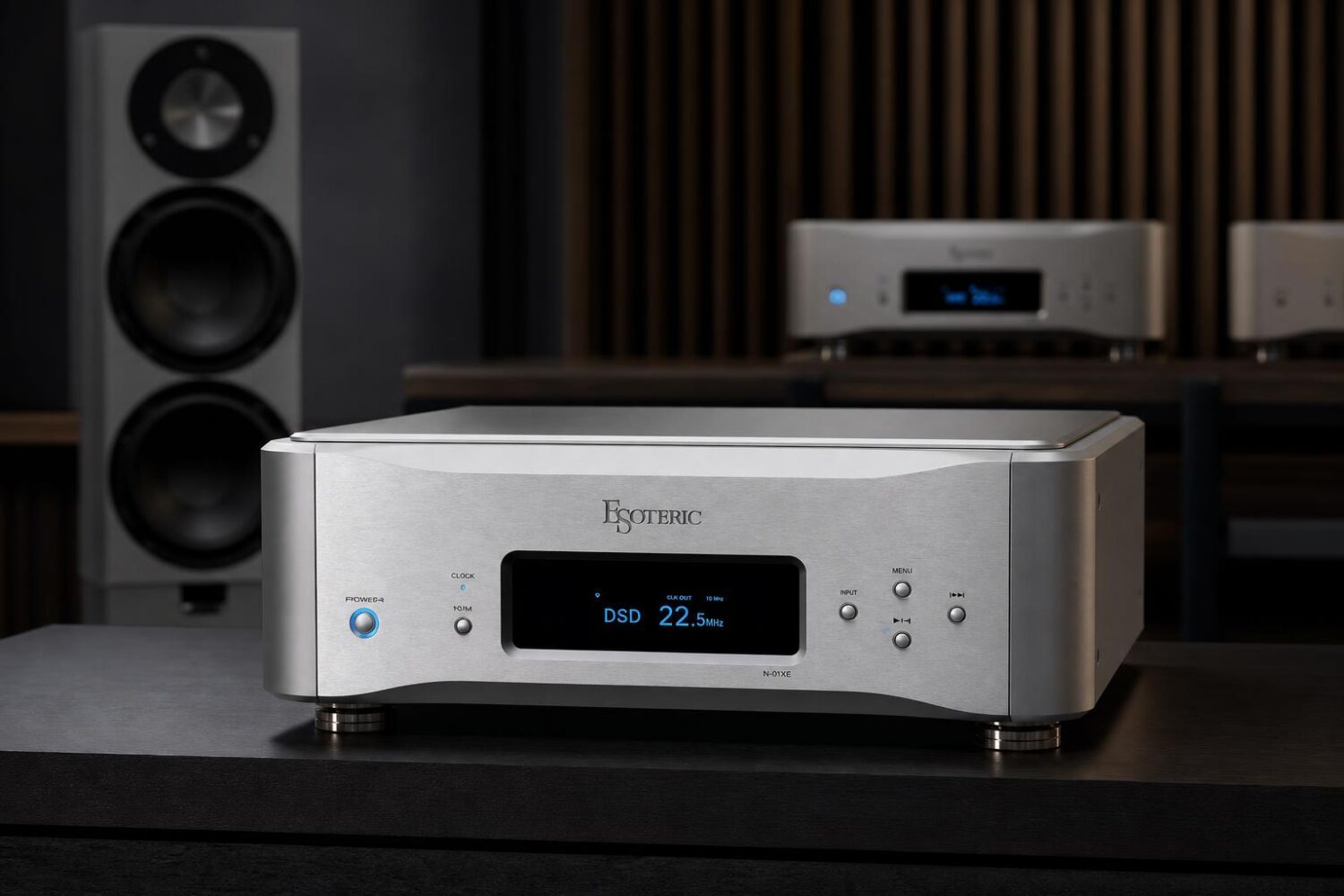
3. Esoteric N-01XE Brings Grandioso-Derived Digital Technology to the 01 Series
The Esoteric N-01XE pairs the Master Sound Discrete DAC G2 with Esoteric’s Network Engine G4 in a single high-end chassis.
The Esoteric N-01XE is a flagship network player and DAC that uses Esoteric’s Master Sound Discrete DAC G2 rather than an off-the-shelf converter chip.
Its FPGA-based, multilayer delta-sigma architecture is arranged as a dual-mono circuit with 32 elements per channel, dedicated processing for DSD and PCM, selectable digital filters and PCM-to-DSD conversion.
It also incorporates Esoteric’s fourth-generation Network Engine G4, making it a digital source component as much as a standalone DAC.
Best for: High-end systems needing a network player and DAC in one flagship component
- Discrete FPGA-based DAC architecture
- Dual-mono circuit with 32 elements per channel
- Fourth-generation Esoteric Network Engine G4
- Selectable filters and PCM-to-DSD conversion
Verdict: A sophisticated network DAC for systems where discrete conversion, streaming integration and extensive digital processing are central priorities.

4. AKM has introduced its latest DAC chip, the AK4498EXVQ
The AKM AK4498EXVQ is a premium DAC chip intended for manufacturers designing digital-to-analog converters.
The AK4498EXVQ is not a complete hi-fi component but a Stereo Premium DAC chip from Asahi Kasei Microdevices.
Its inclusion is useful because it underlines an important buying point: the DAC chip is only one part of a converter’s performance.
The source explicitly notes that manufacturers using the same chip can still differentiate their DACs through surrounding electronics, design and implementation quality.
Best for: Readers comparing DAC platforms and the role of converter chips
- Stereo Premium DAC chip from AKM
- Uses Switched Capacitor Filter Voltage Output Velvet Sound technology
- Highlights the importance of DAC implementation
- Relevant for understanding converter design choices
Verdict: A useful technology reference that explains why a DAC chip matters, but does not define a complete DAC on its own.

5. Soundaware DAM1 15TH: High-end DAC for discerning audiophiles
The Soundaware DAM1 15TH provides multiple digital inputs, XLR and RCA outputs, and a proprietary Jingling DSP platform.
The Soundaware DAM1 15TH is a high-end DAC built around the company’s proprietary Jingling DSP system.
It offers five digital inputs, including USB with the PA1 filter module, optical, coaxial, AES/EBU and I2S, plus balanced XLR and unbalanced RCA outputs.
The source also notes a dedicated power-supply approach with a choice of external power units and four operating modes, making it a highly configurable converter for systems that can use its input and output flexibility.
Best for: Hi-fi systems needing a configurable high-end DAC with multiple digital inputs
- Five digital input options
- Balanced XLR and unbalanced RCA outputs
- Proprietary Jingling DSP system
- Choice of compatible external power units
Verdict: A flexible high-end DAC for users who value DSP-based operation, input variety and balanced system integration.

6. Questyle M15C: Portable Lossless DAC with Headphone Amplifier
The Questyle M15C is a portable DAC with 3.5mm unbalanced and 4.4mm balanced headphone outputs.
The Questyle M15C is a portable DAC and headphone amplifier using a Cirrus Logic CS43198 DAC.
It supports PCM up to 384 kHz/32-bit and DSD up to DSD256, and provides both 3.5mm unbalanced and 4.4mm balanced headphone outputs.
Manual gain control gives it more headphone-matching flexibility than a basic dongle, while its compact aluminum alloy body keeps the design travel-friendly.
Best for: Portable headphone users who want balanced output and manual gain control
- Cirrus Logic CS43198 DAC
- 3.5mm and 4.4mm balanced outputs
- Manual standard and high gain modes
- PCM up to 384 kHz and DSD256
Verdict: A compact portable DAC/headphone amp with stronger connection flexibility than single-output dongles.

7. PS Audio PMG Signature 512 DAC: PureStream DSD512 Engine Delivers Uncompromising Sound Quality
The PS Audio PMG Signature 512 DAC uses PureStream DSD512 processing and offers RCA and XLR analog outputs.
The PS Audio PMG Signature 512 DAC takes a distinctive architectural path by converting all incoming digital music signals, including PCM, into an 8x DSD stream through its PureStream DSD512 engine.
The signal is then processed by the SpectraWave 64-Tap Sequencer and output through a fully balanced, direct-coupled analog stage with RCA and XLR connections.
The source also identifies galvanically isolated inputs, a built-in streamer and precision analog volume control, positioning it as a central digital source rather than a minimal DAC box.
Best for: High-end systems seeking a DAC that can serve as a digital control hub
- Converts incoming signals to an 8x DSD stream
- PureStream DSD512 engine
- Fully balanced direct-coupled analog output stage
- Built-in streamer and analog volume control
Verdict: A full-scale DAC platform built around PS Audio’s DSD conversion approach, streaming capability and balanced analog output stage.

8. SMSL SU-2: A Compact, Balanced DAC Built for Serious Desktop Audio
The SMSL SU-2 is a compact balanced DAC with XLR and RCA outputs for desktop and monitor-based systems.
The SMSL SU-2 is a compact desktop DAC designed around a balanced signal path.
It uses the ES9039Q2M DAC chip with four OPA1612A operational amplifiers in a symmetrical left-right layout, and provides both balanced XLR and unbalanced RCA outputs.
With its solid metal chassis, LED indicators and no-menu operating concept, it is aimed at desktop audio, studio monitoring and active speaker setups that benefit from simple, balanced connectivity.
Best for: Desktop systems, active speakers and balanced amplifier setups
- Balanced XLR and RCA outputs
- ES9039Q2M DAC chip
- Four OPA1612A operational amplifiers
- Simple LED-based operation
Verdict: A compact, no-fuss balanced DAC suited to listeners who need clean integration more than extra interface features.

9. SMSL DAC MINI: Mac Mini-Optimized DAC, Balanced Headphone Amp & USB Hub
The SMSL DAC MINI is shaped to stack under a Mac mini and combines DAC, headphone amplifier and USB hub roles.
The SMSL DAC MINI is designed specifically to sit beneath a Mac mini, with a matching footprint and CNC-milled aluminum enclosure.
It is built around the ESS ES9039Q2M DAC chip and combines DAC duties with a balanced headphone amplifier and USB hub functionality.
Its most unusual integration detail is a mechanical power-on system that can wake the Mac mini from the DAC MINI’s front button, making it more specialized than a conventional desktop DAC.
Best for: Mac mini desktop setups needing integrated audio and hub functions
- Mac mini-matching footprint
- CNC-milled aluminum enclosure
- ESS ES9039Q2M DAC chip
- DAC, balanced headphone amp and USB hub functions
Verdict: A purpose-built desktop companion for Mac mini users who want DAC, headphone amplification and workspace integration in one unit.

10. Topping D90 III Discrete: Balanced DAC equipped with Bluetooth 5.1
The Topping D90 III Discrete combines discrete conversion modules, Bluetooth 5.1 and software-based parametric EQ control.
The Topping D90 III Discrete uses fully discrete digital-to-analog conversion modules rather than a conventional DAC-chip approach, with each channel using a PSRM module.
It supports PCM up to 32-bit/768 kHz and DSD512, adds Bluetooth 5.1 through a Qualcomm QCC5125 receiver, and supports codecs including aptX, aptX HD, aptX Adaptive and LDAC.
A 10-band parametric EQ through the Topping Tune Windows application gives it a level of tone-shaping flexibility not found on many straightforward DACs.
Best for: Balanced systems needing high-resolution support, Bluetooth and software EQ control
- Fully discrete conversion modules
- PCM up to 32-bit/768 kHz and DSD512
- Bluetooth 5.1 with LDAC and aptX family codecs
- 10-band parametric EQ via Topping Tune
Verdict: A highly configurable balanced DAC that combines discrete conversion, advanced Bluetooth support and parametric EQ adjustment.
Quick comparison
The main differences are not simply portable versus desktop.
Some models focus on headphone output, others on balanced line-level integration, streaming, computer-specific ergonomics or converter-chip technology.
The table below summarizes the most useful distinction for each entry without assuming performance beyond the supplied information.
| Product | Best for | Verdict |
|---|---|---|
| Hidizs SD2 | Simple USB-C portable listening with wired 3.5mm headphones | The most straightforward pocket DAC here, centered on USB-C input and a single 3.5mm output. |
| LOXJIE D30 | Compact desktop users wanting DAC, headphone amp and Bluetooth | A small all-in-one desktop option with ESS conversion, aptX HD Bluetooth and broad high-resolution support. |
| Esoteric N-01XE | High-end network-based systems | A flagship network player/DAC using Esoteric’s own discrete DAC architecture and streaming platform. |
| AKM AK4498EXVQ | Understanding the DAC-chip side of converter design | A premium DAC chip article rather than a complete component, useful for explaining why implementation matters. |
| Soundaware DAM1 15TH | Configurable high-end systems with multiple digital sources | A DSP-based DAC with five digital inputs, XLR and RCA outputs, and external power-supply options. |
| Questyle M15C | Portable headphone listening with balanced output | A travel-friendly DAC/headphone amp with both 3.5mm and 4.4mm outputs plus manual gain. |
| PS Audio PMG Signature 512 DAC | High-end systems needing a central digital hub | A DAC built around conversion of incoming signals to 8x DSD, with streaming, volume control and balanced outputs. |
| SMSL SU-2 | Desktop audio, active monitors and balanced amplifiers | A compact balanced DAC focused on XLR/RCA output simplicity and predictable desktop integration. |
| SMSL DAC MINI | Mac mini workstations | A highly specific desktop solution combining DAC, balanced headphone amp, USB hub and Mac mini-oriented physical integration. |
| Topping D90 III Discrete | Balanced systems needing Bluetooth and EQ flexibility | A discrete-conversion balanced DAC with high-resolution format support, advanced Bluetooth codecs and 10-band PEQ. |
Frequently asked questions
Should I choose a portable DAC or a desktop DAC?
Choose a portable DAC if your main source is a phone, tablet, laptop or game console and you primarily need headphone output, as with the Hidizs SD2 or Questyle M15C.
Choose a desktop DAC if you need RCA or XLR outputs, Bluetooth, streamer functions, multiple digital inputs or easier integration with amplifiers, active speakers or monitors.
Do balanced outputs matter on a DAC?
Balanced outputs are useful when your amplifier, active speakers or headphones can use them.
In this selection, the Questyle M15C adds a 4.4mm balanced headphone output, while desktop units such as the SMSL SU-2, Soundaware DAM1 15TH, PS Audio PMG Signature 512 DAC and Topping D90 III Discrete are relevant for systems using balanced line-level connections.
Is the DAC chip the most important specification?
The DAC chip matters, but it is not the whole product.
The AKM AK4498EXVQ article explicitly notes that different manufacturers can use the same chip while differentiating their DACs through surrounding electronics, design and implementation.
Inputs, outputs, power supply, analog stage, filtering and usability should also be considered.
How much attention should I pay to high-resolution format support?
Format support is important if you actually own or stream high-resolution PCM, DSD or MQA content.
Several models here support PCM up to 768 kHz and DSD512, while portable options such as the Hidizs SD2 and Questyle M15C support lower but still high-resolution limits.
For everyday system matching, connection type and output requirements may matter more than the highest supported file number.
How to choose the right DAC from this group
Start with where the DAC will live.
For pocket use, the Hidizs SD2 is the simplest USB-C route to a 3.5mm output, while the Questyle M15C adds a balanced 4.4mm output and manual gain control for more headphone-matching flexibility.
If the DAC is staying on a desk, decide whether you need headphone amplification, balanced line outputs, Bluetooth, a USB hub or a monitor-friendly no-menu design. For compact desktop use, the LOXJIE D30 suits users who want a DAC/headphone amplifier with Bluetooth and broad format support. The SMSL SU-2 is more focused on balanced desktop output for active speakers, monitors or amplifiers. The SMSL DAC MINI is the most specialized of the compact units, making sense primarily when its Mac mini footprint, power-on integration, balanced headphone amp and USB hub functions solve a real workspace problem. For more ambitious hi-fi systems, the Soundaware DAM1 15TH offers multiple digital inputs, proprietary DSP operation and both XLR and RCA outputs. The Topping D90 III Discrete stands out for discrete conversion, Bluetooth codec support and parametric EQ control. The PS Audio PMG Signature 512 DAC goes further as a central digital component, combining DSD-focused conversion, a built-in streamer, galvanically isolated inputs, volume control and balanced analog output. At the top of the architectural discussion sits the Esoteric N-01XE, which is best understood as a high-end network player/DAC with proprietary discrete conversion and Esoteric’s streaming platform. The AKM AK4498EXVQ, meanwhile, is not a finished DAC but a reminder that silicon alone does not define a product. The smartest choice is the one whose connections, control features and system role match your actual setup before you worry about headline specifications.



Sound Off
0Join the discussion if you have something to add.