

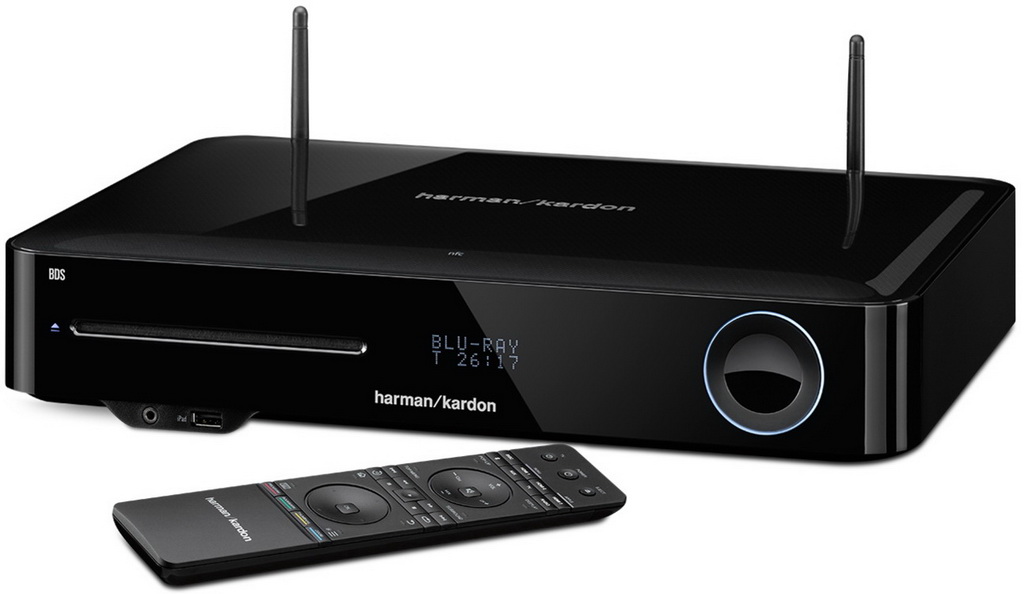
The Harman Kardon BDS 880 BQ approaches home cinema as a complete system rather than a collection of unrelated components. At its center is the BDS 580, a slim Blu-ray receiver that combines source playback, surround decoding, video processing, network functions and five channels of Class D amplification. It is partnered by the HKTS 35 speaker package, comprising four matching satellites, a dedicated center speaker and an active HKTS 220 SUB subwoofer. The attraction of this arrangement is not simply the number of functions it provides. The receiver and speakers have been conceived to address many of the practical complications associated with building a surround system, from speaker matching and room setup to subwoofer placement and everyday control.
A consolidated alternative to separate components
The BDS 580 performs several jobs that would conventionally require separate boxes. Its slot-loading drive supports Blu-ray Video, Blu-ray 3D, BD-Live, DVD and CD media, while the receiver also handles surround processing and amplification. Five Class D amplifier channels are rated at 65 watts per channel into 6 ohms from 20 Hz to 20 kHz, with total harmonic distortion specified at less than 1 percent under those conditions.
That consolidated architecture can be useful in rooms where a full-size AV receiver and separate disc player would occupy too much furniture space. The receiver measures 400 x 80 x 285 mm and weighs 3.6 kg, giving it a relatively low profile despite its broad responsibilities. Cooling is managed by heat sinks and a fan.
The BDS 580 supports the principal Dolby and DTS formats associated with DVD and Blu-ray, including Dolby TrueHD, Dolby Digital Plus and DTS-HD. Dolby Pro Logic II is also included for deriving multichannel playback from suitable non-surround material. Standard-definition video can be scaled to 1080p, while support for 30/36-bit Deep Color is provided for compatible video equipment. These capabilities allow older discs and newer high-definition sources to coexist within the same system.
Room setup without extensive manual adjustment
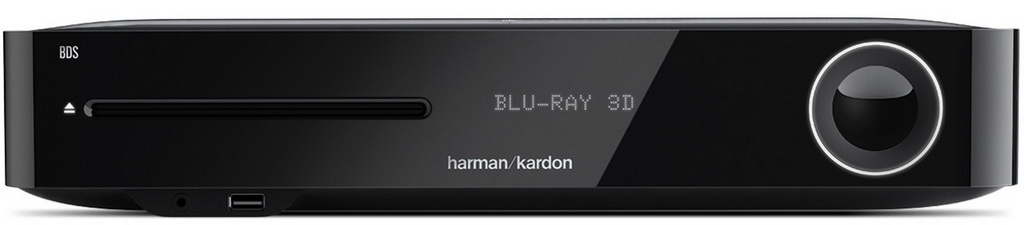
Multichannel systems require more setup than a conventional pair of speakers because the output level, equalization and timing of several channels must work together. Harman Kardon's EzSet/EQ III process is intended to reduce that burden. A calibration microphone connects to the socket beneath the disc tray, after which the system automatically adjusts channel levels, tuning and equalization for the connected speakers and the room.
Automatic calibration is especially relevant here because the BDS 880 BQ is positioned as an integrated package. Owners can install the supplied speakers in practical locations and use EzSet/EQ III as the starting point for system configuration instead of navigating every parameter manually. The receiver nevertheless retains a menu-based interface for general configuration.
Dynamic Range Control provides another everyday convenience. By compressing the difference between quiet and loud passages, it can make dialogue easier to follow and reduce abrupt level changes between different kinds of programming. This may be helpful during lower-volume viewing, although listeners who want the full dynamic range of a film soundtrack can choose settings appropriate to that material.
Disc, network and mobile playback in one receiver
The BDS 580 is not limited to physical discs. Its front USB connection can play compatible media from flash storage and is also compatible with Apple devices. Listed file support includes MKV, MPEG-2, DivX, MP3, WMA and JPEG, with GIF and PNG also supported as photo formats. Over a local network, it can access MP3, WMA and FLAC files held on a computer or NAS server through DLNA.
AirPlay and Bluetooth 4.1+EDR provide alternatives for mobile playback. Bluetooth support includes A2DP, AVRCP and AAC, allowing compatible phones and tablets to send audio without requiring the listener to browse the receiver's network menus. AirPlay addresses Apple-based systems, while DLNA is useful for households maintaining a centralized media library.
Internet connectivity also brings access to the supported YouTube and Picasa services. These functions reflect the receiver's role as a multimedia hub rather than only a Blu-ray transport. An FM tuner with RDS and 30 station presets provides a conventional broadcast option alongside discs, local network files and wireless sources.
Connectivity for a wider entertainment system
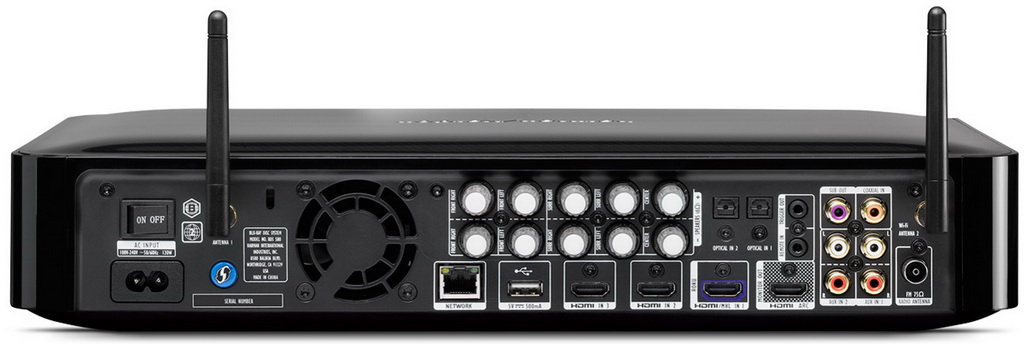
Three HDMI 2.0 inputs with 3D support allow the receiver to accommodate additional video sources. A single HDMI output with Audio Return Channel can send video to a television while accepting compatible TV audio over the same connection. That arrangement can reduce cable clutter when the television's own tuner or applications are in use.
Legacy and audio-only equipment are covered by a component-video input, two stereo RCA line inputs, one coaxial digital input and two optical digital inputs. A LAN port handles wired network access, while the five speakers connect through color-coded screw terminals. The active subwoofer has its own output, and a 3.5 mm headphone connection is available on the front panel. The receiver also offers a multichannel virtualization mode for headphone listening.
Integration connections include an external IR-receiver input, RS-232, an FM antenna socket and a 3.5 mm trigger output. The trigger can switch a compatible active subwoofer on with the rest of the system, avoiding the need to operate the subwoofer separately. Standby consumption is specified at 0.5 watts, while maximum power consumption is 120 watts.
Matching speakers across all five channels
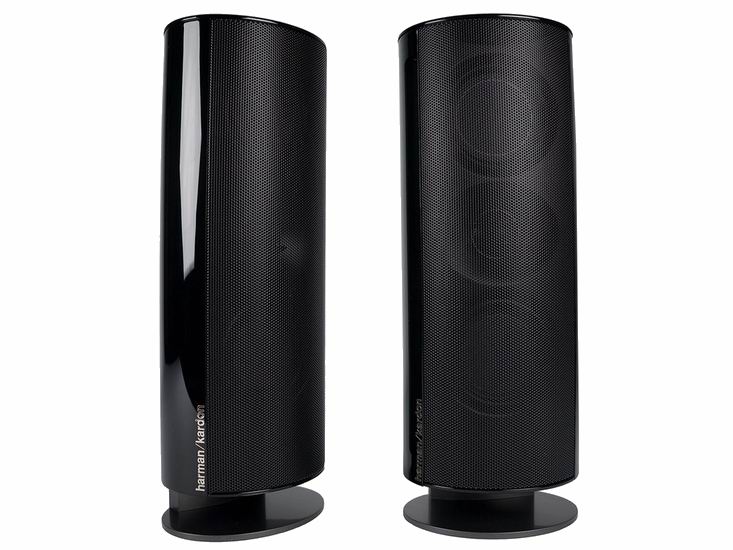
The HKTS 35 package uses four identical two-way satellites for the front-left, front-right and two surround positions. Each contains two 75 mm mid/bass drivers and a 19 mm dome tweeter in a closed enclosure. The center channel employs the same driver complement and crossover concept, arranged horizontally with the tweeter between its two 75 mm drivers.
Using corresponding drivers across the five main channels is a deliberate surround-design choice. As voices, effects or music move between speakers, similar construction helps maintain consistency between positions. The center speaker's horizontal format makes it easier to place above or below a display, while the satellites can be installed on shelves or attached to walls with their dedicated brackets.
The satellites have a nominal impedance of 8 ohms, sensitivity of 86 dB and a recommended amplifier range of 10 to 120 watts. Those figures place them comfortably within the intended role of the BDS 580's five-channel amplifier. Color-coded wiring is supplied to make the physical installation and channel identification more straightforward.

A subwoofer designed for flexible positioning
Low frequencies are handled by the HKTS 220 SUB, a closed-box active subwoofer with a downward-firing 200 mm driver and a built-in 200-watt amplifier. Its specified operating range is 45 to 200 Hz at minus 6 dB. The downward-facing driver and compact 276 x 353 x 267 mm enclosure are intended to make the subwoofer less visually dominant than a conventional front-firing design.
The subwoofer can receive its signal in two ways. Its LFE input provides a direct wired connection to an AV receiver, bypassing the subwoofer's own input filter when appropriate. Stereo RCA inputs are also available, along with controls for level, filter frequency, Bass Boost and absolute phase.
More distinctively, a supplied transmitter allows the subwoofer signal to be sent wirelessly. This removes the need to run a long audio interconnect from the receiver to the subwoofer and broadens the choice of installation positions. The subwoofer still requires local AC power, but eliminating the signal cable can be valuable when the most practical bass position is across the room or when routing cable around doors and furniture would be inconvenient. The wireless system is specified to operate without interfering with existing Wi-Fi or Bluetooth channels.
Controls intended for daily use
The BDS 580's front panel keeps its physical controls simple. The slot-loading drive and touch-sensitive eject control sit to the left, a central display uses large characters, and the illuminated volume control on the right also functions as the power and standby switch. The upper metal cover has a slightly concave form and meets a glossy surround extending across the sides and front, giving the receiver a more furniture-conscious appearance than many equipment-focused AV components.
A programmable remote provides the primary physical control interface and includes backlighting, with two joystick-style wheels used for settings. Harman Kardon also supports control through applications for iOS and Android devices. Smartphone control can be particularly convenient when selecting network or mobile content, while the backlit remote remains useful in a darkened viewing room.
Conclusion
The Harman Kardon BDS 880 BQ is most suitable for someone who wants a coordinated 5.1-channel system without selecting a separate disc player, AV receiver and six individual speakers. Its strongest documented qualities are the unusually broad source support of the BDS 580, five-channel Class D amplification, EzSet/EQ III automatic calibration, matching compact speakers and the flexible wired or wireless connection options of the active subwoofer. It should also appeal to households that still use Blu-ray, DVD and CD media while wanting Bluetooth, AirPlay, DLNA and USB playback in the same installation. It is less suited to users seeking a highly modular theater with more than 5.1 channels, large passive speakers or extensive future expansion. Within its intended scope, however, the system presents a carefully integrated route to surround sound, with practical attention paid to setup, room placement, connectivity and everyday operation.

Sound Off
0Join the discussion if you have something to add.