
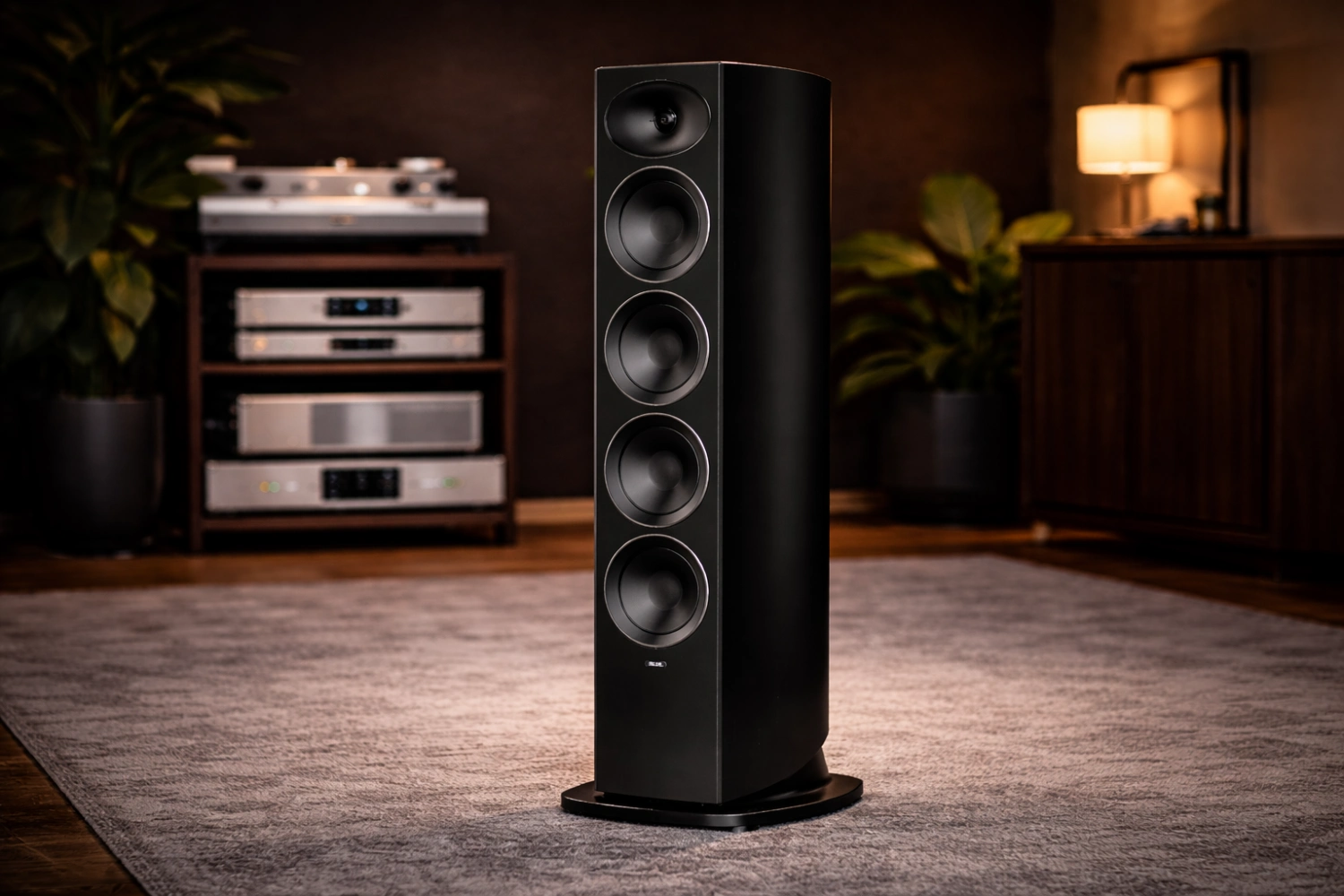
Revel’s Performa4 series approaches loudspeaker design as a complete system rather than a collection of unrelated models. The family includes two floorstanders, two stand-mount monitors, a dedicated center speaker, and an active subwoofer, supported by optional stands for the compact models. That breadth gives owners several ways to build around the same core driver and waveguide technologies.
Central to the range are newly developed Deep Ceramic Composite and Micro Ceramic Composite drivers, abbreviated DCC and MCC, together with Revel’s seventh-generation Acoustic Lens waveguide. These technologies are applied across models of different sizes and intended roles, helping the series address anything from a compact two-channel installation to a multichannel cinema room. Practical details—including bi-amping terminals, integrated stand cable management, magnetic grilles, and a choice of wood veneers—show similar attention to installation and everyday ownership.
A consistent technical foundation
The defining feature of Performa4 is the combination of DCC and MCC driver materials. Revel uses DCC for the 1-inch dome tweeter and for the dedicated midrange drivers in its floorstanding models, while MCC is employed for bass and mid/bass duties. According to Harman Luxury Audio, these composite materials provide greater stiffness at a lower weight than conventional alternatives, with the aim of reducing unwanted coloration.
Stiffness and mass are important considerations in a loudspeaker diaphragm because the driver must move accurately while resisting deformation. A lighter moving assembly can also be easier to accelerate and stop. Those principles do not determine performance on their own, but they explain why Revel has made the new cone materials central to the fourth-generation Performa platform rather than treating them as a model-specific upgrade.
The bass and midrange drivers are installed in patented cast-aluminum frames developed with finite element analysis. Revel says this work was used to optimize airflow and resonant behavior. The rigid frames are therefore more than structural supports: they are designed to give each driver a controlled mechanical foundation while allowing air to move efficiently around the assembly. Applying the same engineering approach throughout the family should also make it easier to preserve common design objectives between the compact monitors, floorstanders, and center channel.
The seventh-generation Acoustic Lens waveguide
Every Performa4 loudspeaker incorporates Revel’s in-house seventh-generation Acoustic Lens waveguide around its 1-inch DCC dome tweeter. The waveguide is designed to integrate the tweeter’s output with that of the adjacent midrange or mid/bass driver, with particular attention paid to how the speaker disperses energy into the room.
Revel claims the new waveguide provides better directional control, greater efficiency, increased dynamic range, and lower distortion, including at positions away from the central listening axis. For a prospective owner, the most relevant objective is a broader and more consistent listening area. That can be useful when more than one person is listening, or when a room does not permit every seat to be located at an ideal central point.
Controlled dispersion may also make the series attractive for mixed-use living spaces. Rooms often impose practical compromises involving furniture, screen placement, and seating distance. A design intended to maintain more consistent off-axis behavior can be valuable in those circumstances, even though final results will still depend on positioning, room acoustics, and system setup.
Two floorstanders for different room and system needs
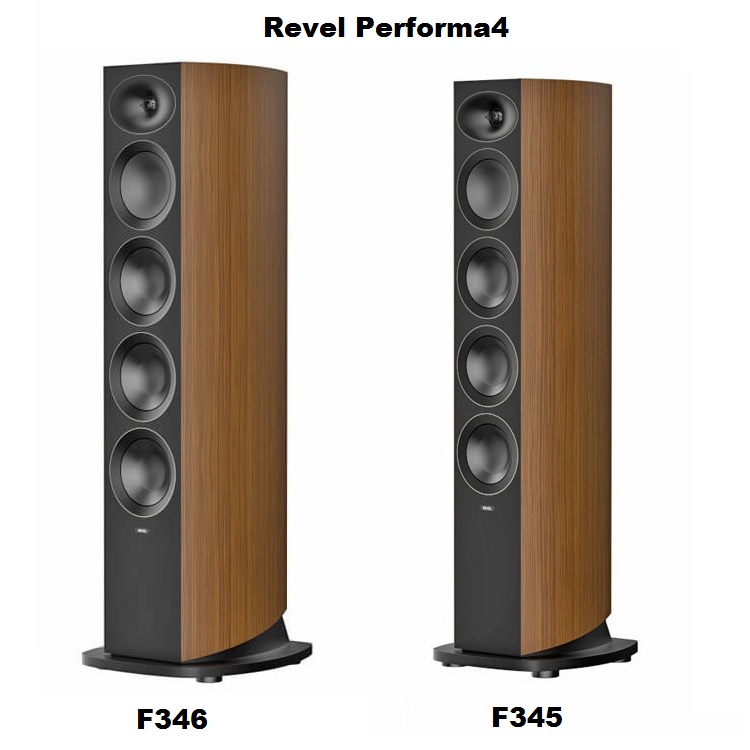
The F346 is the larger of the two floorstanding models. It is a three-way design with three 6.5-inch MCC bass drivers and a dedicated 6.5-inch DCC midrange driver. The F345 follows the same three-way architecture but uses smaller 5.25-inch drivers. This gives buyers a choice of scale without requiring them to move to a fundamentally different design concept.
Both floorstanders use two rear-facing bass ports and provide dual connections for bi-amping. The latter feature gives system builders the option to use separate amplification channels for different sections of the speaker. Bi-amping is not a requirement, but the provision is useful for owners who already have suitable electronics or who want room to develop their systems over time.
The dual rear ports make placement behind the speakers an important consideration. As with other rear-ported designs, available wall clearance and room interaction should be taken into account during installation. The two cabinet and driver sizes allow prospective owners to choose according to available space, desired visual presence, and the scale of the rest of the system rather than simply defaulting to the largest model.
Compact monitors with dedicated stand support
The M146 and M145 bring the Performa4 technologies to smaller enclosures. The M146 combines a 6.5-inch MCC mid/bass driver with the DCC dome tweeter and Acoustic Lens waveguide, while the more compact M145 uses a 5.25-inch MCC driver. Their two-way configuration makes them natural candidates for smaller stereo systems, surround-channel positions, or installations where floorstanding cabinets would be impractical.
Both monitors are compatible with Revel’s optional MFS4 stands. Constructed from extruded aluminum and steel, the stands include integrated cable management. That combination addresses two practical issues: placing the speakers at an appropriate height and keeping visible wiring under control. A purpose-designed stand can also produce a more visually unified installation than a generic alternative.
The two monitor sizes give owners flexibility when assembling a multichannel system. The larger M146 may suit applications where more cabinet and driver capacity can be accommodated, while the M145 provides a less imposing option for tighter spaces. Because both use the same tweeter and waveguide concept as the rest of the series, they can be incorporated into a coordinated Performa4 setup.
A center channel and active subwoofer for cinema systems
For home theater, the C245 center speaker positions two 5.25-inch MCC mid/bass drivers on either side of the DCC tweeter and its waveguide. Its horizontal layout is intended for placement near a display, while its dedicated center-channel role addresses dialogue and other information mixed into the front-center position. Using related driver materials and high-frequency technology across the front speakers is a sensible foundation for a tonally coordinated cinema system.
The B140 active subwoofer provides the low-frequency component of the range. It uses a 10-inch fiber-composite cone driven by a 750-watt RMS Class D amplifier. Its specified bass extension reaches 26 Hz, giving it a clearly defined role in reproducing the deepest effects and supporting the main loudspeakers at low frequencies.
At the rear of the B140 is Revel’s Constant Pressure Gradient port. The design is intended to eliminate turbulence at the port output. Integrating amplification and the driver within one enclosure also simplifies system planning: the main amplifier or AV receiver does not have to power the subwoofer driver directly. Together, the C245 and B140 allow the stereo-oriented models to become part of a complete Performa4 home-cinema installation.
Cabinet construction and domestic presentation
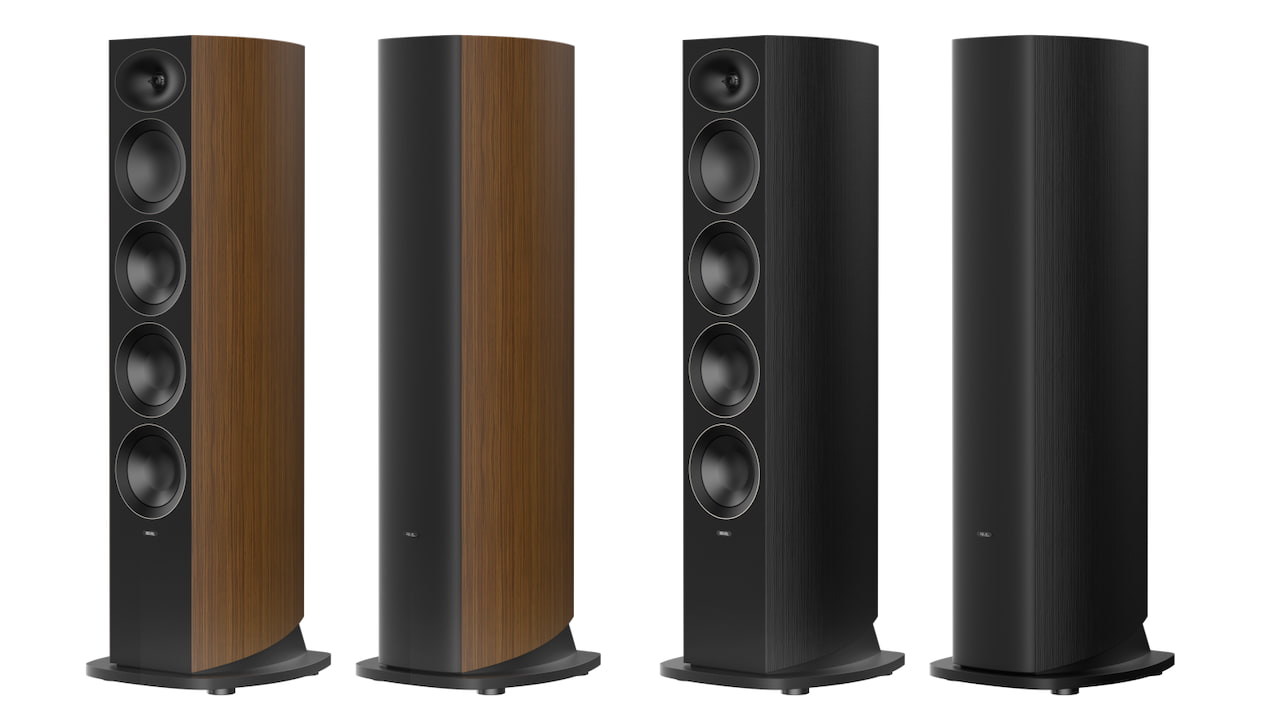
Performa4 cabinets use sturdy, cross-reinforced panels and slightly curved sides. Internal reinforcement is relevant because a loudspeaker enclosure must provide a stable platform for its drivers, while the curved exterior helps distinguish the series from conventional rectangular boxes.
Finish choices include natural walnut and black walnut veneer. Both options give the speakers a furniture-oriented appearance without introducing an excessive number of cosmetic variations. Magnetically attached grilles allow the front surfaces to remain free from visible mounting points when the grilles are removed, while also making them easy to refit for protection or a more discreet look.
These details matter because loudspeakers in this category are often permanent and prominent parts of a room. The combination of real-wood finishes, curved sides, concealed grille attachments, and cable management on the optional monitor stands reflects an effort to consider the complete installation rather than concentrating solely on the internal components.
Who the Revel Performa4 series is for
Performa4 is most suitable for listeners who want to build either a dedicated stereo system or a coordinated home theater from one speaker family. The two floorstander sizes and two monitor sizes make the range adaptable to different room dimensions, while the center channel and active subwoofer provide clear routes into multichannel use.
The series may be especially relevant to households with several regular listening positions because the waveguide has been developed to improve consistency away from the central axis. It should also appeal to system owners who value upgrade flexibility: the monitors can be paired with dedicated stands, the floorstanders support bi-amping, and the active subwoofer can extend a stereo or cinema installation.
It is less directly aimed at buyers seeking wireless, portable, or all-in-one speakers. The main models remain components of a conventional hi-fi or home-theater system and therefore require appropriate amplification, source equipment, cabling, and careful placement. The rear-ported floorstanders also deserve adequate consideration during room setup. For owners comfortable with those requirements, however, the breadth of the family provides considerable freedom to choose the configuration that fits the room and intended use.
Conclusion
Revel’s Performa4 series is distinguished by the consistent application of its DCC and MCC driver materials, cast-aluminum frames, and seventh-generation Acoustic Lens waveguide across several speaker formats. Two floorstanders, two monitors, a dedicated center channel, and an actively powered subwoofer make it possible to assemble anything from a compact stereo setup to a coordinated multichannel system. Purpose-built monitor stands, bi-amping connections on the floorstanders, reinforced curved cabinets, magnetic grilles, and walnut veneer options add practical flexibility and considered presentation. The range is best suited to listeners who want conventional component hi-fi, value a coherent family of models, and need enough choice to match their speakers to both the room and the intended system.


Sound Off
0Join the discussion if you have something to add.