
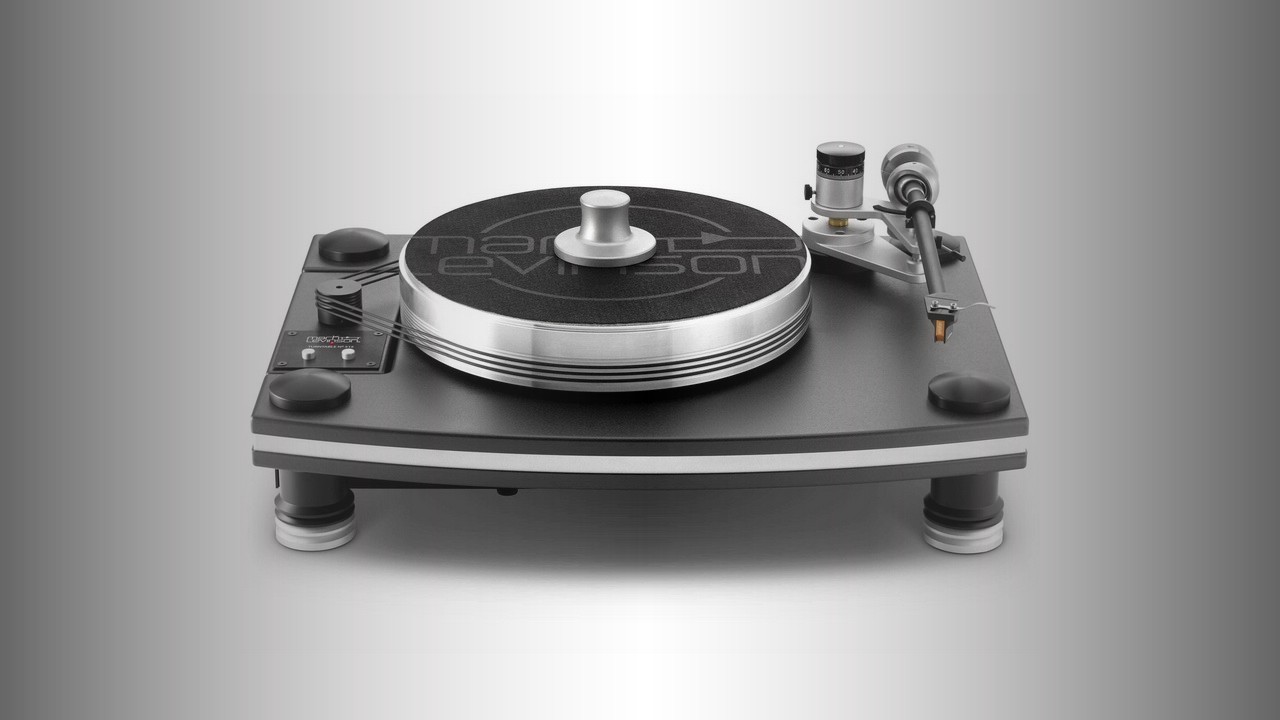
The Mark Levinson No. 515 occupies a distinctive place in the brand’s catalog: it is the first turntable to carry the Mark Levinson name, and it was developed in collaboration with VPI Industries, a company closely associated with high-end turntable engineering and manufacturing. Rather than presenting vinyl playback as a decorative add-on to an electronics range, the No. 515 is built as a substantial analog source component, with attention given to the platter bearing, drive system, motor control, tonearm, record interface, and mechanical grounding. Its appeal lies in how deliberately these parts are arranged to address the practical problems of vinyl playback: vibration, speed consistency, cartridge alignment, record stability, and system matching.
A Mark Levinson Turntable with VPI Engineering Behind It
The No. 515 is notable not only because it is a Mark Levinson-branded record player, but because it was designed and manufactured in collaboration with VPI Industries. That partnership gives the product a clear engineering context. Mark Levinson brings its industrial design language and system-level ambitions, while VPI contributes established turntable manufacturing knowledge and mechanical design experience.
The result is a turntable that appears intended to sit naturally alongside Mark Levinson preamplifiers and source components rather than merely borrow an external platform. It is hand-assembled in the USA to meet the standards set by Mark Levinson’s engineering and design teams. For a prospective owner, that matters because a turntable is not a single circuit board or a simple enclosure; it is a precision mechanical system in which assembly, adjustment, and material choices are fundamental to long-term performance.
A Chassis Focused on Damping and Mass
The No. 515 uses a vinyl-coated aluminum composite sandwich-panel housing. This type of construction points to a central design priority: controlling unwanted vibration before it reaches the stylus. In vinyl playback, mechanical energy can enter the system from the motor, supporting furniture, loudspeakers, or even the record itself. A well-damped chassis is not simply about visual solidity; it supports the tonearm, platter, and bearing under more stable conditions.
The plinth is supported by machine-turned Delrin polyacetate resin and aluminum legs with a vibration-damping polymer core. Delrin and aluminum are used here as part of a layered mechanical strategy rather than as ornamental materials. The combination of rigid structure and damping elements helps explain why the No. 515 weighs 26 kg. That mass also reinforces the impression that this is a stationary, dedicated source component intended for a properly arranged hi-fi system, not a lightweight lifestyle turntable.
Platter, Bearing, and Drive System
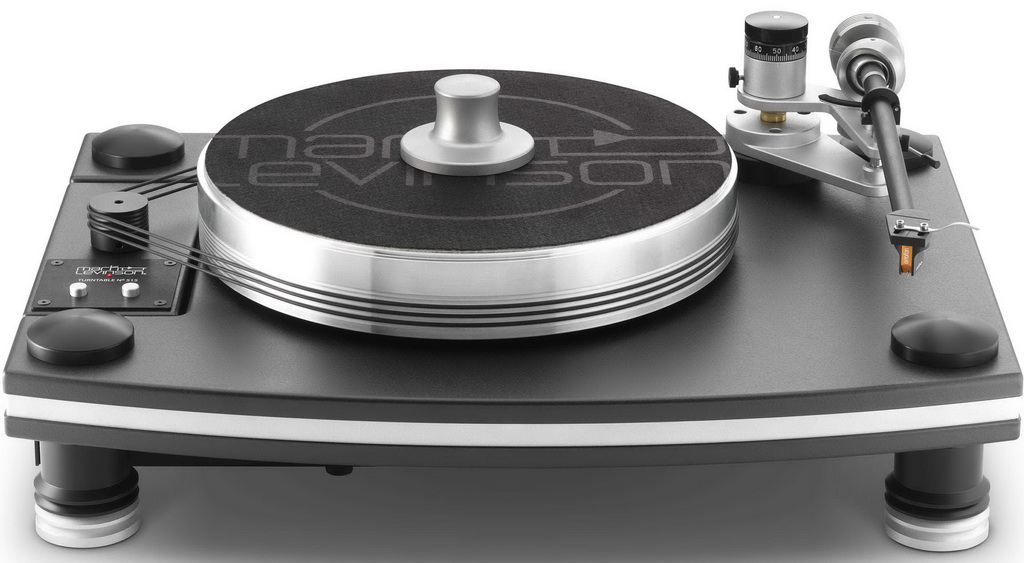
At the center of the No. 515 is an all-metal aluminum platter rotating on an inverted bearing. The bearing uses a hardened stainless steel shaft running in a phosphor bronze bushing, with the design intended to minimize radial runout. For vinyl users, the bearing is one of the most consequential parts of the whole machine. It is responsible for supporting the platter smoothly and consistently, and any unwanted movement at this point can affect how the stylus traces the groove.
The turntable is belt driven, but not by a single belt. The No. 515 uses a triple-belt drive system connected to a precision-machined pulley. This approach is documented as supporting smooth, quiet operation. The drive system is paired with a high-torque AC synchronous motor, which is mounted separately from the main chassis on its own vinyl-coated aluminum composite sandwich-panel structure. The motor is also housed in a mechanically insulated enclosure. That separation is important because the motor must provide rotational force while being kept from feeding vibration into the platter and tonearm system.
Electronic Speed Control with a Serious Power Arrangement
The No. 515 supports 33 1/3 and 45 rpm playback, with electronic switching between speeds at the press of a button. This is a practical convenience, especially for listeners with both LPs and 45 rpm records, because it removes the need for manual belt repositioning when changing speeds.
More significant is the way the motor is supplied and controlled. The design uses a custom low-distortion analog oscillator and a discrete Class AB power amplifier to feed the synchronous motor. Built-in electronic rotation control circuitry manages the operating frequencies for the two supported speeds. The published specifications state speed instability of less than 0.1% and speed-setting accuracy no worse than 0.03%. Those figures underline the attention given to rotational consistency, which is one of the core engineering concerns in any serious turntable.
A 10-Inch 3D-Printed Tonearm with On-the-Fly Adjustment
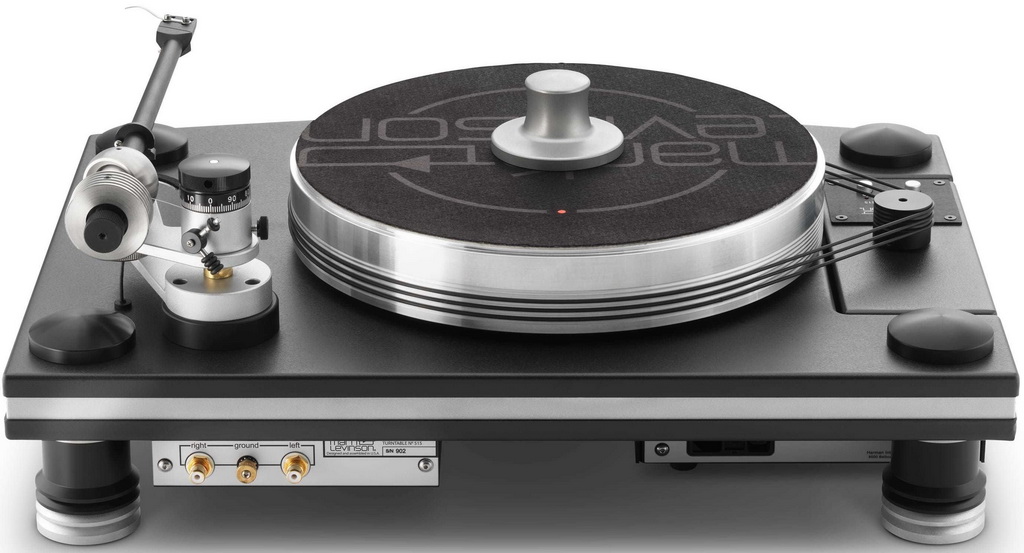
The No. 515 is fitted with an articulated 10-inch tonearm made using 3D printing and featuring an integrated headshell. The arm includes a stainless steel counterweight and separate internal pickup routing. These details matter because the tonearm must allow the cartridge to follow the groove accurately while managing resonance, alignment, and signal routing without adding avoidable interference.
The tonearm is mounted to a rigid machined aluminum base, and the vertical tracking angle can be adjusted during operation through a precision calibrated mechanism. On-the-fly VTA adjustment is useful for listeners who want to fine-tune setup for different records or cartridge requirements without making the turntable difficult to use. The No. 515 is offered either with or without a factory-installed moving-coil cartridge, which gives buyers some flexibility. Those who want a more complete factory configuration can choose the installed cartridge option, while experienced vinyl owners may prefer to use a cartridge already selected for their system.
Record Stability and the Playback Interface
The No. 515 includes a stainless steel clamp weight styled in the manner of Mark Levinson control knobs, along with a felt record mat. These are small details compared with the platter and chassis, but they are central to the interface between record and turntable. The clamp weight is intended to improve playback stability by helping the record sit securely against the mat and platter surface.
The felt mat provides the contact layer for the record. In a product like the No. 515, such accessories are not afterthoughts; they form part of the complete mechanical environment in which the cartridge operates. A prospective owner does not need to source a separate clamp immediately in order to use the turntable as specified, and the design language of the clamp helps the deck feel visually connected to the rest of the Mark Levinson ecosystem.

System Matching with Mark Levinson Electronics
The No. 515 is described as a complement to the Pure Phono stage included in the Mark Levinson No. 526 and No. 523 preamplifiers. That positioning is important. This is not a turntable aimed primarily at entry-level plug-and-play systems; it is conceived as an analog source for a high-end component setup where the phono stage, preamplifier, amplification, and loudspeakers are chosen with comparable care.
The moving-coil cartridge option also indicates the level of associated equipment likely to be used. Moving-coil cartridges typically require appropriate phono gain and loading, so pairing the No. 515 with capable phono electronics is part of the ownership picture. The signal-to-noise ratio is specified at more than 85 dB, and the deck’s mechanical and electrical design choices are consistent with a product intended to keep the analog signal path as stable and quiet as possible before it reaches the phono stage.
Conclusion
The Mark Levinson No. 515 is most suitable for committed vinyl listeners building a substantial high-end analog system, particularly those already using or considering Mark Levinson preamplification with a suitable phono stage. Its strongest documented qualities are its VPI-supported engineering, damped composite chassis, isolated high-torque motor, triple-belt drive, inverted bearing, electronic speed control, substantial 26 kg construction, and adjustable 10-inch 3D-printed tonearm. It will make the most sense for owners who value mechanical precision, careful setup, and system integration over compactness or casual convenience. For listeners who want a Mark Levinson-compatible turntable designed around vibration control, speed stability, and serious analog use, the No. 515 presents a carefully considered route into premium vinyl playback.



Sound Off
0Join the discussion if you have something to add.