

The ToneWinner AD-89D is an integrated amplifier for listeners who want a single component to manage a surprisingly wide range of sources. Rather than concentrating only on traditional line-level inputs, it combines Class AB amplification with an internal CD player, Bluetooth reception, HDMI ARC, USB-B digital input, optical and coaxial digital inputs, memory-card and USB storage playback, analog RCA inputs, and a dedicated subwoofer output. That makes it less a conventional two-channel amplifier with a few extras and more a compact control center for a mixed music and TV system.
A 2.1-channel amplifier built around practical system consolidation
The most immediately attractive quality of the AD-89D is its breadth of integration. Many hi-fi systems now include several different kinds of sources: a television, a computer, a smartphone, a disc collection, stored music files, and perhaps conventional analog components. The AD-89D is designed to gather many of those use cases into one chassis, reducing the need for separate boxes while still retaining familiar speaker-level amplification.
At its core, the unit is a 2.1-channel Class AB integrated amplifier rated at up to 2 x 130 watts into 8 ohms at 1 kHz. The inclusion of a subwoofer output is especially useful for owners who want the scale and low-frequency support of a powered subwoofer without moving to a full AV receiver. In practical terms, the AD-89D can sit at the center of a stereo loudspeaker system while also accommodating bass reinforcement for films, TV, or music playback where a subwoofer is desired.
This combination of stereo amplifier and 2.1-channel connectivity gives the product a clear role: it is not trying to become a multi-channel home theater processor, but it does acknowledge that many music-first systems also serve a television or media room.
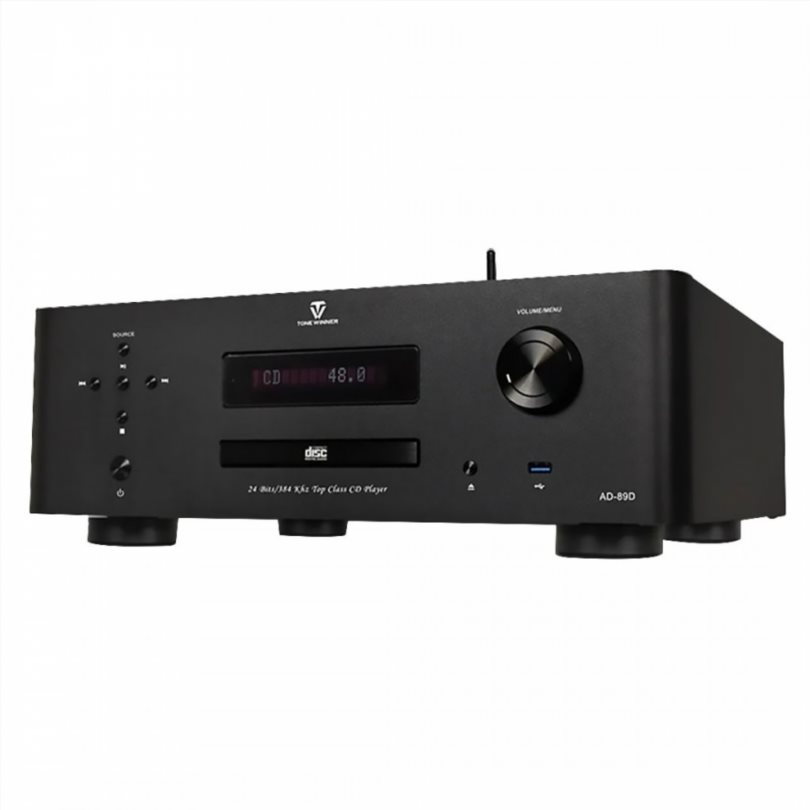
CD playback remains part of the design
One of the AD-89D’s distinctive features is its built-in CD player. In an era when many integrated amplifiers assume streaming or external digital sources, the inclusion of disc playback is meaningful for listeners who still own a CD library and prefer not to add a separate transport. It also helps simplify cabling and system layout, because disc playback is handled inside the same component that manages amplification and source selection.
For prospective owners, this is less about nostalgia than utility. A built-in CD section gives the amplifier another self-contained playback route, useful in a living room, office, or secondary system where convenience matters. It also makes the AD-89D more versatile for households where different users rely on different formats.
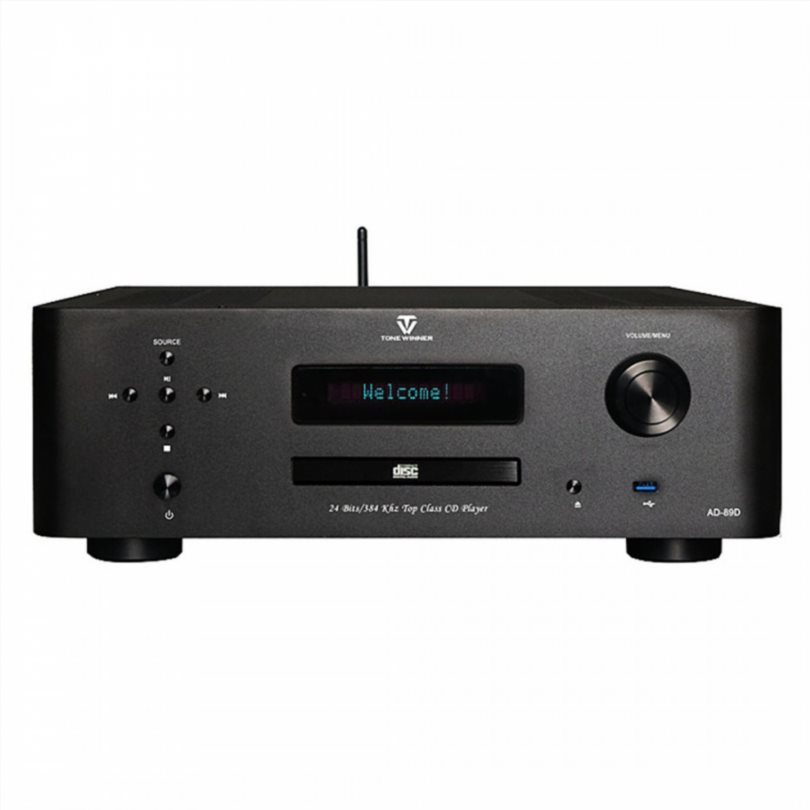
Digital, wireless, and removable-media inputs
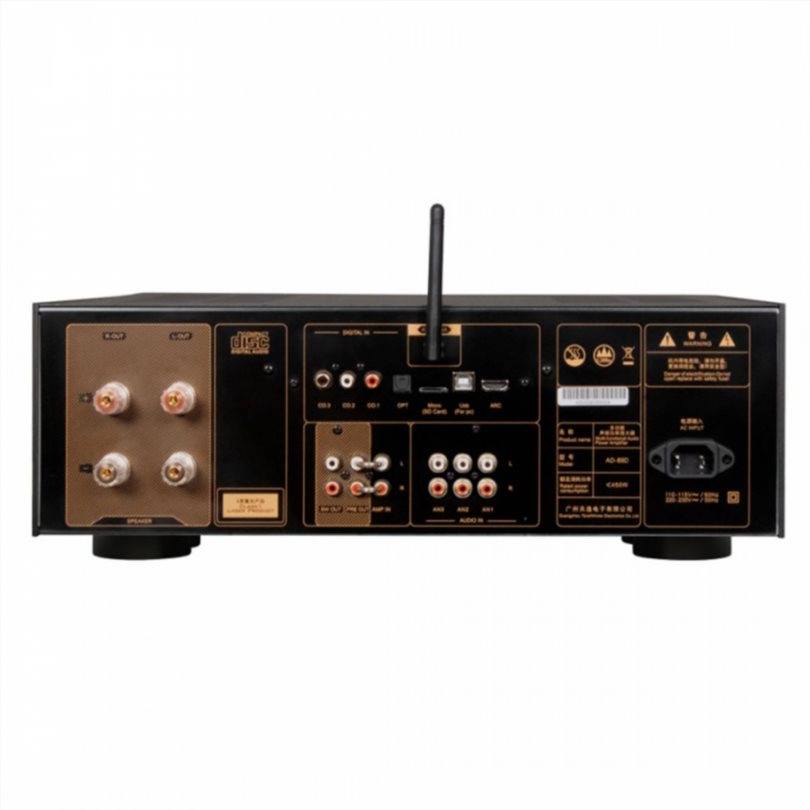
The AD-89D’s input list is unusually broad for an integrated amplifier. Digital connections include USB-B, optical Toslink, three coaxial SPDIF inputs, and HDMI ARC. The USB-B interface supports PCM streams up to 24-bit/48 kHz, allowing a computer to be connected directly for digital playback. While that specification is not aimed at the highest available PCM rates, it covers many common computer-audio and streaming scenarios without requiring a separate DAC.
Bluetooth is also included for wireless playback from a smartphone or tablet. ToneWinner describes the Bluetooth function as supporting stable wireless data transmission with low distortion and latency. The main value here is everyday convenience: guests, family members, or casual listening sessions can use a mobile device without needing to connect a cable or configure a more elaborate network playback system.
The AD-89D also accepts files from removable storage. Its U disk input supports drives up to 128GB, and there is a TF memory card slot as well. The control interface supports up to eight levels of file folder management, which matters if a user stores music in a structured library rather than a single flat folder. This kind of file-navigation support can make local media playback more usable, particularly for listeners who maintain music collections on USB drives or memory cards.
HDMI ARC gives it a role beside the television
HDMI ARC is one of the features that broadens the AD-89D beyond a conventional hi-fi amplifier. With ARC, the amplifier can receive audio from a compatible television through HDMI, helping a stereo system become the main sound source for TV viewing. For many users, that is more convenient than routing television sound through optical or analog outputs, especially when the TV is already the household’s main media display.
The combination of HDMI ARC and subwoofer output makes the AD-89D particularly relevant for a living-room stereo system. It can support a pair of main speakers and a powered subwoofer for a fuller 2.1 arrangement, while still preserving a two-channel amplifier layout for music. The source also notes a mobile application with a TV settings menu, suggesting that ToneWinner has considered TV integration as part of the product’s regular use rather than treating it as a token input.
Analog connectivity and amplifier-role flexibility
Alongside its digital and media inputs, the AD-89D includes three stereo RCA inputs. This is important because the product is not limited to contemporary digital sources. A user can still connect external analog components such as a tuner, phono stage, or other line-level source, provided those components supply the appropriate analog output.
The U-ring connectors add another layer of flexibility. With the rings in place, the AD-89D operates as an integrated amplifier. Removing them allows the unit to be used as a pure power amplifier within a larger sound system. That kind of configuration option can matter to owners who expect their system to evolve. The amplifier can begin life as an all-in-one hub, then later serve in a different role if an external preamplifier or processor is introduced.
This does not turn the AD-89D into a specialist separates system by itself, but it gives the chassis a longer potential service life in changing setups. For buyers who dislike replacing otherwise useful components when their system grows, that flexibility is a practical advantage.
Internal layout and power-supply choices
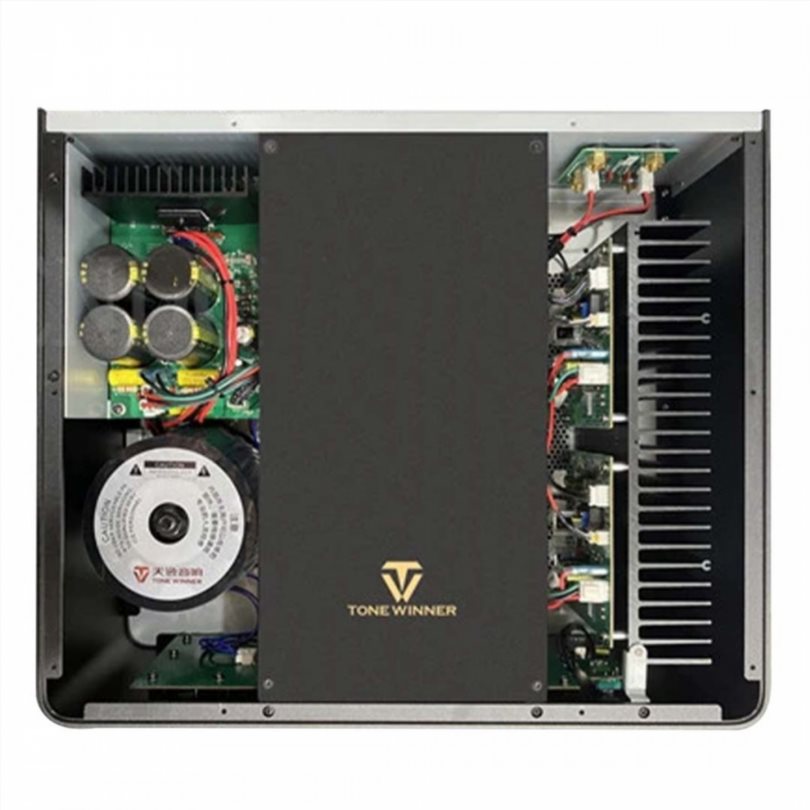
ToneWinner’s documented design choices point to an effort to manage interference and maintain channel separation inside a densely featured product. The internal structure separates the power stage from the input signal and signal-processing stages, while the left and right channels are processed independently. In a component that includes amplification, digital inputs, disc playback, Bluetooth, and media handling, this kind of internal organization is significant because it addresses the challenge of housing many functions together.
The power supply is based on a 350 VA toroidal transformer and 40,000 µF of capacitance. Those are notable figures in the context of an integrated amplifier specified for up to 2 x 130 watts into 8 ohms. The output stage is described as using at least eight matched high-precision output devices. The amplifier also specifies a frequency response of 10 Hz to 50 kHz, total harmonic distortion of no more than 0.05% in A-weighted analog direct mode, and a signal-to-noise ratio of at least 95 dB in the same weighting and mode.
These specifications do not replace system matching or personal preference, but they help explain the engineering priorities behind the product: a conventional high-current power-supply approach, separation of internal sections, and enough connectivity to serve as a central amplifier rather than a minimalist line-stage design.
Control and day-to-day usability
A heavily connected amplifier is only useful if source navigation is manageable. The AD-89D addresses this through a dedicated control app, intended to make it easier to move between sources and navigate media. The mention of folder support up to eight levels is a small but practical detail, because it suggests the product is intended to handle real user libraries rather than only simple demonstration files.
The physical size and weight also indicate a substantial component rather than a compact desktop amplifier. The AD-89D measures 430 x 397 x 151 mm and weighs 12.7 kg. Those dimensions make it closer to full-width hi-fi components, so prospective owners should plan for proper shelf space, ventilation, and access to rear-panel connections. Its maximum power consumption is listed at 450 W into 8 ohms, with versions for 110V-115V at 60Hz and 220V-230V at 50Hz power environments.
Conclusion
The ToneWinner AD-89D is most suitable for listeners who want one full-size component to anchor a flexible stereo or 2.1-channel system. Its strongest documented qualities are its wide source support, built-in CD playback, HDMI ARC for TV integration, Bluetooth and removable-media playback, subwoofer output, substantial Class AB amplification, and the option to operate either as an integrated amplifier or as a power amplifier through its U-ring configuration. It is likely to appeal most to users building a music-first system that also needs to handle television audio, computer playback, wireless convenience, and physical media without spreading those duties across multiple separate components.


Sound Off
0Join the discussion if you have something to add.