

The Klipsch Detroit occupies the largest and most powerful position in the company’s Music City Bluetooth speaker series, but it remains designed around portability rather than permanent installation. Its combination of a two-way stereo configuration, four passive radiators, IP67 protection, app-based adjustment, and a claimed 20 hours of battery life gives it a broader role than a basic travel speaker. It is intended to provide enough scale for social listening while retaining the practical features needed for outdoor use and regular transportation.
A Larger Portable Format
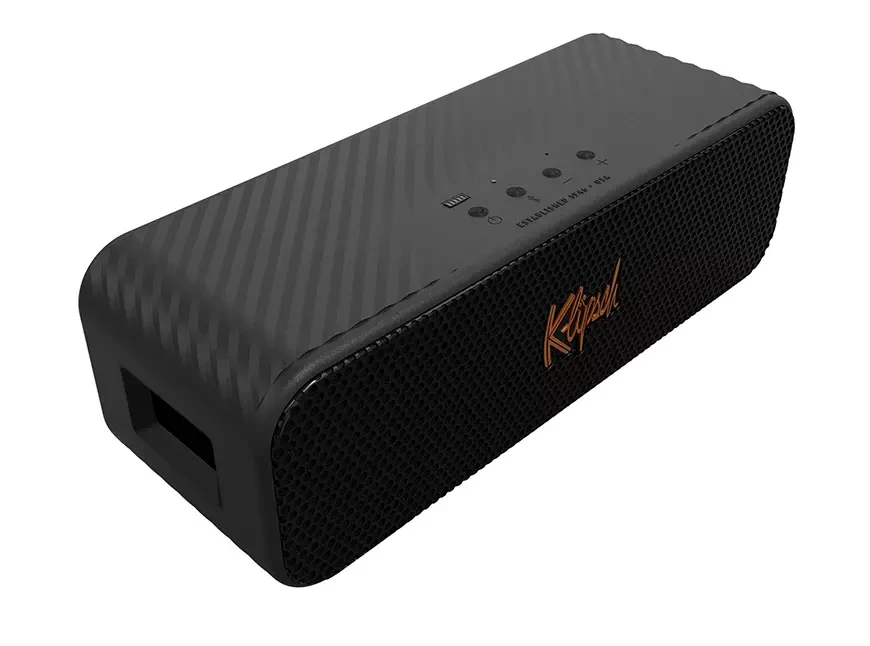
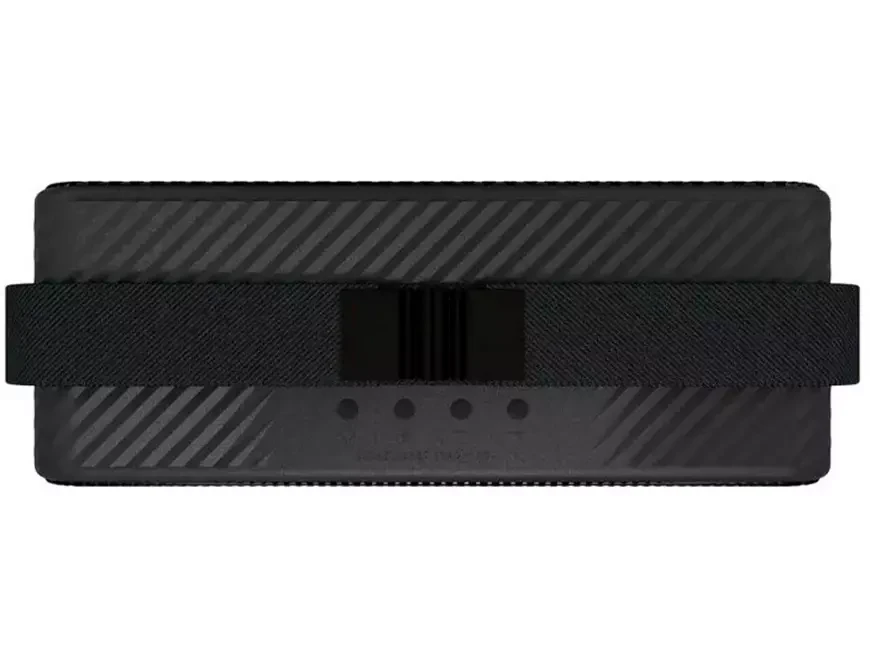
At 107 x 334 x 119 mm, the Detroit is compact enough to move between rooms, take outside, or carry to a gathering without becoming a piece of fixed audio furniture. Its 2.46 kg weight is more substantial than that of a pocket-sized Bluetooth speaker, but Klipsch includes a shoulder strap to make transportation easier. That choice acknowledges the speaker’s larger construction while preserving the portability expected from the Music City range.
The elongated enclosure also provides room for a more involved acoustic layout than is commonly found in very small wireless speakers. Klipsch has not simply increased battery capacity or cabinet size: the Detroit uses separate drivers for different parts of the frequency range, supported by multiple passive radiators and a bass-reflex port. For an owner, that makes its physical scale purposeful rather than merely decorative.
A rubber coating adds another practical layer of protection. Portable speakers are likely to encounter hard surfaces, bags, patios, and unpredictable weather, so an exterior intended to withstand routine handling is a useful design decision. The Detroit’s form therefore sits between highly compact personal speakers and larger systems that are less convenient to carry.
A Two-Way Stereo Architecture
The Detroit employs two 7.6 cm drivers for the midrange and lower frequencies, together with a pair of tweeters for high-frequency reproduction. Built-in Class D amplification supplies 15 watts to each channel. This stereo, two-way arrangement allows the different drivers to concentrate on separate frequency regions rather than asking a single full-range unit to reproduce everything.
Class D amplification is a logical choice for a battery-powered product because it supports a compact, efficient integrated design. The amplifiers, drivers, wireless receiver, and battery are all contained within the enclosure, removing the need for external electronics or speaker cables. The owner only needs a compatible source device and a Bluetooth connection to create a self-contained playback system.
Four passive radiators and a bass-reflex port support the low-frequency section. Passive radiators can reinforce bass output without requiring additional powered bass drivers, an approach well suited to an enclosure where internal space and battery demand both matter. Klipsch specifies a frequency range of 55 Hz to 20 kHz. That figure provides useful context for the Detroit’s intended bandwidth, although it should be understood as a manufacturer specification rather than an independently verified measurement.
Bluetooth and App-Based Control
Bluetooth 5.3 provides the Detroit’s primary wireless connection. This lets phones and other compatible Bluetooth sources connect directly, keeping everyday operation straightforward and avoiding dependence on a separate network audio system. It is particularly relevant for outdoor use, temporary setups, and travel, where Wi-Fi may not be available.
The Klipsch Connect app, offered for Apple iOS and Google Android devices, extends control beyond basic playback. Its equalizer allows the user to adjust the presentation according to personal preference, placement, or program material. A speaker used close to a wall may call for different settings from one placed in an open outdoor space, so accessible tonal adjustment adds practical flexibility even without changing the physical setup.
The app can also connect as many as ten Klipsch Music City systems for a larger arrangement. That option may be useful for parties or gatherings where wider coverage is more important than relying on one speaker in a single location. Klipsch does not require every owner to build such a system, but the expansion capability gives the Detroit a path beyond standalone use. It also makes the product relevant to existing Music City owners who want to extend a compatible setup.
Prepared for Outdoor Use
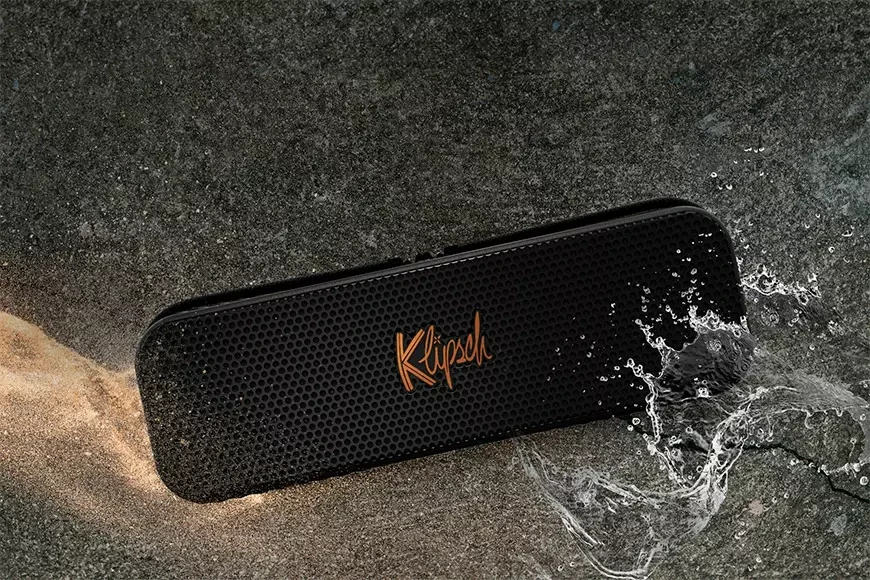
An IP67 rating is one of the Detroit’s most important functional attributes. It indicates protection against dust and temporary water immersion under the conditions covered by the certification. In practical terms, the speaker is designed to cope with environments involving rain, sand, dust, or an accidental brief dip in a pool more confidently than an unprotected indoor model.
That does not eliminate the need for sensible handling, but it substantially broadens where the speaker can be used. A patio, poolside area, beach trip, campsite, or outdoor gathering is a more natural setting for an IP67-rated product than for conventional mains-powered audio equipment. The combination of sealing, rubber coating, and shoulder strap suggests that outdoor capability was considered as part of the core design rather than treated as an afterthought.
The weather-resistant construction is also useful indoors. Kitchens, workshops, and other spaces where dust or occasional splashes are possible can benefit from the same protective measures. Owners who move a speaker frequently may therefore value IP67 certification even if they do not routinely take it on extended trips.
Battery Life and USB-C Utility
Klipsch states that the built-in lithium-ion battery provides up to 20 hours of continuous playback. Actual endurance can vary with operating conditions, but the quoted figure is long enough to support day trips, extended gatherings, or several shorter listening sessions between charges. This reduces dependence on nearby wall outlets and complements the speaker’s weather-resistant, portable character.
Charging is handled through USB-C, with a stated charging time of two hours. USB-C is a convenient choice for a current portable device because many users already carry compatible cables and chargers for phones, tablets, or computers. A relatively short stated recharge period also helps the Detroit return to service without an overnight wait.
The USB connection adds another function: the speaker can operate as a power bank for a smartphone. This is especially useful away from mains power, where music streaming and Bluetooth use may place additional demand on a phone’s battery. Sharing the Detroit’s stored energy will naturally leave less capacity for playback, but the option provides a practical backup when keeping the source device running is the greater priority.
Who the Klipsch Detroit Is For
The Detroit is best suited to listeners who want more physical scale and a more elaborate driver layout than a very small Bluetooth speaker can accommodate, while still needing a system that can be carried easily. Its shoulder strap, battery operation, and IP67 construction make particular sense for people who regularly move their music between indoor and outdoor spaces.
It should also appeal to users who value adjustment and expansion. The Klipsch Connect equalizer offers more control than a fixed-voicing design, while support for linking up to ten Music City speakers creates options for larger social settings. Existing owners of compatible Klipsch models may find that ecosystem support especially relevant.
By contrast, someone seeking a pocketable speaker may consider the 2.46 kg weight more than they want to carry. Likewise, the Detroit is not presented as a substitute for a component hi-fi system with separate sources, amplification, and loudspeakers. Its priorities are integration, resilience, battery life, and convenient wireless operation. Prospective owners should therefore see it as a substantial portable system rather than a miniature conventional stereo.
Conclusion
The Klipsch Detroit’s strongest documented qualities come from the way its features work together. A two-way stereo configuration, dedicated Class D amplification, four passive radiators, and a bass-reflex port provide a purposeful acoustic foundation, while Bluetooth 5.3 and app-based equalization keep operation accessible. IP67 protection, a rubber-coated enclosure, an included shoulder strap, USB-C charging, smartphone power-bank functionality, and up to 20 hours of claimed playback reinforce its portable role. It is most appropriate for listeners who want a larger, weather-resistant Bluetooth speaker for home, travel, and gatherings, especially those interested in adjustable sound settings or the ability to link multiple Klipsch Music City systems.



Sound Off
0Join the discussion if you have something to add.