

The Triangle Capella is designed for listeners who want to reduce the number of conventional hi-fi components without giving up access to a varied collection of sources. It is a two-way active speaker system, but its defining feature is the included Stereo Hub: a compact control center that accepts wired and wireless sources before transmitting audio to the speakers over WiSA.
This division of responsibilities gives Capella a useful degree of flexibility. The speakers contain the amplification, digital processing and active crossover, while the hub handles streaming, physical inputs and system control. As a result, a prospective owner can connect a television, computer, turntable with a suitable phono stage and several digital components without running signal cables across the room to both speakers. Room calibration, dedicated amplification for every driver and cabinet engineering derived from Triangle’s Esprit research complete a system intended to combine domestic convenience with purpose-built loudspeaker technology.
A hub-based approach to wireless stereo
Capella’s architecture is centered on the included Stereo Hub. Every source connects to this compact unit, either through a physical input or over a network, and the hub sends the resulting audio signal wirelessly to the two active speakers using WiSA technology. Triangle notes that WiSA can bridge greater distances than Bluetooth, making it better suited to communication across a listening room.
The practical benefit is cleaner installation. The hub can sit near a television, computer or collection of source components, while the speakers need not be linked to those devices by long analog or digital signal cables. The loudspeakers remain active and therefore still require power, but the separation of source connectivity from speaker placement can simplify a multipurpose living-room system.
Centralizing connections also makes Capella more adaptable than an active speaker with only a small input panel on one cabinet. Sources can be grouped around the hub, leaving the speakers free to occupy positions chosen for stereo listening and room interaction rather than proximity to a television stand or equipment rack.
Streaming without committing to one ecosystem
The Stereo Hub supports Bluetooth and Wi-Fi, with AirPlay, Chromecast, UPnP/DLNA and Roon Ready compatibility documented for network playback. That selection accommodates several common listening habits, from sending audio directly from a phone to accessing music stored on a home network or incorporating Capella into a Roon-based library and playback environment.
This breadth matters in a shared household. An Apple user can work through AirPlay, someone already using Chromecast can remain within that system, and a listener with network-attached music can use UPnP/DLNA. Bluetooth offers a straightforward option when network integration is unnecessary. Capella is therefore not tied to a single app, device brand or music-management method.

Enough inputs for a mixed digital and analog system
Physical connectivity is unusually broad for a compact wireless control hub. The input selection consists of HDMI with ARC and CEC, one stereo RCA input, one coaxial S/PDIF input, USB-B, three optical S/PDIF inputs, and a stereo mini-jack that also serves as an optical connection.
HDMI ARC makes Capella relevant to listeners who want their stereo speakers to handle television audio, while CEC is intended to make the relationship between compatible equipment more convenient. USB-B provides a direct route for a computer, and the collection of coaxial and optical connections leaves room for multiple digital sources such as disc transports, televisions or streamers. The analog RCA input preserves a place for equipment that does not provide a digital output.
Triangle’s accompanying Lunar 3 turntable illustrates how that analog connection can be used. Developed in collaboration with Pro-Ject, the Lunar 3 includes a phono preamplifier, allowing it to connect directly to the Stereo Hub’s RCA input. It also comes with a carbon tonearm and a pre-installed Ortofon 2M Red cartridge. Capella owners are not required to use that specific turntable, but any record player connected directly to the hub will similarly need an appropriate phono stage.

Dedicated amplification and digital control
The active design provides a stated total output configuration of 2 x 100 watts. Each individual driver has its own conversion stage and dedicated 50-watt amplifier circuit. This removes the need for an external integrated amplifier and allows the electronics to be configured around the known behavior of the installed drivers.
A next-generation digital signal processor continuously monitors driver behavior, with particular attention paid to making effective use of the system in the low frequencies. The crossover is also controlled digitally and is designed to maintain a linear frequency response. In an active system, this direct relationship among crossover, amplification and driver gives the manufacturer control over elements that would otherwise depend on the owner’s choice of amplifier and passive speaker crossover.
For the user, the immediate advantage is reduced uncertainty in system matching. There is no need to determine an appropriate amplifier power rating or to assemble separate amplification and crossover components. The core electronic and acoustic elements arrive as a coordinated package.

Two-way drivers informed by Triangle’s Esprit research
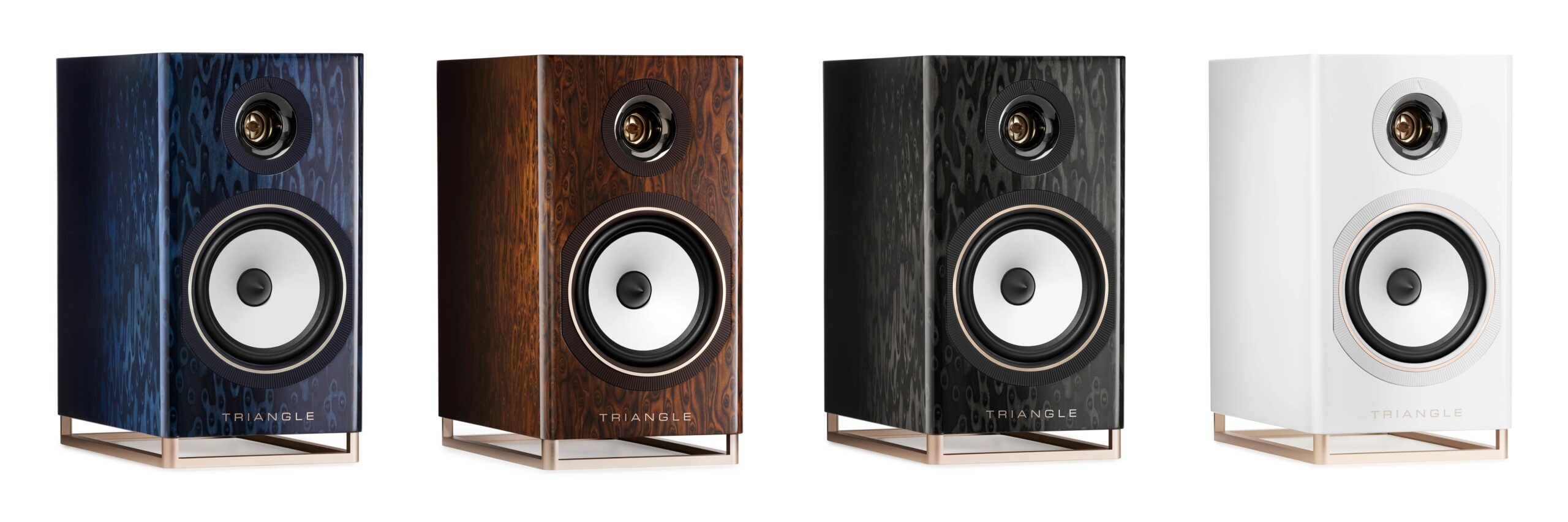
Capella uses a horn-loaded tweeter with a 25mm magnesium-alloy dome and matching phase plug. Its 16cm woofer employs a cellulose-pulp cone, a material closely associated with Triangle’s speaker designs. The driver development benefits from acoustic research undertaken for the limited 40th-anniversary edition of the company’s Esprit range.
The combination is a conventional two-way format executed with Triangle-specific components. Rather than relying on a full-range driver or a complex multiway cabinet, Capella assigns high and low frequencies to dedicated drivers, each supported by its own amplifier channel and managed through the digital crossover. This keeps the physical design relatively compact while retaining the control advantages of a fully active architecture.

Cabinet details address airflow and vibration
The speakers sit on aluminum bases that leave unobstructed space around the downward-facing port in the base plate. Triangle says this arrangement promotes even low-frequency distribution and makes room placement easier. Because the port is given a defined amount of clearance by the base, its operation is less dependent on the speaker being positioned at the edge of a particular shelf or stand.
Inside the cabinet, Triangle uses its patented DVAS construction. A perforated brace is pressed against the driver through damping material, stiffening the enclosure while allowing airflow toward the port. The rounded cabinet profile and sculpted edges around the drivers are also intended to reduce distortions transmitted toward the listener.
These details show that the wireless and streaming functions are not the only focus. Air management, cabinet rigidity and the physical transitions around the drive units have been treated as integral parts of the loudspeaker design.

App-based room calibration
Automatic calibration allows Capella to account for the listening room. The user takes measurements in the room, after which the Triangle Capella app analyzes the collected information and adjusts the speakers’ response. This can be particularly useful in domestic spaces where speaker and seating positions must coexist with furniture, walls and everyday use.
The measurement method depends on the mobile platform. Apple devices can use their built-in microphones for calibration. Android phones and tablets require Triangle’s optional wireless ZEN microphone. The ZEN collects measurement data and sends it to the app for analysis and correction. Android owners should therefore consider the microphone an additional requirement if they intend to use room calibration, whereas Apple users can access the feature with hardware already built into their device.
Conclusion
Triangle Capella is most suitable for listeners seeking a consolidated stereo system that can accommodate network streaming, television sound, computers, digital components and an analog source without a separate integrated amplifier. Its compact Stereo Hub, extensive input selection and WiSA speaker link are particularly attractive where sources and speakers need to occupy different parts of a room. Dedicated amplification for each driver, a digitally controlled crossover, DSP management and app-based room calibration add technical coordination beyond basic wireless convenience. Buyers who prefer fully passive speakers, independently selected amplification or an entirely platform-neutral calibration process may favor a more traditional system, and Android users should account for the optional ZEN microphone. For its intended audience, however, Capella’s strongest qualities are its centralized connectivity, flexible streaming support, integrated active engineering and carefully considered cabinet construction.



Sound Off
0Join the discussion if you have something to add.