
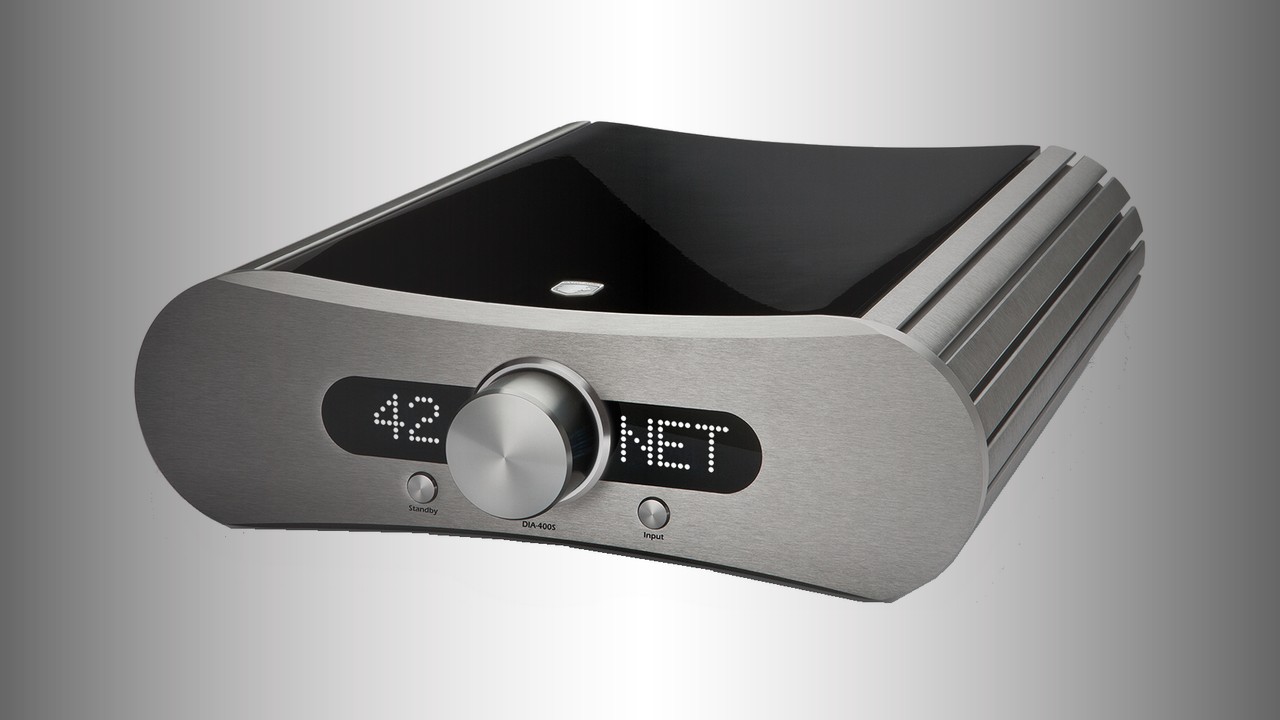
The Gato Audio DIA-400S is presented as the most powerful integrated amplifier in Gato Audio’s line, but its appeal is not only about wattage. It is an integrated amplifier with a built-in digital-to-analog converter, a broad input set, wireless streaming support, line outputs, trigger connectivity, and a configurable home theater input. That combination makes it a product aimed at listeners who want a serious two-channel amplifier to sit at the center of a flexible modern system without requiring a large stack of separate components.
A high-output integrated amplifier with a compact footprint
The headline specification for the DIA-400S is its rated output power: 2 x 400 watts RMS into 8 ohms and 2 x 800 watts RMS into 4 ohms, measured at 230 VAC. Those numbers place the amplifier firmly in the high-power category for an integrated design, and they help explain why Gato Audio positions it at the top of its integrated amplifier range.
For a prospective owner, output power is not simply about playing loudly. A powerful amplifier can be useful when partnering with speakers that have lower sensitivity, more demanding impedance behavior, or are used in larger rooms. The DIA-400S is specified for recommended load impedances from 4 to 16 ohms, which gives it broad compatibility with many conventional hi-fi loudspeakers.
Despite its output rating, the chassis dimensions remain relatively manageable at 325 x 105 x 420 mm, or 12.8 x 4.1 x 16.5 inches. At 13 kg, it is not a lightweight component, but it is still a single-box integrated amplifier rather than a multi-component preamp, power amp, and DAC arrangement. For listeners trying to build a capable system without filling a rack, that integration is a major part of the product’s attraction.

Class D architecture with dedicated power supply thinking
The DIA-400S uses Class D output stages with a separate power supply arrangement. Its amplification section is based on International Rectifier technology, supported by an optimized precision high-frequency generator and PWM modulator. The design also uses fast-switching MOS-FET transistors with very low resistance in the open state, a choice intended to reduce losses during high-frequency switching.
In a Class D amplifier, the output filter has a critical job: it converts the powerful PWM switching signal back into an analog signal suitable for loudspeakers. Gato Audio specifies polypropylene capacitors and low-resistance coils in the output filters of the DIA-400S. These parts choices are part of the amplifier’s technical identity and show attention to the conversion stage where efficiency, stability, and signal integrity intersect.
The documented distortion and noise figures also support the idea of a carefully engineered platform. The power amplifier section is specified at less than 0.01 percent THD, while the preamplifier section is listed at less than 0.001 percent THD. Signal-to-noise ratio is specified at greater than 110 dB. These are not listening impressions, but they are useful indicators of the design priorities behind the product.

A built-in DAC designed as more than an add-on
One of the most important features of the DIA-400S is its integrated DAC. Rather than serving only analog users, the amplifier is designed to accept digital sources directly through USB Type B, Toslink optical, RCA digital input, and aptX Bluetooth 4.0. All digital inputs can be upsampled to 24-bit/192 kHz, allowing a wide range of sources to be handled within the amplifier itself.
The DAC section is built around a Burr-Brown PCM1794 chip with balanced output. It also has its own dedicated power supply, an improved current-to-voltage converter with an extended frequency range, and an analog section using a low-Q low-pass filter. The significance here is practical: a buyer can connect a computer, streamer, wireless device, TV digital output, or disc transport without necessarily adding a separate DAC box.
This is particularly useful in systems where simplicity matters. A DAC, preamplifier, and power amplifier all in one enclosure can reduce cabling and shelf space, while still giving the user digital and analog connection options. The DIA-400S is therefore not limited to traditional line-level sources; it is equally oriented toward contemporary digital playback habits.

Analog inputs, line outputs, and system expansion
The analog input complement includes one pair of gold-plated XLR inputs using Neutrik connectors and two pairs of gold-plated RCA stereo inputs. That gives the DIA-400S enough analog flexibility for a source such as a phono stage, tuner, external DAC, CD player, or other line-level component. The specified input impedance is 20 kΩ via RCA or 40 kΩ via balanced connection.
The amplifier also includes line outputs on XLR and RCA connectors, as documented in the supplied specifications. Line outputs can be useful in systems that may expand later, for example by feeding another amplifier, a recorder, or another downstream component depending on the installation. The maximum line output levels are specified as 13 V balanced and 6.5 V unbalanced, with a line output impedance of 75 ohms.
A 12 V trigger output is also included via mini jack. This is a small but valuable installation feature, especially when the amplifier is used with other power-controlled components. In a system with compatible equipment, trigger control can simplify daily use by allowing connected devices to power on and off in coordination.

Home theater integration without giving up two-channel focus
A distinctive usability feature of the DIA-400S is its configurable home theater input. This input can allow the amplifier to function as a power amplifier with a fixed gain level when used as part of a surround sound system. In practical terms, that means the DIA-400S can remain the main amplifier for the front left and right speakers in a two-channel music system, while also integrating into a home theater environment.
This matters for listeners who do not want separate speaker systems for music and movies. A fixed-gain home theater input allows an AV processor or AV receiver to control volume for surround use, while the integrated amplifier continues to drive the main speakers. When configured appropriately, the user can keep the advantages of a dedicated stereo amplifier at the heart of the system while still participating in multichannel playback.
Not every integrated amplifier offers this kind of installation flexibility. For households where music listening and home theater share the same room, it can be one of the most practical features on the specification sheet.
Wireless convenience through aptX Bluetooth
The DIA-400S includes aptX Bluetooth 4.0 for receiving audio streams from a phone, tablet, or computer. Bluetooth is not the only digital route into the amplifier, but it adds an everyday convenience that many users will appreciate. It allows casual listening without turning on a separate streamer or physically connecting a cable.
The value of Bluetooth in an integrated amplifier is not that it replaces every other source. Rather, it broadens the ways the system can be used. Guests can share music more easily, mobile devices can connect quickly, and the amplifier can serve both planned listening sessions and informal playback. For a powerful integrated amplifier, that kind of convenience helps make the product less specialized and more approachable in daily use.
The significance of the S update
The source information describes the S-index models not as minor revisions but as new products based on the earlier design. Development work is said to have included new DAC circuits, new input circuits, changes to the output stages and power supplies, updated firmware, and improved connectors.
For buyers comparing generations, this is relevant because it indicates that the DIA-400S is not only a cosmetic or naming update. The changes touch several important parts of an integrated amplifier: signal intake, digital conversion, power delivery, amplification, firmware behavior, and physical connection quality. These are the areas that influence long-term usefulness and compatibility as much as the basic output rating.
The documented standby consumption of less than 1 watt and idle consumption below 35 watts also show attention to practical ownership. Maximum consumption is specified at less than 1600 watts, which reflects the amplifier’s high-output capability under demand, but the low standby figure is useful for users who keep equipment connected and ready for regular use.
Conclusion
The Gato Audio DIA-400S is most suitable for listeners who want a powerful integrated amplifier that can anchor both traditional hi-fi and modern digital systems. Its strongest documented qualities are its high rated output power, Class D output architecture, dedicated DAC section with Burr-Brown PCM1794 conversion, USB, optical, coaxial, and aptX Bluetooth inputs, balanced and unbalanced analog connectivity, line outputs, 12 V trigger support, and configurable home theater input. It will make the most sense for owners who need one capable central component for demanding loudspeakers, multiple source types, and possible surround-system integration, while still preferring the simplicity of an integrated amplifier rather than a larger stack of separates.



Sound Off
0Join the discussion if you have something to add.