
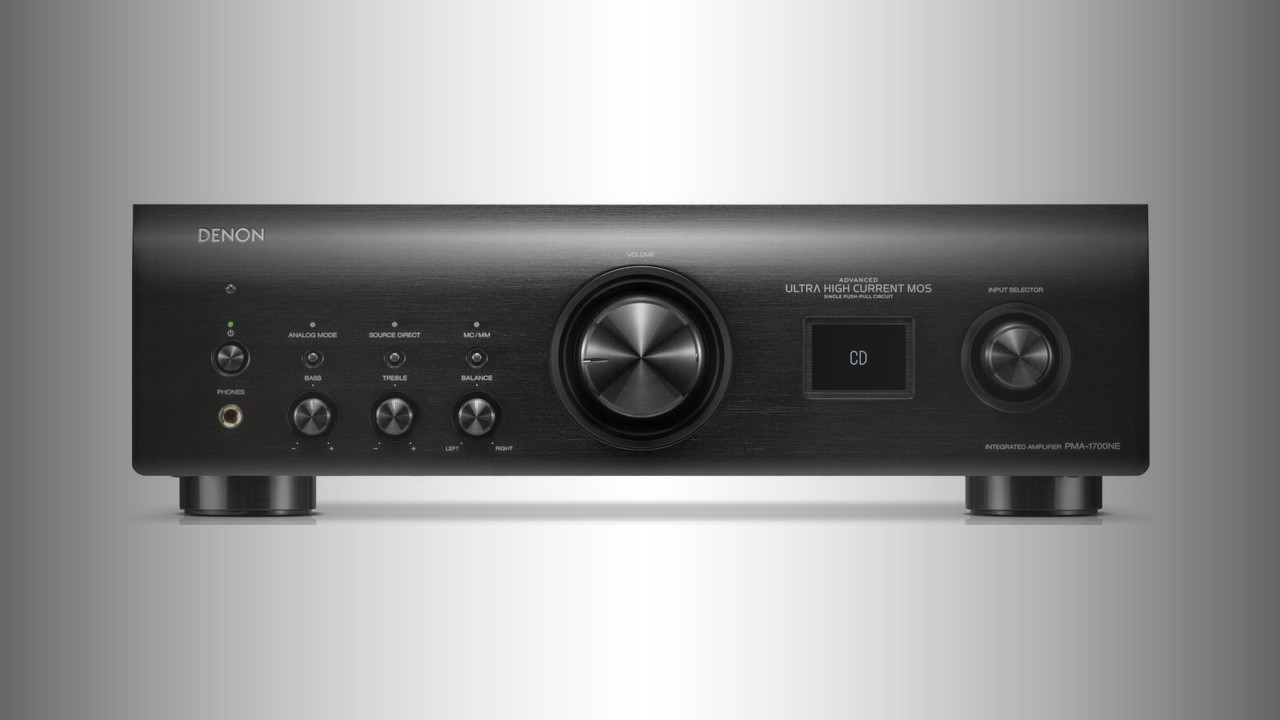
The Denon PMA-1700NE approaches the integrated amplifier as the central point of a substantial two-channel system. It combines a discrete power-amplifier section with conventional line-level connectivity, a phono stage for both moving-magnet and moving-coil cartridges, and a high-resolution DAC. Just as importantly, Denon has included dedicated operating modes for listeners who want to simplify the signal path or isolate analog playback from unused digital circuitry. Its appeal lies not in a single headline feature, but in how its construction, source flexibility and front-panel controls work together.
A familiar design with useful physical controls
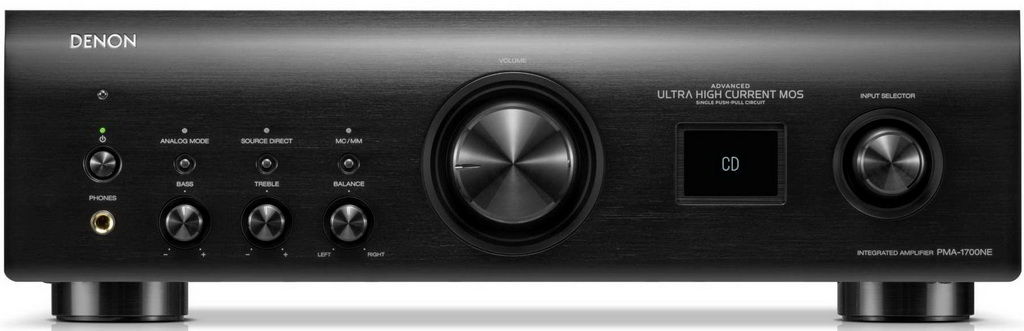
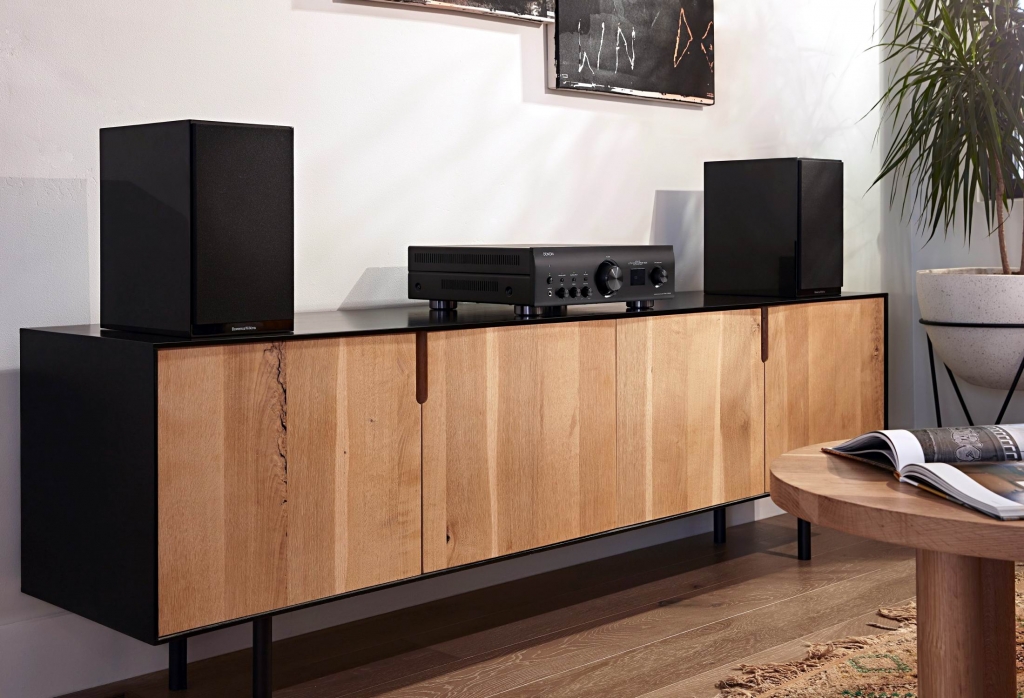
The PMA-1700NE has a curved aluminum front panel centered around a large volume control. Bass, treble and stereo-balance controls are positioned to the left, giving owners direct access to adjustments that can be useful with different recordings, rooms and speaker placements. The tone controls offer an adjustment range of plus or minus 8 dB at 100 Hz and 10 kHz.
Those controls do not have to remain in the signal path. A direct signal option bypasses additional circuitry when tonal adjustment is unnecessary. This gives the amplifier two practical personalities: one that supports everyday correction and another that prioritizes a more direct route through the electronics. Separate buttons make these specialist modes accessible without requiring menu navigation.
A luminescent front-panel display identifies the selected source and shows the parameters of an incoming digital signal. That is particularly useful when the amplifier is connected to a computer or another digital transport, since the owner can confirm both the active input and the received format from the listening position. A front headphone output adds another convenient playback option.
Construction intended to keep sections isolated
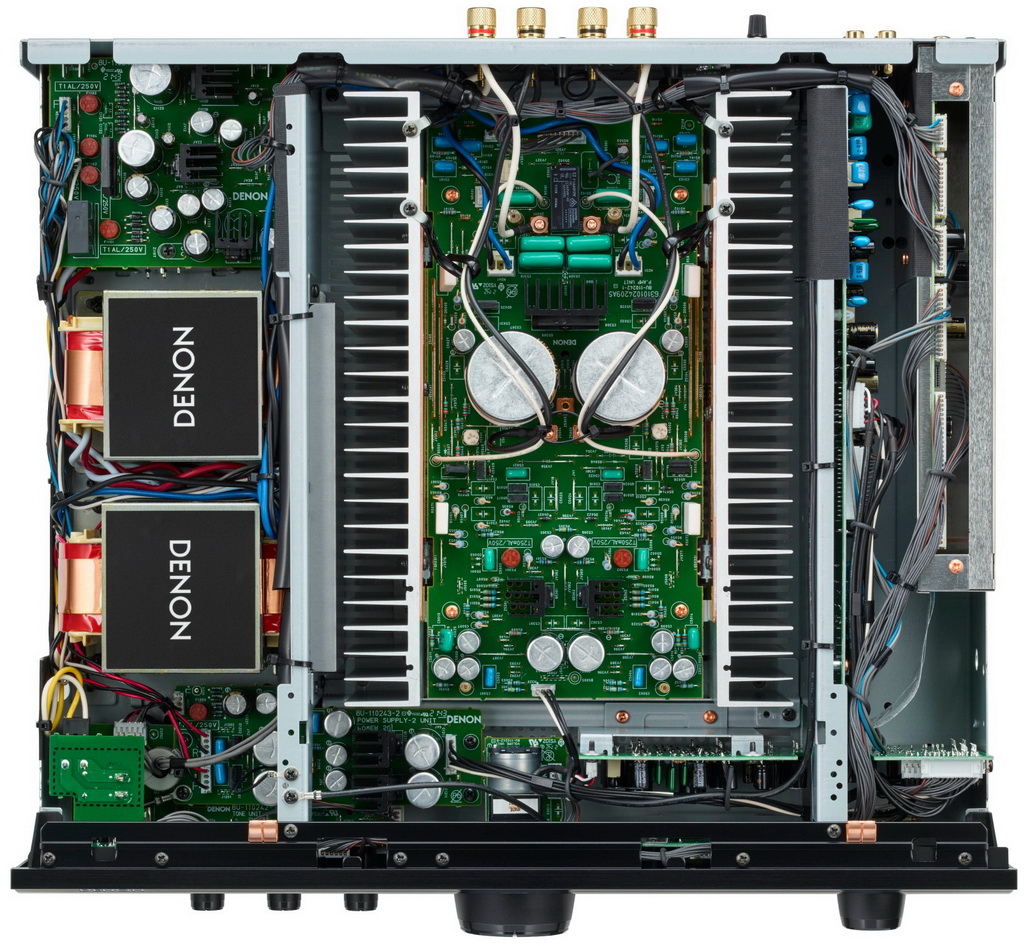
Internally, the functional layout is divided into six separate blocks. The purpose of this arrangement is to reduce interaction between different parts of the amplifier and limit the interference and distortion that can result when power, analog and digital sections occupy the same enclosure.
The chassis uses 1 mm steel plates to protect the circuits from vibration and help isolate the functional blocks from one another. Denon also uses acoustically inert ABS plastic for the mountings associated with the power transformers, heat sinks and internal partition walls. These are deliberate mechanical choices in a component that weighs 17.6 kg and measures 434 x 135 x 410 mm.
Its power supply employs two separate W-shaped mains transformers. The left- and right-channel output-transistor groups are mounted on separate heat-sink sections, while the final amplifier stages are built from discrete components. Together, these details show an emphasis on physical separation, power delivery and thermal management rather than a highly miniaturized architecture.
Discrete UHC MOS power amplification
The output stage uses a push-pull configuration with high-current UHC MOS transistors. Denon rates the PMA-1700NE at 70 W per channel into 8 ohms and 140 W per channel into 4 ohms. The doubling of the stated output figure into the lower impedance is a relevant system-matching detail for owners considering speakers that present a 4-ohm nominal load.
The specified frequency range is 10 Hz to 70 kHz, while total harmonic distortion for the power-amplifier section is listed at less than 0.01%. The stated signal-to-noise ratio for the line input is 108 dB. These published figures help define the amplifier’s electrical design, although speaker sensitivity, impedance behavior, room size and preferred playback level should still inform any pairing decision.
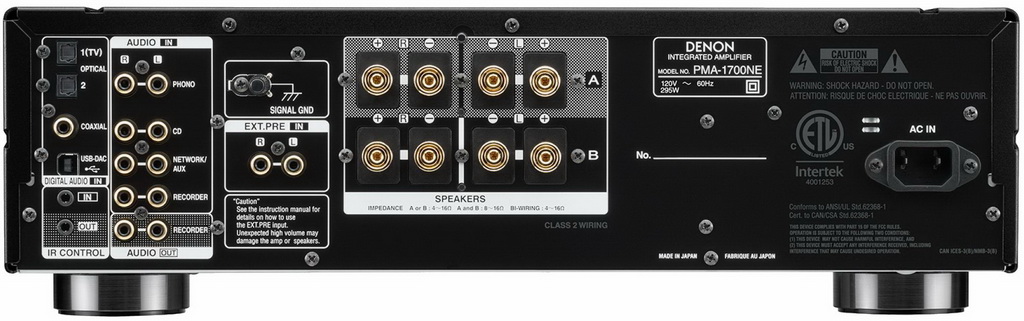
Two sets of speaker outputs are provided through custom screw terminals. The terminals are spaced well apart to make cable installation more manageable, especially when thicker speaker cables or separate pairs of speakers are involved.
Digital playback without requiring a separate DAC
The integrated DAC expands the PMA-1700NE beyond a conventional analog amplifier. Its digital connections comprise USB-B for a computer, two optical inputs and one coaxial input. This allows several wired digital sources to be accommodated, such as a computer, television, CD transport or another component with a compatible digital output.
Through USB, the amplifier accepts PCM data at resolutions up to 32-bit/384 kHz and DSD up to 11.2 MHz. Advanced AL32 Processing Plus is included, together with Denon’s DAC Master Clock Design. The latter is intended to reduce timing jitter by organizing digital conversion around a dedicated master-clock implementation.
Computer audio can introduce electrical noise through the USB connection, so Denon has fitted an isolation circuit to that input. This is a thoughtful inclusion for desktop and music-server installations, where the computer and audio system share a direct physical link. The PMA-1700NE therefore offers more than format compatibility; its USB implementation also addresses a practical source of unwanted interaction between connected devices.
A serious provision for vinyl playback
The built-in phono stage supports both moving-magnet and moving-coil cartridges. MM sensitivity and impedance are specified at 2 mV and 47 kilohms, while the MC input is rated at 0.2 mV and 100 ohms. Supporting both cartridge types gives owners room to change turntables or cartridges without automatically adding an external phono preamplifier.
The stated signal-to-noise ratios are 89 dB for MM and 74 dB for MC. More broadly, including an MC-compatible stage distinguishes the PMA-1700NE from integrated designs that provide only basic MM support. It makes the amplifier relevant to vinyl systems spanning a wider range of cartridge configurations.
Analog Mode is particularly pertinent to record playback. It completely disables the amplifier’s digital circuits when an analog source is in use. This is separate from the direct signal function, which bypasses additional signal-processing circuitry. Providing dedicated buttons for both modes makes it straightforward to configure the amplifier around the active source rather than leaving every subsystem powered regardless of use.
Connectivity for a mixed-source system
Alongside its phono input, the PMA-1700NE provides three line-level inputs. A recording output supports a compatible recorder or another device that requires a fixed-level feed. Combined with USB, dual optical and coaxial digital inputs, this connection set is suited to systems containing a turntable, legacy analog components and modern wired digital sources.
Rear-panel infrared input and output connections allow control signals to be passed between compatible external devices. This can help when coordinating components in a larger installation or when equipment is positioned where direct infrared reception is inconvenient.
The amplifier is fundamentally oriented toward physical source connections. Its documented feature set does not center on an integrated network-streaming platform; owners who want app-based services or network playback can connect an appropriate external source through one of the available digital or analog inputs. That modular approach may appeal to users who prefer to select or upgrade their streaming hardware independently of the amplifier.
Who the Denon PMA-1700NE suits
The PMA-1700NE is most suitable for listeners building a full-size, wired two-channel system around several source types. Vinyl users benefit from MM and MC compatibility, while computer-audio listeners can use the high-resolution USB-B input without purchasing a separate DAC. Optical and coaxial inputs accommodate additional digital hardware, and the analog line inputs preserve support for conventional components.
It should also suit owners who value hands-on control. Tone and balance adjustments remain available for practical use, but both a direct path and a digital-circuit shutdown mode are provided for occasions when those facilities are not wanted. The substantial chassis, separated internal blocks and dual-transformer power supply further indicate that this is intended as a permanent system centerpiece rather than a compact lifestyle amplifier.
Prospective owners should account for its 17.6 kg weight and 410 mm depth when selecting furniture or rack space. Those seeking built-in wireless streaming may need an external device, while anyone using particularly demanding loudspeakers should evaluate the amplifier’s published 70 W into 8 ohms and 140 W into 4 ohms in the context of the intended room and listening levels. Its strongest fit is a system where source flexibility, vinyl support and conventional amplifier ergonomics matter more than compact dimensions or an all-in-one wireless interface.
Conclusion
The Denon PMA-1700NE brings together several well-defined strengths: discrete UHC MOS output stages, a mechanically partitioned chassis, dual power transformers, MM/MC phono compatibility and a DAC capable of accepting high-resolution PCM and DSD over USB. Its direct signal path and Analog Mode give owners meaningful control over which circuits remain active, while tone, balance and clearly arranged front-panel controls preserve everyday usability. For listeners assembling a substantial wired hi-fi system around turntables, computers and conventional digital or analog sources, it offers a flexible and carefully structured foundation.



Sound Off
0Join the discussion if you have something to add.