
Choosing speakers starts with the system you want to build, not with a single specification or cabinet style.
Passive floorstanders such as the KEF R5 Meta, PS Audio Aspen FR30, Piega Premium 801 and Fyne Audio F704SP require separate amplification, while active designs including the Dali Oberon 7 C and HECO Aurora 200P reduce the need for additional electronics.
Soundbars offer a more compact route to stronger television sound, and a dedicated subwoofer can extend the bass performance of an existing system. Room size and placement matter just as much as format. Large floorstanders need enough physical space to operate comfortably, whereas near-field monitors and compact active speakers suit shorter listening distances. Television users should pay particular attention to HDMI ARC or eARC, while music-focused systems may place more emphasis on driver design, amplification compatibility and low-frequency extension. The selections below cover several distinct approaches rather than ranking like-for-like products. Each entry is assessed from the supplied product information, with manufacturer claims identified where appropriate and no assumption that the most elaborate option will suit every room or listener.

1. KEF R5 Meta
The KEF R5 Meta is a passive three-way floorstander built around a twelfth-generation Uni-Q coaxial driver.
The KEF R5 Meta is a relatively compact passive three-way floorstander intended for both stereo and home-theater systems.
Its twelfth-generation Uni-Q assembly places a 25mm tweeter at the center of a 125mm midrange driver, while KEF’s Metamaterial Absorption Technology uses a network of channels behind the tweeter.
The company says this structure absorbs 99% of unwanted rear radiation to reduce resulting distortion. The source also describes convincing bass and a wide, sophisticated sound picture, making the R5 Meta a versatile option for listeners who want floorstanding scale without an especially large enclosure.
Best for: Versatile passive systems in shared living spaces
- Relatively compact floorstanding design
- Three-way configuration
- Uni-Q driver with Metamaterial Absorption Technology
- Suitable for stereo or home theater
Verdict: The KEF R5 Meta combines a placement-friendly floorstanding cabinet with KEF’s coaxial Uni-Q architecture and rear-radiation absorption technology.

2. PS Audio Aspen FR30
The PS Audio Aspen FR30 separates its woofer section from the ribbon midrange and tweeter enclosure.
PS Audio designed the Aspen FR30 as a full-range three-way floorstanding system with low distortion as a central objective.
Its substantial driver array includes four 8-inch aluminum-cone woofers, four 10-inch passive woofers, a 10-inch ribbon midrange and two 2.5-inch planar ribbon tweeters.
Separate bass and midrange-tweeter cabinet sections are joined by a sliding mechanism. PS Audio also developed a phase-corrected crossover intended to produce an almost flat impedance curve, with the stated aim of making the speaker compatible with a broad range of power amplifiers. This is the most ambitious proposition here for readers considering a large, technically elaborate passive system.
Best for: Large, ambitious passive hi-fi systems
- Extensive active and passive bass-driver array
- Ribbon midrange and dual planar ribbon tweeters
- Phase-corrected crossover design
- Cabinet engineered to limit sound-distorting vibration
Verdict: The Aspen FR30 is a technically intensive full-range floorstander aimed at listeners with the space and system context for its substantial design.
3. Dali Oberon 7 C and Sound Hub Compact
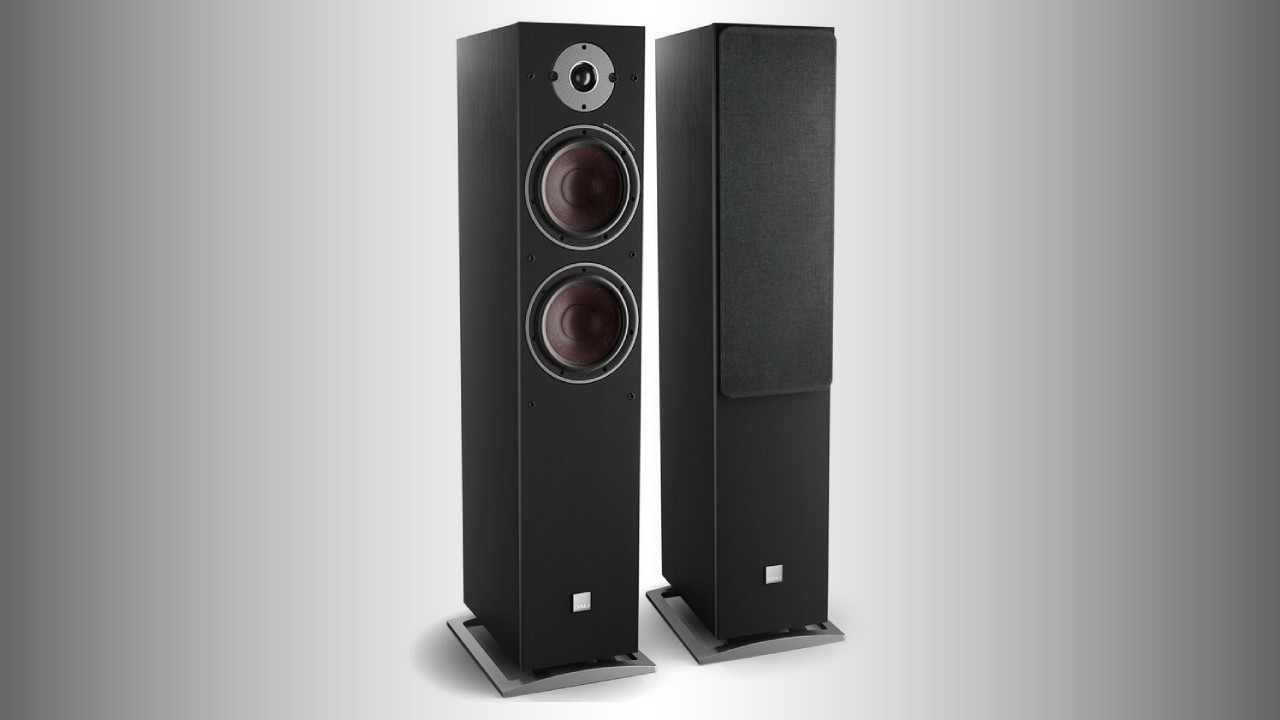
The active Dali Oberon 7 C floorstanders work wirelessly with the supplied Sound Hub Compact.
The Dali Oberon 7 C is an active adaptation of the Oberon 7, supplied here with the Sound Hub Compact.
Amplification is built into the speakers, and Dali’s hub distributes audio over a proprietary 30-bit wireless protocol, removing the need for a separate full-size amplifier and long speaker-cable runs.
Source connections include two optical inputs, RCA and mini-jack analog inputs, while a subwoofer output allows later bass expansion. HDMI ARC connects the system to a television, supports volume adjustment from the television remote and enables coordinated power operation. This combination makes the system particularly relevant to listeners who want floorstanding speakers for both music and television without assembling a conventional component stack.
Best for: Wireless floorstanding sound for music and television
- Amplification built into the speakers
- Sound Hub Compact included
- HDMI ARC with television remote control
- Dedicated subwoofer connection
Verdict: The Oberon 7 C system offers the scale of active floorstanders with a compact connection hub and practical television integration.

4. Fostex NF06
The Fostex NF06 pairs a 6.5-inch HR-diaphragm woofer with a one-inch titanium-dome tweeter.
The Fostex NF06 is a near-field monitor centered on a 6.5-inch woofer with the company’s proprietary HR diaphragm.
Its fan-blade-like profile is designed for rigidity, low weight and reduced internal stress and resonance, while the dome combines wood fibers, carbon and other materials.
A tangential UDR surround and a magnetic system engineered for a consistent field across the frequency range complete the bass driver. High frequencies are handled by a one-inch titanium-dome tweeter, and the drivers are housed in an MDF cabinet with an experimentally determined front-wall thickness. The quoted operating range is 40Hz to 35kHz, with 8-ohm impedance and 84.5dB/W sensitivity.
Best for: Short-distance near-field monitoring
- Proprietary 6.5-inch HR-diaphragm woofer
- One-inch titanium-dome tweeter
- MDF cabinet with tested front-wall thickness
- Specified 40Hz to 35kHz operating range
Verdict: The Fostex NF06 is a focused near-field design distinguished by its engineered HR woofer and titanium-dome tweeter.

5. Piega Premium 801
The Piega Premium 801 is a slim aluminum floorstander featuring an SSD ribbon tweeter and four woofers.
The Premium 801 is the flagship floorstander in Piega’s Premium line, positioned by the company between the Premium 701 Gen2 and Coax 611.
Its defining feature is the RM 01-24 SSD ribbon tweeter, which places a diaphragm with a stated moving mass of 0.03 grams in a specially developed horn mount.
The speaker uses a slim extruded-aluminum cabinet based on the Coax 611 profile. Piega says the high-pressure forming process creates a rigid, resonance-resistant structure, supplemented internally by longitudinal bracing, damping and a wood-matrix bracing system. A midrange driver operates in its own sealed enclosure, while four woofers share a bass-reflex arrangement.
Best for: Premium passive systems prioritizing cabinet and ribbon-driver engineering
- New SSD ribbon tweeter in a horn mount
- Rigid extruded-aluminum cabinet
- Dedicated sealed midrange enclosure
- Four-woofer bass-reflex system
Verdict: The Piega Premium 801 brings a new horn-mounted ribbon tweeter and extensive internal reinforcement to the company’s slim aluminum floorstander format.

6. Guide to purchasing the perfect soundbar
Soundbar selection should account for cabinet width, television clearance and the available mounting surface.
This buying guide addresses soundbars as a space-conscious alternative to a room filled with separate speakers.
A soundbar combines multiple drivers in one elongated enclosure and may use reflected sound to simulate surround effects.
Choosing one involves more than matching a feature list: the unit must fit near the television without obstructing the screen or conflicting with furniture. Width does not have to match the television exactly, although a large visual mismatch may look awkward. The source also notes that smaller, easier-to-conceal models can sacrifice some of the sound depth available from larger designs.
Best for: Readers choosing a space-efficient television speaker
- Explains soundbar sizing considerations
- Addresses placement around a television
- Clarifies the trade-off between compactness and sound depth
- Useful starting point for space-limited systems
Verdict: This guide is a practical primer on balancing soundbar size, placement and visual compatibility with a television setup.

7. Acoustic Energy AE108 Mk2
The compact Acoustic Energy AE108 Mk2 uses a 254mm driver and includes remote setup control.
The Acoustic Energy AE108 Mk2 is a compact active subwoofer designed primarily for smaller rooms.
Its 254mm driver is larger than the 203mm unit used in the earlier version, and the quoted lower frequency boundary extends from the previous 38Hz to 30Hz.
Built-in power is stated at 150W, while remote control is provided to simplify adjustment. At just under one cubic foot, the enclosure is small enough to offer useful placement flexibility. The source characterizes its presentation as controlled and delicate through its main operating range despite the strong bass output available from the compact cabinet.
Best for: Adding controlled low bass in a smaller room
- Compact enclosure
- 254mm driver
- Specified extension down to 30Hz
- Remote control for setup
Verdict: The AE108 Mk2 is a compact powered subwoofer for listeners who need deeper bass without accommodating a large enclosure.

8. HECO Aurora 200P
The HECO Aurora 200P places its amplifier and connection electronics inside the left speaker.
The HECO Aurora 200P is an active stereo speaker system with its electronics and two-channel Class D amplifier housed in the left speaker.
Total amplifier power is stated at 75W.
HDMI ARC sends television audio directly to the speakers, while CEC allows volume adjustment from a compatible television remote. Conventional digital and analog inputs are also provided, and the digital section accepts signals up to 24-bit/192kHz. The system is offered in black with a lacquered front panel and textured veneer. Its mixture of television integration and traditional source inputs makes it a practical alternative to both an entry-level component system and a single-cabinet soundbar.
Best for: Compact active stereo sound around a television
- Integrated two-channel Class D amplification
- HDMI ARC and CEC support
- Digital and analog source connections
- Accepts digital signals up to 24-bit/192kHz
Verdict: The HECO Aurora 200P combines stereo speaker separation with the HDMI convenience usually associated with soundbars.

9. Fyne Audio F704SP
The Fyne Audio F704SP uses a 300mm IsoFlare driver above a second 300mm woofer.
The Fyne Audio F704SP refines the company’s original F704 floorstander with technology intended to combine that model’s dynamic character with ideas from the flagship F1 series.
Its main 300mm IsoFlare point-source driver integrates a multifiber bass-midrange cone with a centrally positioned 75mm titanium-dome compression tweeter.
Neodymium magnets are used in the high-frequency system, while the main cone employs a large ferrite motor. A second 300mm multifiber woofer extends the low-frequency section. Fyne Audio specifies system sensitivity at 96dB/W, making amplifier matching a notable part of the F704SP’s appeal, although room size and listening distance remain important considerations for such a substantial driver configuration.
Best for: High-sensitivity passive floorstanding systems
- 300mm IsoFlare point-source driver
- 75mm titanium compression tweeter
- Second 300mm woofer for bass extension
- Specified sensitivity of 96dB/W
Verdict: The F704SP combines a large coaxial point-source driver, an additional woofer and high quoted sensitivity in a substantial passive floorstander.

10. Klipsch Flexus Core 300
The 137cm-wide Klipsch Flexus Core 300 houses 13 drivers in a 5.1.2-channel soundbar configuration.
The Klipsch Flexus Core 300 is a 5.1.2-channel soundbar developed as part of the Flexus Sound System in collaboration with Onkyo.
Its 137cm-wide cabinet contains 13 drivers, including channels intended for Dolby Atmos reproduction, and it also decodes DTS:X.
The modular system can be expanded with a wireless subwoofer or wireless rear speakers. Klipsch’s Connect Plus app handles audio settings, device management and firmware updates. Source and streaming support includes Bluetooth 5.3, AirPlay, Google Cast, Spotify Connect, Tidal Connect, optical audio, USB-C, HDMI 2.1 passthrough and HDMI eARC. It is the most connectivity-rich television option in this selection, but its considerable width should be checked against the available furniture and screen position.
Best for: Expandable television sound with immersive-format support
- 5.1.2-channel layout with 13 drivers
- Dolby Atmos drivers and DTS:X decoding
- Expandable with wireless subwoofer and rear speakers
- Broad wired, wireless and streaming connectivity
Verdict: The Flexus Core 300 is a wide, expandable soundbar for viewers seeking Atmos and DTS:X support alongside extensive streaming options.
Frequently asked questions
Should I choose passive or active speakers?
Passive speakers require an external amplifier and suit buyers who want to select or upgrade components separately.
Active models such as the Dali Oberon 7 C and HECO Aurora 200P include amplification, reducing the number of separate boxes and simplifying installation.
Are floorstanding speakers always better than compact speakers or soundbars?
No.
Floorstanders can provide greater cabinet volume and larger driver arrays, but they also need more room.
Compact active speakers, near-field monitors and soundbars may be more appropriate where listening distance, furniture space or television placement is limited.
Which connections matter most for television use?
HDMI ARC or eARC allows a compatible television to send audio to the speaker system through HDMI.
CEC can add control from the television remote.
Optical input remains useful for televisions or sources without suitable HDMI audio support.
When does a system need a separate subwoofer?
A subwoofer is useful when the main speakers or soundbar do not provide the desired low-frequency extension.
Room size and placement should guide the choice: a compact model such as the AE108 Mk2 is designed around smaller-room use, while several active systems provide a subwoofer output for later expansion.
How to choose the right speaker format
Begin by deciding where the system will be used and what it must connect to.
A music-first passive setup requires an appropriate amplifier, enough space around the speakers and attention to impedance and sensitivity.
Active speakers simplify that chain by integrating amplification, while models with HDMI ARC or eARC are easier to combine with a television. Soundbars save the most space, although cabinet width, screen clearance and the possibility of adding rear speakers or a subwoofer should be considered before installation. Do not treat driver count, cabinet size or quoted frequency range as a complete measure of suitability. A large floorstander may be excessive at a short listening distance, while a compact speaker can be the more coherent choice in a small room. Near-field monitors are designed around close placement, and subwoofer performance depends heavily on room position and careful level adjustment. The clearest distinctions in this selection are practical. The KEF R5 Meta offers a relatively compact passive floorstanding format; the Aspen FR30, Piega Premium 801 and Fyne Audio F704SP represent progressively more elaborate passive designs; the Dali and HECO systems integrate amplification; the Fostex NF06 addresses near-field listening; and the Klipsch soundbar concentrates television, immersive audio and streaming functions in one expandable platform. Matching one of these approaches to the room and existing equipment is more useful than choosing on specifications alone.



Sound Off
0Join the discussion if you have something to add.