

The Pro-Ject X1 is built around a familiar idea: a manually operated, belt-driven turntable that keeps the user close to the vinyl playback process while reducing the setup frustrations that can make analogue audio intimidating. Its appeal lies less in novelty for its own sake and more in the way Pro-Ject has updated a traditional format with a heavier chassis, acrylic platter, refined motor control, adjustable tonearm architecture and practical accessories. For listeners who want a turntable that looks clean, supports proper cartridge setup and does not bury core functions behind unnecessary complexity, the X1 has a clearly defined role.
A classic layout with more attention to resonance control
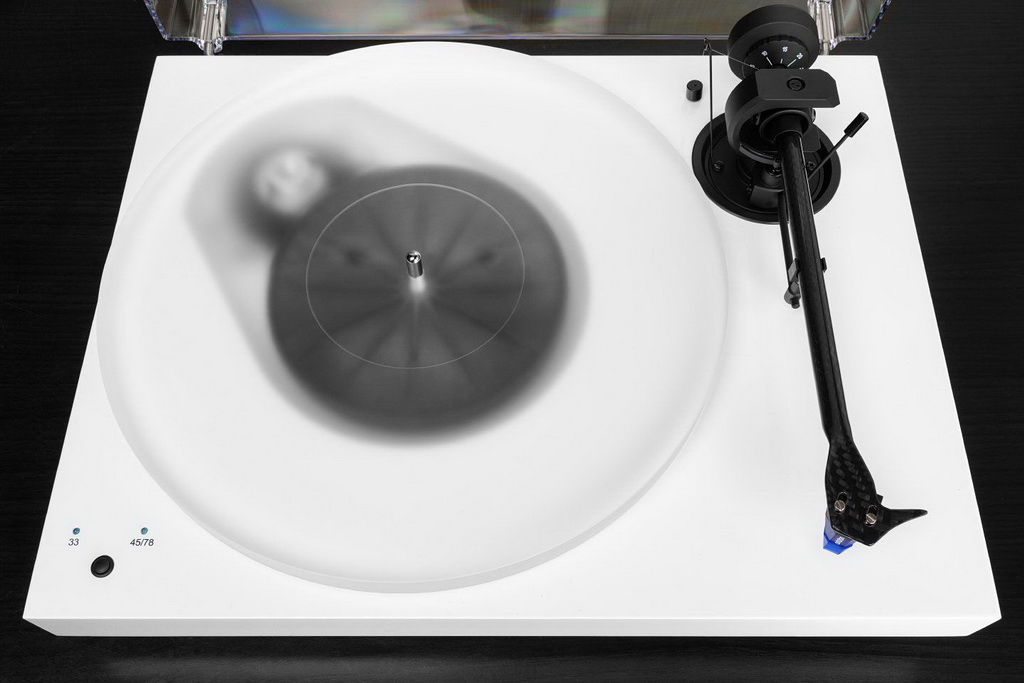
The X1 follows the established Pro-Ject formula of a simple plinth, exposed platter and separate tonearm assembly, but several construction choices are aimed at controlling unwanted vibration. The cabinet is made from high-density MDF, selected for its mechanical properties and suitability for turntable use. Pro-Ject finishes the cabinet with eight layers of paint and hand polishing, giving the model a more furniture-like presence than a purely utilitarian deck.
The plinth is available in walnut veneer as well as black or white gloss, which makes the X1 easier to integrate into different listening rooms. That matters because a turntable is rarely hidden away: it is a functional component, but also a visible object. The X1’s design remains restrained, with the finish choices doing most of the visual work rather than relying on decorative complexity.
At 7 kg, the turntable has enough physical substance to feel like a serious component without becoming impractical for a normal rack or sideboard. Its listed dimensions of 415 x 125 x 335 mm also keep it within the footprint expected of a conventional hi-fi turntable, making it suitable for systems where space is considered but not extremely limited.

Acrylic platter and bearing system
One of the central upgrades in the X1 is its 1.5 kg, 20 mm acrylic platter. Acrylic is often used in turntable design because it can help reduce platter ringing and offers a stable surface for vinyl playback. Here it is described as non-resonant and is mounted on an auxiliary platter supported by a premium main bearing. The goal is smooth, consistent rotation rather than visual drama.
For a prospective owner, the platter and bearing arrangement matter because rotational stability is fundamental to record playback. A turntable’s job is mechanically simple but unforgiving: rotate the record at the correct speed while the stylus traces extremely small groove modulations. A better-controlled platter system gives the cartridge and tonearm a more stable platform from which to work.
The X1 also includes electronic speed switching for 33 1/3, 45 and 78 rpm. This is a useful everyday feature, especially for listeners who regularly move between LPs and singles. The inclusion of 78 rpm support also adds flexibility for owners with suitable records and cartridge/stylus arrangements, though 78 playback should always be approached with the correct stylus for the record type.

Motor control designed for stable operation
Inside the X1 is a DC-AC generator board intended to provide clean and stable power to the motor. Pro-Ject pairs this with electronic speed control rather than asking the user to rely only on manual belt movement for common speed changes. The listed speed setting accuracy is 0.30% at 33 rpm and 0.25% at 45 rpm, with speed deviation specified at 0.15% for 33 rpm and 0.13% for 45 rpm.
The motor is also described as quiet and benefits from improved isolation through a revised motor mount and decoupling. In a turntable, motor behavior is not just an engineering detail. Any vibration that reaches the platter, record, cartridge or tonearm can become part of the playback chain. By addressing motor power and mechanical isolation together, the X1 reflects a design approach that treats speed control and resonance control as connected problems.
The controls remain simple. This is still a manual turntable, so the owner participates in cueing and handling records, but speed selection is made more convenient. That balance is likely to appeal to users who enjoy the tactile nature of vinyl without wanting avoidable operational friction.

Adjustable carbon-aluminum tonearm
The X1 uses an 8.6-inch carbon EVO tonearm with an effective mass listed at 10 grams and a 22 mm overhang. The arm is described as a carbon-aluminum design made as a single unit, without a resonant headshell. Its construction is supported by a damped counterweight, with TPE damping used to reduce cartridge resonance.
This tonearm is significant because the X1 is not merely a plug-and-forget record player. It provides the necessary adjustments for serious cartridge setup, including azimuth and VTA adjustment via the aluminum tonearm base. Those adjustments allow the user or dealer to align a cartridge more precisely, which is important when changing cartridges or refining setup over time.
The presence of these adjustment options broadens the X1’s long-term usefulness. A beginner may initially value that the turntable can be made ready quickly, while a more experienced vinyl listener may appreciate that the arm does not lock them into a narrow cartridge path. In that sense, the X1 sits in a useful middle ground: approachable enough for a first serious turntable, but not so simplified that it discourages future experimentation.
Cartridge considerations and the Pick It S2
The documented package and specifications reference a Pro-Ject Pick It S2 moving-magnet cartridge made by Ortofon. Its design is based on Ortofon’s professional Concorde concept, but adapted for home hi-fi use. The cartridge body is narrow to resist external vibration, and the body material is polycarbonate with anti-resonance characteristics.
Several practical features make the Pick It S2 noteworthy. It has a finger grip mounted on a ring holder, and a semicircular cutout above the stylus area is intended to help the user see placement on the record groove more clearly. For day-to-day record playing, this kind of visual and ergonomic detail can be as important as headline specifications, particularly for users who are still developing confidence in manual cueing.
The cartridge uses an elliptical diamond stylus and has a replaceable stylus assembly. Compatibility with Ortofon OM20 and OM30 replacement styli is also documented, giving owners a possible upgrade or service path without replacing the entire cartridge body. Its output voltage is listed at 6 mV, with a recommended input impedance of 47 kOhm and input capacitance of 200–600 pF. Those figures place it comfortably within the expectations of many moving-magnet phono stages, including phono inputs built into some integrated amplifiers and AV receivers.
The recommended tracking force is 3 grams, within a broader range of 2.0–5.0 grams. The cartridge is described as suitable for medium-weight tonearms, and the X1’s adjustable arm allows setup to be checked rather than assumed. As always with vinyl, careful alignment and tracking force setup remain essential, whether the cartridge is supplied in a package or selected separately.
Feet, cable and setup-friendly details
The X1 includes height-adjustable Alu-TPE sandwich feet. This is a small but important part of the design. Leveling a turntable is not cosmetic; it helps the platter, bearing and tonearm operate as intended. The TPE element also contributes mechanical isolation from the support surface, which is valuable in real rooms where racks, floors and furniture vary widely.
The supplied cabling is another practical point. The package includes a Pro-Ject Connect it E RCA phono cable with gold-plated RCA connectors, low capacitance and shielding optimized for turntable use. Phono signals are low-level and more vulnerable to noise than ordinary line-level connections, so using a cable intended for this purpose helps avoid a common weak link in entry and mid-level analogue systems.
Pro-Ject describes the X1 as able to play within minutes of unpacking. That does not remove the value of checking tracking force, anti-skate, level and cartridge alignment, but it does suggest that the product is designed to be accessible rather than specialist-only. For many owners, that combination of partial preparation and proper adjustability is more useful than either extreme: fully automatic convenience with little upgrade scope, or a highly technical deck that demands expert setup from the outset.
Who the Pro-Ject X1 is most suitable for
The X1 is best suited to listeners who want a traditional manual turntable with modern refinements and room to grow. It makes sense for someone building a dedicated stereo system around an integrated amplifier or external phono preamp, as well as for owners of amplifiers or receivers with a suitable moving-magnet input. Its 6 mV cartridge output, where the Pick It S2 is used, supports broad compatibility with common MM phono stages.
It is also a strong conceptual fit for vinyl users who value setup flexibility. The adjustable tonearm base, azimuth and VTA support, replaceable stylus options and electronically selectable speeds all make the X1 more adaptable than a basic record player. Someone with a mixed record collection that includes LPs, 45s and potentially 78 rpm discs may also appreciate the speed range, provided the correct cartridge and stylus are used for each format.
The X1 may be less suitable for buyers who want automatic start/stop functions, built-in wireless streaming, USB digitizing or a fully integrated phono stage. It is not presented as an all-in-one lifestyle deck. Its strengths are mechanical, analogue and setup-oriented, which means it rewards users who are willing to engage with the fundamentals of vinyl playback.
Conclusion
The Pro-Ject X1 stands out for its careful balance of classic belt-drive simplicity and practical engineering. Its high-density MDF plinth, 20 mm acrylic platter, improved bearing, DC-AC motor control, electronic speed switching, adjustable carbon-aluminum tonearm, isolated feet and purpose-made phono cable all support the same goal: stable, flexible record playback without unnecessary complexity. With documented support for an Ortofon-made Pick It S2 moving-magnet cartridge and useful tonearm adjustments for future cartridge work, the X1 is aimed at listeners who want a serious manual turntable that remains approachable. It is most compelling for vinyl owners who value clean design, upgrade potential and hands-on analogue operation over automation or built-in digital features.



Sound Off
0Join the discussion if you have something to add.