
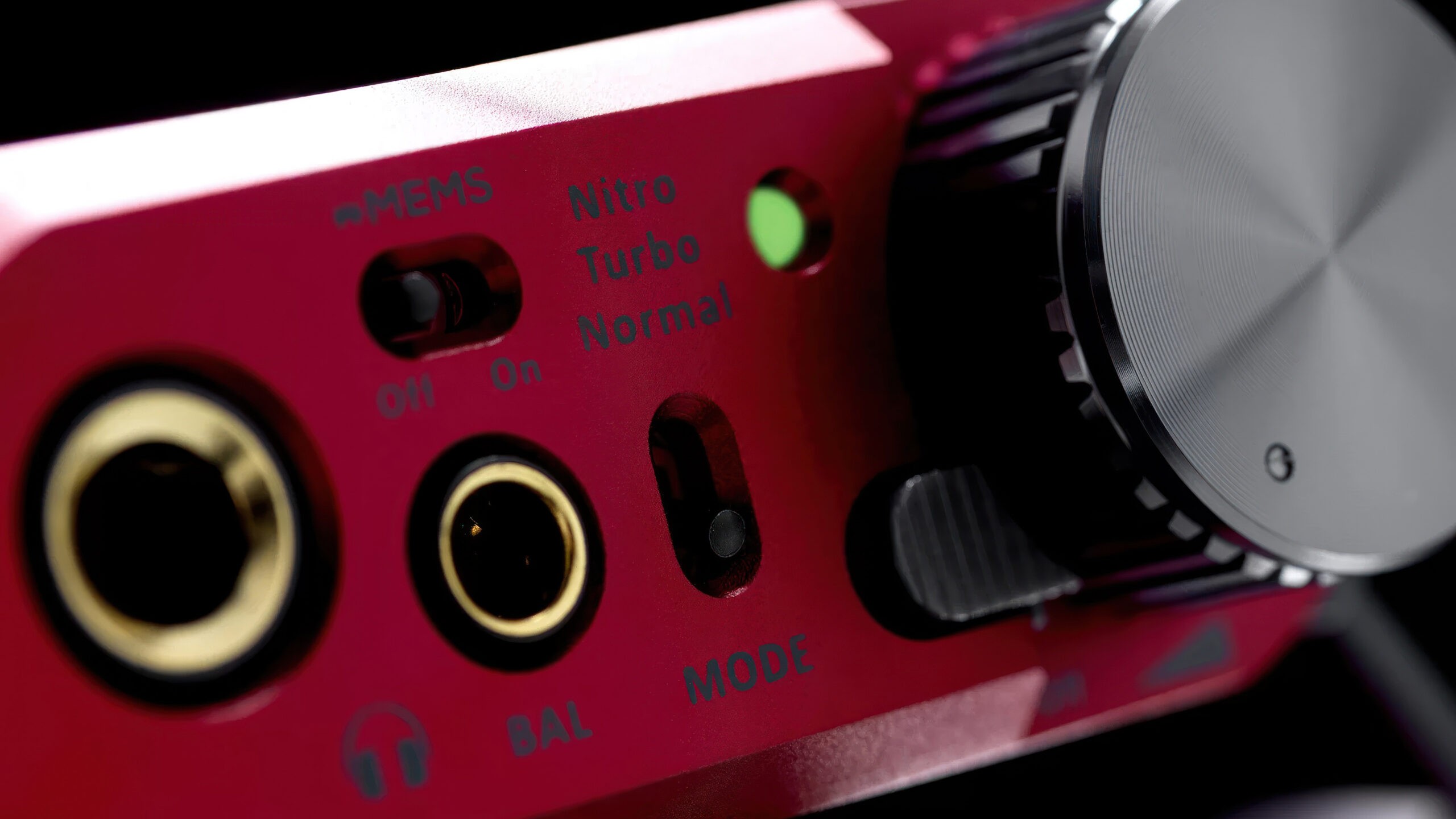
Many headphone enthusiasts divide their listening between a full-size home system and a smaller mobile arrangement. The iFi Audio Diablo 2 is designed to reduce that separation. Replacing the Diablo-X, it combines a DAC, a powerful headphone amplifier, Bluetooth reception, USB-C connectivity, iEMatch, and support for emerging solid-state earphone technology in a single transportable component. Its appeal lies not in any one feature, but in the breadth of headphone systems it is intended to accommodate—from sensitive in-ear monitors to more demanding full-size designs and specialized xMEMS earphones.
A transportable approach to headphone listening
The Diablo 2 occupies a useful space between compact mobile accessories and conventional desktop headphone amplifiers. Its portable format allows it to move between locations, while its stated 5,180mW output gives it substantially more power on paper than a typical dongle-style DAC. The supplied figure is meaningful as an indication of the product’s priorities, although output always depends on the connected load and operating configuration.
This approach may be attractive to listeners who do not want to maintain entirely separate digital front ends for a desk, another room, and occasional travel. A single DAC/amplifier that can accept wired or wireless audio and work with several categories of headphones can simplify such a setup. The striking red finish also gives the Diablo 2 a clear visual identity rather than disguising it as another anonymous black electronics box.
Balanced dual-mono circuitry
At the heart of the Diablo 2 is a balanced dual-mono circuit architecture. In a dual-mono layout, the left and right channels are treated as separate signal paths rather than sharing every stage of the circuit. For prospective owners, the practical significance is that the design has been organized around channel separation and balanced headphone operation rather than adding a balanced connector as an afterthought.
This architecture also fits the Diablo 2’s role as a high-output headphone amplifier. Owners of headphones equipped for balanced connection can use the corresponding signal path, while the amplifier’s increased output compared with its predecessor broadens the range of headphones for which it is intended. The source information does not specify output by impedance, so system matching should still be based on the requirements of the particular headphone rather than the maximum wattage figure alone.
Bluetooth 5.4 and aptX Lossless
Wireless audio is one of the Diablo 2’s most notable updates. It incorporates Bluetooth 5.4 and supports aptX Lossless, a codec designed to transmit CD-quality audio without lossy data reduction when the complete connection meets the codec’s operating requirements. This gives the unit a convenient alternative to a physical digital cable without treating Bluetooth solely as a basic convenience input.
The important point is flexibility. A listener can use a compatible phone, tablet, or other transmitter as the source while retaining the Diablo 2 as the DAC and headphone amplifier. AptX Lossless requires a compatible transmitting device, so the benefit depends on the wider system rather than the Diablo 2 alone. Even with that consideration, the combination of a current Bluetooth implementation and a lossless-capable codec makes wireless use more relevant to listeners who would previously have reserved the amplifier for wired sources.

USB-C for contemporary wired systems
For wired digital playback, the move to USB-C makes the Diablo 2 easier to integrate with current computers and mobile devices. USB-C is now common across laptops, tablets, and smartphones, reducing dependence on older connector formats and making the amplifier a more natural companion to modern source hardware.
A wired USB connection remains useful when wireless compatibility is uncertain or when the owner wants a direct digital path. Providing both USB-C and Bluetooth means the Diablo 2 does not force a single operating model: it can serve as a desk-based USB DAC, then receive audio wirelessly when cable-free operation is more convenient. That dual role is central to its home-and-mobile positioning.
Support for xMEMS solid-state earphones
The Diablo 2 also addresses a less conventional category of personal audio hardware: earphones using xMEMS solid-state drivers. These drivers employ the piezoelectric effect, converting electrical energy into mechanical movement. A thin semiconductor structure excites an integrated silicon membrane to produce acoustic waves, replacing the more familiar plastic diaphragm and voice-coil arrangement used by many conventional drivers.
According to the documented technology specifications, the xMEMS design has a 15-microsecond response, described as 150 times faster than conventional speakers. It is also specified with a two-degree flat phase response and phase matching accurate to plus or minus one degree. The silicon diaphragm is stated to be 95 times tougher than plastic, with the aim of reducing degradation while supporting clear mid- and high-frequency reproduction.
The challenge is that xMEMS drivers have unusual high-voltage requirements. iFi’s partnership with xMEMS allowed the necessary support to be incorporated into the Diablo platform, and that capability continues in the Diablo 2. This is a genuinely distinctive form of system compatibility: owners interested in solid-state earphones do not need to treat them as conventional models and hope that a standard amplifier will be suitable.
Power and sensitivity at opposite ends of the range
High amplifier output is valuable for demanding headphones, but it can be less convenient with very sensitive in-ear monitors. Small changes in volume may become difficult to control, and the available gain can be excessive for the earphone being used. The inclusion of iEMatch addresses that contrast by making the Diablo 2 more adaptable to sensitive IEMs as well as power-hungry full-size headphones.
That breadth matters because many enthusiasts own more than one type of transducer. A portable amplifier may be paired with compact in-ear monitors while travelling, then connected to full-size balanced headphones at a desk. Combining substantial output with iEMatch gives the Diablo 2 a clearer reason to serve both situations instead of being confined to only the most demanding loads.

A product built around flexibility
The Diablo 2’s strongest design theme is accommodation. Balanced dual-mono amplification serves conventional high-performance headphones; iEMatch addresses sensitive earphones; xMEMS support covers an emerging solid-state driver format; and Bluetooth 5.4 with aptX Lossless complements the USB-C wired input. These features are not merely a long list of formats—they address materially different ways of building and using a personal audio system.
Its format may also help reduce duplication. Someone who listens at a computer, from a mobile device, and in more than one physical location can keep the same amplification and conversion platform while changing the source or headphones. That continuity can make cable management, device familiarity, and system planning more straightforward.
Conclusion
The iFi Audio Diablo 2 is most suitable for headphone enthusiasts who want one transportable DAC/amplifier to cover several distinct use cases. Its documented 5,180mW output and balanced dual-mono circuitry make demanding full-size headphones a central part of its remit, while iEMatch extends its usefulness to sensitive in-ear monitors. USB-C supports contemporary wired sources, and Bluetooth 5.4 with aptX Lossless adds a more capable wireless route when paired with a compatible transmitter. Support for high-voltage xMEMS solid-state earphones further distinguishes it from conventional portable amplifiers. Listeners seeking the smallest possible accessory or those using only easy-to-drive headphones may not need this range of capabilities. For owners moving between home and mobile listening, balancing wired and wireless sources, or maintaining a varied headphone collection, however, the Diablo 2 presents an unusually broad and coherent feature set.


Sound Off
0Join the discussion if you have something to add.