
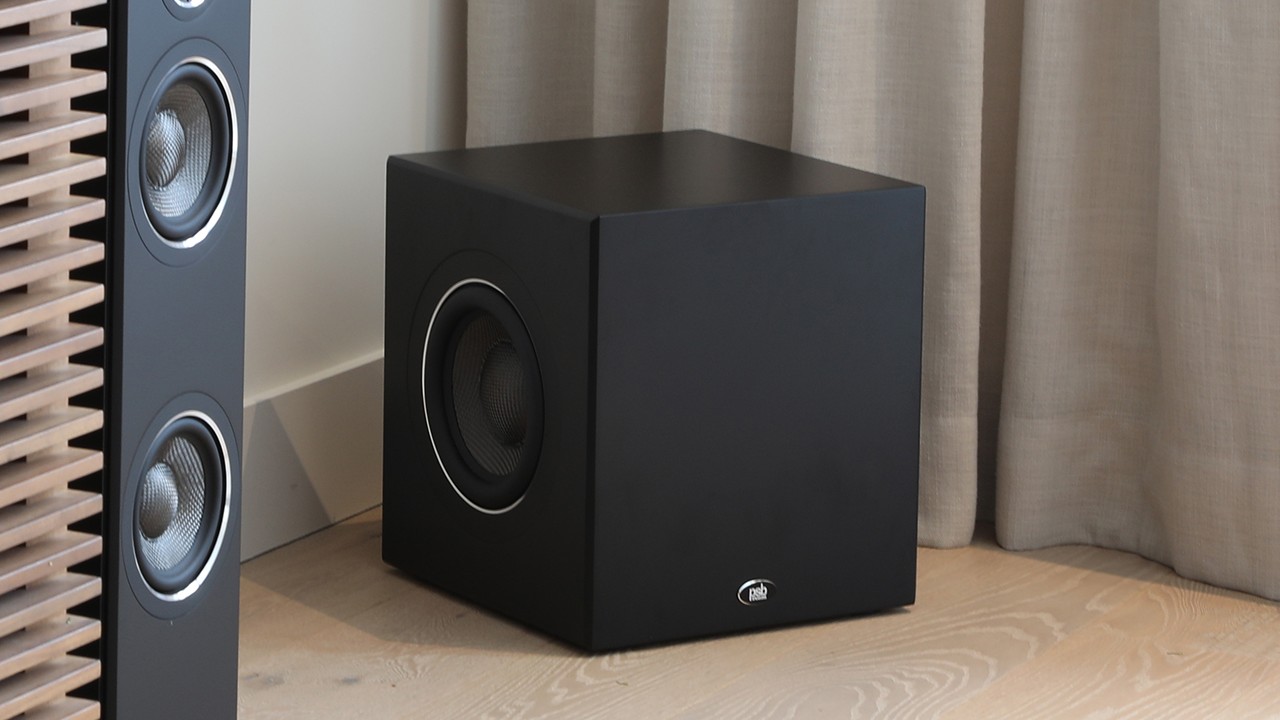
The PSB SubSeries BP8 is designed for listeners who want substantial low-frequency capability without accommodating an unusually large enclosure. Measuring 14 x 13 x 13 inches, it combines two opposing 8-inch drivers with a sealed cabinet and a 500-watt continuous HybridDigital amplifier using nCore technology. Its $1,499 price places it in the premium subwoofer market, where thoughtful engineering, integration flexibility, and physical refinement matter alongside bass extension. Rather than relying on one large visible driver, the BP8 uses a force-opposed arrangement intended to reduce unwanted cabinet vibration. IsoAcoustics feet add another layer of mechanical isolation, while variable crossover, phase adjustment, line-level connectivity, an LFE input, and a 12-volt trigger make the subwoofer adaptable to both music and home theater systems.
A compact, sealed approach to deep bass
At 14 inches high, 13 inches wide, and 13 inches deep, the SubSeries BP8 occupies a relatively manageable footprint. That is useful in living rooms, media rooms, and dedicated audio systems where floor space may be limited or where a subwoofer needs to remain visually discreet. Satin black and satin white finishes also give owners options for coordinating it with loudspeakers, furniture, or the room itself.
The sealed enclosure is central to the BP8’s design. PSB has emphasized cabinet rigidity and acoustic neutrality, reflecting the need to keep the enclosure from contributing resonances of its own. A subwoofer cabinet must cope with considerable internal pressure and driver movement, so controlling panel behavior is particularly important. The BP8’s compact dimensions and sealed construction also make it easier to consider in systems where a large ported cabinet would be impractical.
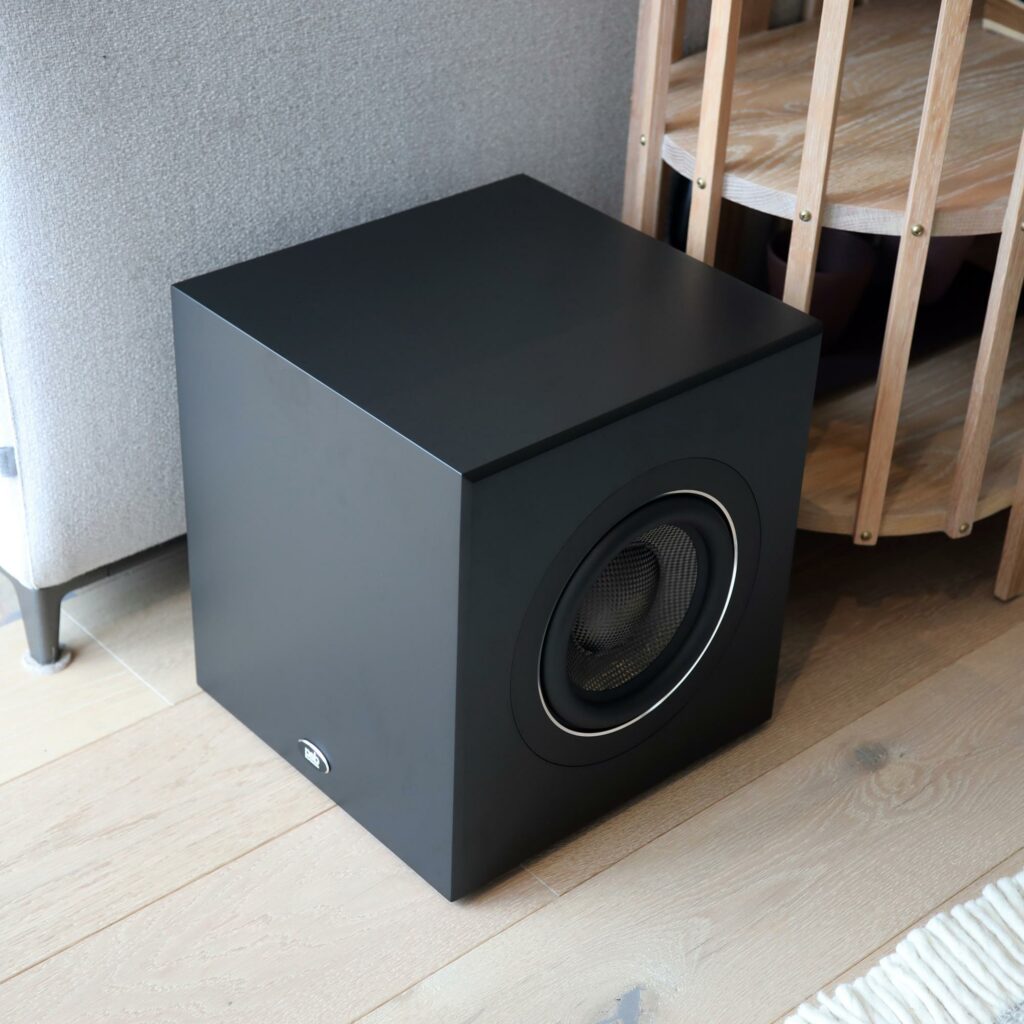
Dual opposing 8-inch drivers
The defining feature of the BP8 is its pair of opposing 8-inch drivers. They are arranged in a bipolar configuration and connected in phase, allowing their mechanical forces to work against each other. PSB’s objective is to cancel vibration that might otherwise be transferred to the enclosure while retaining the acoustic output of both drivers.
This approach addresses more than appearance. A conventional single-driver subwoofer can exert a reactive force on its cabinet as the cone moves. By placing two matching drivers on opposite sides, the BP8 is designed to balance those forces. Reducing cabinet movement helps keep more of the system’s activity focused on producing bass rather than physically shaking the enclosure. It may also make the compact cabinet easier to integrate into a room, although normal room acoustics and placement considerations still apply.
Each driver uses a carbon-fiber fabric cone with a high-density rubber surround. Its motor assembly incorporates a 2.5-inch voice coil and a 2.8-pound magnet. These details indicate that the drivers were developed to handle the excursion and electrical demands associated with low-frequency reproduction rather than being adapted from a conventional woofer design.

500 watts of continuous amplification
The two drivers are powered by a HybridDigital amplifier based on nCore technology, rated at 500 watts continuously. A continuous rating is especially relevant for a subwoofer because sustained low-frequency passages can place significant demands on both the amplifier and the drivers. It is also more informative than quoting only a short-duration peak figure.
The integrated amplifier means the BP8 does not require an external power amplifier. Its amplification, drivers, and sealed enclosure are conceived as one system, giving PSB control over how the electrical and mechanical elements work together. For an owner, this keeps installation straightforward: the subwoofer needs a signal connection from a compatible preamplifier, integrated amplifier, processor, or AV receiver, plus mains power.

Extension to 25 Hz
PSB specifies low-frequency extension to 25 Hz at ±3 dB. That places the BP8 within the range needed to reproduce much of the deep bass found in film soundtracks and music recordings. The specification is particularly notable in the context of a 14-inch-high sealed enclosure and reflects the combined contribution of the two drivers and built-in amplification.
A published extension figure does not remove the influence of the listening room. Room dimensions, boundaries, seating position, and subwoofer placement can all alter bass response. The BP8’s opposed-driver design is intended to control vibration and support immersive bass across different installation positions, but owners should still treat placement and adjustment as important parts of system setup.

IsoAcoustics feet address vibration at the floor
Mechanical isolation is carried beyond the force-opposed driver arrangement through the inclusion of IsoAcoustics feet. These are intended to minimize the transmission of low-frequency vibration and reduce associated resonances. This can be useful on suspended floors, hard surfaces, or furniture-sensitive installations where energy transferred from a subwoofer may cause nearby objects or surfaces to react.
The combination of opposing drivers, a rigid cabinet, and dedicated isolation feet gives the BP8 a coherent vibration-management strategy. Each element addresses a different potential path: the driver layout balances reactive forces, the enclosure is designed to resist unwanted movement, and the feet reduce interaction with the supporting surface.

Controls for stereo and theater integration
A variable crossover spanning 50 to 150 Hz gives owners scope to match the BP8 to different main speakers. Larger floorstanding models may call for a lower crossover point, while compact stand-mount or satellite speakers may benefit from a higher setting. The available range covers many common system configurations without tying the subwoofer to one type of loudspeaker.
Phase control provides another tool for integration. Adjusting phase can help coordinate the subwoofer’s output with the main speakers at the listening position, particularly when their physical locations are not aligned. Correct setup depends on the room and system, but including phase adjustment makes the BP8 more adaptable than a fixed-configuration design.
Signal connections include LFE and line-level inputs using gold-plated RCA connectors. The LFE connection suits surround processors and AV receivers that handle bass management, while line-level connectivity accommodates stereo components with a suitable subwoofer or preamplifier output. A 12-volt trigger allows compatible electronics to control the BP8’s power state as part of a coordinated system, reducing the need for manual operation.

Designed to fit rather than dominate
The BP8’s cubic proportions and choice of satin black or white suggest a product intended to blend into contemporary rooms rather than become a visual centerpiece. The absence of an oversized enclosure is likely to be one of its strongest practical attractions for owners who want low-frequency extension but are reluctant to introduce a much larger cabinet.
Its design also offers flexibility when considering more than one subwoofer. The compact footprint may make multiple-unit placement easier in rooms where owners want to distribute bass sources. The supplied information does not prescribe such a configuration, but the BP8’s size and standard line-level integration make it suitable for consideration within systems that support multiple subwoofers.
Conclusion
The PSB SubSeries BP8 is most suitable for music and home theater owners seeking a premium, self-powered subwoofer with meaningful low-frequency extension in a compact enclosure. Its strongest documented qualities are the dual opposed 8-inch driver layout, 500-watt continuous nCore-based HybridDigital amplifier, sealed and rigid cabinet, and layered approach to vibration control through force cancellation and IsoAcoustics feet. Variable crossover and phase controls support matching with a range of loudspeakers, while LFE and line-level inputs address both theater and stereo applications. The 12-volt trigger is a useful convenience in integrated systems. Listeners who prioritize a manageable footprint, restrained styling, and practical setup flexibility are the clearest audience, though placement and calibration will remain important in any room.


Sound Off
0Join the discussion if you have something to add.