

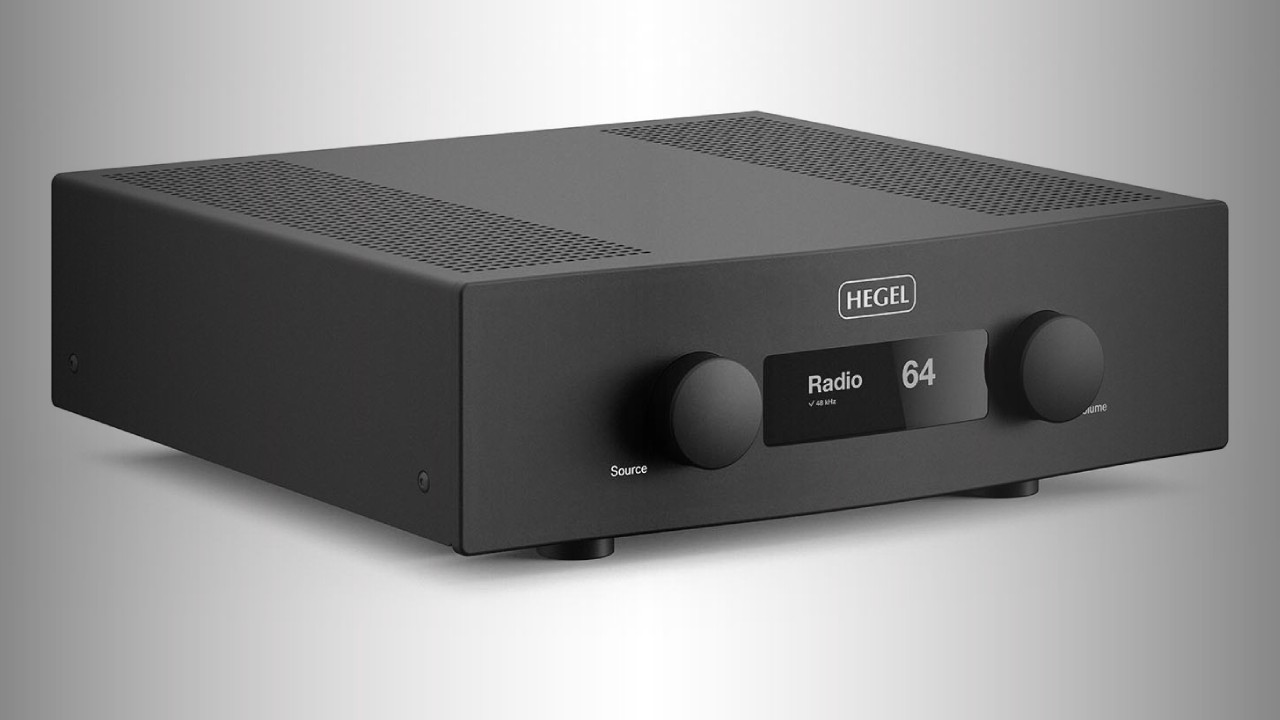
The Hegel H400 brings several traditionally separate hi-fi functions into a single, understated component. At its core is a 2 x 250-watt analog amplifier built around a dual-mono architecture, but it also incorporates a new digital-to-analog converter, wired network streaming, high-resolution USB playback, app control, and unusually flexible preamplifier options. Its appeal is therefore not limited to power alone. The H400 is intended for listeners who want to simplify a serious stereo system without giving up access to physical sources, computer audio, network services, television sound, or future system expansion. Technologies derived from the flagship H600, including the revised streaming module and DAC, also position the H400 as a substantial step beyond the earlier H390 while retaining a more streamlined specification than Hegel’s top model.
A dual-mono foundation for demanding loudspeakers
The defining specification of the H400 is its rated output of 2 x 250 watts. Its dual-mono construction gives the left and right channels substantially independent amplifier paths, an approach intended to reduce interaction between channels and provide a strong electrical foundation for stereo reproduction. That architecture is housed in a heavy, mechanically reinforced chassis with a restrained aluminum front panel.
Just as important as the headline power figure is the amplifier’s stated ability to remain stable with loudspeaker loads down to 2 ohms. Loudspeaker impedance can vary considerably with frequency, and some large floorstanding designs present much more demanding loads than their nominal ratings suggest. The H400 is consequently aimed at systems where amplifier stability and available power are serious considerations, including installations built around high-end floorstanders.
The H400 gives owners access to much of the amplification concept associated with the H600 while accepting somewhat lower power and fewer connections than the flagship. That distinction makes it relevant to listeners who need substantial drive capability but do not require every facility offered by Hegel’s larger model.

A modern digital hub as well as an analog amplifier
Hegel has equipped the H400 with an upgraded streaming module and a new D/A converter, with both developments drawing on work completed for the H600. Coaxial and optical digital inputs allow external transports and digital sources to use the amplifier’s internal conversion stage. This can reduce duplication in a system built around a CD transport, television, or separate network player.
The USB-B connection extends that role to computer audio. A PC or Mac can send digital music directly to the H400, with support for DSD and high-resolution files up to 32-bit/384kHz. MQA support is also included. For owners with downloaded music libraries, the USB input provides a direct route into the amplifier without requiring a separate USB DAC.
The digital section does not force owners to abandon conventional sources. Analog inputs remain available for existing components, while vinyl playback can be added through an external RIAA phono stage such as Hegel’s V10. Keeping the phono stage separate may suit listeners who prefer to choose that part of the signal chain independently, although it also means a turntable cannot be connected directly without additional hardware.

Wired streaming with broad service support
The H400’s built-in network platform supports Spotify Connect, TIDAL Connect, AirPlay, Google Cast, and Roon Ready operation. This selection covers several common ways of playing music, from sending audio through a compatible mobile ecosystem to controlling a network endpoint directly from a streaming service. Roon users can incorporate the amplifier into a library that combines locally stored files with supported online content, including high-resolution material.
Network access is provided through Ethernet rather than Wi-Fi. A wired connection can be attractive in a fixed hi-fi installation because it avoids reliance on local wireless conditions, but prospective owners need a network socket or another suitable wired-network solution near the system. There is also no built-in Bluetooth, so casual direct pairing from a phone is not part of the H400’s feature set.
The dedicated Hegel Control app provides access to music playback and amplifier functions. Hegel also designed the streaming module to accept online updates, with further features and service support planned. The updateable platform gives the digital side of the amplifier room to evolve, although buyers should base a purchase on the functions currently available rather than assuming a particular future addition.

Practical television integration without HDMI
Although the H400 does not include HDMI, it provides a thoughtful alternative for integrating television audio. A TV can be connected to an optical input, after which the amplifier can be configured for the relevant television brand. On compatible models, adjusting volume with the TV remote prompts the H400 to select the television input and respond to the command.
Compatibility covers a range of newer televisions and associated products from brands including Samsung, Sony, LG, Philips, and Apple TV. The arrangement is useful for households that want television sound through their main stereo speakers but do not want to reach for a separate amplifier remote whenever they watch something.
The setup menu also includes start-up volume and maximum-volume settings. A predictable starting level can make daily operation more convenient, while the upper limit provides a degree of protection against accidental high-volume commands or unsupervised use. These are modest features individually, but they make a powerful amplifier easier to incorporate into a shared living space.

Flexible pre-outs and surround-system integration
Both fixed and variable analog preamplifier outputs broaden the ways in which the H400 can be used. A variable output can feed a subwoofer or separate power amplifier while remaining under the H400’s volume control. A fixed output is useful for components that require a consistent line-level signal, including an external headphone amplifier with its own volume adjustment. The latter is especially relevant because the H400 does not provide a direct headphone socket.
A BNC digital output creates another route for system development, including integration with an external DAC or a room-correction device. The H400 does not have built-in room correction, but its connection options give owners scope to place external digital processing within a more elaborate system.
Individual inputs can also be configured for fixed-level operation. This allows the front-channel pre-outs of an AV receiver to feed the H400, which then powers the main left and right speakers during surround playback. Switching back to a conventional stereo source returns the system to two-channel use. This arrangement is particularly useful for owners who want one pair of front speakers to serve both a multichannel cinema system and a dedicated music setup.
The same fixed-level option can be used with an external streamer from a company such as Bluesound or Sonos. Volume and music selection can then be handled through that source’s app. Because a fixed input bypasses normal volume adjustment at the amplifier, careful configuration is important, but the feature provides meaningful operational flexibility.
Who the Hegel H400 is designed for
The H400 is most suitable for listeners assembling a high-end stereo system around demanding passive loudspeakers and multiple digital sources. Its 2-ohm stability and 2 x 250-watt output make it relevant where electrical drive capability is a priority, while its internal DAC and network platform can reduce the number of separate boxes required. It is also well suited to mixed-use rooms where music, television, and the front channels of a surround system share the same loudspeakers.
Owners of computer-based music libraries, Roon systems, or supported streaming subscriptions receive the most direct benefit from its digital platform. Traditional source users are accommodated through analog connectivity, but turntable owners must budget space for an external phono stage. Headphone listening similarly requires a separate amplifier connected to one of the pre-outs.
There are other practical boundaries to consider. Networking is Ethernet-only, Bluetooth is absent, USB storage devices cannot be connected for direct playback, and there is no provision for expansion modules. Room correction also requires an external component. These omissions make the H400 less appropriate for someone prioritizing wireless convenience, built-in headphone listening, or an all-inclusive vinyl setup. Its strengths instead lie in robust amplification, wired digital integration, and adaptable system configuration.
Conclusion
The Hegel H400 combines a 2 x 250-watt dual-mono amplifier with 2-ohm load stability, an updated DAC, high-resolution USB playback, wired network streaming, and app-based control. Fixed and variable pre-outs, configurable input levels, television-remote compatibility, and surround integration allow it to occupy several roles without losing its focus on two-channel systems. It is best matched to owners of demanding loudspeakers who want a powerful stereo centerpiece with comprehensive digital facilities and room for external source, headphone, subwoofer, or AV components. Those who require Wi-Fi, Bluetooth, a phono input, a headphone socket, or built-in room correction will need supplementary equipment or a different feature set.



Sound Off
0Join the discussion if you have something to add.