
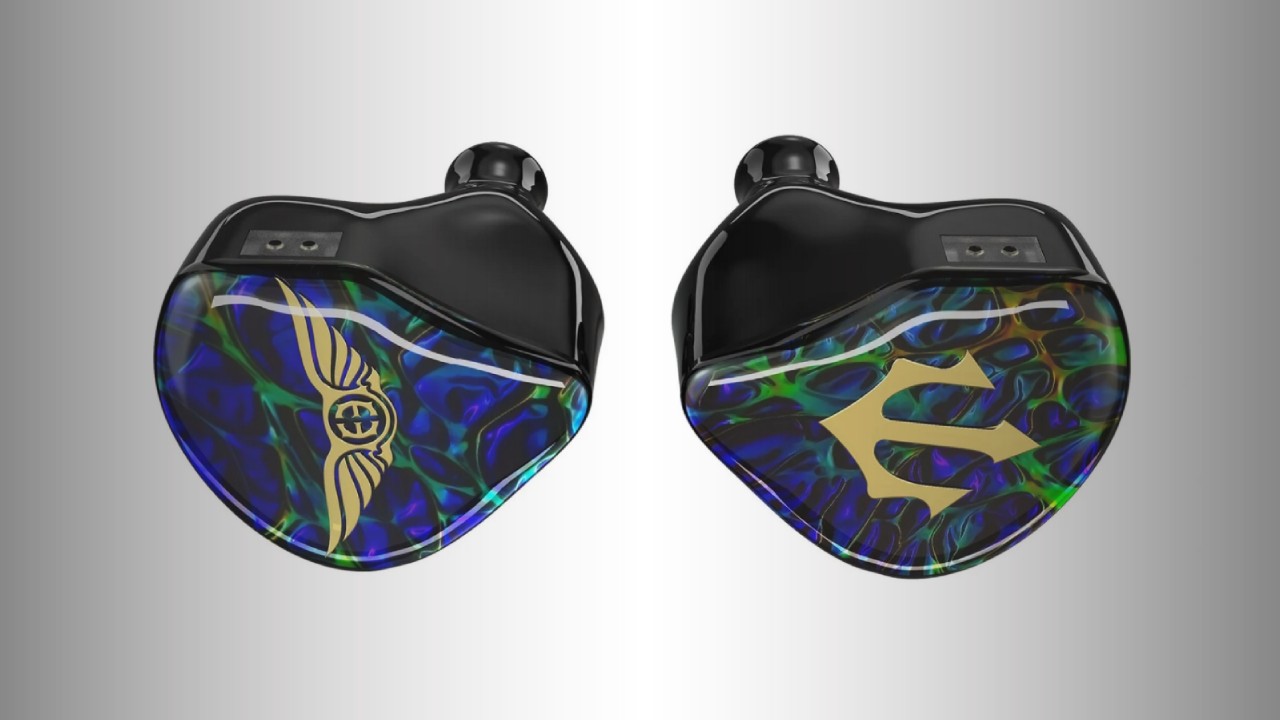
Combining several types of transducer in one in-ear monitor is not simply a matter of increasing the driver count. Each technology needs an appropriate role, while the enclosure, crossover arrangement, ventilation, and resonance management must function as a coherent system. Empire Ears addresses that challenge in the Triton with three complementary driver technologies and several of the company’s established integration systems. Priced at $1,799, the Triton brings together a 9mm W9+ dynamic woofer, an EMP75 precision balanced-armature driver, and a pair of new dual-mass bone conductors. Just as importantly, these components are fitted into a compact body derived from the Legend X, emphasizing wearability alongside technical complexity.
A tribrid architecture with clearly defined roles
The Triton is called a tribrid because it uses three forms of transducer: dynamic, balanced armature, and bone conduction. In total, the configuration includes one W9+ dynamic driver, one EMP75 balanced-armature driver, and two bone-conduction units. Rather than relying on several similar drivers, this layout assigns different reproduction tasks to technologies with distinct operating principles.
A 9mm W9+ woofer forms the low-frequency foundation. Dynamic drivers move air using a diaphragm and are commonly selected for bass duties where displacement and enclosure airflow are important. Empire Ears describes the W9+ as a subwoofer intended to produce powerful but controlled low frequencies. That dedicated role may appeal to listeners who want an IEM designed around substantial bass capability rather than asking a small full-range transducer to cover the entire spectrum.
The EMP75 precision balanced-armature driver is responsible for critical midrange information. Balanced-armature drivers can be packaged into a small space, making them useful in compact multi-driver earphones. Empire Ears also cites development work involving Knowles and Sonion, established names in miniature transducer technology. The use of one specified midrange driver keeps the architecture understandable even though the overall system is technically ambitious.
Two dual-mass bone conductors complete the arrangement. Unlike conventional drivers that primarily transmit sound through the air, bone-conduction elements introduce energy through physical contact with the IEM shell and the listener’s ear. Empire Ears intends these drivers to contribute detail, richness, and a tactile dimension. This does not replace normal air conduction; it supplements it as part of a combined system.
How the driver systems are brought together
A diverse driver complement needs careful integration if it is to operate as one earphone. Triton uses Empire Ears’ synX technology to coordinate the three transducer types. The supplied information does not disclose crossover frequencies or a detailed circuit topology, but the purpose is clear: synX manages the relationship between the dynamic, balanced-armature, and bone-conduction sections.
The broader operating principle is described as Dual Conduction Architecture, or DCA. This combines conventional airborne sound with bone-conducted energy, addressing both auditory and tactile aspects of reproduction. For a prospective owner, the significance is not merely the number of drivers. Triton has been designed around two transmission paths, with the bone-conduction system treated as an integral part of the architecture rather than an isolated novelty.
Empire Ears also incorporates ARC, short for Anti-Resonance Control. Its role is to reduce unwanted vibration and resonance while improving the operation of the bone-conduction system. Resonance management is especially relevant here because physical vibration is deliberately being introduced into a small enclosure. ARC is intended to preserve the useful contribution of the bone conductors while limiting energy that could interfere with clarity.
Fine-tuned enclosure ventilation provides another layer of system management. Venting can affect dynamic-driver behavior, internal pressure, and bass alignment, so its inclusion is a practical consequence of using the W9+ woofer in a sealed in-ear format. Together, synX, DCA, ARC, and the ventilation scheme show that the Triton’s design extends beyond assembling four drivers inside one shell.

Compact ergonomics and recognizable styling
Complex multi-driver IEMs can become large, particularly when they combine a dynamic woofer with additional transducers and the internal structures needed to control them. Triton instead uses a compact body based on the Legend X. Empire Ears explicitly presents this as an effort to avoid sacrificing ergonomics as technical complexity increases.
Fit remains personal with any universal in-ear monitor, and shell dimensions alone cannot guarantee comfort for every listener. Even so, the decision to package the tribrid system in an established compact form is a meaningful design choice. It should be particularly relevant to users who are interested in bone-conduction and multi-driver technology but are wary of oversized earpieces.
The visual treatment connects Triton to several points in the company’s history. Its faceplate is a variation on the Valkyrie Dragonhide design, while the left earpiece carries a Trident symbol. Empire Ears associates the three points of that emblem with past, present, and future. The design also draws inspiration from the Olympus series, making Triton a deliberate reference to earlier models rather than a purely new visual direction.
Each unit is designed and hand-assembled in North Atlanta, Georgia. For owners interested in where and how specialist IEMs are produced, that domestic assembly is a concrete part of Triton’s identity.
A cable prepared for balanced portable systems
Every Triton includes an exclusive Monarch cable made from five precious materials. The exact composition of those materials is not specified, so the most practical documented detail is its 4.4mm Pentaconn termination. This balanced connector is widely associated with contemporary digital audio players, portable headphone amplifiers, and some desktop headphone components.
The 4.4mm plug makes Triton especially straightforward to integrate into a system that already provides a matching balanced output. Prospective owners whose equipment is limited to 3.5mm or 6.35mm outputs should account for that termination when planning their setup. The included cable also contributes to the complete presentation of a $1,799 specialist IEM, rather than leaving the owner to source a balanced cable separately.

Who the Empire Ears Triton is for
Triton is most suitable for enthusiasts who actively want a multi-technology IEM rather than the simplicity of a single-driver design. Its dedicated W9+ woofer and stated emphasis on a bold, immersive presentation point toward listeners who value bass capability, while the midrange balanced armature and dual bone conductors broaden the technical brief beyond low-frequency impact alone.
It is also relevant to users who want bone conduction implemented as part of a coordinated air-and-tactile architecture. Buyers attracted by engineering variety, compact packaging, balanced portable connectivity, and hand assembly in the United States will find several clearly documented points of interest here.
The qualification is price and system fit. At $1,799, Triton occupies a premium part of the universal-IEM market, and its 4.4mm cable is most convenient for owners of compatible sources. Those who prefer a basic driver layout, a conventional single-ended plug, or a lower-cost entry into personal audio may not need this degree of complexity. As with any universal IEM, prospective owners should also consider their individual fit requirements rather than assuming that a compact shell will suit every ear equally.
Conclusion
The Empire Ears Triton’s strongest documented quality is the way it packages three transducer technologies into a comparatively compact in-ear design. Its 9mm W9+ woofer, EMP75 balanced-armature driver, and two dual-mass bone conductors are supported by synX integration, Dual Conduction Architecture, Anti-Resonance Control, and tuned enclosure ventilation. Add the Legend X-derived body, historically influenced faceplate, North Atlanta assembly, and supplied Monarch cable with a 4.4mm Pentaconn plug, and Triton presents a focused proposition for enthusiasts seeking a premium, bass-oriented tribrid IEM with tactile bone-conduction technology and balanced-source compatibility.



Sound Off
0Join the discussion if you have something to add.