

Some home cinema products arrive with obvious attention: flagship processors, slim installation receivers, compact 5.1 speaker systems, and projectors built for serious screen sizes.
Others are easy to overlook because they sit between categories, replace long-running entry models, or target custom-install rooms rather than living-room shelves.
This guide highlights a varied group of home cinema components and systems that stand out in the supplied source material for clear, practical reasons. Some are complete starter packages, while others are specialist building blocks for ambitious surround layouts. The aim is not to crown a single winner, but to explain where each product fits and why it may be the right kind of discovery for a specific system. The selection spans AV receivers, processors, speaker packages, a custom-install ecosystem expansion, and a 4K ultra HD projector. Each recommendation is grounded in stated features only, with careful attention to channel support, video compatibility, room correction, installation flexibility, and system-matching needs.

1. McIntosh MX200: Engineered to support extensive Dolby Atmos configurations
McIntosh MX200 home cinema processor with 11 balanced XLR outputs and HDMI 2.1 connectivity.
The McIntosh MX200 is a serious 11.2-channel home cinema decoder processor for systems that need flexible surround processing rather than built-in amplification.
It is designed for layouts from 5.1 to 7.2.4 channels, with support for Dolby Atmos and DTS:X, plus modern video handling including 4K/120Hz, Dolby Vision, and HDR10+.
Its 11 balanced XLR outputs, independent subwoofer outputs, Dirac Live room correction, and compatibility with Control4 and Crestron Home make it particularly relevant for carefully planned installations. The inclusion of an MM phono input also gives it an unusual analogue-friendly touch for a cinema processor.
Best for: High-end surround systems built around separate amplification
- 11.2-channel processor with Dolby Atmos and DTS:X support
- Designed for 5.1 to 7.2.4-channel home theater layouts
- 4K/120Hz, Dolby Vision, and HDR10+ support
- Dirac Live room correction and installation-system compatibility
Verdict: A flexible McIntosh processor for ambitious home cinemas where balanced outputs, room correction, and installation control matter more than all-in-one convenience.
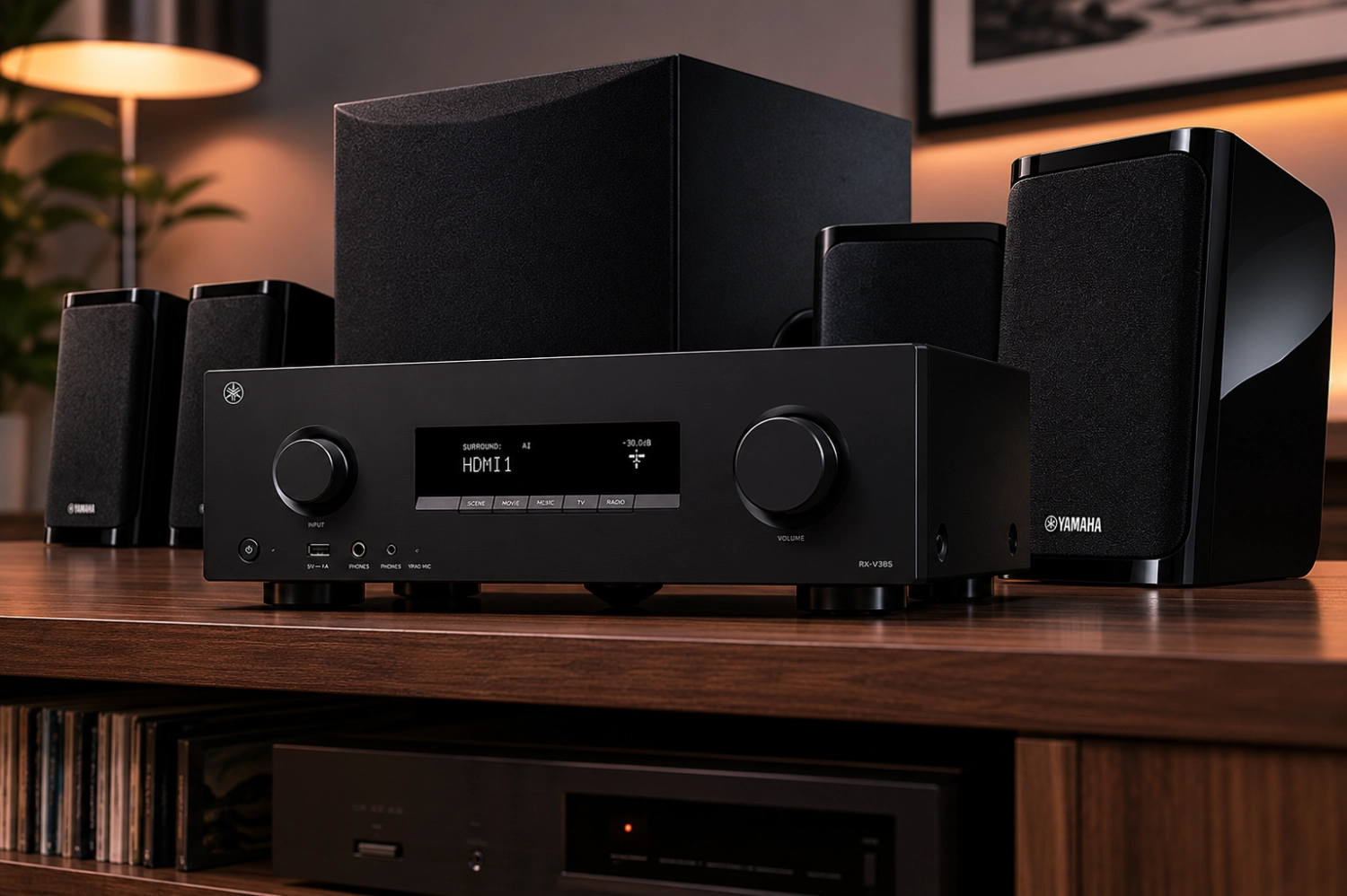
2. Yamaha YHT-4970U: Affordable 5.1 Home Theater System With 8K HDMI
Yamaha YHT-4970U 5.1 home theater system with compact satellite speakers, active subwoofer, and RX300A receiver.
The Yamaha YHT-4970U is aimed at buyers who want a complete 5.1-channel system without sourcing a receiver, speakers, subwoofer, cables, and setup accessories separately.
Its major update is the included RX300A AV receiver, which brings HDMI 2.1 ports, 8K/60Hz and 4K/120Hz video support, HDR10+, Dolby Vision, VRR, ALLM, Bluetooth 5.3 Multipoint, and Dolby Atmos decoding.
The speaker package remains a compact satellite-based setup with an active subwoofer using an 8-inch driver, so its appeal lies in simplicity and current connectivity rather than large-speaker scale.
Best for: First component-based surround systems
- Complete 5.1 package with receiver, speakers, subwoofer, cable, and accessories
- HDMI 2.1 support with 8K/60Hz and 4K/120Hz video compatibility
- HDR10+, Dolby Vision, VRR, and ALLM support
- Bluetooth 5.3 Multipoint
Verdict: A practical entry point for buyers who want a ready-made 5.1 system with modern HDMI features rather than a soundbar-style solution.

3. JBL Synthesis Unveils Massive Home Theater Lineup at ISE
JBL Synthesis home theater lineup including custom-install speakers and next-generation processing components.
JBL Synthesis is not a single-box recommendation here, but a broad ecosystem expansion for larger and more integrated theater projects.
The announcement covers custom-install loudspeakers, freestanding speakers, AV processors, an AV receiver, and a subwoofer, all intended to work within JBL Synthesis systems.
The in-wall and in-ceiling models are described as timbre-matched for front LCR, surround, and immersive-channel duties, which is especially relevant when a cinema room needs consistent voicing across hidden or architectural speaker positions. The SCL-2XL is positioned as the new flagship in-wall speaker for reference-level LCR applications in large and extra-large rooms.
Best for: Custom-install and dedicated theater builds
- Broad JBL Synthesis ecosystem expansion
- Includes custom-install loudspeakers plus processing and amplification components
- In-wall and in-ceiling models are described as timbre-matched
- SCL-2XL positioned for large-room LCR use
Verdict: A major system-building development for installers and enthusiasts planning a cohesive JBL Synthesis cinema rather than buying isolated components.

4. Arcam AVR31: Powerful 7.1-channel AV receiver
Arcam AVR31 7.1-channel AV receiver with Dirac calibration and Class G amplification.
The Arcam AVR31 sits at the powerful end of Arcam’s AV receiver range, with seven channels of amplification rated at 7 x 100 W into 8 ohms and Class G amplifier stages.
It supports Dolby Atmos in a 5.1.2 configuration from its internal amplification, and can operate in 7.1.4-channel mode when partnered with additional external power amplification.
DTS:X and IMAX Enhanced are also supported. Full 16-channel Dirac calibration, Apple AirPlay 2, Google Chromecast, a toroidal transformer, and front-panel headphone and auxiliary inputs give it a balance of cinema capability, room correction, and everyday usability.
Best for: Performance-focused systems that may grow beyond the receiver’s built-in channels
- 7 x 100 W amplification into 8 ohms
- Dolby Atmos, DTS:X, and IMAX Enhanced support
- Can support 7.1.4 operation with added external amplification
- Full 16-channel Dirac calibration
Verdict: A capable Arcam receiver for users who want strong onboard amplification now and a credible path toward a larger Atmos layout later.

5. Anthem MRX SLM is a compact and powerful five-channel AV receiver
Anthem MRX SLM slim five-channel AV receiver designed for compact and custom-install systems.
The Anthem MRX SLM is designed for spaces where a conventional full-size receiver is impractical.
Its slim chassis is only a fraction of the size of a traditional AV receiver, yet it includes five channels of amplification, HDMI 2.0b eARC with HDCP 2.3, Dolby Atmos and DTS:X support, and Anthem’s ARC Genesis room-correction platform.
Streaming options are unusually broad for such a compact unit, with Spotify Connect, AirPlay, Chromecast built-in, and Bluetooth, plus analogue jack and optical inputs. Its custom-install focus makes it particularly interesting for discreet installations and media spaces where equipment has to disappear.
Best for: Discreet installations and small entertainment systems
- Very compact slimline receiver design
- Five-channel amplification with HDMI eARC
- Dolby Atmos and DTS:X support
- ARC Genesis room correction plus multiple streaming options
Verdict: A space-saving Anthem receiver for installations that need proper AV processing and room correction without a full-size component footprint.

6. DALI Opticon 1 MK2 5.1: A compact and advanced 5.1 surround system
DALI Opticon 1 MK2 5.1 surround system with compact speakers, center channel, and SUB C-8 D subwoofer.
The DALI Opticon 1 MK2 5.1 is a compact speaker package built around four Opticon 1 MK2 speakers, an Opticon Vokal MK2 center, and the SUB C-8 D subwoofer.
Its strongest pitch is that it brings a focused 5.1 layout to rooms where full-size floorstanders may not be realistic.
The center speaker is presented as a key part of dialogue clarity, while the subwoofer uses an 8-inch driver and downward-facing bass reflex port for low-frequency support. DALI’s SMC technology and hybrid tweeter system are included to support detailed treble performance, and the system is described as compatible with standard amplifiers and receivers.
Best for: Compact 5.1 rooms that still need a dedicated speaker system
- Compact 5.1 speaker package
- Dedicated Opticon Vokal MK2 center speaker
- SUB C-8 D subwoofer with 8-inch driver
- Designed for use with standard amplifiers and receivers
Verdict: A space-conscious DALI surround package for listeners who want a conventional 5.1 layout without relying on large enclosures.

7. Optoma UHZ68LV: 4K ultra HD dual laser projector with Dolby Vision and HDR10+ support
Optoma UHZ68LV 4K ultra HD dual-laser projector with Dolby Vision, HDR10+, zoom, and lens-shift support.
The Optoma UHZ68LV is the visual outlier in this audio-heavy selection: a 4K ultra HD dual-laser projector for home cinema rooms that prioritize screen impact.
It combines 4K UHD resolution with a stated peak brightness of 5,000 lumens and 90% DCI-P3 color coverage, positioning it for demanding viewing environments, including brighter spaces.
Dolby Vision and HDR10+ support are central to its appeal, while 1.6x zoom, lens shift, and 360-degree projection options provide useful installation flexibility. Optoma’s PureEngine Ultra processor is specified for motion, detail, and color handling.
Best for: Large-screen home cinema with flexible projector placement
- 4K UHD dual-laser projection
- 5,000-lumen peak brightness
- Dolby Vision and HDR10+ support
- 1.6x zoom, lens shift, and 360-degree projection options
Verdict: A feature-rich Optoma projector for viewers who want 4K laser projection, broad HDR support, and installation flexibility in one display component.

8. Yamaha NS-P41 5.1: Home Theater Sound with Advanced YST II Subwoofer
Yamaha NS-P41 5.1 speaker system with compact satellites, center speaker, and Advanced YST II subwoofer.
The Yamaha NS-P41 is a traditional 5.1-channel speaker package for buyers who already have, or plan to add, a compatible AV receiver.
Its compact satellite and center speakers are paired with a powered subwoofer using Yamaha’s Advanced YST II technology, which is described as improving speaker cone control and low-frequency response through negative impedance, constant current principles, and Advanced Impedance Converter circuits.
Rear mounting holes allow wall placement, while the glossy black enclosures are intended to suit modern flat-screen TV setups. It is a straightforward way to move into discrete surround speakers without choosing each channel separately.
Best for: Simple 5.1 speaker upgrades around an existing receiver
- Traditional 5.1 speaker package
- Advanced YST II powered subwoofer
- Rear mounting holes for wall installation
- Glossy black enclosures for TV-based setups
Verdict: A compact Yamaha speaker package for users who want separate surround channels and a powered subwoofer without building a system piece by piece.

9. Denon AVR-S270BT: Affordable 5.1 AV Receiver Brings True Home Theater Sound for Just $399
Denon AVR-S270BT entry-level 5.1 AV receiver with HDMI connectivity and support for core surround formats.
The Denon AVR-S270BT is a deliberately simple 5.1 AV receiver for budget-conscious users starting a traditional surround system.
It does not offer Dolby Atmos, which the source explicitly notes, but it supports Dolby Digital, Dolby TrueHD, DTS-HD Master Audio, Dolby Pro Logic II, and DTS Neo:6 for 5.1 playback and upmixing.
Connectivity includes five HDMI inputs, with three supporting 4K UHD and two supporting up to 1080p, plus HDR and HLG video support. Its rated power is stated as up to 70 watts per channel into 8 ohms across its five channels under the specified conditions, making it a practical foundation for modest speaker systems.
Best for: Budget 5.1 systems without height-channel plans
- Accessible 5.1-channel AV receiver
- Dolby TrueHD and DTS-HD Master Audio support
- Five HDMI inputs
- HDR and HLG support
Verdict: A clear-cut Denon starter receiver for users who want conventional 5.1 surround and can live without Dolby Atmos.

10. Pioneer SC-LX704: Powerful AV receiver with Google Cast support
Pioneer SC-LX704 AV receiver with Direct Energy HD amplification and support for immersive surround formats.
The Pioneer SC-LX704 is a high-channel-count AV receiver aimed at immersive surround systems.
It supports Dolby Atmos, DTS:X, and IMAX Enhanced, and the source describes four ceiling channels as part of the route to a three-dimensional sound field.
Its sixth-generation Direct Energy HD amplifiers are specified at 9 x 135 W into 8-ohm speakers, with simultaneous multi-channel amplification also noted. The receiver includes Google Cast support, and its front-panel flap conceals useful connections including HDMI, USB, and headphone sockets. It is physically substantial, with a listed weight of 15.3 kg and a 44 cm case depth.
Best for: Immersive theater systems needing nine amplified channels
- 9-channel amplification specified at 9 x 135 W into 8 ohms
- Dolby Atmos, DTS:X, and IMAX Enhanced support
- Designed to support four ceiling channels
- Google Cast support
Verdict: A substantial Pioneer receiver for users building a speaker-rich cinema system with height-channel ambitions and built-in Google Cast support.
Quick comparison
These products do not compete in a single narrow lane.
The most useful comparison is by role: processor, receiver, complete system, speaker package, installation ecosystem, or projector.
That distinction matters because some choices require external amplification or speakers, while others are designed as ready-made starting points.
| Product | Best for | Verdict |
|---|---|---|
| McIntosh MX200 | High-end systems with separate power amplifiers | Choose it when processing flexibility, balanced outputs, Dirac Live, and 7.2.4-channel support are priorities. |
| Yamaha YHT-4970U | All-in-one 5.1 starter systems | A convenient receiver-and-speaker package with modern HDMI features and compact speakers. |
| JBL Synthesis home theater lineup | Custom-install and dedicated theater projects | A broad ecosystem expansion for rooms that need matched speakers, processing, amplification, and subwoofer options. |
| Arcam AVR31 | Expandable performance receivers | A powerful 7.1-channel receiver with Dirac calibration and a path to 7.1.4 using extra amplifiers. |
| Anthem MRX SLM | Slim custom installations | A compact five-channel receiver with ARC Genesis and strong streaming support for discreet systems. |
| DALI Opticon 1 MK2 5.1 | Compact 5.1 speaker systems | A dedicated 5.1 speaker package built around small Opticon speakers, a center channel, and an 8-inch subwoofer. |
| Optoma UHZ68LV | Large-screen projection setups | A 4K UHD dual-laser projector with strong HDR format support and flexible placement tools. |
| Yamaha NS-P41 5.1 | Receiver-based 5.1 speaker upgrades | A straightforward compact speaker package with a powered Advanced YST II subwoofer. |
| Denon AVR-S270BT | Budget 5.1 receiver builds | A simple AV receiver for conventional 5.1 surround, with no Dolby Atmos support. |
| Pioneer SC-LX704 | Nine-channel immersive systems | A substantial receiver for Dolby Atmos, DTS:X, and IMAX Enhanced systems with height-channel plans. |
Frequently asked questions
Should I buy an AV receiver, a processor, or a complete home theater system?
Choose an AV receiver if you need source switching, decoding, and amplification in one box.
Choose a processor such as the McIntosh MX200 only if you already plan to use separate power amplifiers.
Choose a complete package such as the Yamaha YHT-4970U if you want the receiver, speakers, subwoofer, and accessories supplied together.
Do I need Dolby Atmos for a home cinema system?
Not always.
A 5.1 receiver such as the Denon AVR-S270BT can still support traditional surround formats, but it does not provide Dolby Atmos.
If you plan to add height or ceiling channels, look at products that support Atmos and have the processing or amplification path to match, such as the McIntosh MX200, Arcam AVR31, or Pioneer SC-LX704.
How important are HDMI video features?
HDMI features matter most when your sources and display can use them.
The McIntosh MX200 supports 4K/120Hz, Dolby Vision, and HDR10+, while the Yamaha YHT-4970U adds support for 8K/60Hz, 4K/120Hz, VRR, and ALLM through its receiver.
Simpler systems may not need every video feature, but the receiver or processor should match the capabilities of the TV, projector, and game sources in the room.
Are room-correction systems worth considering?
Room correction can be valuable in multi-speaker systems because speaker placement and room acoustics strongly affect the final result.
Dirac Live is listed on the McIntosh MX200 and Arcam AVR31, while Anthem’s MRX SLM includes ARC Genesis.
These systems do not replace careful setup, but they give the installer or owner more tools for balancing the room.
How to choose the right missed gem for your room
Start with the role your system needs to fill.
If there is no existing equipment, a complete kit such as the Yamaha YHT-4970U is the simplest route into discrete 5.1 surround.
If a receiver is already in place, speaker packages such as the DALI Opticon 1 MK2 5.1 and Yamaha NS-P41 make more sense than buying another electronics hub. If the goal is a larger, more ambitious theater, the electronics decision becomes more important: the Denon AVR-S270BT is deliberately simple and 5.1-only, the Anthem MRX SLM prioritizes compact custom installation, the Arcam AVR31 offers stronger expansion potential, and the Pioneer SC-LX704 is aimed at nine-channel immersive layouts. For separate-amplifier systems, the McIntosh MX200 belongs in a different category. It is a processor, not an all-in-one receiver, so it suits rooms where balanced outputs, 11.2-channel processing, Dirac Live, and control-system integration are part of the plan. The JBL Synthesis announcement also points toward this kind of thinking: not a single component upgrade, but a coordinated ecosystem for dedicated theater spaces with matched architectural speakers and supporting electronics. Do not overlook the display side. The Optoma UHZ68LV is the only projector in this group, and its 4K UHD dual-laser design, 5,000-lumen peak brightness, Dolby Vision, HDR10+, zoom, lens shift, and 360-degree projection options make it relevant where a TV no longer provides the desired scale. In a balanced home cinema, screen size, speaker layout, room correction, HDMI compatibility, and installation practicalities all matter together. The strongest choice is the one that fits the room, the sources, and the upgrade path without paying for capabilities that will never be used.


Join the discussion
Share your thoughts, listening impressions or product experience.