

Choosing a portable music player starts with deciding how and where you listen.
Some readers need a compact player for a local music library, while others want streaming, Bluetooth, demanding-headphone support or extensive sound adjustment.
A dedicated player can also keep music separate from a phone, avoid library clutter and preserve the phone’s battery. This selection covers several distinct approaches. The Astell & Kern PD20 emphasizes hearing-based personalization, the HiBy RS2 focuses on a dedicated R2R playback architecture, and the Cayin N8iii offers switchable tube and solid-state amplification. TempoTec and iBasso provide more conventional feature-rich portable options. The source list also includes useful adjacent products: the Shanling EA5 is a desktop music center, the Shanling CD-S100 (23) is a full-size CD player, the HiBy WH2 is a pair of true wireless earphones, and the beginner’s guide is a planning resource rather than a device. Because these entries do not all serve the same purpose, the most useful comparison is not a simple ranking. Consider whether you need a genuinely pocketable player, a home source, wireless earphones or guidance before buying, then examine storage, streaming support, outputs and sound-control options.

1. Shanling EA5: Multifunctional music center
The Shanling EA5 combines network and local-file playback with headphone, speaker and system-level connectivity.
The Shanling EA5 is better understood as a compact desktop hub than as a portable player.
Its closed custom Android system can access streaming services and local music stored on microSD, a connected hard drive or a network.
Phone-app control makes it suitable for a system that is operated from across a desk or room. Its integrated amplification is unusually broad for this selection: a headphone output delivers up to 570 mW at 32 ohms, while an Abletec Class D speaker amplifier is rated at 50 W per channel into 4 ohms. The EA5 can also function as a standalone DAC, preamplifier, integrated amplifier or Bluetooth receiver and source. Choose it when one device needs to coordinate headphones, passive speakers and multiple digital sources at a fixed listening position.
Best for: A desktop system shared by headphones and passive speakers
- Plays from streaming services, microSD, hard drives and a local network
- Includes headphone and passive-speaker amplification
- Can operate as a DAC, preamplifier or integrated amplifier
- Supports Bluetooth reception and transmission
Verdict: The EA5 is the most suitable choice here for a flexible desktop music system, but it is not a pocketable portable player.
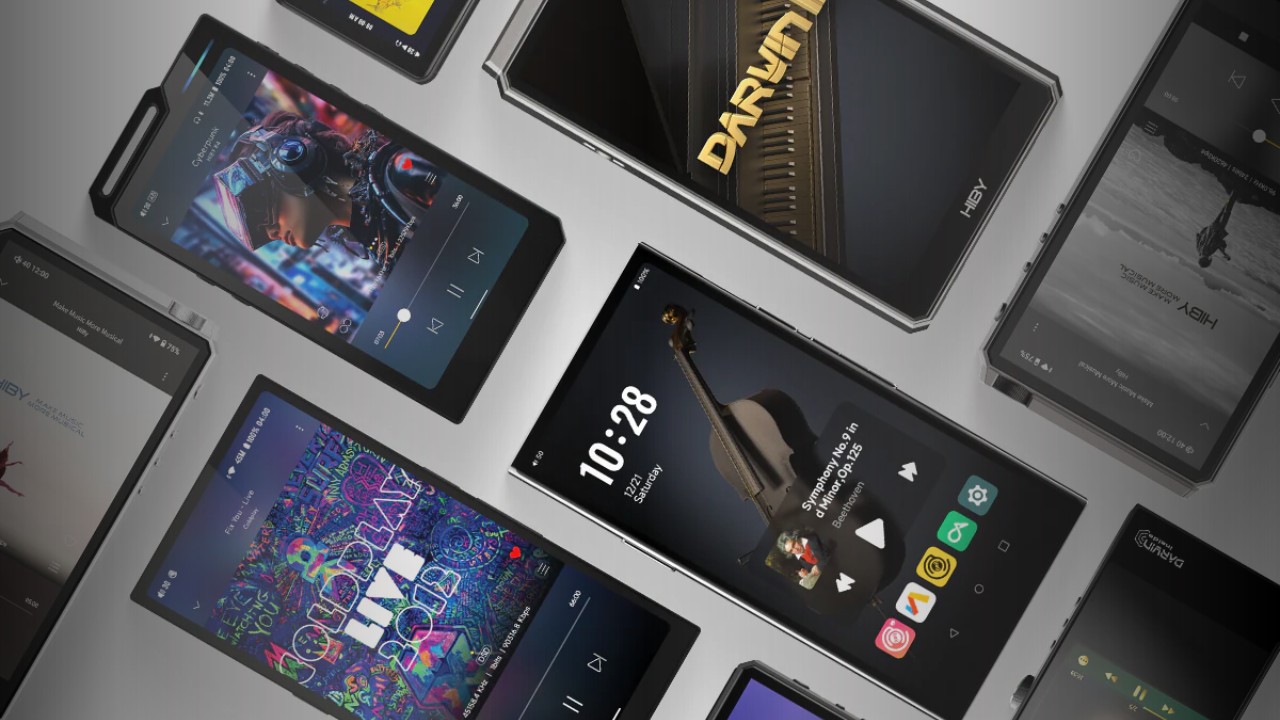
2. Choosing your first Hi-fi player: 10 useful tips for beginners
The beginner’s guide breaks the first hi-fi player decision into practical questions rather than promoting a single device.
This is a buying resource rather than a specific music player.
It is aimed at newcomers facing unfamiliar terminology, brands, specifications and price levels, and begins with the fundamental question of why a separate player is needed at all.
The reasons outlined include preserving a phone’s battery, keeping a music library from cluttering a smartphone and using a compact dedicated device for activities such as sports. Read it before comparing hardware if you have not yet established what a separate player should add to your current listening routine.
Best for: First-time buyers defining their requirements
- Explains player-buying concepts for beginners
- Starts with the case for owning a separate device
- Addresses phone battery life and music-library management
Verdict: A sensible starting point for newcomers who need to establish priorities before choosing a player.

3. Astell & Kern PD20: World’s First Personalized Sound DAP with Quad DAC & Audiodo Tech
The Astell & Kern PD20 uses an included-earpiece hearing test to build separate compensation for each ear.
The Astell & Kern PD20 stands apart through its Personal Sound system, developed with Audiodo.
Using the included in-ear eartips, the system runs a hearing test, analyzes the listener’s hearing characteristics and creates compensation profiles independently for the left and right ears.
Further adjustment comes from the Sound Master Wheel, which provides 160-step control across bass, midrange and treble from minus 8.0 dB to plus 8.0 dB without interrupting playback. The hardware described includes an aluminum enclosure, a 6-inch FHD+ screen and an ESS ES9027PRO Quad DAC configuration. It is the clearest fit in this group for listeners who want the player to account for their personal hearing profile rather than relying only on conventional EQ.
Best for: Listeners seeking hearing-based sound personalization
- Creates a profile based on the user’s hearing characteristics
- Compensates the left and right ears independently
- Offers fine bass, midrange and treble adjustment
- Uses an ESS ES9027PRO Quad DAC configuration
Verdict: The PD20 is the specialist option for individualized hearing compensation and unusually precise tonal adjustment.

4. Hiby WH2: TWS headphones with LDAC support and Bluetooth 5.22
HiBy’s WH2 true wireless earphones are offered in dynamic-driver and dual-balanced-armature configurations.
The HiBy WH2 is not a standalone music player but a pair of true wireless earphones that can complement one.
Two versions are described: one with a single dynamic driver and another with two balanced-armature drivers.
Codec support includes LDAC, UAT TWS, AAC and SBC, while the HiBy Blue app provides management and an adjustable digital crossover. Either earpiece can be used separately, and IPX4 splash protection suits everyday mobile use. Claimed battery life reaches six hours for the earphones and 30 hours when the charging case is included. Consider the WH2 if wireless listening is the actual requirement; buyers seeking local storage or independent playback need a player instead.
Best for: Wireless listening from a compatible phone or music player
- Supports LDAC, UAT TWS, AAC and SBC
- Available with a dynamic driver or dual balanced-armature drivers
- Includes app management and an adjustable digital crossover
- Rated IPX4 for splash protection
Verdict: The WH2 is a flexible wireless-earphone option, not a replacement for a standalone digital audio player.

5. Shanling CD-S100 (23): High-performance and versatile CD player
The Shanling CD-S100 (23) combines dedicated CD hardware with USB, Bluetooth and digital-output facilities.
The Shanling CD-S100 (23) is a full-size source for listeners whose collection includes compact discs and stored digital music.
CD playback uses a Philips CD80 servo system and Sanyo HD850 pickup, while conversion is handled by an AKM AK4493 chip.
It also receives Bluetooth 5.0 audio with LDAC compatibility, reads files from USB storage and accepts computer audio through USB-B at up to PCM 32-bit/768 kHz and DSD512. Stereo RCA, optical and coaxial outputs allow connection to different systems, and the circular front display can show playback information and album artwork. Traditional remote control is supplemented by the Edict Player mobile app. It belongs in a home system rather than a portable setup.
Best for: A home system combining CD and digital playback
- Plays CDs and files from USB storage
- Accepts USB audio up to PCM 32-bit/768 kHz and DSD512
- Receives Bluetooth audio with LDAC compatibility
- Provides analog, optical and coaxial outputs
Verdict: The CD-S100 (23) is the relevant choice for disc collectors who also need modern digital inputs, but it is not portable.

6. HiBy RS2: Digital player with Darwin architecture
The compact HiBy RS2 provides single-ended and balanced outputs alongside its Darwin R2R processing architecture.
The HiBy RS2 is a compact portable player built around the company’s Darwin R2R architecture and the PureAudio version of HiByOS.
Its design is explicitly focused on optimized music playback and system-level audio processing rather than a broadly described general-purpose platform.
The Darwin implementation adds R2R array linearity compensation, an adjustable 256-tap FIR filter, harmonic control and a choice of non-oversampling or oversampling operation, with support for up to 16-times oversampling. A 3.5 mm single-ended output and 4.4 mm balanced output provide connections for a range of in-ear monitors and headphones. It is the focused option for listeners particularly interested in R2R conversion and configurable digital processing.
Best for: Portable R2R playback with configurable processing
- Uses HiBy’s Darwin R2R architecture
- Runs the music-focused PureAudio version of HiByOS
- Offers adjustable FIR filtering and harmonic control
- Includes 3.5 mm and 4.4 mm headphone outputs
Verdict: The RS2 prioritizes a dedicated R2R playback architecture and detailed audio controls in a compact player.
7. This Isn’t Just Another DAP – Cayin N8iii Feels Like Real Hi-Fi in Your Pocket
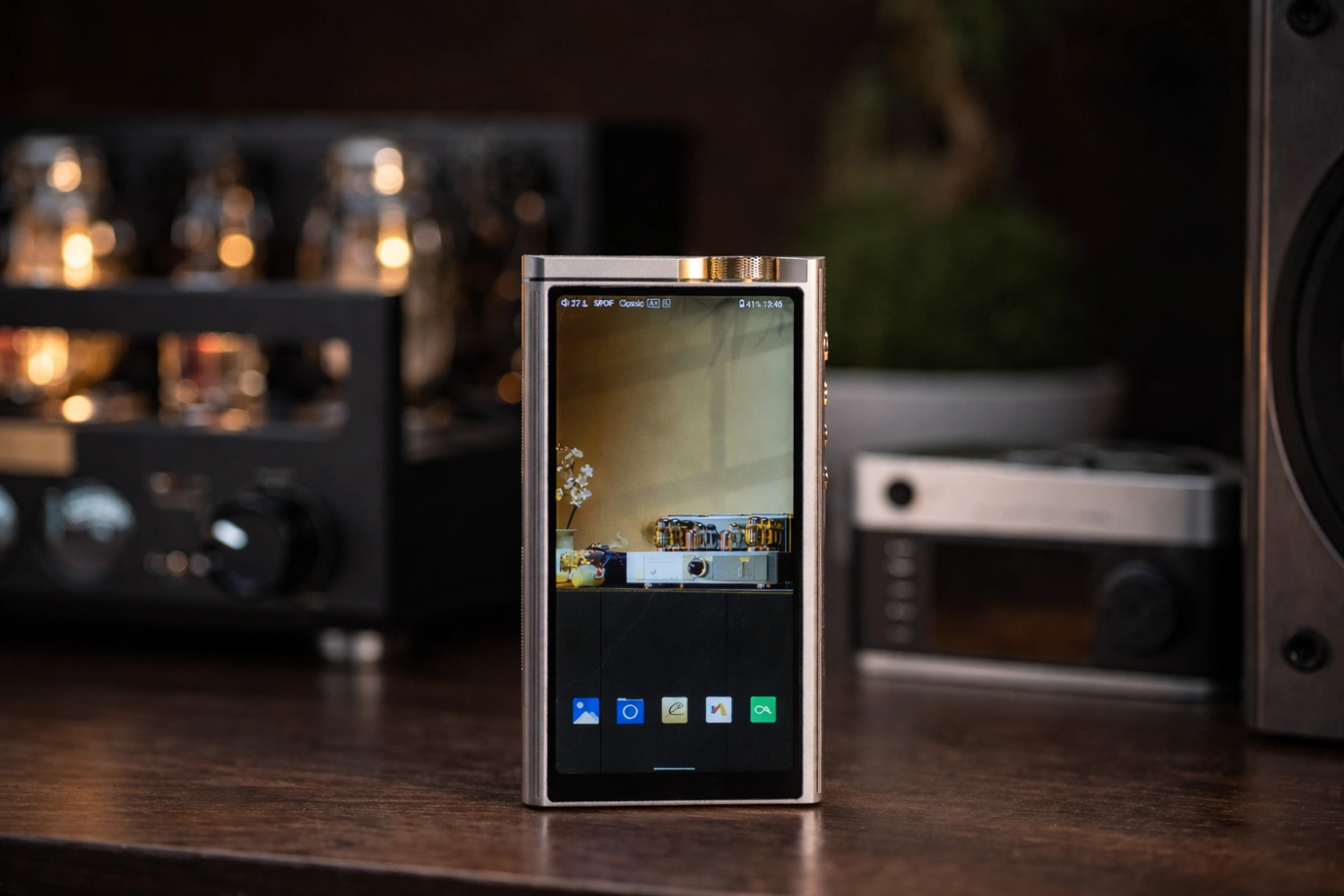
Cayin’s N8iii places selectable Tube Classic, Tube Modern and Solid State amplification paths in one portable player.
The Cayin N8iii combines a modern Android player platform with three selectable amplification characters.
Its Triple Timbre system offers Tube Classic, described as warmer and fuller; Tube Modern, intended to add speed and control while retaining some tube smoothness; and Solid State, focused on precision, punch and clarity.
The platform uses a Snapdragon 665 processor with 8 GB of RAM and 256 GB of storage, and it supports streaming services including TIDAL and Qobuz as well as local libraries. This makes the N8iii the most directly differentiated choice for listeners who want to change amplification character without moving to a separate player or amplifier.
Best for: Listeners who want switchable tube and solid-state character
- Switches between two tube modes and solid-state amplification
- Supports TIDAL, Qobuz and local music libraries
- Includes 256 GB of internal storage
- Uses an Android-based operating system
Verdict: The N8iii offers the broadest choice of amplification voicing in this selection while retaining streaming and local playback.

8. TempoTec Variations V1: Hi-Res Music Player, DAC & LDAC Bluetooth Adapter
The TempoTec Variations V1 combines microSD playback, streaming, external-DAC operation and bidirectional Bluetooth.
The TempoTec Variations V1 is a compact multi-role player that can serve as a standalone source, an external DAC or a Bluetooth adapter.
It reads music from microSD cards up to 2 TB and supports PCM up to 32-bit/384 kHz and DSD256 through a dual CS43131 DAC implementation.
Bluetooth operation is bidirectional: it can receive LDAC audio from a phone or transmit music to true wireless earphones. Streaming support covers TIDAL, Qobuz, AirPlay and DLNA, while a 10-band parametric equalizer provides frequency adjustment and presets for different genres and headphones. A 4.4 mm balanced output is listed, so prospective owners should check that this connection suits their existing earphones or headphones.
Best for: Versatile local, streaming, DAC and Bluetooth use
- Works as a standalone player, external DAC and Bluetooth adapter
- Supports microSD cards up to 2 TB
- Can receive LDAC or transmit to true wireless earphones
- Provides streaming and a 10-band parametric equalizer
Verdict: The Variations V1 is the utility-focused choice for buyers who want several digital-source roles in one compact device.

9. iBasso DX320: Player on two ROHM BD34301EKV chips
The iBasso DX320 uses dual ROHM DAC chips and a high-output balanced stage intended for a wide range of headphones.
The iBasso DX320 is a high-end portable player based on two ROHM BD34301EKV DAC chips.
The supplied measurements state a 125 dB signal-to-noise ratio, 125 dBV dynamic range and minus 112 dB THD+N.
Its balanced output reaches a stated maximum of 7.1 Vrms, with output power of 1,200 mW into 32 ohms. Those figures distinguish it as the option in this selection for buyers who need substantial balanced output for many full-size headphones rather than only sensitive in-ear monitors. As always, power requirements and connection type should be matched to the intended headphones before purchase.
Best for: Driving many full-size headphones from a portable player
- Uses two ROHM BD34301EKV DAC chips
- Provides up to 7.1 Vrms from the balanced output
- Rated at 1,200 mW into 32 ohms
- Specified with 125 dB signal-to-noise ratio
Verdict: The DX320 is the output-focused option for listeners pairing a portable source with more demanding headphones.

10. iBasso DX170: Player with the latest generation Dual DAC chipset
The iBasso DX170 pairs a 5-inch touchscreen with dual CS43131 conversion and FPGA-managed audio architecture.
The iBasso DX170 is a full Android portable player using two Cirrus Logic CS43131 DAC chips.
Its custom FPGA Master audio architecture receives the signal from the system-on-chip and passes it to the DAC stage, with two independent NDK femtosecond crystal oscillators supporting system timing.
Format support includes PCM up to 32-bit/384 kHz, native DSD256 and full 8-times MQA decoding. A 5-inch color display and quad-core Rockchip processor support the interface and multitasking. It is the straightforward choice for buyers seeking an Android-based player with broad high-resolution format compatibility and a conventional touchscreen form.
Best for: General-purpose Android playback of high-resolution files
- Uses dual Cirrus Logic CS43131 DAC chips
- Supports PCM 32-bit/384 kHz and native DSD256
- Provides full 8-times MQA decoding
- Combines a 5-inch display with Android operation
Verdict: The DX170 presents a balanced mix of Android usability, touchscreen operation and broad file-format support.
Quick comparison
These entries divide into four practical groups: portable digital audio players, fixed home sources, wireless earphones and buying guidance.
Compare products within the same group first, then use the distinctions below to identify the design that matches your library, headphones and preferred listening method.
| Product | Best for | Verdict |
|---|---|---|
| Shanling EA5: Multifunctional music center | Desktop playback through headphones or passive speakers | A highly connected fixed music center rather than a portable player. |
| Choosing your first Hi-fi player: 10 useful tips for beginners | Clarifying the reasons for buying a dedicated player | A beginner-oriented planning guide, not a hardware recommendation. |
| Astell & Kern PD20: World’s First Personalized Sound DAP with Quad DAC & Audiodo Tech | Personalized compensation based on a hearing test | The distinctive choice for separate left- and right-ear sound profiling. |
| Hiby WH2: TWS headphones with LDAC support and Bluetooth 5.22 | Wireless earphones with multiple codec options | A portable listening accessory that still requires a source device. |
| Shanling CD-S100 (23): High-performance and versatile CD player | Playing CDs and digital sources in a home system | A versatile full-size disc and digital player without portable operation. |
| HiBy RS2: Digital player with Darwin architecture | Compact R2R playback and adjustable audio processing | A focused portable player built around Darwin architecture and PureAudio HiByOS. |
| This Isn’t Just Another DAP – Cayin N8iii Feels Like Real Hi-Fi in Your Pocket | Switching between tube and solid-state amplification | A streaming-capable Android player with three distinct amplification modes. |
| TempoTec Variations V1: Hi-Res Music Player, DAC & LDAC Bluetooth Adapter | Combining local playback, streaming, DAC and Bluetooth duties | A compact multi-role source with extensive connectivity and EQ options. |
| iBasso DX320: Player on two ROHM BD34301EKV chips | Higher-output use with many full-size headphones | A dual-ROHM portable player distinguished by its stated balanced-output capability. |
| iBasso DX170: Player with the latest generation Dual DAC chipset | Touchscreen Android playback with broad format support | A conventional dual-DAC player for local high-resolution music and Android use. |
Frequently asked questions
Why choose a dedicated music player instead of a smartphone?
A separate player can preserve your phone’s battery, keep a large music library from cluttering the phone and provide dedicated audio connections or processing.
Buy one only if those benefits address a real limitation in your current setup.
Should streaming support or microSD storage be the priority?
Prioritize streaming if most of your listening is through online services; choose generous microSD support if you own or maintain a local file library.
The TempoTec Variations V1 supports both streaming and microSD cards up to 2 TB, while other designs may place more emphasis on dedicated local playback.
Do I need a 4.4 mm balanced headphone output?
Only if your headphones or earphones use a compatible balanced cable and the player’s output suits their requirements.
The HiBy RS2 offers both 3.5 mm single-ended and 4.4 mm balanced connections, while the TempoTec Variations V1 source material specifically lists a 4.4 mm balanced output.
Which features matter most when comparing portable players?
Start with headphone compatibility, output connections, local-storage capacity, streaming requirements and interface type.
Then consider specialist features such as the PD20’s hearing profile, the RS2’s R2R architecture, the N8iii’s selectable amplification paths or the DX320’s higher stated balanced output.
How to make the final choice
Begin by removing anything that does not match the intended setting.
The Shanling EA5 and CD-S100 (23) are fixed home components, while the HiBy WH2 is a pair of wireless earphones and the beginner’s article is a research guide.
That leaves the PD20, RS2, N8iii, Variations V1, DX320 and DX170 as the directly relevant portable-player choices. Next, match the player to one defining requirement. Choose the PD20 if hearing-based personalization is central to the purchase. Consider the RS2 for its dedicated R2R architecture and configurable processing, or the N8iii when switching among tube and solid-state amplification paths is the priority. The Variations V1 is the broad utility option for microSD playback, streaming, DAC use and bidirectional Bluetooth. The DX320 stands out for its stated balanced-output capability, while the DX170 offers a more conventional Android touchscreen platform with broad high-resolution format support. Finally, verify practical compatibility before deciding. Check the connection used by your headphones, the output required to drive them, support for your preferred streaming service, storage capacity for your library and whether the operating system suits the way you browse music. A specialized feature is worthwhile only when it solves a specific need; otherwise, the player with the simplest suitable combination of storage, connectivity and controls is usually the more coherent purchase.


Join the discussion
Share your thoughts, listening impressions or product experience.