

A good DAC is not just a format checklist.
The right choice depends on where it will live, what it will connect to, and whether you need headphone drive, balanced outputs, wireless input, studio-style control, or a purist conversion architecture.
The products below cover very different roles. Some are compact USB DAC and headphone amplifiers for phones, laptops, and travel. Others are desktop components with multiple digital inputs and fixed analog outputs for a hi-fi system. Several take the R2R route, using resistor-ladder conversion and, in some cases, NOS operation for listeners building a more specialized digital front end. This guide is based only on the supplied product information, so it does not rank by listening impressions or value claims. Instead, each recommendation highlights the practical strengths that are directly supported: conversion platform, input and output flexibility, headphone capability, format support, power-supply design, and control features.

1. DUNU launches DTC-800 portable DAC and headphone amplifier
DUNU DTC-800 portable USB DAC and headphone amplifier with 3.5 mm and 4.4 mm outputs.
The DUNU DTC-800 is a compact portable USB DAC and headphone amplifier built for listeners who want more than a basic dongle.
Its dual Cirrus Logic CS43198 DAC chips are assigned per channel, while the amplifier section uses two independent SGM8262 operational amplifiers.
Format support reaches PCM up to 32-bit/384 kHz and native DSD256, giving it a strong high-resolution specification for a pocketable unit. Its practical appeal comes from the combination of balanced and unbalanced headphone outputs in a very small chassis. The DTC-800 provides 3.5 mm unbalanced and 4.4 mm balanced outputs, physical volume buttons, and a multi-color LED indicator for bit-rate status. The CNC-machined aluminum alloy body weighs 20 grams, so this is one of the most travel-friendly options in the group.
Best for: Portable hi-res listening from a phone, tablet, or laptop
- Dual Cirrus Logic CS43198 DAC chips
- 3.5 mm and 4.4 mm headphone outputs
- PCM up to 32-bit/384 kHz and native DSD256
- 20-gram CNC-machined aluminum alloy body
Verdict: A compact DAC and headphone amp with balanced output and serious format support for mobile use.

2. TEAC UD-301-X: Dual-Mono USB DAC with Burr-Brown Chip and Headphone Amp
TEAC UD-301-X desktop USB DAC with balanced XLR and RCA analog outputs.
The TEAC UD-301-X is a desktop USB DAC for users who want balanced analog output and a traditional hi-fi component layout without moving into TEAC’s larger model.
Its dual-mono design uses one Burr-Brown PCM1795 DAC per channel, Muses operational amplifiers in the analog circuit, and a toroidal transformer power supply.
Connectivity is broad for a compact desktop DAC. USB handles DSD 2.8/5.6 MHz and PCM up to 24-bit/192 kHz, while optical and coaxial inputs also support up to 24-bit/192 kHz. Analog output is available over RCA and XLR, and the unit can upsample incoming signals to 192 kHz, with the option to disable that processing.
Best for: Desktop hi-fi systems needing USB input and balanced analog output
- Dual-mono circuit with one Burr-Brown PCM1795 DAC per channel
- USB, optical, and coaxial digital inputs
- RCA and XLR analog outputs
- Switchable upsampling to 192 kHz
Verdict: A compact balanced desktop DAC with a dual-mono signal path and useful digital input flexibility.

3. Questyle Sigma Pro: Portable Power Without Compromise
Questyle Sigma Pro transportable DAC and headphone amplifier with dual-mono ESS conversion.
The Questyle Sigma Pro is described as a transportable DAC and headphone amplifier rather than a tiny USB dongle.
Its dual-mono DAC layout uses two ESS ES9069 chips, paired with Questyle’s analog circuitry and four fully discrete Current Mode amplifier stages.
The design is intended to provide stable control across different headphone loads, from sensitive IEMs to more demanding full-size headphones. Its flexibility is a major part of the proposition. Multiple hardware gain levels allow analog adjustment without relying on software attenuation, while the XMOS XU316 digital engine supports high-resolution PCM, DSD, and full MQA decoding, including MQA-CD. The Sigma Pro also includes a dedicated Studio Monitoring mode, making it one of the more professionally oriented portable choices here.
Best for: Transportable headphone listening and monitoring setups
- Dual-mono design with two ESS ES9069 DAC chips
- Four fully discrete Current Mode amplifier stages
- Multiple hardware gain levels
- High-resolution PCM, DSD, and full MQA decoding
Verdict: A larger portable DAC and headphone amp aimed at users who need gain control, format support, and stronger headphone flexibility than a small dongle can provide.

4. Marantz HD-DAC1: Modern DAC in a classic suit
Marantz HD-DAC1 DAC and headphone amplifier with round display and wood side panels.
The Marantz HD-DAC1 combines a DAC and headphone amplifier in a component with classic Marantz styling.
It uses Advanced AL32 signal processing and supports 32-bit/192 kHz digital-to-analog conversion technology associated in the source material with Marantz’s higher-end CD/SACD players.
Build and ergonomics are central to its identity. The metal case has a thick aluminum front panel, natural-wood side panels, anti-resonance supports, a round display, and separate rotary controls for source selection and volume. For listeners who want a DAC that feels like a traditional hi-fi component rather than a small interface box, the HD-DAC1 stands out.
Best for: Classic hi-fi desks and headphone stations
- Advanced AL32 signal processing
- 32-bit/192 kHz digital-to-analog conversion
- Built-in headphone amplifier
- Metal case with aluminum front panel and wood side panels
Verdict: A stylish DAC and headphone amplifier that pairs Marantz-style industrial design with 32-bit/192 kHz conversion.
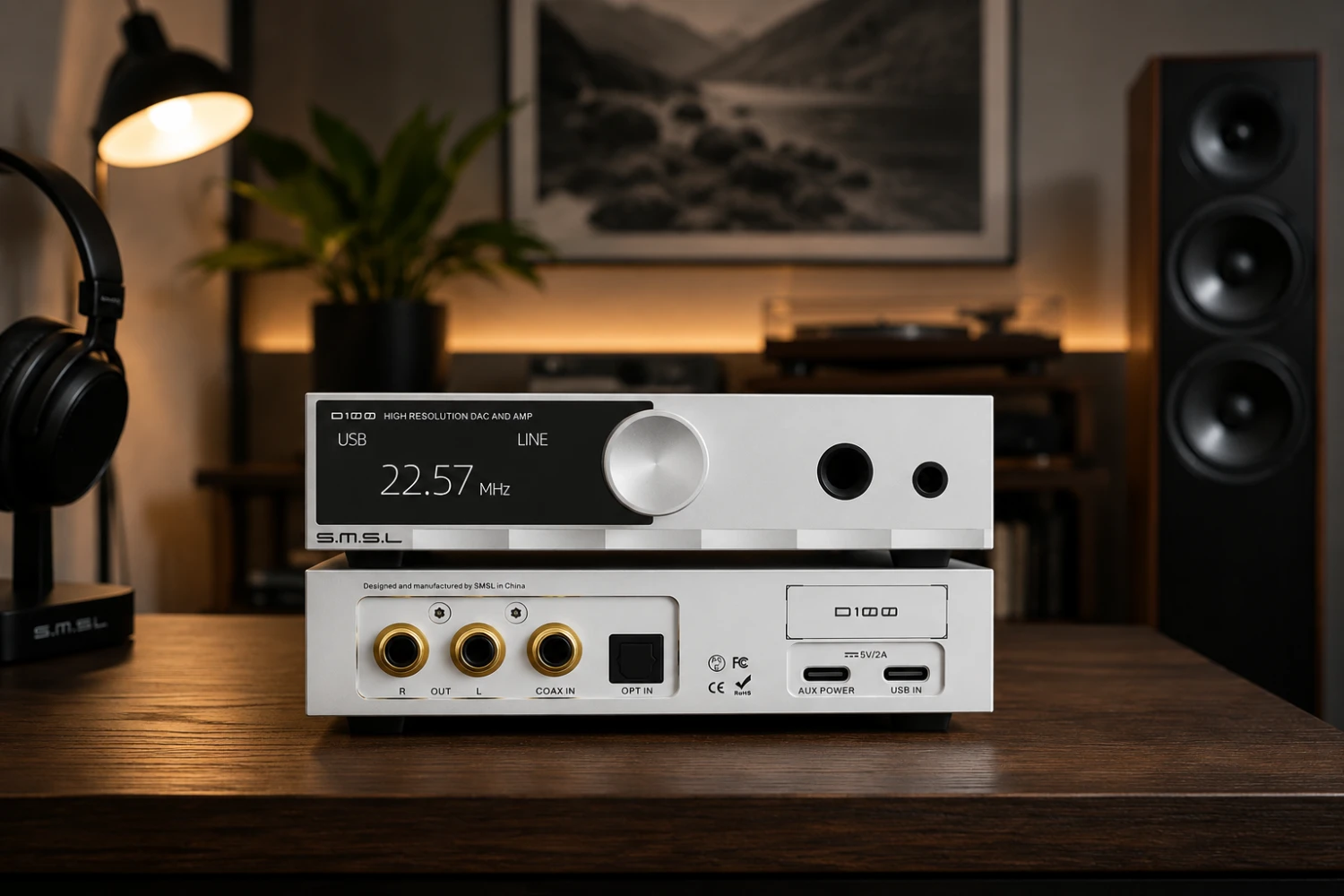
5. SMSL D100 Desktop DAC Adds Balanced Headphone Drive in a Compact Chassis
SMSL D100 compact desktop DAC and headphone amplifier with display and front headphone outputs.
The SMSL D100 is a compact desktop DAC and headphone amplifier designed as a digital hub for computer audio, digital transports, and headphone listening.
Its ESS ES9081 DAC is configured with eight-channel parallel summing, and USB input is handled by an XMOS XU-316 interface.
The stated playback support includes PCM up to 32-bit/768 kHz, DSD up to DSD512, and MQA. The D100 is also more system-oriented than a USB dongle. It provides USB, optical, and coaxial digital inputs, RCA line output, and two front-panel headphone connections. Optical and coaxial inputs support PCM up to 24-bit/192 kHz, along with DoP64 and MQA support, while the analog section uses multiple low-noise voltage regulators.
Best for: Compact desktop systems with both speakers and headphones
- ESS ES9081 DAC with eight-channel parallel summing
- XMOS XU-316 USB interface
- PCM up to 32-bit/768 kHz and DSD up to DSD512 over supported paths
- USB, optical, and coaxial digital inputs
Verdict: A small desktop DAC that combines broad digital compatibility, RCA line output, and front-panel headphone connectivity.

6. SMSL RAW-MDA1: High-quality DAC and headphone amplifier
SMSL RAW-MDA1 DAC and headphone amplifier with color display, Bluetooth, RCA, XLR, and headphone outputs.
The SMSL RAW-MDA1 is a feature-rich DAC and headphone amplifier built around two ESS ES9039Q2M DAC chips.
It supports MQA and MQA-CD, uses an XMOS XU-316 USB interface, and includes USB, optical, coaxial, and Bluetooth inputs.
Analog output options include RCA, XLR, and headphones, making it suitable for both desktop headphone use and connection to a larger system. Wireless support is unusually broad for this group. The Qualcomm Bluetooth 5.1 section supports LDAC, aptX HD, SBC, and AAC. USB 2.0 operation supports PCM up to 32-bit/768 kHz and DSD512 with driver installation, while USB 1.1 supports PCM up to 16-bit/96 kHz without drivers. Its independent headphone amplifier is specified at up to 2.5 W x 2 into 16 ohms.
Best for: Users who want wired digital inputs plus Bluetooth in one desktop DAC
- Two ESS ES9039Q2M DAC chips
- MQA and MQA-CD support
- Bluetooth 5.1 with LDAC and aptX HD
- RCA, XLR, and headphone outputs
Verdict: A versatile desktop DAC and headphone amplifier with balanced outputs, high-resolution USB support, and useful wireless codec coverage.

7. TOPPING Centaurus: New R2R DAC developed in collaboration with HOLO Audio
TOPPING Centaurus R2R DAC with Aurora UI color display and touch controls.
The TOPPING Centaurus is an R2R DAC developed with HOLO Audio and built around a fully balanced 8-channel configuration.
Its architecture uses eight resistor networks, with separate handling for DSD and PCM: Vector Step Resistance Network technology is used for DSD decoding, while a traditional R2R scheme is used for PCM.
A CPLD chip manages decoding. Centaurus is also notable for its control features. It offers NOS, OS, and Best processing modes, with Best automatically selecting the suitable mode. The Aurora UI uses a 2-inch color display with touch controls, and the DAC includes a 10-band parametric equalizer for PCM signals up to 32-bit/192 kHz. For an R2R DAC, that level of on-device adjustment is a clear differentiator.
Best for: Listeners wanting an R2R DAC with modern controls and EQ
- R2R architecture developed with HOLO Audio
- Fully balanced 8-channel configuration
- Separate DSD and PCM processing approaches
- NOS, OS, and automatic Best modes
Verdict: A feature-heavy R2R DAC that combines resistor-ladder conversion with touch control, selectable processing modes, and parametric EQ.

8. Denafrips Terminator II 12Th: High-performance, balanced R2R NOS DAC
Denafrips Terminator II 12Th balanced R2R NOS DAC with extensive digital inputs and RCA/XLR outputs.
The Denafrips Terminator II 12Th is a balanced R2R NOS DAC aimed at integration into serious digital systems.
It offers extensive digital input options, including USB-B, I2S over RJ45 in LVCMOS and LVDS forms, I2S HDMI LVDS, AES/EBU, optical, and coaxial.
Analog output is available over stereo RCA and stereo XLR. Its internal design emphasizes power supply, timing, and signal routing. The linear power stage sits below the DAC board and is separated by a steel partition to reduce interference. Two O-Core toroidal transformers supply the digital and analog sections, I2S and SPDIF signals are processed by an FPGA without additional conversion chips, and two OCXO clocks operate at 45.1584 MHz and 49.152 MHz.
Best for: High-end systems needing extensive digital connectivity and clocking options
- Balanced R2R NOS DAC architecture
- USB-B, multiple I2S, AES/EBU, optical, and coaxial inputs
- RCA and XLR analog outputs
- Two OCXO clocks and separate linear power stage
Verdict: A serious balanced R2R NOS DAC with unusually broad input support and carefully separated power and clocking sections.

9. Denafrips Terminator PLUS 12Th: High-performance, balanced R2R NOS DAC
Denafrips Terminator PLUS 12Th balanced R2R NOS DAC with clock outputs and wide digital connectivity.
The Denafrips Terminator PLUS 12Th builds on the Terminator concept with a balanced R2R NOS design, extensive connectivity, and attention to component selection.
The source material highlights design improvements including a redesigned OCXO clock power circuit and hand-selected elements from the OCXO clock to the R2R ladder networks.
Connectivity mirrors the serious system focus. Inputs include USB-B, I2S RJ45 LVCMOS, I2S RJ45 LVDS, I2S HDMI LVDS, AES/EBU, optical, and Toslink coaxial, with stereo RCA and stereo XLR outputs. Two clock outputs allow synchronization with other audio devices, while the internal linear power stage is separated from the DAC board by a steel partition to reduce interference.
Best for: Reference-style R2R systems needing premium clocking and connectivity
- Balanced R2R NOS DAC design
- Hand-selected OCXO clock and R2R ladder network elements
- Extensive USB, I2S, AES/EBU, optical, and coaxial input options
- Two clock outputs for system synchronization
Verdict: A more intensively specified Terminator-family R2R NOS DAC for systems where clocking, component selection, and digital input flexibility matter.

10. Vincent DAC-1MK: Upgraded DAC with improved sound quality and functionality
Vincent DAC-1MK desktop DAC with USB, optical, and coaxial digital input support.
The Vincent DAC-1MK is an upgraded version of Vincent’s junior DAC, adding DSD signal reception via USB and support for files up to 32-bit/384 kHz through that input.
Optical and coaxial inputs handle digital signals up to 24-bit/192 kHz, which suits conventional digital transports as well as computer-based playback.
Conversion is handled by an ES9038 chip, followed by balanced signal processing. The design uses components from WIMA and Nichicon, and its power supply uses a transformer with dual windings so the analog and digital sections receive separate feeds. The source material presents this approach as a way to reduce parasitic interference and preserve signal dynamics.
Best for: Traditional hi-fi systems needing a straightforward upgraded DAC
- USB supports DSD and up to 32-bit/384 kHz PCM
- Optical and coaxial inputs support up to 24-bit/192 kHz
- ES9038 digital-to-analog converter chip
- Dual-winding transformer for separate analog and digital supply feeds
Verdict: A desktop DAC with modern USB support, ES9038 conversion, and separate power-supply feeds for analog and digital sections.
Quick comparison
The strongest distinctions here are not about a single universal winner.
They are about form factor, conversion architecture, input and output needs, and whether the DAC also needs to drive headphones.
| Product | Best for | Verdict |
|---|---|---|
| DUNU DTC-800 | Portable hi-res listening | Small, light, and built around balanced and unbalanced headphone outputs with PCM 32-bit/384 kHz and native DSD256 support. |
| TEAC UD-301-X | Compact balanced desktop DAC use | Dual-mono Burr-Brown conversion with USB, optical, coaxial, RCA, and XLR connectivity. |
| Questyle Sigma Pro | Transportable headphone and monitoring setups | Larger than a dongle, with dual ESS conversion, Current Mode amplification, hardware gain, and full MQA decoding. |
| Marantz HD-DAC1 | Classic hi-fi headphone stations | A DAC and headphone amplifier with Advanced AL32 processing and a traditional Marantz-style chassis. |
| SMSL D100 | Compact computer-audio desktops | ESS-based desktop DAC with XMOS USB, RCA line output, front headphone outputs, and broad high-resolution format support. |
| SMSL RAW-MDA1 | Desktop systems needing wired and wireless inputs | Dual ESS DAC design with USB, optical, coaxial, Bluetooth, RCA, XLR, headphone output, MQA, and MQA-CD support. |
| TOPPING Centaurus | R2R users who want modern control features | Balanced R2R DAC with separate DSD and PCM processing, NOS/OS modes, touch display, and parametric EQ. |
| Denafrips Terminator II 12Th | High-end R2R NOS system integration | Balanced R2R NOS DAC with many digital inputs, RCA/XLR outputs, OCXO clocks, and a separated linear power stage. |
| Denafrips Terminator PLUS 12Th | More specialized Terminator-family R2R systems | Balanced R2R NOS DAC with hand-selected clock and ladder elements, broad input support, and clock outputs. |
| Vincent DAC-1MK | Straightforward desktop hi-fi DAC upgrades | ES9038-based DAC with USB DSD support, 32-bit/384 kHz USB PCM, and separated analog and digital power feeds. |
Frequently asked questions
Should I choose a portable DAC or a desktop DAC?
Choose a portable DAC if you mainly listen from a phone, tablet, or laptop and need headphone output on the move.
The DUNU DTC-800 is the lightest option here, while the Questyle Sigma Pro is transportable but larger and more focused on headphone control.
Choose a desktop DAC if you need multiple digital inputs, RCA or XLR outputs, or a more permanent connection to an amplifier or powered speakers.
Do I need balanced outputs?
Balanced outputs are useful only if the rest of your system can use them.
For headphones, the DUNU DTC-800 includes a 4.4 mm balanced output alongside 3.5 mm.
For system connection, models such as the TEAC UD-301-X, SMSL RAW-MDA1, Denafrips Terminator models, and Vincent DAC-1MK provide balanced analog output in the supplied material. If your amplifier only has RCA inputs, balanced output is not essential.
What is the practical difference between R2R DACs and ESS, Burr-Brown, or Cirrus-based DACs?
The R2R models here use resistor-ladder conversion approaches, with the Denafrips units specified as balanced R2R NOS DACs and the TOPPING Centaurus adding selectable NOS, OS, and Best modes.
ESS, Burr-Brown, and Cirrus-based DACs in this guide tend to emphasize format support, compact integration, headphone drive, or digital hub features.
The better choice depends on system role, connectivity, and preferred control options rather than chip type alone.
How much do PCM, DSD, and MQA specifications matter?
They matter most when they match your music library and source.
Several USB inputs support higher PCM and DSD rates than optical or coaxial inputs, such as the SMSL D100, SMSL RAW-MDA1, and Vincent DAC-1MK.
MQA support appears on the Questyle Sigma Pro, SMSL D100, and SMSL RAW-MDA1. If your library is mostly standard PCM over optical or coaxial, input flexibility may matter more than the highest USB ceiling.
How to choose the right DAC from this group
Start with the system, not the specification sheet.
If the DAC will live in a pocket or laptop bag, the DUNU DTC-800 makes the most sense because it is extremely light and still provides both 3.5 mm and 4.4 mm headphone outputs.
If you want something portable but more control-focused for headphones and monitoring, the Questyle Sigma Pro is the more ambitious transportable design, with hardware gain levels and Current Mode amplification. For a desktop that combines headphone listening with system output, the SMSL D100 and SMSL RAW-MDA1 are the most feature-dense choices. The D100 is a compact digital hub with USB, optical, coaxial, RCA line output, and front headphone connections. The RAW-MDA1 adds Bluetooth with LDAC and aptX HD, XLR output, MQA-CD support, and a specified high-power headphone stage, making it better suited to users who want one box to cover many source types. If your priority is a classic component feel, the TEAC UD-301-X, Marantz HD-DAC1, and Vincent DAC-1MK each approach the role differently. TEAC emphasizes dual-mono Burr-Brown conversion and balanced XLR output. Marantz focuses on Advanced AL32 processing, headphone amplification, and traditional hi-fi styling. Vincent offers an ES9038-based upgrade path with USB DSD support and separate transformer windings for analog and digital sections. For listeners building around R2R conversion, the TOPPING Centaurus is the most control-oriented option, with NOS/OS modes, separate DSD and PCM processing, a touch interface, and parametric EQ. The Denafrips Terminator II 12Th and Terminator PLUS 12Th are more system-integration-focused, with extensive I2S and digital inputs, RCA and XLR outputs, clocking provisions, and separated linear power-supply arrangements. The PLUS version is distinguished in the supplied material by hand-selected elements and clock-power refinements. Before choosing, confirm three practical details: the exact digital outputs on your source, the analog inputs on your amplifier or active speakers, and the headphone connection you actually use. Once those are settled, the shortlist becomes much clearer: pocketable DUNU, transportable Questyle, flexible SMSL, classic TEAC or Marantz, straightforward Vincent, or R2R-focused TOPPING and Denafrips.


Join the discussion
Share your thoughts, listening impressions or product experience.