
Amplifiers That Made Our Editors Take Notice
A practical Stereoindex buying guide to amplifier-related products that stand out through documented design, connectivity, topology, and system fit rather than unsupported claims.

The strongest amplifier choices are rarely interchangeable.
Some are built as pure power engines, some are integrated hubs for vinyl and digital sources, and others put tonal control or tube character at the center of the system.
This selection focuses on amplifier articles from our source material that give buyers clear reasons to consider a specific design approach. Rather than ranking by price, fashion, or assumed sound quality, the emphasis here is on documented features: circuit topology, connectivity, phono support, power configuration, chassis design, and day-to-day system fit. A monoblock with 2,000 watts and impedance-matched speaker terminals serves a very different listener from a compact integrated amplifier with Bluetooth and a phono input. Several entries are highly specialized. The McIntosh MC2.1KW is a statement mono power amplifier, the Quad Artera Pre is a preamplifier rather than a complete amplification solution, and the Luxman LX-380 and Cayin Jazz 100 approach amplification through tube-based designs. The Denon PMA-600NE, NAD C 268, and Hegel H200 are more system-oriented in different ways, from affordability and input flexibility to power amplification and all-in-one integration.
1. McIntosh MC2.1KW: Anniversary edition monoblock power amplifier launched

McIntosh MC2.1KW monoblock power amplifier with its three-chassis architecture and signature blue meter.
The McIntosh MC2.1KW is a large-scale monophonic power amplifier built around a three-chassis layout.
The signal circuits are divided between two upper blocks, while the lower section houses the traditional blue meter along with the connection array.
Its three pairs of speaker terminals are intended for matching 2-ohm, 4-ohm, or 8-ohm loudspeaker loads, and the construction combines tempered glass, steel, aluminum, and four passive cooling radiators. With a stated output power of 2,000 watts, this is clearly positioned for systems where a dedicated mono amplifier is appropriate rather than for compact or casual setups.
Best for: Statement mono power systems
- Stated 2,000-watt output power
- Separate terminals for 2-ohm, 4-ohm, and 8-ohm speakers
- Triple-chassis construction
- Tempered glass, steel, and aluminum casework
Verdict: A specialist monoblock for ambitious loudspeaker systems that require very high stated power and impedance-specific speaker connections.
2. Denon PMA-600NE: An excellent affordable amplifier for vinyl enthusiasts
Denon PMA-600NE integrated stereo amplifier with analog, digital, phono, and Bluetooth input options.
The Denon PMA-600NE is an integrated stereo amplifier aimed at buyers who want traditional hi-fi connectivity with useful modern inputs.
Its High-Single-Push-Pull amplification circuit is described as minimizing distortion while supporting enhanced frequency and dynamic range and higher output current capacity.
The power supply uses high-capacity filter capacitors and separate sources for functional sections, while the anti-resonant chassis incorporates Denon’s Direct Mechanical Ground technology. Connectivity is broad for this class of product, with four line inputs, a recording input and output, a dedicated phono input, two optical inputs, one coaxial input for PCM signals up to 24-bit/192 kHz, and Bluetooth with aptX support.
Best for: Affordable vinyl and mixed-source systems
- Dedicated phono input
- Optical, coaxial, and Bluetooth aptX connectivity
- Anti-resonant chassis with Direct Mechanical Ground technology
- Two pairs of speaker terminals compatible with banana plugs
Verdict: A practical integrated amplifier for listeners who want vinyl support, digital inputs, and wireless convenience in one component.
3. Luxman LX-380: Classic tube integrated amplifier
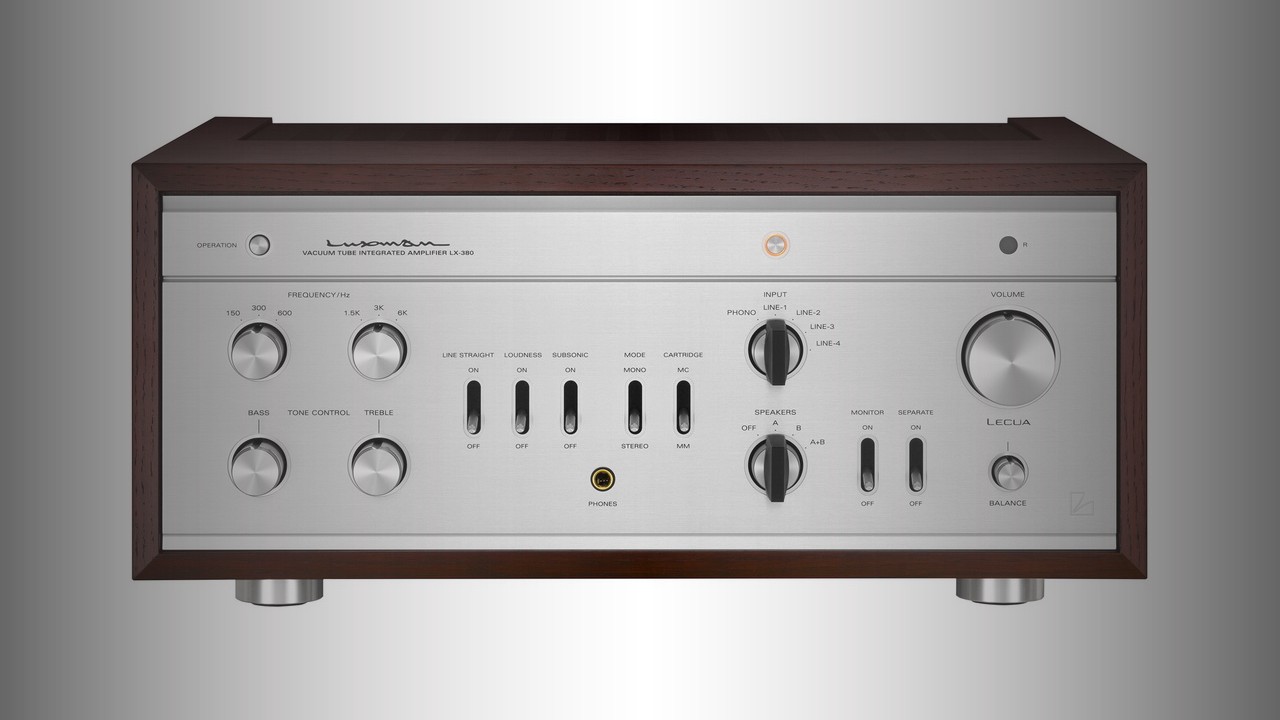
Luxman LX-380 tube integrated amplifier in a wooden case with an aluminum front panel and extensive front-panel controls.
The Luxman LX-380 continues the company’s classic tube integrated amplifier lineage with a push-pull circuit topology.
Its driver section uses three ECC82 tubes, while the output section uses four 6L6GC beam tetrodes, with stated output of 18 watts per channel into 8 ohms.
The amplifier also includes a built-in phono stage for MM and MC cartridges, plus an infrasonic filter intended to reduce low-frequency rumble. Its wooden case, aluminum front panel, many physical controls, headphone socket, balance and tone adjustments, loudness function, and LECUA volume attenuator give it a distinctly tactile, traditional character.
Best for: Classic tube integrated systems with vinyl
- Tube push-pull integrated design
- MM and MC phono stage
- Infrasonic filter for low-frequency rumble
- LECUA electronically controlled volume attenuator
Verdict: A characterful tube integrated amplifier for listeners who value hands-on controls, phono flexibility, and traditional Luxman styling.
4. NAD C 268: Amplifier packed with rich features
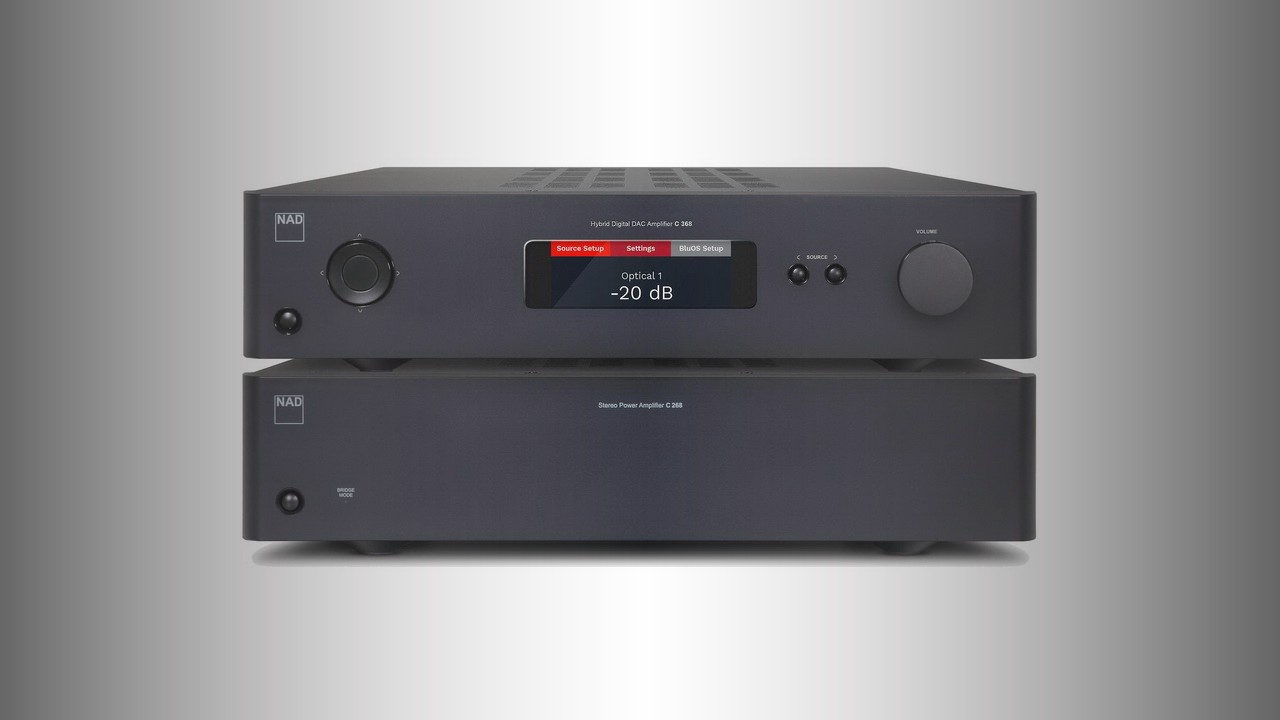
NAD C 268 two-channel power amplifier with balanced and RCA input options in a metal chassis.
The NAD C 268 is a two-channel power amplifier rather than an integrated amplifier, so it is designed to work with a separate preamplifier or source with volume control.
It is housed in a metal case with internal layout intended to allow free air circulation without forced cooling.
The amplifier provides both balanced inputs and RCA inputs, and its Class D output stages are built on Hypex UcD modules. Each channel has its own rectifier with high-capacity filter capacitors, and the source material emphasizes reduced charge and discharge time as important for reproducing energetic dynamic passages accurately.
Best for: Systems needing a dedicated two-channel power amplifier
- Balanced and RCA inputs
- Class D output stages using Hypex UcD modules
- Passive internal airflow without forced cooling
- Separate rectifier for each channel
Verdict: A focused NAD power amplifier for buyers who already have source control and want balanced-input compatibility in a two-channel setup.
5. Cayin Jazz 100: A worthy successor to the Jazz 80 tube amplifier

Cayin Jazz 100 tube amplifier, positioned as an upgraded successor to the Jazz 80 with wireless connectivity.
The Cayin Jazz 100 is presented as an enhanced successor to the Jazz 80, with changes to design, components, and functionality.
It operates in pure Class A and is specified at 2 x 46 watts.
The output stage uses 805A generator triodes, while the preliminary and control stages use 6JC6, 6SN7, and 6L6 tubes from Mullard. Alongside its analog tube architecture, the Jazz 100 adds contemporary convenience through Bluetooth 5.0, including aptX HD and aptX Low Latency codec support, making it one of the more hybrid traditional-modern amplifiers in this selection.
Best for: Tube listeners who also want wireless convenience
- Pure Class A operation
- Specified 2 x 46 W output
- 805A generator triodes in the output stage
- Bluetooth 5.0 with aptX HD and aptX Low Latency
Verdict: A modernized tube amplifier concept that combines pure Class A operation with Bluetooth support for easier everyday use.
6. Korean Inventor made a speaker with visualization based on ferromagnetic fluid

Concept wireless speaker with a ferromagnetic-fluid visualizer and built-in compact amplification.
This article is not an amplifier recommendation in the strict hi-fi component sense, but it is relevant to the broader powered-audio landscape because the wireless speaker contains several upward-facing speakers and a compact amplifier.
Its main focus is visual rather than amplifier design: a backlit glass screen contains ferromagnetic fluid that reacts to changes in the magnetic field during music playback, producing a lava-lamp-like display.
The unit also uses a 3D-printed case and an Arduino Nano-based visualization system.
Best for: Design-led wireless speaker curiosity
- Built-in compact amplifier
- Wireless speaker concept
- Ferromagnetic-fluid music visualization
- 3D-printed case
Verdict: An inventive powered speaker concept whose appeal rests on visual interaction rather than conventional amplifier selection criteria.
7. Beosound A5: Retro style wireless speaker from Bang & Olufsen

Bang & Olufsen Beosound A5 portable wireless speaker with retro styling and built-in multi-amplifier drive.
The Beosound A5 is a portable wireless speaker system rather than a separate amplifier, but it includes four amplifiers driving four emitters with a total stated power of 280 watts.
Its 360-degree radiation pattern is produced by a 130 mm bass driver, two 50 mm midrange drivers, and a 20 mm tweeter.
The design references retro Bang & Olufsen styling and was developed with GamFratesi, while the feature set includes a battery rated for up to 12 hours, IP65 protection, Bluetooth 5.2, AirPlay 2, Chromecast, Spotify Connect, and support for Bang & Olufsen’s Mozart platform.
Best for: Portable all-in-one wireless listening
- Four built-in amplifiers with 280 W total stated power
- 360-degree radiation pattern
- Battery operation up to 12 hours
- Bluetooth 5.2, AirPlay 2, Chromecast, and Spotify Connect
Verdict: A stylish powered speaker for buyers who want amplification, drivers, streaming, and portability in one finished product rather than a component amplifier.
8. Denon Introduces Home Compact Wireless Subwoofer for HEOS Systems

Denon Home Subwoofer with built-in Class D amplification for HEOS-based wireless systems.
The Denon Home Subwoofer is not a standalone amplifier recommendation, but its powered design includes a Class D amplifier driving a downward-facing 8-inch driver through an optimized bass-reflex port.
It is designed as an addition to Denon Home systems and can be paired with products such as the Denon Home Sound Bar 550, with Denon Home speakers used as rear satellites for a 5.1 setup.
HEOS wireless technology handles control and audio transmission, while the HEOS app allows filter frequency, phase, and level adjustments. Wired network connection is also supported through RJ45, and a USB port is provided for reading audio tracks from storage media.
Best for: Denon Home bass extension
- Built-in Class D amplifier
- Designed for HEOS wireless systems
- App control for filter frequency, phase, and level
- Compact enclosure with downward-facing 8-inch driver
Verdict: A powered HEOS subwoofer for expanding compatible Denon Home systems rather than a general-purpose amplifier component.
9. Hegel H200 Review: A Modern Hi-Fi Powerhouse Without the Gimmicks
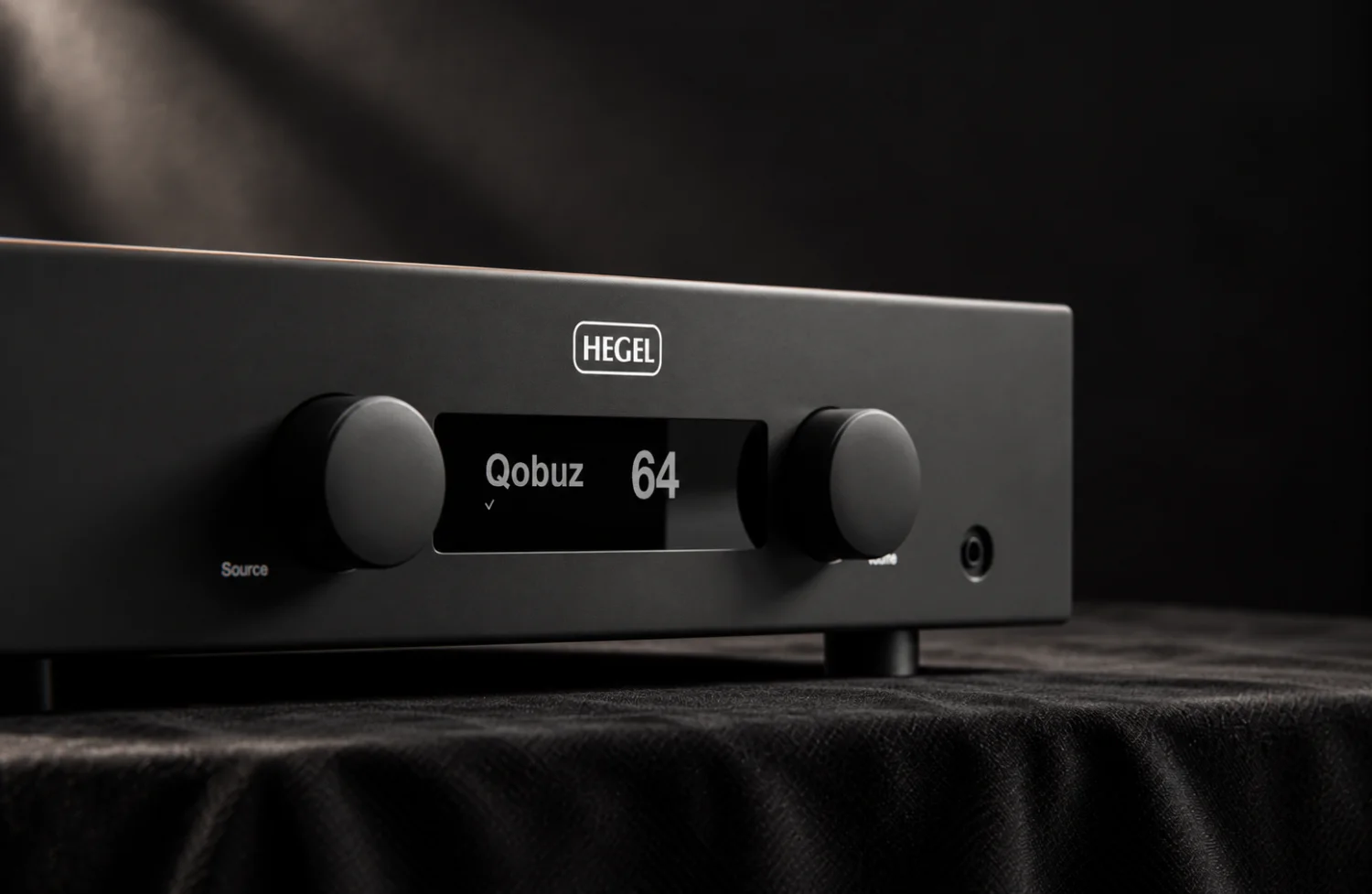
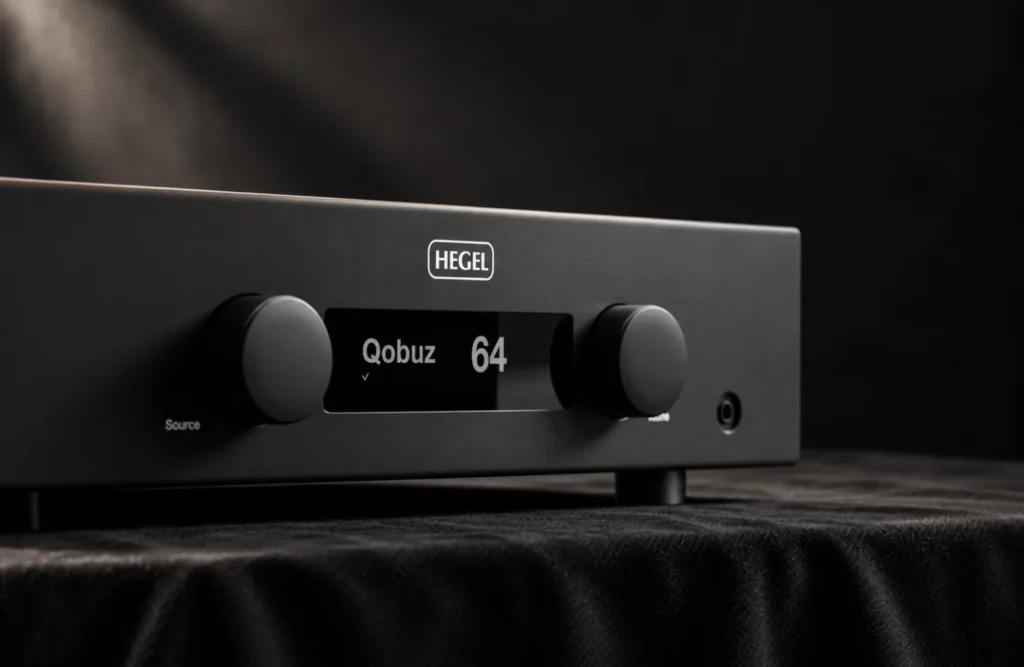
Hegel H200 all-in-one amplifier with minimalist controls, central display, and black or white finish options.
The Hegel H200 is described as a deliberately focused all-in-one amplifier.
It combines Class AB amplification rated at 150 watts per channel into 8 ohms with digital conversion, network streaming, and vinyl support, while avoiding a large color display or an expansive wireless feature list.
Its minimalist front panel uses two rotary controls and a central display that shows essential information such as input, volume, and sampling rate where relevant, but not album art or animated VU meters. The availability of black and white finishes adds installation flexibility, while the SoundEngine 2 feed-forward design is identified as part of the amplifier’s engineering foundation.
Best for: Performance-led all-in-one hi-fi systems
- 150 W per channel into 8 ohms
- Class AB amplification
- Digital conversion, network streaming, and vinyl support
- Minimalist display focused on essential information
Verdict: A restrained integrated hub for listeners who want power, streaming, digital conversion, and vinyl support without a lifestyle-style screen interface.
10. Quad Artera Pre: Preamplifier with Tilt tone control
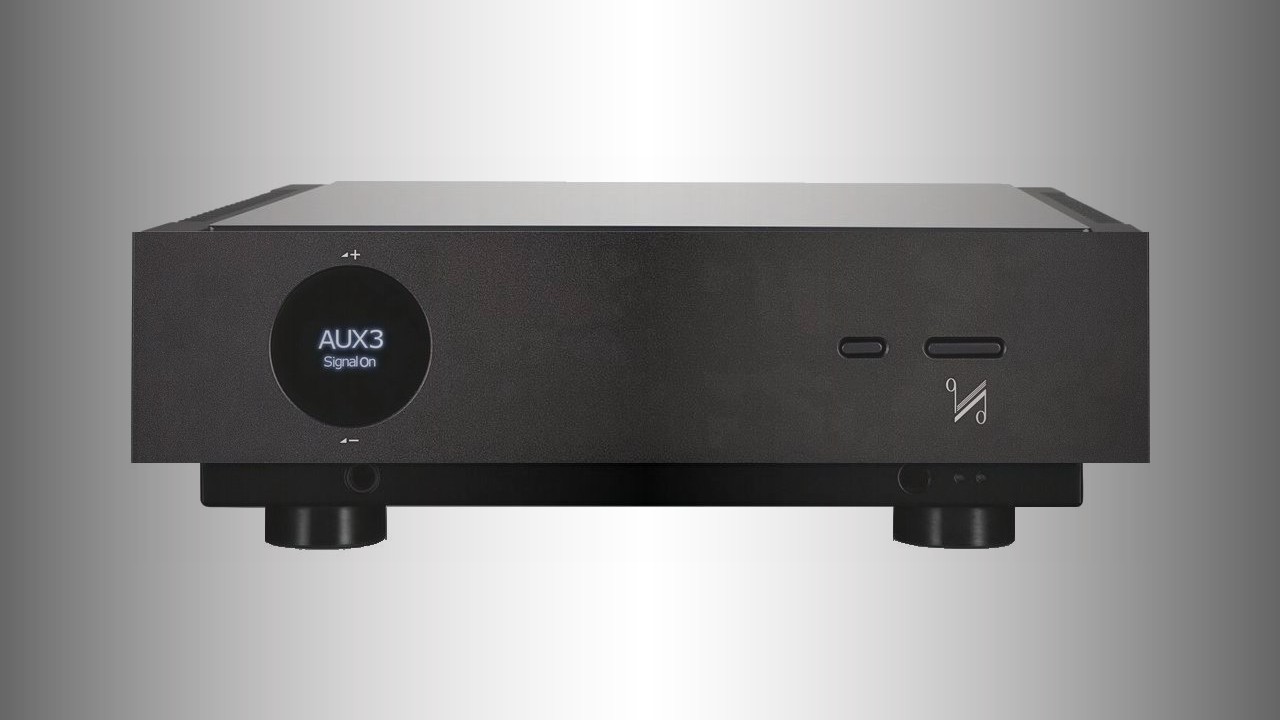
Quad Artera Pre preamplifier with Tilt tone control, phono support, RCA inputs, and balanced XLR input.
The Quad Artera Pre is a preamplifier, so it belongs in systems where source selection and control are separated from power amplification.
Its power supply uses 11 adjustable power rails, some described as ultra-low-noise.
The defining feature is Quad’s Tilt tone control, which changes the relationship between upper and lower frequencies in 1 dB steps around a stationary point of about 700 Hz, effectively leaning the tonal balance one way or the other. It also offers three selectable bass settings, input-specific adjustment combinations, four stereo RCA inputs including a Class A phono input switchable for MM or MC cartridges, one balanced XLR input, and direct mode for all inputs.
Best for: Separate systems needing flexible preamp control
- Tilt tone control in 1 dB steps
- Selectable bass adjustment levels
- MM and MC phono input
- Balanced XLR input plus RCA inputs
Verdict: A control-focused preamplifier for users who want input flexibility, phono support, and subtle tonal adjustment before the power amplifier stage.
Quick comparison
These products differ most clearly by role.
Some are traditional component amplifiers, one is a preamplifier, and several are powered speaker or subwoofer products with built-in amplification rather than separate amplifier components.
| Product | Best for | Verdict |
|---|---|---|
| McIntosh MC2.1KW | Statement mono power systems | A very high-power monoblock with impedance-specific speaker terminals and a three-chassis construction. |
| Denon PMA-600NE | Affordable vinyl and mixed-source systems | An integrated amplifier with phono, analog, digital, and Bluetooth aptX connectivity. |
| Luxman LX-380 | Classic tube integrated systems with vinyl | A tube integrated amplifier with MM/MC phono support, tone controls, and traditional styling. |
| NAD C 268 | Systems needing a dedicated two-channel power amplifier | A power amplifier with balanced and RCA inputs, Class D Hypex UcD modules, and passive airflow. |
| Cayin Jazz 100 | Tube listeners who also want wireless convenience | A pure Class A tube amplifier with 805A output triodes and Bluetooth codec support. |
| Ferromagnetic-fluid wireless speaker concept | Design-led wireless speaker curiosity | A powered speaker concept centered on visualized playback rather than conventional amplifier architecture. |
| Bang & Olufsen Beosound A5 | Portable all-in-one wireless listening | A portable powered speaker with four built-in amplifiers, 360-degree dispersion, and broad wireless platform support. |
| Denon Home Subwoofer | Denon Home bass extension | A powered wireless subwoofer with a built-in Class D amplifier for HEOS-based systems. |
| Hegel H200 | Performance-led all-in-one hi-fi systems | An all-in-one amplifier combining Class AB power, digital conversion, network streaming, and vinyl support. |
| Quad Artera Pre | Separate systems needing flexible preamp control | A preamplifier with Tilt tone shaping, phono support, RCA and XLR inputs, and direct mode. |
Frequently asked questions
Should I choose an integrated amplifier, power amplifier, or preamplifier?
Choose an integrated amplifier if you want source switching, volume control, and power amplification in one unit, as with the Denon PMA-600NE, Luxman LX-380, Cayin Jazz 100, or Hegel H200.
Choose a power amplifier such as the NAD C 268 or McIntosh MC2.1KW only if you already have preamp control.
Choose a preamplifier such as the Quad Artera Pre when you want source control and tonal adjustment feeding a separate power amplifier.
Which models here are most relevant for vinyl playback?
The Denon PMA-600NE includes a dedicated phono input, the Luxman LX-380 has a built-in phono stage for MM and MC cartridges, the Hegel H200 is described as including vinyl support, and the Quad Artera Pre has a Class A phono input switchable for MM or MC cartridges.
If vinyl is central to the system, confirm cartridge compatibility before choosing.
Are tube amplifiers a practical choice?
They can be, but they should be matched carefully to speakers and usage.
The Luxman LX-380 offers 18 W per channel into 8 ohms, while the Cayin Jazz 100 is specified at 2 x 46 W and operates in pure Class A.
Those figures and topologies point to different system-matching considerations than higher-power solid-state options such as the Hegel H200 or McIntosh MC2.1KW.
Do the powered speakers and subwoofer replace a hi-fi amplifier?
Not in the same way.
The ferromagnetic-fluid speaker, Beosound A5, and Denon Home Subwoofer contain built-in amplification, but they are complete powered audio products rather than separate amplifier components for passive speakers.
They make sense for self-contained wireless or ecosystem-based systems, while the component amplifiers are intended for more traditional hi-fi setups.
How to choose from this amplifier shortlist
Start by identifying the role the amplifier must play.
If you need one box to handle sources and drive passive speakers, the integrated amplifiers are the natural place to begin: the Denon PMA-600NE emphasizes practical affordability, vinyl support, digital inputs, and Bluetooth; the Luxman LX-380 offers a classic tube integrated format with MM/MC phono support and extensive front-panel control; the Cayin Jazz 100 adds pure Class A tube operation and modern Bluetooth codec support; and the Hegel H200 takes a focused all-in-one route with Class AB power, digital conversion, network streaming, and vinyl support.
If your system is already built around separates, look instead at the dedicated control and power options. The NAD C 268 is a two-channel power amplifier with balanced and RCA inputs, Class D Hypex UcD modules, and passive cooling through internal airflow. The McIntosh MC2.1KW is far more specialized: a monoblock with stated 2,000-watt output power, three impedance-specific speaker terminal sets, and a large three-chassis structure. The Quad Artera Pre sits at the other end of the separates chain, offering preamplifier functions, Tilt tone control, phono support, and input flexibility for use with a power amplifier. The remaining powered products should be considered only if their all-in-one nature matches the system goal. The Beosound A5 is a portable wireless speaker with built-in amplification and broad wireless platform support, the Denon Home Subwoofer is a powered HEOS subwoofer for compatible Denon Home systems, and the ferromagnetic-fluid concept speaker is primarily a design and visualization idea. For a conventional hi-fi amplifier purchase, focus first on whether you need integrated operation, separate power amplification, tube character, vinyl support, digital connectivity, or ecosystem-based convenience.











 VS
VS VS
VS VS
VS VS
VS VS
VS VS
VS VS
VS VS
VS

Share your thoughts on this 0
Keep it civil, relevant and respectful.