


The D&A Alpha and Topping D900 both sit in the modern DAC landscape, but they approach the category from very different directions.
The D&A Alpha is presented as a compact desktop control center: a DAC, preamplifier, and headphone amplifier built around dual-mono ESS conversion, balanced circuitry, analog volume control, and enough connectivity to serve headphones, active speakers, or a compact near-field system.
The Topping D900, by contrast, is described as a flagship full-size DAC aimed at traditional hi-fi systems, with a proprietary discrete 1-bit PSRM conversion architecture, a substantial aluminum chassis, broad digital input support, and balanced XLR outputs designed for connection to amplifiers, preamps, power amps, or active speakers. That difference matters more than any simple specification comparison. The Alpha is the more self-contained and desktop-friendly device, especially for listeners who need headphone outputs and both RCA and XLR analog connections. The D900 is the more ambitious dedicated DAC platform, with a proprietary conversion topology, full hi-fi component dimensions, AES/EBU and HDMI I2S input support, and a high-end build emphasis. The supplied articles do not provide listening tests for either unit, so this comparison does not claim one sounds better. Instead, it weighs the evidence that is available: architecture, connectivity, usability, system fit, and stated performance intent.
At a glance
At a glance: choose the D&A Alpha if you want a compact DAC/headphone amplifier/preamplifier with balanced and single-ended analog outputs, Bluetooth 5.3, USB high-resolution support up to PCM 768 kHz and DSD512, 4.4 mm balanced and 6.35 mm headphone outputs, and desktop-friendly dimensions.
Choose the Topping D900 if you want a full-size flagship DAC with proprietary discrete 1-bit PSRM conversion, eight digital inputs including USB-B, USB-C, optical, coaxial, AES/EBU, and HDMI I2S, USB and I2S support up to PCM 32-bit/768 kHz and native DSD512, dual balanced XLR output pairs, and a more traditional hi-fi component format.
The Alpha is the more versatile all-in-one for headphone and compact systems; the D900 is the more specialized high-end DAC for balanced hi-fi systems.
D&A Alpha
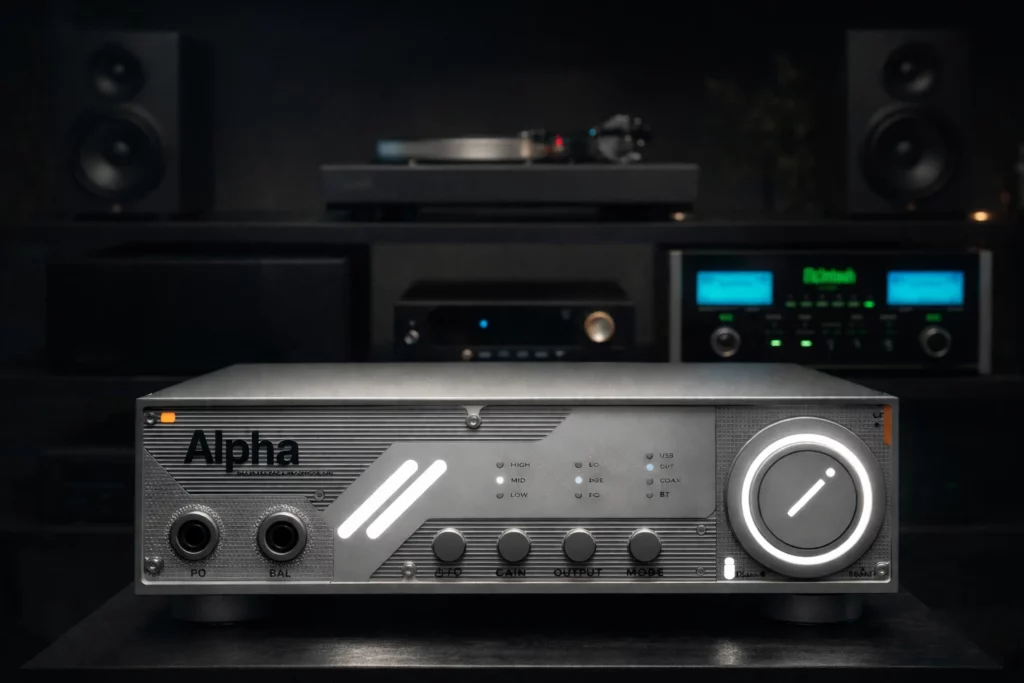
The D&A Alpha is described as a compact DAC, preamplifier, and headphone amplifier designed around proper engineering rather than lifestyle convenience.
Its core architecture uses a dual-mono DAC arrangement with two ES9039Q2M chips, each with its own clocking and signal path.
The article emphasizes independent left and right channels, a fully discrete 4-channel balanced amplifier design, analog-domain volume control, femtosecond oscillators, a two-stage PLL system, and separated digital and analog sections on a four-layer PCB. Connectivity is broad for a desktop unit: USB, optical, coaxial, Bluetooth 5.3, balanced XLR and single-ended RCA line outputs, plus 4.4 mm balanced and 6.35 mm single-ended headphone outputs. USB support reaches PCM 768 kHz and DSD512. In system terms, the Alpha is positioned as a compact control center that can drive headphones, feed active speakers, or work as a preamp into a power amplifier.
Strengths
- Compact all-in-one design combining DAC, preamplifier, and headphone amplifier functions.
- Dual-mono DAC architecture using two ES9039Q2M chips with separate clocking and signal paths for the left and right channels.
- Fully discrete 4-channel balanced headphone amplifier design aimed at low output impedance and high current delivery.
- Analog-domain volume control via an NJU72315 chip, allowing the unit to function as a true preamplifier rather than relying on digital attenuation.
- Balanced XLR and single-ended RCA line outputs, plus both 4.4 mm balanced and 6.35 mm single-ended headphone outputs.
- Bluetooth 5.3 with support for LDAC, aptX HD, AAC, and SBC.
- USB support for PCM up to 768 kHz and DSD512.
- Compact aluminum chassis suited to desktop and near-field systems.
Considerations
- The supplied article positions it as a compact desktop unit rather than a full-size hi-fi flagship component.
- Its listed digital inputs are USB, optical, and coaxial, so it does not offer the wider input set described for the Topping D900, such as AES/EBU or HDMI I2S.
- The article does not provide a price, so value cannot be judged against the D900 on cost-per-feature terms.
- Its conversion approach is based on ESS DAC chips, whereas the D900 is presented as using Topping’s proprietary discrete 1-bit PSRM architecture.
Best for: Listeners who want one compact component to serve as DAC, headphone amplifier, and preamplifier, especially in a desktop, headphone, active speaker, or near-field setup where balanced and single-ended outputs are both useful.
Topping D900

The Topping D900 is presented as a flagship DAC built around Topping’s proprietary Precision Stream Reconstruction Matrix, or PSRM, a discrete 1-bit conversion technology rather than a conventional DAC-chip implementation.
The article highlights its full aluminum construction, three-millimeter-thick aluminum panels, eight-millimeter-thick front panel, side cooling fins, vibration-absorbing feet, and an aluminum remote milled from a single block.
Its input set is extensive: USB-B, USB-C, two optical S/PDIF inputs, coaxial S/PDIF, AES/EBU on XLR, and HDMI for LVDS-format I2S. USB and I2S support PCM up to 32-bit/768 kHz and native DSD512, while S/PDIF and AES/EBU support up to 24-bit/192 kHz PCM and DSD64 via DoP. Its analog outputs are fully balanced, with two XLR pairs using Neutrik connectors: one fixed line-level pair and one volume-controlled pair for direct connection to power amplifiers or active speakers. The article states a price of $1,800 and frames the D900 as an attempt to compete with established high-end manufacturers.
Strengths
- Proprietary discrete 1-bit PSRM conversion architecture rather than a standard DAC-chip design.
- Full-size hi-fi component format with substantial aluminum construction, including three-millimeter-thick panels and an eight-millimeter-thick front panel.
- High-quality aluminum remote control milled from a single block, according to the article.
- Eight digital inputs, including USB-B, USB-C, optical, coaxial, AES/EBU, and HDMI I2S.
- USB and I2S support for PCM up to 32-bit/768 kHz and native DSD512.
- S/PDIF and AES/EBU support up to 24-bit/192 kHz PCM and DSD64 via DoP.
- Two balanced XLR output pairs with Neutrik connectors: one fixed and one volume-controlled.
- Bluetooth 5.1 connectivity with support for LDAC, aptX Adaptive, and aptX HD as listed in the supplied article.
Considerations
- No RCA outputs are fitted, and the article notes that adapter plugs may be needed for users wanting RCA connection to an amplifier.
- The supplied article lists only balanced XLR analog outputs, so it is less convenient for systems built around single-ended analog inputs.
- No headphone output is listed in the supplied article, unlike the D&A Alpha.
- Its full-size dimensions make it less desktop-oriented than the compact D&A Alpha.
- At $1,800, it is explicitly positioned as a flagship-priced DAC rather than a compact all-in-one value proposition.
Best for: Listeners building a balanced hi-fi system around a dedicated flagship DAC, especially those who need multiple digital inputs, AES/EBU or HDMI I2S, fixed and variable XLR outputs, and a full-size component with high-end build cues.
Head-to-head comparison
Design and build
The D&A Alpha is clearly designed as a compact desktop and near-field component.
The article describes an aluminum chassis measuring just under 20 cm wide, with internal attention paid to signal integrity: digital and analog sections are physically separated on a four-layer PCB with independent grounding and shielding.
Its design language is functional rather than overtly luxurious, with the emphasis placed on compact integration and balanced signal routing from input to output. The Topping D900 takes a very different approach. It follows standard hi-fi component dimensions at 330 x 57 x 210 millimeters and is built from three-millimeter-thick aluminum panels with an eight-millimeter-thick front panel. The article also calls out side cooling fins, vibration-absorbing feet, and an aluminum remote control milled from a single block. In build presentation, the D900 is the more visibly high-end, full-size component; in layout and size, the Alpha is the more space-efficient control center.
Edge: Topping D900 for full-size high-end construction and premium physical presentation; D&A Alpha for compact desktop practicality and internally separated digital/analog layout.
Features and usability
The Alpha is the more versatile all-in-one device.
It combines DAC, preamplifier, and headphone amplifier duties, uses analog-domain volume control, and provides both balanced XLR and single-ended RCA line outputs.
It also includes 4.4 mm balanced and 6.35 mm single-ended headphone outputs, which makes it directly usable with a wide range of headphones. Its digital inputs cover USB, optical, coaxial, and Bluetooth 5.3, with wireless codec support for LDAC, aptX HD, AAC, and SBC. The D900 is more specialized as a dedicated DAC for a hi-fi system, but its digital input set is broader. It offers USB-B, USB-C, two optical S/PDIF inputs, coaxial S/PDIF, AES/EBU, and HDMI I2S. Its outputs are balanced-only, with two XLR pairs: one fixed and one volume-controlled. That makes it well suited to balanced amplifiers, power amps, and active speakers, but less immediately convenient for RCA-based systems. The supplied article explicitly states that RCA outputs are not present on the D900.
Edge: D&A Alpha for overall day-to-day versatility, headphone use, and mixed RCA/XLR systems; Topping D900 for the broader digital input set and balanced hi-fi integration.
Sound and performance evidence
The supplied articles describe engineering choices and format support, but they do not provide comparative listening impressions or independent measurements.
That means a responsible comparison cannot declare that one sounds better.
The Alpha’s performance case rests on its dual-mono ES9039Q2M architecture, independent left and right signal paths, fully discrete 4-channel balanced amplifier design, femtosecond oscillators, two-stage PLL, analog volume control, and physically separated digital and analog PCB sections. The article states that its published numbers place it in modern high-performance territory and that its headphone amplifier is intended to handle sensitive in-ears as well as demanding high-impedance dynamic and planar magnetic headphones. The D900’s performance case rests on its proprietary discrete 1-bit PSRM conversion system, which Topping presents as fundamentally different from conventional ESS, AKM, Burr-Brown, R2R, and FPGA-based approaches. It applies a 1-bit operating principle to incoming PCM and DSD using Topping-developed algorithms and discrete logic components. On file support, both units reach PCM 768 kHz and DSD512 via their strongest digital paths, though the D900 specifies PCM 32-bit/768 kHz and native DSD512 through USB and I2S, while the Alpha’s article states USB handling of PCM up to 768 kHz and DSD512.
Edge: No sound-quality winner can be proven from the supplied articles. The D&A Alpha has the stronger stated case for headphone-driving performance; the Topping D900 has the more distinctive dedicated DAC architecture.
Value
The value comparison is necessarily limited because only the Topping D900 article supplies a price: $1,800.
At that price, the D900 is framed as a flagship DAC with true high-end build, proprietary PSRM conversion, a premium aluminum remote, extensive digital inputs, and balanced fixed and variable XLR outputs.
The Alpha article does not provide pricing, so it cannot be judged as cheaper, more expensive, or better value in a strict monetary sense. What can be compared is functional value. The Alpha combines three roles in one compact chassis: DAC, preamplifier, and headphone amplifier. It also supplies RCA, XLR, balanced headphone, and single-ended headphone connectivity. For someone who would otherwise need a separate headphone amplifier or preamp, that breadth is a major practical advantage. The D900’s value is more focused: it spends its proposition on flagship DAC architecture, construction, digital input range, and balanced system use rather than headphone or RCA flexibility.
Edge: Depends. D&A Alpha offers broader functional value as an all-in-one; Topping D900 offers flagship DAC value for users specifically seeking its PSRM architecture, high-end build, and extensive digital inputs.
Ideal user
The ideal D&A Alpha user is a listener with a compact desk, headphone station, active-speaker setup, or near-field system who wants a single device to manage digital sources, headphone listening, volume control, and analog output to speakers or amplification.
It is also the better match when single-ended RCA outputs are required alongside balanced XLR.
The ideal Topping D900 user is building a more traditional hi-fi system around a dedicated DAC and values a full-width-style component, balanced XLR connectivity, multiple digital inputs, AES/EBU, HDMI I2S, and the appeal of a proprietary discrete 1-bit conversion platform. The D900 is less obviously suited to a headphone-first setup because the supplied article does not list headphone outputs, and it is less straightforward for RCA-based systems because RCA outputs are absent.
Edge: D&A Alpha for desktop, headphone, and mixed-output systems; Topping D900 for balanced high-end digital front ends.
Trade-offs that matter
The main trade-off is not simply compact versus large; it is integrated flexibility versus dedicated DAC specialization.
The Alpha gives you headphone amplification, preamp use, RCA and XLR outputs, Bluetooth 5.3, and compact placement.
Its listed digital inputs are more conventional: USB, optical, and coaxial. The D900 gives you more digital source flexibility, including AES/EBU and HDMI I2S, plus two balanced XLR output paths, a fixed one and a volume-controlled one. But it omits RCA outputs, and the supplied article does not list headphone outputs. The Alpha uses known ESS DAC chips in a dual-mono implementation; the D900 uses a proprietary discrete 1-bit system that is central to its identity. Neither article provides enough listening evidence to rank musicality, tonality, imaging, or dynamics in real-world use.
Edge: D&A Alpha if the system needs flexibility at the analog and headphone end; Topping D900 if the system needs flexibility at the digital input end and balanced-only analog output is acceptable.
Final verdict
Winner: Depends
This is a matchup where the right answer depends strongly on the system.
The D&A Alpha is the more complete everyday hub.
Based on the supplied article, it is the clear choice for desktop listening, headphone use, compact active-speaker systems, or anyone who needs both balanced XLR and single-ended RCA outputs. Its dual-mono ES9039Q2M design, discrete balanced headphone amplifier, analog volume control, careful clocking, and compact aluminum chassis make it a serious all-in-one rather than a simple convenience DAC. The Topping D900 is the more ambitious dedicated DAC. Its proprietary discrete 1-bit PSRM architecture, full aluminum build, premium remote, wide range of digital inputs, USB and I2S high-resolution support, and dual XLR output pairs make it better suited to a balanced hi-fi system where a standalone flagship DAC is the goal. It is also the stronger option if AES/EBU or HDMI I2S is required. However, the D900’s lack of RCA outputs and the absence of any listed headphone output narrow its practical audience compared with the Alpha. Because the two products serve different roles, and because the supplied articles do not include comparative listening tests, the fairest winner is Depends. Choose the D&A Alpha for versatility, headphones, compact systems, and mixed analog connectivity. Choose the Topping D900 for a dedicated balanced DAC front end with broader digital input support and a more flagship-style build.
Comparison FAQ
Which is better for headphone listening, the D&A Alpha or the Topping D900?
The D&A Alpha is the better-supported choice for headphone listening based on the supplied articles.
It includes both a 4.4 mm balanced headphone output and a 6.35 mm single-ended headphone output, and its fully discrete 4-channel balanced amplifier design is described as suitable for a wide range of headphones, including sensitive in-ears, high-impedance dynamics, and planar magnetics.
The Topping D900 article does not list a headphone output.
Which DAC has better connectivity?
It depends on what kind of connectivity matters.
The Topping D900 has the broader digital input set, with USB-B, USB-C, two optical inputs, coaxial S/PDIF, AES/EBU, and HDMI I2S.
The D&A Alpha has fewer listed digital input types, but it is more flexible on the analog and headphone side, offering balanced XLR and single-ended RCA line outputs plus 4.4 mm balanced and 6.35 mm headphone outputs. The D900 has two balanced XLR output pairs but no RCA outputs.
Do both support high-resolution PCM and DSD?
Yes, both articles describe high-resolution support.
The D&A Alpha supports PCM up to 768 kHz and DSD512 over USB.
The Topping D900 supports PCM up to 32-bit/768 kHz and native DSD512 through USB and I2S, while its S/PDIF and AES/EBU inputs support up to 24-bit/192 kHz PCM and DSD64 via DoP.
Can the Topping D900 replace a preamplifier like the D&A Alpha can?
The Topping D900 includes a volume-controlled balanced XLR output pair intended for direct connection to power amplifiers or active speakers, so it can perform a variable-output role in a balanced system.
The D&A Alpha also functions as a preamplifier, using analog-domain volume control via an NJU72315 chip, and it offers both XLR and RCA line outputs.
The Alpha is therefore more flexible for systems that need single-ended RCA output, while the D900 is oriented toward balanced XLR systems.