

The Arcam AVR21 and MiniDSP Tide16 both target serious home-cinema systems, but they approach the job from very different directions.
The Arcam AVR21 is a full AV receiver: it combines surround processing, seven channels of onboard amplification, HDMI switching, network playback, radio features, room correction and conventional speaker terminals in one chassis.
The MiniDSP Tide16, by contrast, is presented as a 16-channel Dolby Atmos/DTS:X AV DSP processor with extensive Dirac functionality, balanced XLR outputs and a strong emphasis on flexible signal processing, bass management and installations using external amplification, active loudspeakers or multiple subwoofers. That distinction matters more than any single codec or headline channel count. The AVR21 is the more self-contained route into an audiophile-leaning home-cinema receiver, while the Tide16 is the more installation-oriented processor for users who want to build around external amplification and advanced DSP. Both support immersive formats and both include Dirac technology, but their strengths, limitations and ideal buyers are not the same.
At a glance
At a glance: choose the Arcam AVR21 if you want a conventional high-end AV receiver with seven built-in amplification channels, 7 HDMI inputs, 3 HDMI 2.1 outputs, 7.2.4-channel pre-outs, Dirac Live calibration, network playback, AirPlay 2, Chromecast, Spotify, web radio, FM/DAB radio and a front-panel interface with a volume knob, source buttons, headphone output and Aux input.
Choose the MiniDSP Tide16 if you are building a processor-based system around external amplification or active speakers and want 16-channel Dolby Atmos/DTS:X decoding, 16 balanced XLR outputs, Dirac Live, Dirac Bass Control and Dirac Active Room Treatment included, plus a flexible matrix mixer, advanced bass management, MiniDSP processing across all sixteen outputs and stereo connectivity including USB, Bluetooth with LDAC and aptX HD, RCA, XLR and S/PDIF inputs.
The winner is not universal: the Arcam is the stronger all-in-one receiver, while the MiniDSP is the more flexible processor platform.
Arcam AVR21
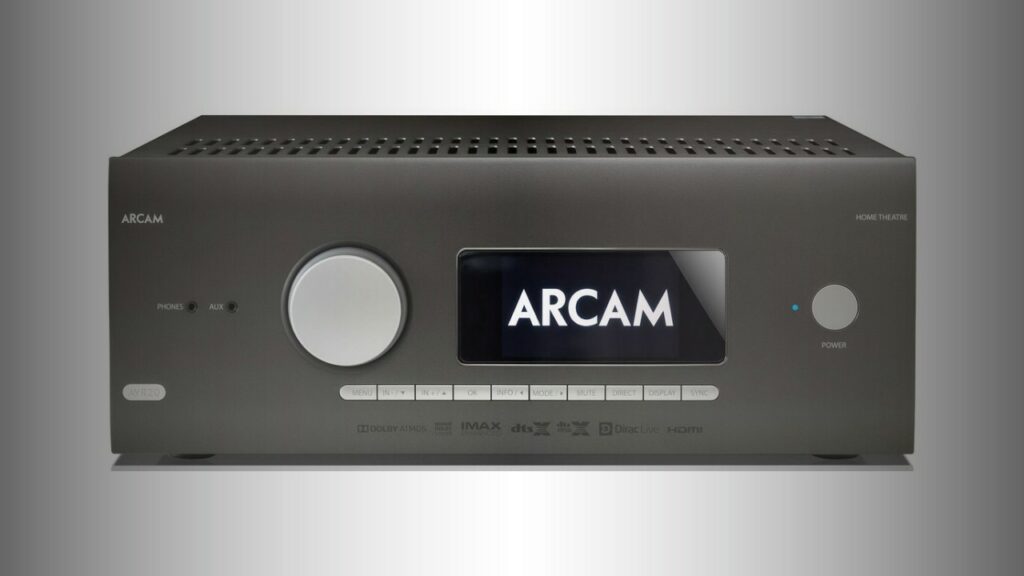
The Arcam AVR21 is a 7.1-channel AV receiver from Arcam’s updated receiver line, described in the source article as optimized for audiophiles.
It supports Dolby Atmos in a 5.1.2-channel configuration using its onboard amplification, and the article notes that expansion to 7.1.4 requires adding a 4-channel power amplifier or a pair of 2-channel power amplifiers.
It works with major codecs including DTS-HD Master Audio, Dolby TrueHD, DTS:X and IMAX Enhanced, and it includes full 16-channel Dirac calibration. The AVR21 uses a toroidal transformer and is specified in the source article at 7 x 90 W into 8 ohms with all channels operating. It also includes HDMI 2.1 connectivity, network integration, streaming options, FM and DAB radio, 7.2.4-channel RCA pre-outs, and a broad mix of digital and analog connections.
Strengths
- Self-contained AV receiver with seven built-in amplification channels, unlike a processor-only solution.
- Supports Dolby Atmos, DTS:X, DTS-HD Master Audio, Dolby TrueHD and IMAX Enhanced as cited in the source article.
- Includes full 16-channel Dirac calibration and can be expanded via pre-outs for larger immersive layouts.
- HDMI provision is extensive in the article: 7 inputs and 3 HDMI 2.1 outputs with HDCP 2.3 support for protected 8K content.
- Offers practical everyday features including Ethernet networking, UPnP playback, vTuner, Spotify, Apple AirPlay 2, Google Chromecast, FM tuner and DAB digital radio.
- Traditional receiver usability is strong, with a front-panel volume knob, display, source/menu/direct-mode buttons, headphone jack and Aux input.
Considerations
- Its onboard amplification is limited to seven channels, so the article states that 7.1.4 expansion requires additional external amplification.
- The pre-outs are RCA rather than the fully balanced XLR outputs specified for the MiniDSP Tide16.
- The supplied article does not mention Dirac Bass Control or Dirac Active Room Treatment as included features, while the Tide16 article explicitly does.
- Although it has 16.1 processor channels in the listed characteristics, it is still a receiver whose built-in amp section does not cover all possible processor-channel layouts.
Best for: Home-cinema users who want a high-quality, audiophile-leaning AV receiver that can drive a 5.1.2 Atmos system directly, offers familiar receiver operation, includes room correction and streaming, and can later be expanded with external amplifiers through its 7.2.4-channel pre-outs.
MiniDSP Tide16
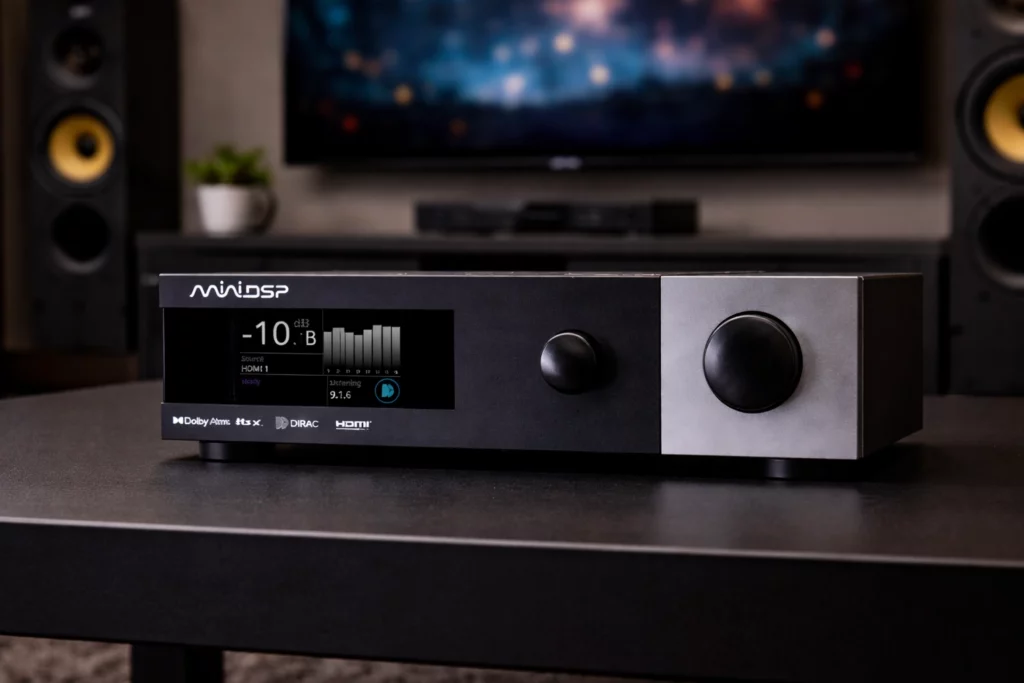
The MiniDSP Tide16 is described in the source article as a 16-channel Dolby Atmos/DTS:X AV DSP processor that also promises high-quality two-channel audio.
It is built around a 1.8 GHz quad-core A53 ARM processor capable of digital audio processing up to 32-bit/48 kHz, and it is rack-mountable.
It can decode up to 16 channels depending on the speaker configuration and source content, and it supports Dolby Atmos, Dolby Atmos Height Virtualization, Dolby Atmos Music, Dolby TrueHD, DTS HD Master, DTS:X, DTS Neural:X and DTS Virtual:X. Its rear panel includes three HDMI inputs plus eARC, with output via 16 fully balanced XLR ports. The article emphasizes a full Dirac suite at no extra cost, including Dirac Live, Dirac Bass Control and Dirac Active Room Treatment, as well as a flexible matrix mixer, advanced bass management and MiniDSP processing across all sixteen outputs.
Strengths
- Processor-first architecture with 16 fully balanced XLR outputs for systems using external amplification, active loudspeakers or multi-speaker studio-style setups.
- Includes Dirac Live, Dirac Bass Control and Dirac Active Room Treatment licenses at no extra cost according to the source article.
- Supports a broad set of immersive and post-processing formats including Dolby Atmos, Dolby Atmos Height Virtualization, Dolby Atmos Music, Dolby TrueHD, DTS HD Master, DTS:X, DTS Neural:X and DTS Virtual:X.
- Offers flexible matrix mixing, advanced bass management and MiniDSP’s processing suite across all sixteen outputs.
- Provides stereo-focused inputs including USB, Bluetooth with LDAC and aptX HD, analog RCA and XLR, and four S/PDIF digital inputs across coaxial and optical.
- The source article cites strong measured specifications for stereo use: 127 dB signal-to-noise ratio and THD+N of 0.0001% at -118 dB.
Considerations
- The source article presents it as an AV DSP processor and does not describe any built-in power amplification, so users must plan for external amplification or active loudspeakers.
- It has three HDMI inputs plus eARC, fewer direct HDMI inputs than the seven HDMI inputs listed for the Arcam AVR21.
- The article says it was announced and should be available for delivery in the coming weeks, so it is presented as a newly announced product rather than an already established receiver platform in the supplied material.
- It does not offer the same conventional AV receiver amenities described for the Arcam, such as onboard FM/DAB radio, speaker terminals, a front-panel headphone jack or built-in multichannel power amp.
Best for: Advanced home-cinema builders, integrators and enthusiasts who want a 16-channel processor with balanced outputs, full Dirac room/bass/ART tools and powerful DSP flexibility, and who are comfortable supplying external amplification or using active loudspeakers.
Head-to-head comparison
Design and build
The Arcam AVR21 follows the design logic of a traditional high-performance AV receiver.
The source article highlights the return of a physical volume knob on the left side of its slightly curved front panel, a display to the right, ten front-panel buttons for source selection, menu access and Direct mode, plus a power button, standby indicator, 3.5 mm headphone jack and 3.5 mm Aux input.
Internally, the article calls out a powerful toroidal transformer, which supports its role as a receiver with onboard amplification. Its rear panel includes speaker terminals, HDMI, USB, trigger connectors, RS-232 and other connections. The MiniDSP Tide16 is described differently: it is rack-mountable, uses a 1.8 GHz quad-core A53 ARM processor, and has a front-panel 1,080-pixel colour OLED display. Its rear-panel identity is processor-centric, with HDMI/eARC input routing and 16 fully balanced XLR outputs. In short, the Arcam is built as a receiver you can wire directly to passive speakers, while the MiniDSP is built as a DSP/control hub for an externally amplified or active-speaker system.
Edge: Arcam AVR21 for traditional receiver integration and onboard amplification; MiniDSP Tide16 for rack-friendly processor-based installations and balanced output architecture.
Features and usability
The Arcam AVR21 is the broader one-box solution.
It includes seven amplification channels, full 16-channel Dirac calibration, Ethernet networking, UPnP playback from network devices, vTuner web radio, Spotify, Apple AirPlay 2, Google Chromecast, FM tuner and DAB digital radio.
It can be controlled by remote, IP control or the MusicLife iOS application. Its HDMI provision is also extensive in the source article, with 7 inputs and 3 HDMI 2.1 outputs supporting HDCP 2.3, plus one HDMI port supporting MHL. The MiniDSP Tide16 is more specialized but deeper in DSP terms. It includes Dirac Live, Dirac Bass Control and Dirac Active Room Treatment at no extra cost, alongside matrix mixing, advanced bass management and processing across sixteen outputs. It also includes stereo inputs via USB, Bluetooth with LDAC and aptX HD, analog RCA and XLR, and four S/PDIF inputs. However, its HDMI switching is more limited in the article: three HDMI inputs plus eARC. Usability therefore depends on system philosophy. The Arcam is more convenient as a central receiver for many source devices and passive speakers; the MiniDSP is more powerful as a configurable signal-processing platform.
Edge: Arcam AVR21 for all-in-one receiver convenience and HDMI/input breadth; MiniDSP Tide16 for Dirac suite depth, DSP flexibility and balanced-output system design.
Sound and performance
The supplied articles do not provide comparative listening impressions, so the safest comparison is based on architecture, supported formats and stated performance-related specifications.
The Arcam AVR21 is described as optimized for audiophiles and includes Direct mode for high-quality stereo sound.
It is specified at 7 x 90 W into 8 ohms with all channels operating, and 110 W per channel into 4 ohms with all channels operational, according to the article’s characteristics. It supports Dolby Atmos in 5.1.2 using its onboard channels, with expansion to 7.1.4 requiring added power amplification, and it includes 7.2.4-channel pre-outs. The article also lists a 20 Hz to 20 kHz frequency response and 110 dB signal-to-noise ratio in Direct mode. The MiniDSP Tide16’s performance argument is different. It decodes up to 16 channels depending on configuration and content, outputs over 16 fully balanced XLR ports, and includes the full Dirac suite for room correction, bass control and active room treatment. For stereo, the source article states a 127 dB signal-to-noise ratio and THD+N of 0.0001% at -118 dB. It also processes digital audio up to 32-bit/48 kHz. The Arcam has the practical advantage of being able to power speakers directly; the MiniDSP has the processing and channel-output advantage for more ambitious external-amplifier systems.
Edge: MiniDSP Tide16 for maximum processing/channel-output flexibility and cited stereo measurements; Arcam AVR21 for integrated amplification and receiver-based immersive playback.
Value
Value is difficult to compare directly because the products do not include the same hardware.
The MiniDSP Tide16 article gives a price of $3,500 and states that Dirac Live, Dirac Bass Control and Dirac Active Room Treatment licenses are included at no extra cost.
That is a clear value point for users who specifically need those processing tools and already have, or plan to buy, amplification. However, because the article does not describe built-in amplification, the total system cost must include external amplifiers or active loudspeakers. The Arcam AVR21 source article does not provide a price, so no direct price-versus-price judgment can be made. Its value comes from integration: seven amplifier channels, HDMI switching, network playback, radio, room correction and pre-outs in one receiver chassis. For a user starting from passive speakers and needing an AV hub, that integration has obvious practical value. For a user building a dedicated processor-based cinema, paying for onboard receiver amplification may be less relevant.
Edge: MiniDSP Tide16 where its stated $3,500 price, included Dirac suite and processor flexibility match the system plan; Arcam AVR21 where an integrated receiver with amplification and broad source handling reduces system complexity.
Ideal user
The Arcam AVR21 is best suited to someone who wants a serious but conventional AV receiver: connect passive speakers, connect multiple HDMI sources, run Dirac calibration, stream music, use radio services and enjoy immersive formats without immediately assembling a separate preamp/power-amp chain.
It also suits users who want an upgrade path, because the article describes 7.2.4-channel pre-outs and recommends added amplification for 7.1.4 expansion.
The MiniDSP Tide16 is best suited to users who already think in terms of processors, external amplifiers, active loudspeakers, multiple subwoofers and detailed DSP. Its balanced XLR outputs, full Dirac suite, matrix mixer and bass-management tools make most sense in a custom or enthusiast installation where flexibility and calibration depth matter more than receiver simplicity.
Edge: Arcam AVR21 for receiver buyers and gradual upgraders; MiniDSP Tide16 for advanced processor-based cinema builders and integrators.
Connectivity and expansion
The Arcam AVR21 has the stronger conventional AV-receiver connectivity package in the supplied material: 7 HDMI inputs, 3 HDMI 2.1 outputs, HDCP 2.3 support, one HDMI port with MHL, Ethernet, USB, digital and analog inputs, 7.2.4-channel RCA pre-outs, trigger connectors, RS-232 and seven pairs of speaker terminals, two of which can be used for zone 2.
The MiniDSP Tide16 has fewer HDMI inputs at three plus eARC, but it counters with 16 balanced XLR outputs and a wide set of stereo inputs: USB, Bluetooth with LDAC and aptX HD, RCA, XLR and four S/PDIF digital inputs.
The Arcam expands like a receiver, adding external amplification when more channels are needed. The MiniDSP starts as a processor platform and expects the rest of the system to be built around its outputs.
Edge: Arcam AVR21 for HDMI source count and receiver-style expansion; MiniDSP Tide16 for balanced multichannel output and DSP-oriented system expansion.
Final verdict
Winner: Depends
There is no honest single winner for every home-cinema buyer because these two products solve different problems.
The Arcam AVR21 is the better choice if you want a complete AV receiver: it has seven onboard amplifier channels, broad HDMI connectivity, 7.2.4 pre-outs, full 16-channel Dirac calibration, streaming, network playback, FM/DAB radio and familiar receiver controls.
It can run a Dolby Atmos 5.1.2 system directly and can be expanded toward 7.1.4 with additional amplification, as the source article states. For many living-room and dedicated-room systems built around passive speakers, it is the more straightforward and self-contained product. The MiniDSP Tide16 is the better choice if you are deliberately building a processor-led cinema or hybrid stereo/cinema system with external amplification or active speakers. Its 16 balanced XLR outputs, full Dirac Live/Bass Control/Active Room Treatment suite, matrix mixer, advanced bass management and MiniDSP processing across all sixteen outputs give it a level of configuration depth the Arcam article does not claim. It also offers notable stereo-oriented connectivity and the source article cites strong S/N and THD+N figures. The trade-off is that the Tide16 is not described as having built-in amplification, has fewer HDMI inputs, and is framed as a newly announced processor with delivery expected in the coming weeks. Therefore, the winner is Depends: Arcam AVR21 for the best all-in-one AV receiver experience; MiniDSP Tide16 for the more flexible high-channel-count processor platform.
Comparison FAQ
Is the Arcam AVR21 or MiniDSP Tide16 better for a simple home-cinema setup with passive speakers?
The Arcam AVR21 is the more suitable option for a simpler passive-speaker setup because it is an AV receiver with seven built-in amplification channels and speaker terminals.
The MiniDSP Tide16 is described as an AV DSP processor with 16 balanced XLR outputs, and the supplied article does not mention built-in amplification, so it requires external amplification or active loudspeakers.
Which product supports more advanced Dirac room-correction features?
Based on the supplied articles, the MiniDSP Tide16 has the broader named Dirac package.
Its article states that Dirac Live, Dirac Bass Control and Dirac Active Room Treatment licenses are included at no extra cost.
The Arcam AVR21 article states that it has full 16-channel Dirac calibration and uses Dirac Live for speaker auto-calibration, but it does not state that Bass Control or Active Room Treatment are included.
Which has better HDMI connectivity?
For direct HDMI source count, the Arcam AVR21 has the advantage in the supplied material: 7 HDMI inputs and 3 HDMI 2.1 outputs with HDCP 2.3 support.
The MiniDSP Tide16 article lists three HDMI inputs plus eARC.
However, HDMI count is not the only consideration: the Tide16 is more focused on processor output flexibility, with 16 fully balanced XLR outputs.
Can either product handle a 7.1.4 Dolby Atmos system?
The Arcam AVR21 article says it supports Dolby Atmos in a 5.1.2-channel configuration using the receiver setup and recommends adding a 4-channel power amplifier or a pair of 2-channel power amplifiers to expand to 7.1.4.
It also lists 7.2.4-channel pre-outs.
The MiniDSP Tide16 article says it can decode up to 16 channels depending on speaker configuration and Atmos/DTS:X content, and it outputs via 16 balanced XLR ports, but the article does not describe onboard amplification, so external amplification or active speakers would be required.