


Choosing an AV receiver is no longer just about counting amplifier channels. The products compared here range from compact five-channel models to powerful 11- and 16-channel designs, with major differences in HDMI capability, room correction, streaming, expansion and speaker control.
The Marantz Cinema 50 is the strongest all-round choice because it combines a well-equipped nine-channel amplifier with 11.4-channel processing, 8K and 4K/120 video support, flexible room correction and broad music functionality. The alternatives make more sense when you need maximum power, more channels, a lower-cost basic system or a particular calibration platform.
Quick verdict
- Best Overall: Marantz Cinema 50 — the most balanced blend of cinema features, music playback, expansion and room correction.
- Best for a large, powerful system: Onkyo TX-RZ70 B M2 — 11 channels of 140W amplification, 11.2 processing and Dirac Live Bass Control.
- Best for precise cinema localization: Anthem MRX 1140 8K — its ARC Genesis calibration and localization performance are the main attractions.
- Best value among the more ambitious models: Emotiva MR-1L — nine-channel Class AB amplification and a 13.2-channel processor.
- Best for a mature, expandable 7-channel platform: Denon AVR-X3600H — strong connectivity, Audyssey MultEQ XT32 and 11.2-channel signal processing.
- Best basic option: Pioneer VSX-535 — a straightforward five-channel receiver with Dolby Atmos, 8K/4K video switching and MCACC calibration.
Comparison at a glance
| Model | Amplification and processing | Video and gaming | Room correction | Best suited to |
|---|---|---|---|---|
| Marantz Cinema 50 | 9 amplification channels; 11.4-channel processor; 110W per channel under stated conditions | 8K/60Hz, 4K/120Hz, HDR10+, Dolby Vision, eARC | Audyssey MultEQ XT32; optional Dirac Live upgrade | Most all-round home cinemas and music-friendly systems |
| Denon AVR-X3600H | 9 power amplifiers; 11.2-channel signal processing; 105W per channel under stated conditions | 4K/60Hz, HDR, Dolby Vision, 4K upscaling, ALLM | Audyssey MultEQ XT32 | Expandable 7.2.2 or 9.2 systems with varied sources |
| Onkyo TX-RZ70 B M2 | 11 channels; 11 x 140W; 11.2 layout | 8K, HDMI 2.1 and 40Gbps bandwidth | Dirac Live and Dirac Live Bass Control | Large rooms and demanding multichannel systems |
| Anthem MRX 1140 8K | 11 channels; 11 x 140W; 11.2 layout | HDMI 2.1 and 8K | ARC Genesis | Listeners prioritising localization and calibration |
| Emotiva MR-1L | 9 x 85W; 13.2-channel processor; Class AB | 4K UHD, HDR and Dolby Vision | EMO-Q | Big, dense sound with processing headroom |
| Pioneer VSX-535 | 5 x 80W; Dolby Atmos support | 8K/4K Ultra HD and Dolby Vision | MCACC | Affordable, uncomplicated home cinema systems |
| DALI Fazon SUB 1 | Active subwoofer, not an AV receiver | Not applicable | Placement and system matching are important | Adding controlled bass to compact speakers |
Marantz Cinema 50
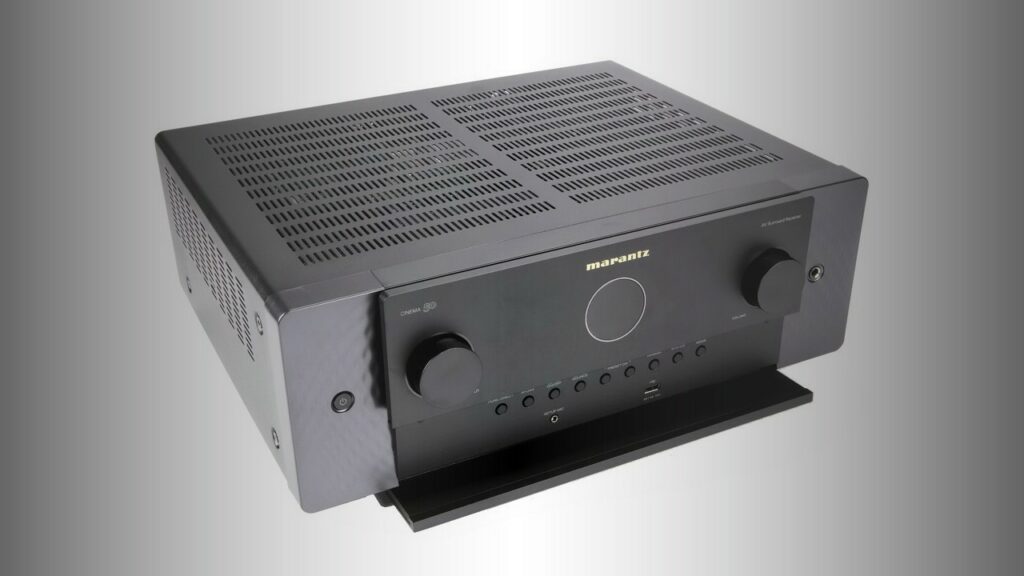
The Marantz Cinema 50 earns Best Overall because it avoids being narrowly optimised for one type of system. Its nine discrete amplifier channels can support a substantial surround setup, while the 11.4-channel processor leaves room for expansion with additional amplification. That combination is more flexible than a receiver limited to its internal channels, but less imposing than the largest 11-channel models.
Its video specification is particularly convincing for a modern mixed-use system. The six HDMI inputs and three outputs support 8K/60Hz and 4K/120Hz, while HDR10, HDR10+, HLG, Dolby Vision and Dynamic HDR are included. Enhanced eARC is available on the main HDMI output. These features make the Cinema 50 equally relevant to film viewing and current gaming hardware.
For surround sound, the receiver decodes Dolby Atmos and DTS:X HD Master 3D formats and can create virtual height channels from standard soundtracks. Audyssey MultEQ XT32 provides the main room-calibration system, with Sub EQ HT available for smoother bass integration. The source also identifies an optional Dirac Live upgrade, which can be purchased as a licence and unlocked through a future firmware update.
The Marantz is also the most obviously music-friendly choice here. It supports high-resolution network and USB playback up to 24-bit/192kHz and DSD 5.6MHz, with support for formats including FLAC, WAV, ALAC and DSD. Wi-Fi, Bluetooth, AirPlay 2, HEOS and voice-assistant compatibility add practical convenience, while a phono input means a turntable can be included without an extra phono stage.
There are useful physical connections too: five line-level RCA inputs, two coaxial and two optical inputs, the phono input, a USB connection and 11.4-channel pre-outs. At 11.8kg, it is substantial without approaching the 22kg weight of the Onkyo. The result is a receiver that suits a serious cinema, a network music system or a hybrid setup without obvious compromise.
Denon AVR-X3600H
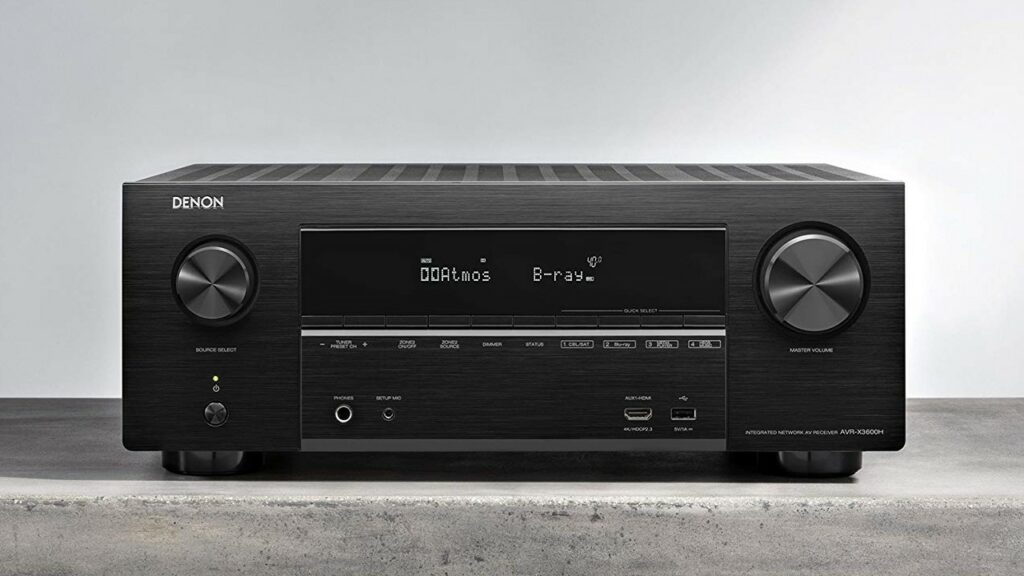
The Denon AVR-X3600H is the closest direct alternative to the Marantz in terms of overall system flexibility, although its video platform is older. It has seven amplification channels and can be configured as a 7.2.2 system with two height channels, or as a 9.2 system for conventional surround formats. Its DSP can process 11.2-channel signals, so an additional power amplifier can extend the system.
That makes the Denon a sensible choice for someone who wants a capable, expandable receiver but does not need the Cinema 50's newer 8K and 4K/120 HDMI specification. The Denon provides eight HDMI inputs and three outputs, 4K/60Hz transmission, HDR, Dolby Vision and 4K upscaling for all sources. One HDMI input is positioned on the front, which is helpful for temporary connections.
Audyssey MultEQ XT32 is included, as it is on the Marantz, and the Denon supports Dolby Atmos, DTS:X, DTS Virtual:X and Dolby Atmos Height Virtualization. Its high-current output stages, powerful power supply and stated 105W per channel rating under the listed conditions make it a strong match for larger floor-standing speakers. The source describes its sound as punchy and dynamic and calls its price reasonable, but no current price is supplied here, so this comparison does not make a price claim.
The AVR-X3600H is also well equipped for music. HEOS, Bluetooth, AirPlay 2 and network playback are included, alongside USB playback of PCM files up to 24-bit/192kHz and DSD 5.6MHz. A phono input, two subwoofer outputs and a broad collection of analogue and digital inputs make it especially useful when the system includes both physical and network sources.
Choose the Denon over the Marantz when the seven-channel architecture, front HDMI input, 4K upscaling or existing system requirements matter more than newer 8K/4K/120 video support. The Marantz is the safer long-term all-rounder for a new system, but the Denon remains a highly flexible platform.
The roundup alternatives: Pioneer, Emotiva, Onkyo, Denon and Anthem
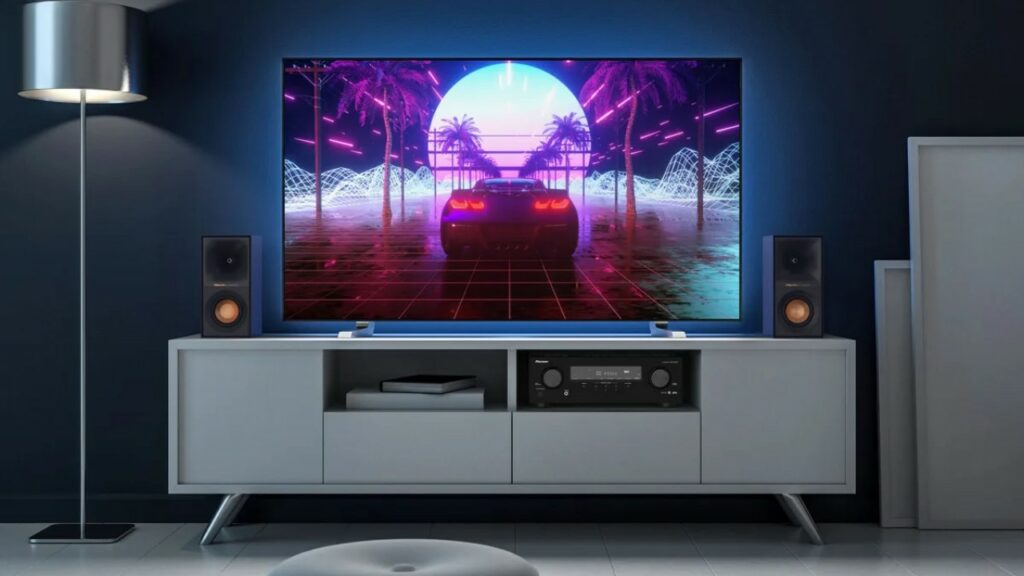
The second source article places several receivers in direct competition, and their differences are more important than their rankings alone suggest.
The Pioneer VSX-535 is the basic-system option. Its five channels of 80W amplification, Dolby Atmos support, Bluetooth, MCACC calibration and 8K/4K video switching cover the essentials. It does not support DTS:X, which limits its format flexibility compared with the Marantz, Denon AVR-X3600H and the more ambitious models. It makes sense for a first home cinema or a smaller speaker package where five channels are sufficient.
The Emotiva MR-1L moves in the opposite direction. It uses nine Class AB amplifier channels rated at 85W each and has a 13.2-channel processor. The source praises its large-scale, dense sound and says it offers excellent value, while noting some shortcomings in microdynamics. Its 4K UHD, HDR and Dolby Vision support is less future-facing than the Marantz's 8K/4K/120 specification, but its processing capacity is attractive for a substantial surround installation.
The Onkyo TX-RZ70 B M2 is the power specialist. It has 11 channels of 140W amplification, 11.2 processing, HDMI 2.1 with 40Gbps bandwidth and Dirac Live Room Correction with Dirac Live Bass Control. The source highlights its precise localization and exceptional power. At 22kg, it is also by far the heaviest receiver discussed here. If the system needs 11 internal amplifier channels and the room or speakers benefit from substantial output, the Onkyo is a more appropriate choice than the Marantz.
The Denon AVC-X6800H is another 11.4-channel design with 11 x 140W amplification. It supports Auro 3D, Dolby Atmos, DTS:X and IMAX Enhanced, alongside 8K Dolby Vision, HDR10, HDR10+, HLG and Dynamic HDR. VRR, QFT and ALLM add gaming support, while Dirac Live handles room correction. It is effectively the high-channel Denon alternative to the Marantz: choose it when 11 internal channels and extensive surround-format support are more important than the Cinema 50's smaller chassis and lower channel count.
The Anthem MRX 1140 8K also provides 11 x 140W amplification and 11.2 processing. Its defining feature is ARC Genesis calibration, with the source giving it particular credit for speaker control, sound localization and recreating a cinema atmosphere. It is the specialist choice for listeners who value calibrated spatial precision above the Marantz's broader combination of streaming, phono connectivity and general-purpose features.
Subwoofer integration matters more than the receiver alone
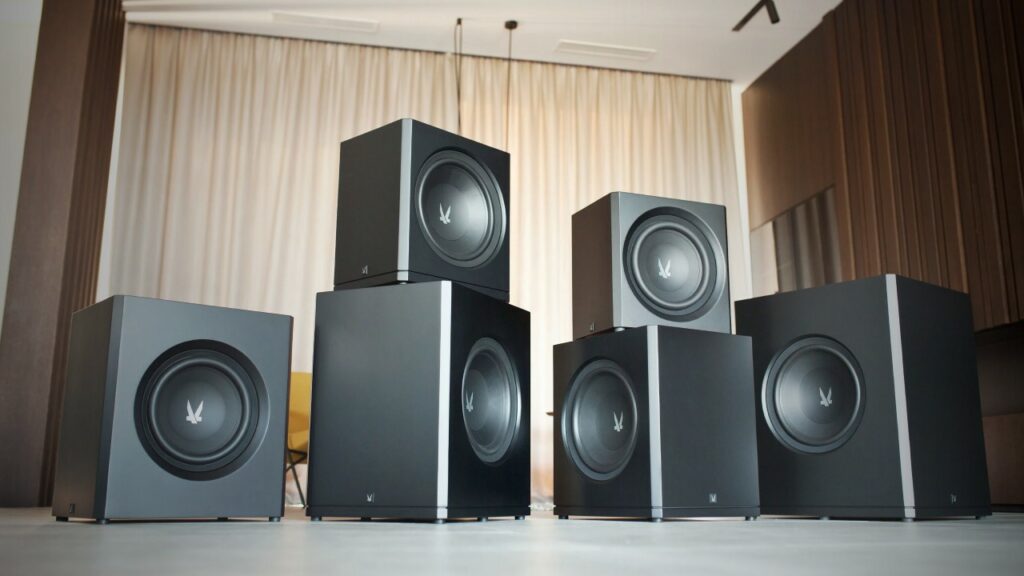
The source article on subwoofer placement is not an AV receiver test, but it highlights an important point when comparing receivers: bass performance depends heavily on the room and the subwoofer's position. Low frequencies reflect from walls and can create either booming standing-wave peaks or dead zones where bass nearly disappears. Even a receiver with sophisticated correction cannot make poor placement irrelevant.
The recommended approach is to test several positions using a familiar track with a repeating bass line, listening from the main seat while the subwoofer is moved around the room. Corner placement can increase bass output and reduce some dead zones, but it is not automatically best. Placing a subwoofer inside furniture is generally discouraged because the enclosure restricts the space needed for low-frequency output.
This is relevant to the Marantz, Denon and the Dirac-equipped alternatives because all of them offer room-calibration tools, but calibration should be treated as part of a wider setup rather than a substitute for sensible placement. In a large cinema with several rows, the source also recommends considering a second subwoofer to improve consistency across seats.
DALI Fazon SUB 1
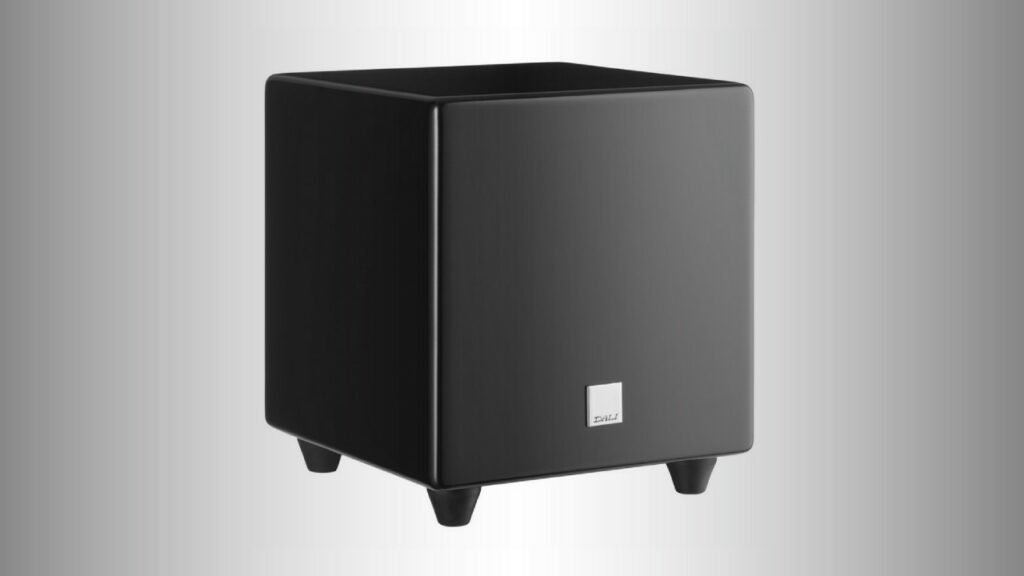
The DALI Fazon SUB 1 is not an alternative AV receiver; it is an active subwoofer that illustrates where the system's bass performance may come from. It is designed for compact lifestyle speakers and Fazon-series satellites rather than highly sensitive full-range systems. Its 6.5-inch downward-firing woofer, closed cabinet and 90W power rating are intended to produce fast, controlled bass, while the source says it can work effectively in rooms up to 20 square metres.
The Fazon SUB 1 includes volume, crossover and phase controls, along with line-level and LFE inputs for connection to an AV receiver or surround processor. Its automatic standby function simplifies operation. The source gives a frequency range of 37–200Hz and a maximum sound pressure level of 103dB.
Matching is important. The source warns that the subwoofer may not provide enough gain with highly sensitive speakers, even at maximum level. It recommends positioning the unit 30–50cm closer to the listener than the main speakers, although its closed cabinet and downward-firing driver also make near-wall or corner placement practical. For a compact system, this kind of carefully matched subwoofer may matter more than moving from one competent room-correction system to another.
How they differ
Channel count: The Pioneer is the simplest at five channels. The Denon AVR-X3600H and Marantz Cinema 50 provide nine internal amplifier channels, while the Onkyo, Denon AVC-X6800H and Anthem provide 11. The Emotiva sits at nine amplifier channels but offers 13.2-channel processing. More processing channels do not automatically mean more internal amplification, so the intended speaker layout matters.
Video capability: The Marantz, Pioneer, Onkyo, Anthem and Denon AVC-X6800H are the strongest choices for current high-bandwidth video, with 8K support identified in the sources. The Cinema 50 additionally specifies 4K/120Hz, while the Onkyo offers HDMI 2.1 with 40Gbps bandwidth. The Denon AVR-X3600H remains a 4K/60Hz design, although it adds 4K upscaling and ALLM.
Room correction: Audyssey MultEQ XT32 appears on both the Marantz and Denon AVR-X3600H. Dirac Live distinguishes the Onkyo and Denon AVC-X6800H, with Dirac Live Bass Control specifically identified for the Onkyo. Anthem uses ARC Genesis, Emotiva uses EMO-Q and Pioneer uses MCACC.
Music and connectivity: The Marantz and Denon AVR-X3600H have particularly broad music support, including HEOS, AirPlay 2, Bluetooth, high-resolution playback and a phono input. The Cinema 50 also provides 11.4-channel pre-outs and optional Dirac Live. The Pioneer is more focused on essential home-cinema functions, while the larger models prioritise processing, power and speaker control.
Which one should you buy?
Buy the Marantz Cinema 50 for the best overall balance. It is the safest recommendation when the system needs modern gaming and movie connectivity, serious surround processing, good music playback, a turntable input, network streaming and room correction. Its nine internal channels and 11.4-channel processing offer useful expansion without the size and weight of the biggest receivers.
Choose the Denon AVR-X3600H for an established 4K-based system. It is a particularly good fit when eight HDMI inputs, 4K upscaling, a front HDMI input, a phono connection and Audyssey MultEQ XT32 are more important than 8K or 4K/120. Its 11.2-channel processing also keeps an upgrade path open.
Choose the Onkyo TX-RZ70 B M2 for maximum internal power and 11-channel cinema. Its 11 x 140W amplification, HDMI 2.1 connectivity and Dirac Live Bass Control make it the specialist choice for large systems, difficult speaker loads or listeners who want extensive calibrated surround capability.
Choose the Anthem MRX 1140 8K for localization and ARC Genesis. The source's strongest praise is directed at its control of the speaker system and precise placement of sound images. It is a focused choice for a dedicated cinema where calibrated spatial performance is the priority.
Choose the Emotiva MR-1L for scale and processing headroom. It is compelling when a dense, expansive presentation and 13.2-channel processing matter more than having the newest video specification or the finest microdynamic performance described in the source.
Choose the Pioneer VSX-535 for a basic five-channel installation. It covers Dolby Atmos, 8K/4K video, Dolby Vision, Bluetooth and room calibration at the entry point of this group, but its lack of DTS:X and limited amplifier count should be accepted from the outset.
Consider the DALI Fazon SUB 1 when the real limitation is compact-speaker bass. It is not a receiver upgrade, but a targeted subwoofer addition for small lifestyle systems. Match it carefully to the speakers and room, and pay attention to placement.
Final verdict
The Marantz Cinema 50 is Best Overall because it offers the most complete balance of current video support, flexible surround processing, useful expansion, room correction, high-resolution music playback and everyday connectivity. The Onkyo, Anthem, Denon AVC-X6800H and Emotiva are better suited to larger or more specialised systems, while the Denon AVR-X3600H remains a strong choice for a mature 4K installation. For a new, varied home-cinema and music system, however, the Cinema 50 is the most convincing all-round buy from the supplied options.

Join the discussion
Share your thoughts, listening impressions or product experience.