


The five DAPs compared here are not variations on the same idea. The Hidizs AP80 PRO-X is an exceptionally small player, the Shanling M3 Ultra is a compact Android-based streamer, and the M5 Ultra targets listeners who want substantially more output power and high-end hardware. Shanling’s M7T Master adds vacuum tubes and a revised audio path, while the EA5 is really a desktop music centre with both headphone and speaker amplification.
That distinction matters more than a simple specification contest. The best choice depends on whether you need pocket portability, streaming, power for demanding headphones, a tube-equipped presentation or an all-in-one desktop system. For the broadest range of listeners, the Shanling M3 Ultra comes closest to doing everything well without becoming a specialist product.
Quick verdict
- Best Overall: Shanling M3 Ultra — The most balanced combination of portability, Android streaming, useful connections, battery life and output options.
- Best Value: Hidizs AP80 PRO-X — The least expensive player here, and the obvious choice when small size and low cost matter most.
- Best for demanding headphones: Shanling M5 Ultra — Its balanced output is rated at 1100mW at 32 ohms, far above the figures supplied for the M3 Ultra and AP80 PRO-X.
- Best for a tube-based portable system: Shanling M7T Master — A focused refinement of the M7T with dual JAN6418 tubes and a stronger balanced output.
- Best desktop hub: Shanling EA5 — The only model here with a built-in 50W-per-channel speaker amplifier.
Comparison at a glance
| Product | Best suited to | Operating approach | Outputs and power | Standout feature |
|---|---|---|---|---|
| Shanling M3 Ultra | Portable streaming and everyday listening | Android 10 with Google Play, AGLO and Roon certification | 3.5mm and 4.4mm; 140mW standard, 260mW balanced | Strong all-round feature set and up to 14.5 hours balanced playback |
| Hidizs AP80 PRO-X | Maximum portability on a budget | HiBy OS 3.0 | 3.5mm and balanced output; 6–8 hours balanced, 8–11 hours single-ended | 61 x 54.5 x 13.8mm, 2.45-inch screen and $172 price |
| Shanling M5 Ultra | High-power portable listening | Shanling MTouch | 3.5mm and 4.4mm; 315mW single-ended, 1100mW balanced at 32 ohms | AK4499EX and AK4191 platform with broad digital support |
| Shanling M7T Master | Listeners who specifically want tubes | Portable hi-res player based on the M7T platform | Balanced output is more powerful than the standard M7T; further figures not supplied | Dual JAN6418 tubes and revised internal audio wiring |
| Shanling EA5 | Desktop headphone-and-speaker systems | Closed custom Android with built-in streaming apps | 570mW headphone output; 50W per channel at 4 ohms | Integrated speaker amplifier plus DAC, preamp and streaming functions |
Shanling M3 Ultra
SOURCE 1 uses

The M3 Ultra is the strongest all-rounder because it avoids the main compromises made by the other four products. It is small enough to carry, but it is not reduced to a basic local-file player. Its Android 10 operating system, Google Play access, dual-band Wi-Fi, Roon certification and full MQA decoding give it a much broader role than the ultra-compact Hidizs AP80 PRO-X. It can also function as an external DAC or digital transport.
The physical design is practical rather than merely miniature. The player measures 109 x 70.5 x 18mm and weighs 200g, with three physical track buttons, a clickable volume wheel, a 4.2-inch touchscreen and both 3.5mm and 4.4mm outputs. That makes it better suited to regular standalone use than a player whose principal appeal is simply being tiny.
Its technical platform is also sensibly balanced. The M3 Ultra uses dual ES9219C DACs, supports PCM up to 32-bit/384kHz and DSD256, and offers 140mW from the standard output or 260mW from the balanced output. The supplied review describes it as primarily intended for IEMs and notes that it may not deliver the same performance with full-sized headphones. That limitation is important, but it also clarifies the product’s purpose: this is a refined portable source for in-ear monitors and moderately demanding headphones, not a replacement for a powerful desktop amplifier.
Battery life is a significant advantage over the AP80 PRO-X. Shanling quotes up to 14.5 hours in balanced mode and up to 20.5 hours in single-DAC asymmetric mode, with Bluetooth playback lasting up to 45 hours. The source notes that the actual battery life was close to the advertised figures, while recommending dual-DAC mode for sound quality. There is also QC3.0 18W fast charging.
The M3 Ultra is priced at $480, which places it well above the Hidizs but below the position occupied by the more ambitious M5 Ultra and the desktop EA5. Its combination of Android streaming, responsive operation, dual outputs, expandable storage and strong battery life makes it the safest recommendation for someone who wants one DAP to cover the most situations.
Hidizs AP80 PRO-X
SOURCE 2 uses
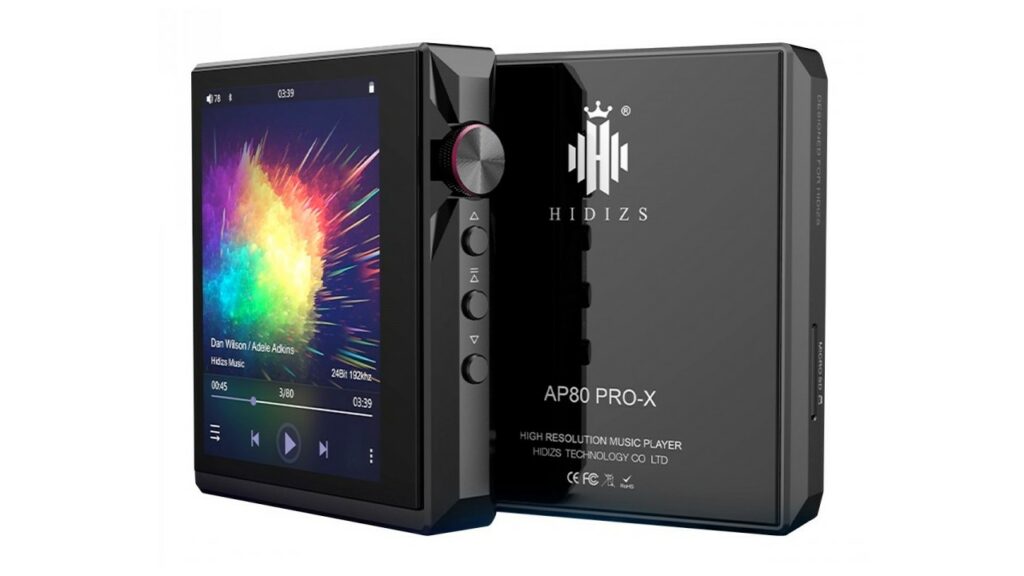
The AP80 PRO-X is the clear alternative for buyers who value size and price above everything else. At 61 x 54.5 x 13.8mm, it is dramatically smaller than the M3 Ultra, and its 800mAh battery keeps the chassis compact. The 2.45-inch IPS touchscreen is also a reminder that this is a pocket player first and a general-purpose smart device second.
Hidizs gives the AP80 PRO-X an unexpectedly serious digital specification for its class. It uses two ES9219C DACs, supports PCM up to 32-bit/384kHz and DSD256, and includes an HBC3000 FPGA for clock processing and native DSD support. The source also lists MQA 8X support, an output level of up to 2Vrms and analog gain control intended to reduce output noise.
Connectivity is well judged for such a small product. There are 3.5mm and balanced outputs, bidirectional Bluetooth 4.2, and support for aptX, LDAC and UAT. The supplied material describes the balanced battery life as 6–8 hours and single-ended use as 8–11 hours, so it cannot match the M3 Ultra’s endurance. Its operating system is HiBy OS 3.0 rather than Android, and the source does not present it as a Google Play streaming device.
That is the key difference, not a defect. The AP80 PRO-X makes sense when a small local-music player with high-resolution support and Bluetooth is more important than a large screen, Android apps or long balanced playback. At $172, it is also the easiest recommendation for a first DAP or a backup player. It is Best Value because it delivers a substantial feature set at a fraction of the M3 Ultra’s price, while accepting a smaller display, shorter battery life and a less expansive software environment.
Shanling M5 Ultra
SOURCE 3 uses
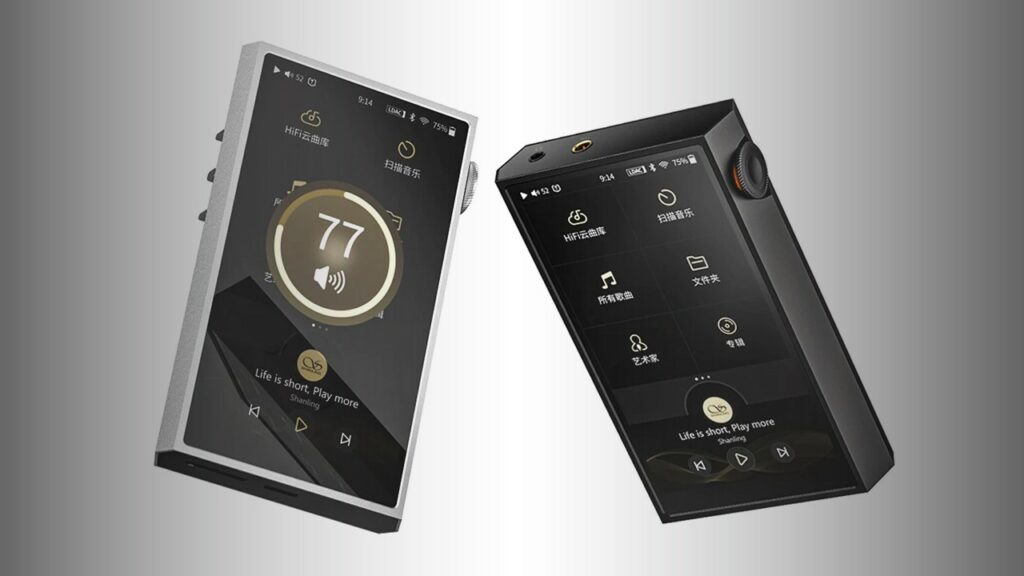
The M5 Ultra is the portable choice for listeners who need considerably more amplifier authority than the M3 Ultra or AP80 PRO-X provide. Its balanced output is rated at 1100mW at 32 ohms, compared with 260mW for the M3 Ultra. It also offers 315mW single-ended at 32 ohms. Those figures make the M5 Ultra the most convincing option in this group for users whose headphones need more power, although the supplied material does not provide a direct headphone-matching test.
Its digital architecture is correspondingly more ambitious: an AKM AK4499EX DAC and AK4191 modulator, an Ingenic X2000 platform, PCM support up to 32-bit/768kHz and DSD512 support. The M5 Ultra also supports USB DAC operation, DLNA, AirPlay, NAS and OTA updates, with Bluetooth 5.2 offering bidirectional LDAC, aptX HD, aptX and AAC. A Tidal Online Streaming app is described as coming with a firmware update.
Unlike the Android-based M3 Ultra, the M5 Ultra uses Shanling’s proprietary MTouch system. That may appeal to buyers who prefer a focused player interface, but it means the two devices approach streaming and app access differently. The M3 Ultra is explicitly described as offering Google Play access and Roon certification; the M5 Ultra’s supplied feature list instead concentrates on network playback, Bluetooth, DLNA, AirPlay and the forthcoming Tidal app.
The M5 Ultra is larger and heavier than the M3 Ultra at 120 x 75 x 19.5mm and 247g. Its battery is rated for up to 11 hours, again less than the M3 Ultra’s quoted balanced figure. The source describes its sound as smooth and slightly warmed-up, with deep sub-bass, a rich soundstage and plenty of detail. That combination of power, high-end conversion hardware and stated presentation makes it the most persuasive choice for high-power portable listening, but it is more player than many people need.
Shanling M7T Master
SOURCE 4 uses
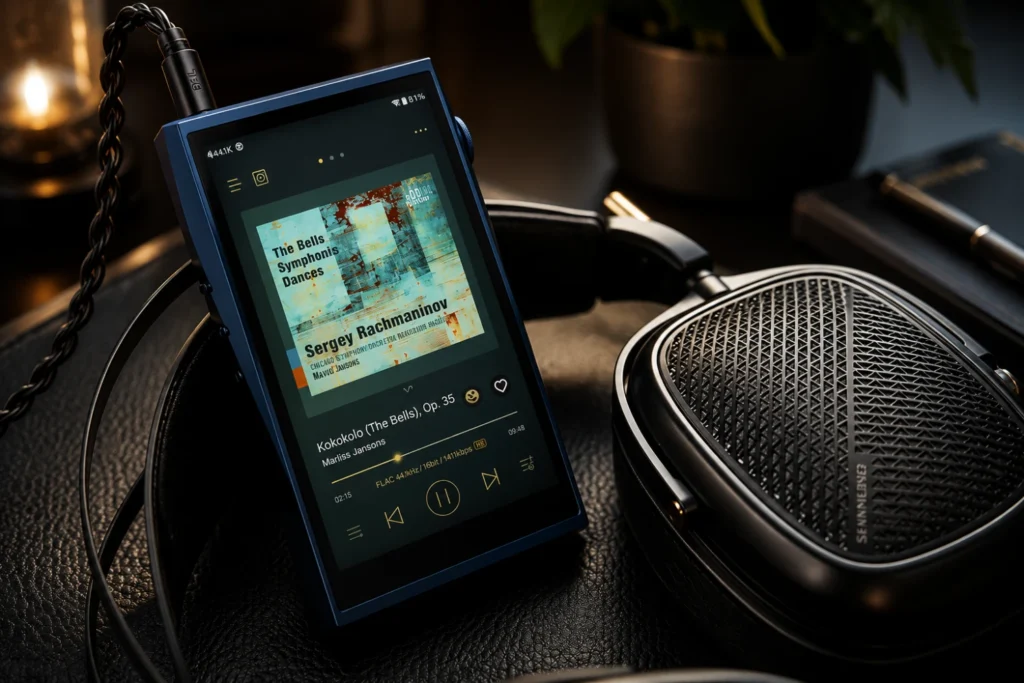
The M7T Master is the specialist option. It is not a ground-up platform change, and Shanling positions it as an interim update to the M7T. The dual AK4498EX DAC arrangement and AK4191 digital filter and delta-sigma modulator remain, as do the pair of miniature JAN6418 vacuum tubes. The important changes are in the amplifier section, internal audio wiring and balanced output stage.
That tube-equipped design gives the M7T Master a distinct identity that none of the other portable models can match. Shanling says the original neutral and straightforward character has been retained, while the Master edition is intended to sound more saturated, substantial and relaxed. The source appropriately notes that the practical result will depend on headphones, output choice and listener preference.
The balanced output is more powerful than that of the standard M7T, but the supplied announcement does not provide output figures. It therefore cannot be compared numerically with the M3 Ultra or M5 Ultra. Nor is a USD price supplied, although Shanling says the recommended pricing remains in line with the standard M7T.
For most buyers, those missing details make the M7T Master harder to recommend as the default choice. For the right buyer, however, they are less important than the hardware concept. Choose it if the combination of portable hi-res playback, dual tubes and a revised, fuller audio path is the reason you are shopping. It is not the obvious choice for someone primarily seeking the broadest software platform, the lowest price or the most clearly documented output power.
Shanling EA5
SOURCE 5 uses
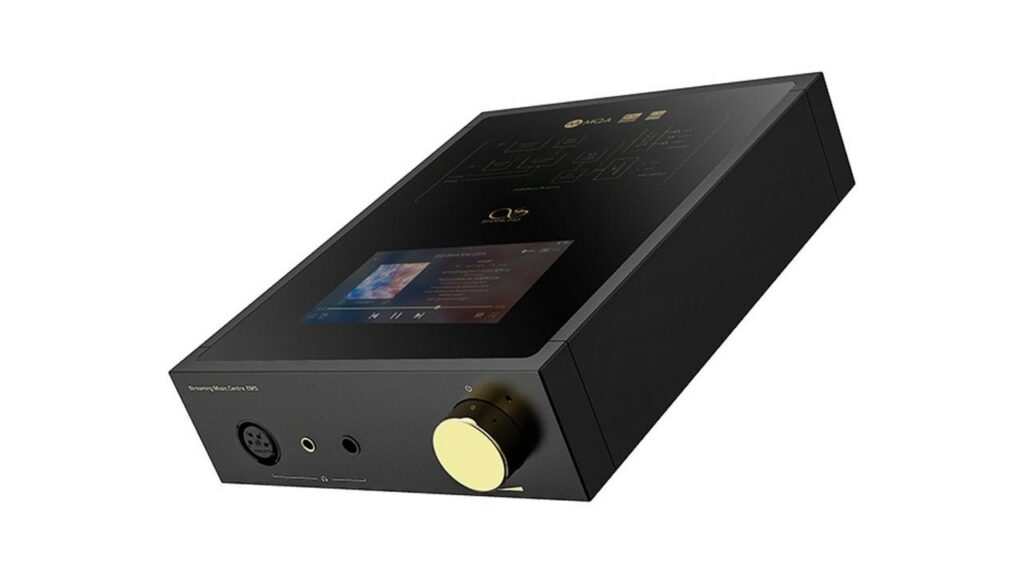
The EA5 should not be treated as a direct rival to the four portable players. It is a desktop music centre, measuring 238 x 188 x 55mm, with a 4.7-inch 720p touchscreen and a closed custom Android system with built-in streaming apps. Its defining advantage is that it contains two amplifiers: a 570mW headphone amplifier through a full-size 6.35mm output and an Abletec Class D speaker amplifier rated at 50W per channel into 4 ohms.
That makes the EA5 the most flexible product here for a compact desktop system. It can switch between headphones and passive speakers, work as a standalone DAC, feed a separate amplifier as a pure DAC or preamp, and operate as an integrated amplifier connected to a separate DAC. It also supports Bluetooth as both a receiver and a source.
The connection list is much more extensive than on the portable DAPs: USB, coaxial, optical, LAN and an external USB drive are listed as digital inputs, while RCA is available for analog input and preamp output. Wi-Fi, DLNA and AirPlay are supported, and the unit can access music from a MicroSD card, hard drive or local network.
The EA5 is priced at $939. That is justified only if its desktop functions are useful to you; it makes little sense to pay for a speaker amplifier when your priority is a player for walking, commuting or travel. Conversely, if you need one box for streaming, headphones, speakers, DAC duties and preamp operation, the EA5 is the most capable fit in this comparison.
How they differ
Portability: The AP80 PRO-X is the smallest and lightest option listed, while the M3 Ultra remains genuinely compact at 200g. The M5 Ultra is larger and heavier, the M7T Master is described as portable but lacks supplied dimensions, and the EA5 is a desktop component rather than a carry-around player.
Software and streaming: The M3 Ultra has the clearest general-purpose software proposition, with Android 10, Google Play, dual-band Wi-Fi, Roon certification and Tidal MQA decoding. The M5 Ultra uses MTouch and offers DLNA, AirPlay, NAS and a Tidal app planned through a firmware update. The AP80 PRO-X uses HiBy OS 3.0, while the EA5 uses closed custom Android with built-in streaming apps. The M7T Master source focuses on its audio-path revision rather than detailing an operating system or streaming platform.
Power: The M5 Ultra leads the portable players on the supplied output figures, with 1100mW balanced at 32 ohms. The EA5 is in a different category but offers 570mW for headphones and 50W per channel for speakers. The M3 Ultra’s 260mW balanced output suits its IEM-focused brief, while the AP80 PRO-X is designed around compact portability. No numerical M7T Master output specification is supplied.
Battery life: The M3 Ultra has the strongest quoted portable endurance in balanced use at up to 14.5 hours, ahead of the AP80 PRO-X’s 6–8 hours and the M5 Ultra’s up to 11 hours. The M3 Ultra also quotes up to 45 hours over Bluetooth. No battery figure is supplied for the M7T Master, and the EA5 is a mains-powered desktop product in practical terms.
System role: The AP80 PRO-X, M3 Ultra, M5 Ultra and M7T Master are portable players. The EA5 is a system-building component. That single distinction should eliminate the EA5 for buyers who need something pocketable, and eliminate the portable DAPs for anyone who specifically wants integrated speaker amplification.
Which one should you buy?
- Buy the Shanling M3 Ultra if you want one portable player that covers local files, streaming, Bluetooth, external DAC use and Roon, with both 3.5mm and 4.4mm outputs. It is the best default recommendation, especially for IEM users.
- Buy the Hidizs AP80 PRO-X if the player must be as small and inexpensive as possible. Its $172 price and 61mm-wide chassis are compelling, provided you can live with HiBy OS, the smaller screen and shorter battery life.
- Buy the Shanling M5 Ultra if your priority is output power, higher-end conversion hardware and a feature-rich portable source for more demanding headphones. Its size, weight and shorter battery life are the trade-offs.
- Buy the Shanling M7T Master if you specifically want the character and design interest of dual JAN6418 vacuum tubes, together with Shanling’s revised amplifier and balanced stage. It is a preference-led purchase rather than the broadest-value choice.
- Buy the Shanling EA5 if your listening happens at a desk and you want one component to drive both headphones and passive speakers. Its 50W-per-channel speaker amplifier is the decisive feature.
Final verdict
The Shanling M3 Ultra is the Best Overall DAP in this group because it offers the most complete balance of portability, battery life, Android-based streaming, connection flexibility and price. The AP80 PRO-X is the smarter budget miniature, the M5 Ultra is the stronger high-power portable choice, the M7T Master is for tube enthusiasts, and the EA5 is the right answer for a desktop system. Choose according to the system you are building, but start with the M3 Ultra if you want the least compromised all-round player.


Join the discussion
Share your thoughts, listening impressions or product experience.