


This comparison is necessarily a little different from a normal model-versus-model shootout.
The supplied source material contains one specific AV receiver, the McIntosh MHT300, and one broader explanatory article that defines what an AV receiver is and how it differs from stereo amplification.
Rather than inventing a second model, this article compares the McIntosh MHT300 with the conventional AV receiver concept described in the source material: a home-theater-focused receiver with a built-in tuner, multichannel amplification, subwoofer output, surround decoding, and video-source switching. That makes the comparison useful for readers deciding whether the MHT300’s high-end, single-box home-theater approach is the right kind of AV receiver for them, or whether their needs are adequately met by the general AV receiver role as defined by the category itself. The key distinction is that the McIntosh is presented as an ambitious, high-power, premium home theater receiver with 7.2 or 5.2.2-channel operation, Dolby Atmos and DTS:X support, HDMI connectivity for 4K/8K video standards, and a distinctive McIntosh build and interface. A conventional AV receiver, by contrast, is described more generally as a component designed to anchor a home cinema system: it has at least five amplifier channels, a subwoofer output, surround-sound decoding, video switching, and can also play music, though the source article notes that an AV receiver generally does not match a stereo amplifier at the same price level for music sound quality. Because the second source is not a product review, the verdict cannot fairly declare that the McIntosh beats every AV receiver in every circumstance. The evidence does, however, support a clear conclusion: the McIntosh MHT300 is the more advanced and better-specified choice among the two compared options when the goal is a premium AV receiver for serious home theater, while a conventional AV receiver remains the broader, more flexible category choice for buyers who simply need the core functions of surround decoding, amplification, subwoofer integration, and video switching.
At a glance
The McIntosh MHT300 is a specific high-end AV receiver built around 7.2-channel amplification, convertible 5.2.2 Dolby Atmos and DTS:X operation, claimed 120 watts per channel into 8 ohms and 150 watts into 4 ohms, with the article emphasizing that this output is available across all channels.
It also includes HDMI connectivity compatible with 8K UHD at 60 fps and 4K UHD up to 120 Hz, plus HDR10+, Dolby Vision and HLG support, while lacking some HDMI 2.1 gaming features such as QMS, VRR and ALLM.
A conventional AV receiver, as defined in the companion source article, is a multichannel home-theater component with a tuner, at least five amplifier channels, a subwoofer output, surround decoding, and video-source switching. The MHT300 is best viewed as a premium execution of the AV receiver idea; the conventional AV receiver is the baseline concept. Choose the McIntosh if you want the supplied article’s strongest evidence for a powerful, premium, single-box cinema receiver. Choose the conventional AV receiver path if you are comparing needs at the category level and mainly require the essential AV receiver functions rather than the specific McIntosh design, power claims and feature set.
McIntosh MHT300
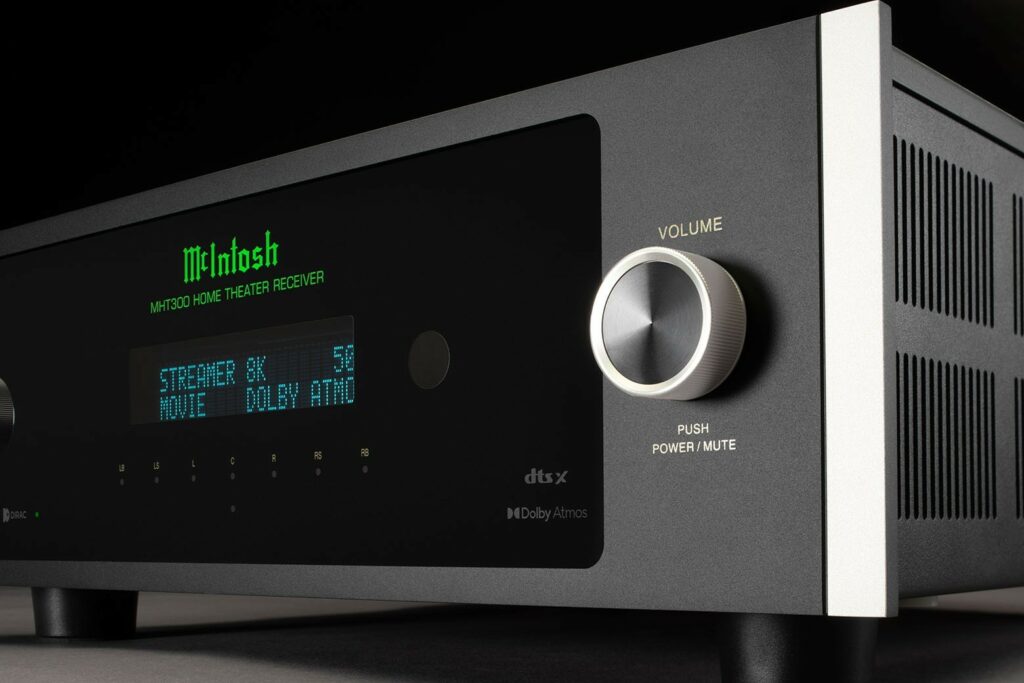
The McIntosh MHT300 is presented as a high-end home theater receiver intended to bring McIntosh’s home cinema experience into one device.
It offers 7.2 channels of amplification or 5.2.2-channel use for Dolby Atmos and DTS:X soundtracks, with pre-outs available for expansion in combination with a power amplifier to create a larger system.
The article highlights its claimed 120 watts per channel into 8 ohms and 150 watts into 4 ohms, noting that the receiver can deliver its rated power across all channels. Its video section includes four HDMI inputs and one HDMI output compatible with 8K UHD at 60 fps and 4K UHD up to 120 Hz, along with HDR10+, Dolby Vision and HLG. The design uses an anodized aluminum cabinet, two large front-panel knobs, a backlit central display, and a remote control.
Strengths
- Specific high-end AV receiver rather than a generic category description
- 7.2-channel amplification, convertible to 5.2.2-channel use for Dolby Atmos and DTS:X
- Pre-outs allow use with an additional power amplifier for an expanded system
- Claimed 120 watts into 8 ohms and 150 watts into 4 ohms, with the source emphasizing power delivery across all channels
- HDMI section supports 8K UHD at 60 fps and 4K UHD up to 120 Hz
- Compatible with HDR10+, Dolby Vision and HLG
- Distinctive McIntosh design with anodized aluminum cabinet, dual front knobs, backlit display and remote control
Considerations
- The source states that its HDMI 2.1-compliant inputs and output do not support all HDMI 2.1-associated features, specifically QMS, VRR and ALLM
- It has four HDMI inputs and one output, which may matter to users with many video sources, though the source does not compare this count with rivals
- The source does not provide a price, room-correction details, streaming features, phono-stage details or measurements
- Although it can be used for music, the companion source notes generally that AV receivers do not usually match stereo amplifiers at the same price level for music sound quality
Best for: Home theater users who want a premium, single-box AV receiver with strong multichannel power claims, Dolby Atmos and DTS:X support, modern UHD video compatibility, and the McIntosh design approach.
Conventional AV Receiver

The companion source article defines an AV receiver as a home-theater component rather than a pure stereo product.
Its built-in tuner explains the word receiver, but the article stresses that the most important aspects are multichannel amplification, a subwoofer output, surround-sound format decoding, and the ability to switch video sources.
It says an AV receiver has at least five or more amplifier channels and is designed for creating a home theater system. It can also be used for music listening, but the article states that the sound quality of an AV receiver is generally not as good as that of a stereo amplifier in the same price range. This entry therefore represents the baseline AV receiver concept against which the McIntosh MHT300 can be understood.
Strengths
- Purpose-built for home theater rather than only two-channel listening
- Includes multichannel amplification, described as at least five or more channels
- Includes a subwoofer output
- Includes surround-sound format decoders needed for home theater use
- Allows switching between video signal sources
- Can also be used for music listening
- The built-in tuner is part of the receiver concept
Considerations
- The source provides no specific model, brand, price, power rating, HDMI capability, room-correction system or measured performance
- The source states that AV receiver sound quality is generally not as good as a stereo amplifier in the same price range for music listening
- The source article’s discussion of AV receivers is definitional, not a review of a particular product
- The source article also notes, in the context of phono stages, that a basic phono module inside an AV receiver cannot rival high-end individual components
Best for: Listeners who need the essential AV receiver functions for a home theater system: multichannel amplification, subwoofer integration, surround decoding, video switching and tuner functionality.
Head-to-head comparison
Design and build
The McIntosh MHT300 is the only product here with specific design and construction details in the supplied sources.
The article describes an anodized aluminum cabinet and a front panel that combines elements associated with McIntosh components such as the MEN220 equalizer and C49 CD player.
It has two large knobs for source selection and volume adjustment. Instead of the usual dial indicators, it uses a backlit display in the center to show information such as source, video resolution or the audio track being played. A remote control is also included. By contrast, the conventional AV receiver source gives no chassis, materials, control layout or display description. It defines the AV receiver by function rather than by industrial design: tuner, multichannel amplification, subwoofer output, surround decoding and video switching. That leaves no evidence to compare build quality directly across named models. What can be said fairly is that the MHT300’s design and build are explicitly positioned as part of a premium McIntosh home-theater receiver, while the conventional AV receiver entry is a category definition without model-specific construction claims.
Edge: McIntosh MHT300, because the source provides concrete premium build and interface details while the conventional AV receiver source provides only a functional definition.
Features and usability
Both options share the core AV receiver idea: they are intended for home theater rather than simple two-channel amplification.
The conventional AV receiver article explains the foundation clearly: an AV receiver has a built-in tuner, a multichannel amplifier with at least five channels, a subwoofer output, surround-sound decoders and video-source switching.
The McIntosh MHT300 builds on that concept with a defined configuration: 7.2 channels of amplification, convertible to 5.2.2 channels for Dolby Atmos and DTS:X tracks. For more complete installations, the article says it has pre-outs that can be used with a power amplifier to create a 7.2.4-channel system. On the video side, it has four HDMI inputs and one output. These are described as compatible with 8K UHD at 60 fps and 4K UHD up to 120 Hz, with HDR10+, Dolby Vision and HLG support. However, the source specifically warns that although the HDMI inputs and output are HDMI 2.1 compliant, they do not support all features associated with that standard, including QMS, VRR and ALLM gaming technologies. In usability terms, the MHT300’s dual knobs, backlit display and remote give it a described user interface; the conventional AV receiver source does not offer model-level usability detail. The MHT300 therefore offers more documented capability, but gamers who specifically want VRR, ALLM or QMS should note the stated limitation.
Edge: McIntosh MHT300 for documented surround, expansion and video features; conventional AV receiver only if the buyer is evaluating the general AV receiver role and does not require the MHT300’s specific feature set.
Sound and performance
The sound and performance comparison must be handled carefully because the source material does not include listening impressions, bench measurements or a direct shootout.
The strongest performance evidence belongs to the McIntosh MHT300.
The article states that it delivers 120 watts into 8 ohms and 150 watts into 4 ohms, and emphasizes that, unlike many amplifiers whose rated power may be specified in stereo or with only one channel driven, the MHT300 is capable of delivering this power across all of its channels. The article further states that this means it can easily power demanding cinema speakers. It supports Dolby Atmos and DTS:X in 5.2.2-channel operation, or 7.2-channel amplification for other layouts. The conventional AV receiver source provides the broader performance purpose: an AV receiver is designed to create a home theater system using multichannel amplification, surround decoders and subwoofer output. It also cautions that while an AV receiver can be used for music, its sound quality is generally not as good as a stereo amplifier in the same price range. That caution applies to the category in general and should not be stretched into a model-specific criticism of the McIntosh beyond the fact that it too is an AV receiver. For cinema performance based on the supplied evidence, the MHT300 is clearly the more substantiated option. For two-channel music, neither source provides a direct MHT300 comparison against a stereo amplifier, so the safest conclusion is that home theater is the MHT300’s documented strength, while music-first buyers should remember the general limitation of AV receivers noted in the source article.
Edge: McIntosh MHT300 for home theater power and documented surround capability; no evidence is supplied to claim it surpasses a dedicated stereo amplifier for music.
Value
No prices are supplied for either option, so value cannot be assessed in the usual cost-versus-performance sense.
What the sources do allow is a value-by-use-case comparison.
The McIntosh MHT300 concentrates a premium home theater receiver approach into one device, with specified multichannel power, Dolby Atmos and DTS:X support, UHD video compatibility, HDR format support, pre-outs for system expansion, and distinctive McIntosh design. For users who want those specific capabilities and the convenience of a single receiver, the MHT300 has strong functional value within the evidence provided. The conventional AV receiver offers value at the conceptual level: it is the type of product that provides the essential home-theater functions of multichannel amplification, subwoofer integration, surround decoding and video switching. Because the source does not identify a model, price or specification set, it is impossible to say whether a conventional AV receiver is better value than the MHT300. It may be the more appropriate purchase for someone who only needs core AV receiver functions, but that is a needs-based conclusion rather than a price-based one.
Edge: Depends. McIntosh MHT300 has stronger documented capability; a conventional AV receiver may be sufficient if the buyer only needs the basic AV receiver functions described in the source.
Ideal user
The McIntosh MHT300 is aimed at the reader who wants a serious home theater receiver with a premium identity and clearly defined multichannel capability.
It suits movie fans who want 7.2-channel amplification or 5.2.2 Dolby Atmos and DTS:X playback, users with modern UHD video sources, and system builders who may later use pre-outs with an additional amplifier for a larger installation.
It is also a fit for buyers who value the described McIntosh design: anodized aluminum construction, large physical controls and a central backlit display. The conventional AV receiver is better understood as the right choice for someone still defining their needs. If the priority is simply to understand or obtain the central hub of a home theater system, the category provides the necessary functions: tuner, multichannel amplification, subwoofer output, surround decoding and video switching. Music-first listeners should also note the general guidance from the source: stereo amplifiers are normally the more suitable comparison point when two-channel music quality is the priority at a given price level.
Edge: McIntosh MHT300 for premium home theater users; conventional AV receiver for buyers focused on the core AV receiver role rather than a specific high-end implementation.
Trade-offs and limitations
The MHT300’s main trade-off in the supplied article is not its home theater ambition but the specific boundaries of its feature set.
Its HDMI section supports important UHD and HDR formats, but the article states that it does not support QMS, VRR or ALLM, which are gaming-related technologies associated with HDMI 2.1.
It also has four HDMI inputs and one output; whether that is sufficient depends on the user’s number of sources, but the source does not compare this with alternatives. The conventional AV receiver entry has the opposite limitation: it supplies the definition of the category but no model-specific evidence. That makes it useful for understanding what an AV receiver does, but not enough for a normal feature-by-feature buying comparison. A further category-level trade-off is music playback. The source article says AV receivers can be used for music, but their sound quality is generally not as good as that of a stereo amplifier in the same price range. Therefore, both options should be considered primarily through a home-theater lens unless further model-specific music performance evidence is available.
Edge: Depends. The MHT300 has known, specific strengths and known HDMI gaming-feature omissions; the conventional AV receiver concept has broad relevance but lacks product-level detail.
Final verdict
Winner: McIntosh MHT300
The McIntosh MHT300 is the justified winner in this comparison, but with an important editorial caveat: the second source is not a rival product review, so this is not a claim that the MHT300 defeats every conventional AV receiver on the market.
It wins because, among the two supplied entries, it is the only specifically documented AV receiver and it provides substantially more evidence of high-end home theater capability.
The article gives concrete details: 7.2-channel amplification, 5.2.2-channel Dolby Atmos and DTS:X operation, pre-outs for expansion with a power amplifier, claimed all-channel power delivery, HDMI compatibility with 8K UHD at 60 fps and 4K UHD up to 120 Hz, HDR10+, Dolby Vision and HLG support, and a distinctive McIntosh physical design. The conventional AV receiver remains essential as a baseline concept. It explains what buyers should expect from the category: a tuner, at least five amplifier channels, subwoofer output, surround decoders and video switching. It also reminds readers that AV receivers are primarily home theater devices and that, for music at the same price level, a stereo amplifier is generally expected to offer better sound quality. That point is important for anyone considering an AV receiver as a music-first purchase. The most nuanced buying advice is this: choose the McIntosh MHT300 if you want the premium, specified, single-box home theater solution described in the source and its omission of QMS, VRR and ALLM is not a problem for your setup. Choose a conventional AV receiver path if you are still at the stage of needing core surround and video-switching functions and do not yet require the MHT300’s particular combination of power claims, McIntosh design and UHD video support. For the evidence supplied, however, the MHT300 is clearly the stronger and more complete AV receiver option.
Comparison FAQ
Is the McIntosh MHT300 a true AV receiver?
Yes.
The source article describes the McIntosh MHT300 as a home theater receiver with 7.2 channels of amplification, convertible to 5.2.2-channel use for Dolby Atmos and DTS:X.
It also includes HDMI video switching and home-theater-oriented features, which align with the companion article’s definition of an AV receiver as a multichannel component with surround decoding, subwoofer output and video-source switching.
How does a conventional AV receiver differ from a stereo amplifier?
According to the supplied explanatory article, a stereo amplifier is a two-channel device for listening to music from different sources.
A stereo receiver adds a built-in tuner, and modern stereo receivers may also include network streaming.
An AV receiver is different because it is built for home theater: it has a multichannel amplifier with at least five or more channels, a subwoofer output, surround-sound decoders and the ability to switch video signal sources.
Does the McIntosh MHT300 support the latest gaming features?
The McIntosh MHT300’s HDMI inputs and output are described as HDMI 2.1 compliant and compatible with 8K UHD at 60 fps and 4K UHD up to 120 Hz.
However, the source article specifically states that it does not support all features associated with HDMI 2.1, including QMS, VRR and ALLM gaming technologies.
Buyers who need those exact features should treat that as a significant limitation.
Should I buy the McIntosh MHT300 for music listening?
The supplied McIntosh article focuses on home theater power, Dolby Atmos and DTS:X, UHD video support and system expansion rather than detailed music listening impressions.
The companion article says that AV receivers can be used for music, but that their sound quality is generally not as good as that of a stereo amplifier in the same price range.
Based on the supplied evidence, the MHT300 should be viewed primarily as a premium home theater receiver, while music-first buyers should also consider the general advantages of dedicated stereo amplification.