
Cambridge Audio AXR85: Traditional Hi-Fi Made Flexible
The Cambridge Audio AXR85 combines a substantial stereo amplifier, MM phono stage, Bluetooth 5.0 and AM/FM radio in a deliberately straightforward design.

The Cambridge Audio AXR85 is built around a familiar and useful hi-fi idea: combine amplification, radio reception and practical source connectivity in one conventional component. It does not attempt to become an all-purpose network hub. Instead, its feature set concentrates on analog equipment, vinyl playback, Bluetooth streaming and everyday physical controls. That focus makes the AXR85 relevant to listeners assembling a traditional stereo system without wanting several separate boxes. Its 2 x 85-watt output, toroidal power transformer, discrete output stages and anti-resonance chassis also show that the underlying amplifier remains central to the design.
A substantial foundation for a stereo system
The AXR85 is rated at 85 watts per channel into 8 ohms and is intended for loudspeakers with a nominal impedance between 4 and 8 ohms. Those figures give prospective owners a clear basis for matching the receiver with a broad range of conventional passive speakers. Although wattage alone cannot describe how an amplifier will behave in every system, this output rating makes the AXR85 more than a compact convenience component.
Its power supply uses a custom-built toroidal transformer designed to provide substantial current while limiting electrical interference. Toroidal transformers are also physically well suited to integrated hi-fi products because they place the core of the power supply inside the same enclosure as sensitive low-level circuitry. Cambridge Audio complements this with discrete output stages derived from the design approach used in its higher-positioned Azur AV receivers.
The specified frequency range is 5 Hz to 50 kHz, while total harmonic distortion is listed as 0.01 percent at 1 kHz and 80 percent of rated power. A signal-to-noise ratio of 82 dB and damping factor of 50 complete the principal amplifier specifications. These numbers define the AXR85’s engineering parameters without changing its essential purpose: it is a full-size stereo receiver designed to form the center of a separate-component system.
Construction that reflects its amplifier-first approach
A robust metal case, sturdy aluminum front panel and anti-resonance chassis give the AXR85 a more substantial physical structure than its accessible positioning might suggest. The enclosure measures 110 x 430 x 340 mm and weighs 8.1 kg, so it should be treated as a full-width hi-fi component rather than a small desktop amplifier.
The anti-resonance construction is a relevant design choice for a receiver that accommodates a transformer, amplifier stages and a phono preamplifier in one chassis. It also provides a stable platform for the front-panel controls and rear connections. Owners will need to allow suitable shelf space and ventilation, particularly because maximum power consumption is specified at 500 watts.
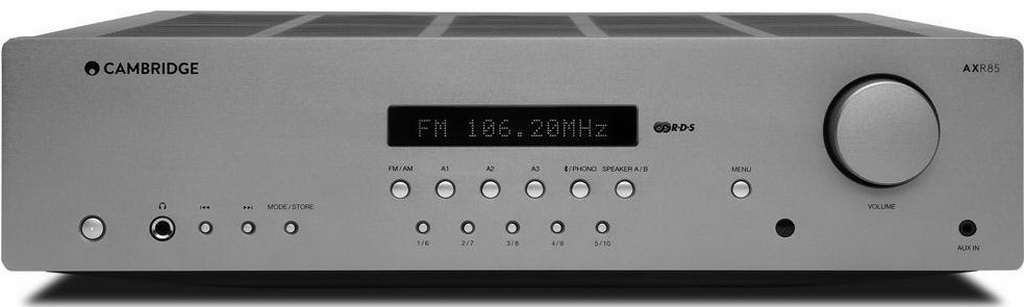
Cambridge Audio has kept the visual and operational design conventional. A clear display presents receiver information, while the controls are arranged to make common functions accessible without depending entirely on a handset. A fully operational remote control is nevertheless included for volume and source management from the listening position. This combination of direct controls and remote operation should appeal to users who prefer equipment that remains straightforward to use without an app.
Analog connectivity for old and new sources
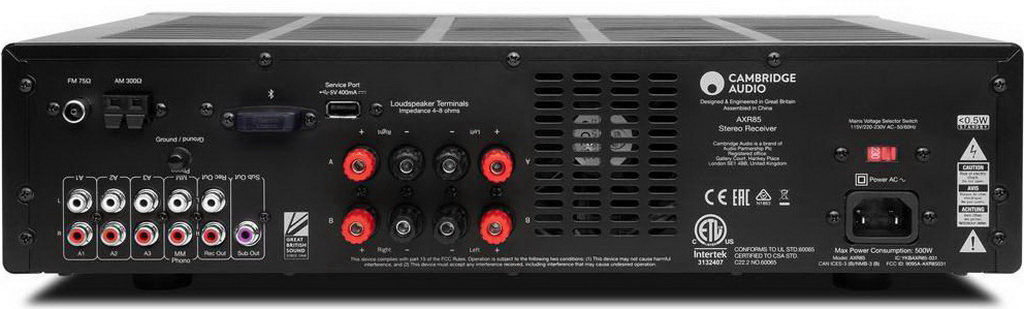
The AXR85 provides multiple rear line-level connections for components such as a CD player, external DAC or other analog source. A further front-panel input is intended for portable equipment, avoiding the need to reach behind the receiver whenever a temporary device is connected. This is a small but practical usability decision, especially in systems installed on shelving or inside furniture.
Vinyl playback is addressed by an integrated phono preamplifier for moving-magnet cartridges. A turntable fitted with a compatible MM cartridge can therefore be connected directly, with no separate phono stage required. For someone returning to records or building a mixed-format system, that reduces both cost and cable clutter. It is important that the input is specified for MM cartridges; owners of moving-coil designs would still need an appropriate external phono solution.
A line output allows the receiver to feed a recording device or another compatible line-level component. There is also a dedicated output for an active subwoofer. The latter creates a useful expansion path for systems that need additional low-frequency capacity, whether because of room size, speaker choice or listening preferences. The subwoofer must be self-powered, as the connection supplies a signal rather than amplified speaker power.
Private listening is supported through a full-size 6.3 mm headphone jack on the front panel. A rear five-volt USB connector is also provided. It should not be confused with a documented USB digital audio input: the stated specification identifies it as a five-volt connection rather than listing USB audio playback capability.
Bluetooth and radio without a network platform
Bluetooth 5.0 gives the AXR85 a simple wireless route for music, podcasts and other audio from a compatible phone, tablet or computer. It supports the A2DP and AVRCP profiles, allowing audio transmission and compatible playback control, with SBC listed as the supported codec. This is a convenience-oriented implementation rather than an elaborate high-resolution network streaming platform.
That distinction helps define the receiver’s role. Bluetooth allows visitors or household members to connect familiar devices quickly, but the AXR85 does not require owners to organize their listening around a proprietary application or network service. Dedicated streamers and other sources can still be added through the analog inputs when greater functionality is wanted.
The integrated tuner covers both AM and FM, with FM reception spanning 87.5 to 108 MHz. RDS support can display station-related information where broadcasters provide it, and as many as 30 presets can be stored. For listeners who continue to use terrestrial radio, these facilities remain meaningfully different from internet radio because they do not depend on a streaming account or home network.
Speaker connections and useful adjustment
Two sets of premium screw terminals provide secure connections for speaker cable and support bi-wiring configurations. Bi-wiring requires compatible loudspeakers with separate terminal sections, but the provision gives system builders more flexibility than a single basic pair of connectors. The recommended 4-to-8-ohm load range should still be observed when planning the speaker installation.
The AXR85 also includes bass and treble adjustments as well as stereo balance control. These features can be useful in real rooms, where speaker placement, furniture and unequal listening distances may make small corrections desirable. They can also help accommodate older recordings or compensate for a system that cannot be positioned symmetrically.
Importantly, these adjustments are implemented as conventional receiver controls rather than as part of a complex calibration system. That suits the AXR85’s wider design philosophy: provide enough flexibility to solve common setup issues while keeping operation recognizable and direct.
Who the Cambridge Audio AXR85 is for
The AXR85 is particularly suitable for someone who wants one component to handle amplification, an MM turntable, several analog sources, Bluetooth playback and broadcast radio. It also makes sense for a listener moving from an all-in-one unit toward separate passive speakers and source components, but who does not want to assemble a system from a standalone amplifier, phono stage, tuner and wireless receiver.
Its 85-watt-per-channel rating and active-subwoofer output make it adaptable to systems beyond a small desktop setup. The front auxiliary input, headphone socket, remote control and tone adjustments add everyday convenience without changing the receiver’s traditional character.
Conversely, users seeking integrated network streaming, advanced Bluetooth codecs or documented optical, coaxial and USB audio inputs will need to add an external source or consider a differently equipped product. Moving-coil turntable owners will also require additional phono hardware. The AXR85 is therefore best understood as an analog-centered stereo receiver with practical wireless access, not as a comprehensive digital control center.
Conclusion
The Cambridge Audio AXR85 brings together the functions many traditional stereo systems still need: 2 x 85-watt amplification, a custom toroidal transformer, discrete output stages, an MM phono preamplifier, AM/FM radio and a useful selection of analog connections. Bluetooth 5.0, a subwoofer output, headphone socket, tone controls and bi-wiring-capable terminals extend its flexibility without overwhelming the direct control scheme. Its strongest appeal is to listeners who value physical sources, vinyl and radio but also want easy wireless playback from a mobile device. For that audience, the AXR85 offers a focused and expandable foundation for a full-size hi-fi system.