
Amplifier choices for building a more capable hi-fi system
A practical guide to amplifier shopping, covering modular integrated amplification, monoblock power amps, tube and passive preamps, phono stages, active loudspeakers and powered subwoofers.

Shopping for amplifiers quickly becomes more complicated than choosing a single box with enough watts.
Integrated amplifiers, monoblock power amps, line preamps and phono stages all solve different problems, and the right choice depends on what is already in the system: source components, cartridge type, loudspeaker demands and the amount of control you want from the listening seat.
This guide brings together amplifier-focused products from the supplied Stereoindex source material, while also noting a few closely related active loudspeaker and subwoofer designs that include built-in amplification or place specific demands on system matching. The emphasis is practical: what each component is, what its architecture suggests, and where it fits in a serious hi-fi setup. The recommendations below avoid treating every product as interchangeable. A modular integrated amplifier such as the Mola Mola Kula serves a very different buyer from a pair of PS Audio monoblocks, a configurable AVM phono preamp, or a passive and active Hattor line stage. Use the distinctions here to narrow the field before thinking about cosmetics, rack space or future expansion.
1. Mola Mola Kula – Optional DAC and phono stage in balanced circuit with processor control

Mola Mola Kula integrated amplifier with optional DAC and phono expansion in a balanced, processor-controlled design.
The Mola Mola Kula is the most complete all-in-one amplifier proposition in this selection.
Its basic form is an integrated amplifier with six switchable analog line inputs, split between three balanced XLR and three unbalanced RCA connections.
The design is modular, allowing the amplifier to be supplemented with a phono stage and a DAC section based on the company’s Tambaqui design. That flexibility is the point of the Kula. It can sit at the center of a system built around analog sources, digital sources, or both, without forcing the buyer into every module at the outset. The source also highlights balanced circuitry, processor control, channel selection, phase inversion, mono summing and a Mastering operating mode. Power is specified by Mola Mola at up to 150 watts per channel into 8 ohms or 300 watts into 4 ohms.
Best for: Listeners wanting a modular integrated amplifier as the system hub
- Modular DAC and phono options
- Three balanced XLR and three RCA line inputs in basic form
- Processor control with phase inversion and mono summing
- Specified at up to 150 watts per channel into 8 ohms
Verdict: The Kula is the practical choice here for buyers who want high integration without giving up balanced analog connectivity or future module options.
2. Noble & Noble Nobilis Sonum 98: Antiphase Dual Midwoofers in Seven-way Enclosures
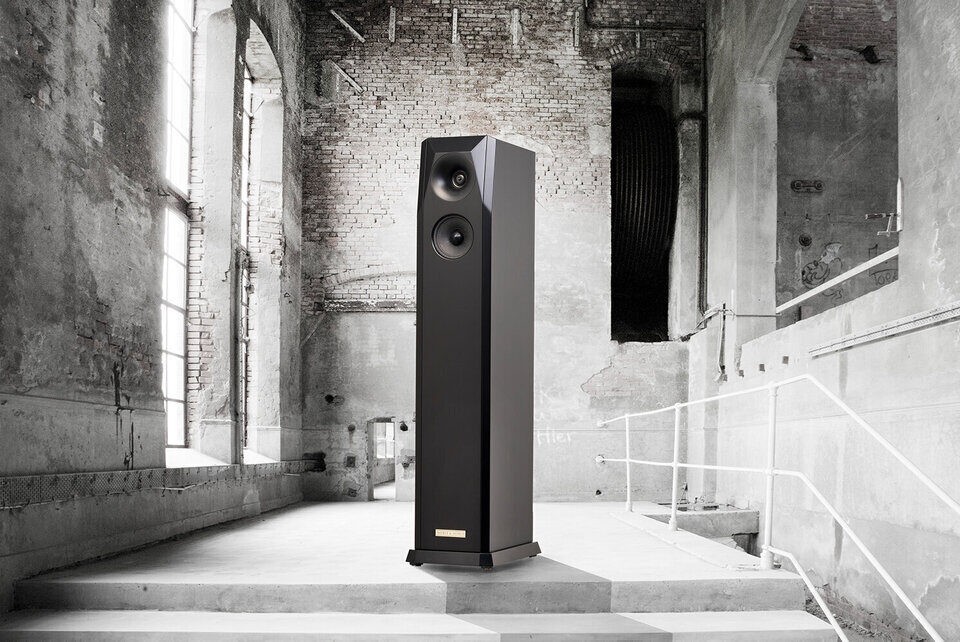
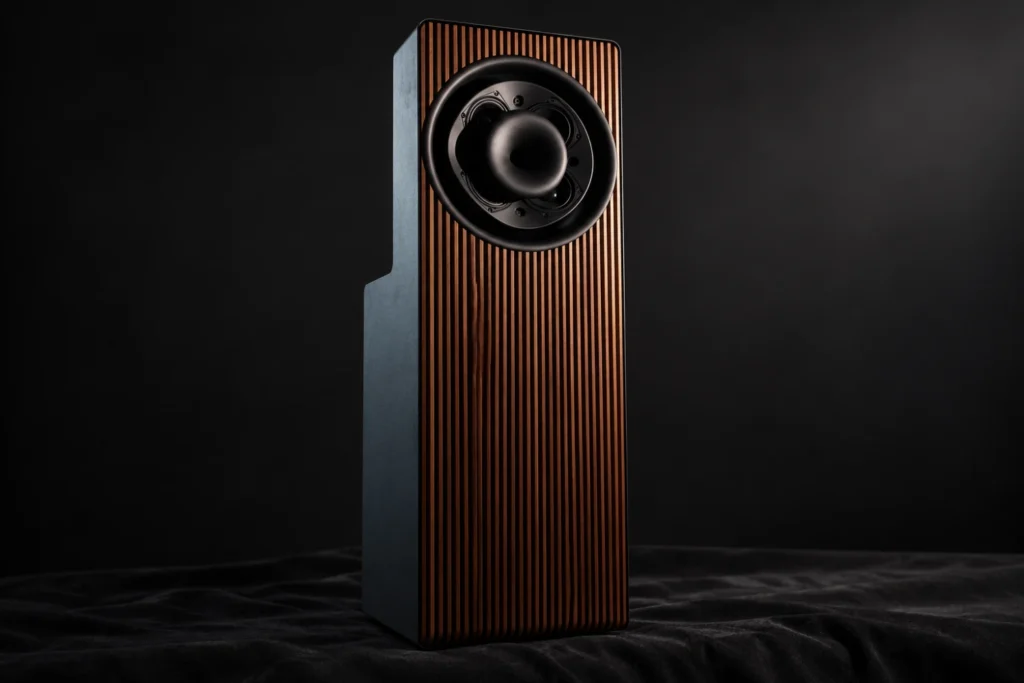
Noble & Noble Nobilis Sonum 98 floor-standing active loudspeaker with a seven-sided enclosure and built-in amplification.
The Noble & Noble Nobilis Sonum 98 is not a conventional standalone amplifier, but it is relevant to amplifier shoppers because amplification is built into the speaker system itself.
The source describes floor-standing acoustics with built-in amplifiers, DSP, three digital inputs and two analog inputs, controlled by a small wireless remote.
Its cabinet concept is the headline feature. The seven-sided enclosure and L-shaped front structure are designed to resist unwanted vibration, while the low-mid-frequency driver arrangement uses two tightly coupled drivers operating in antiphase to neutralize parasitic vibrations. For a buyer considering whether to separate electronics and speakers, this is the integrated active-system alternative in the list.
Best for: Buyers considering an active floor-standing speaker system instead of separate amplification
- Built-in amplifiers with DSP
- Three digital and two analog inputs
- Antiphase dual-midwoofer structure targets parasitic vibration
- Wireless remote control included
Verdict: The Nobilis Sonum 98 suits listeners who want amplification, DSP and speaker engineering combined in one controlled platform rather than assembled from separate boxes.
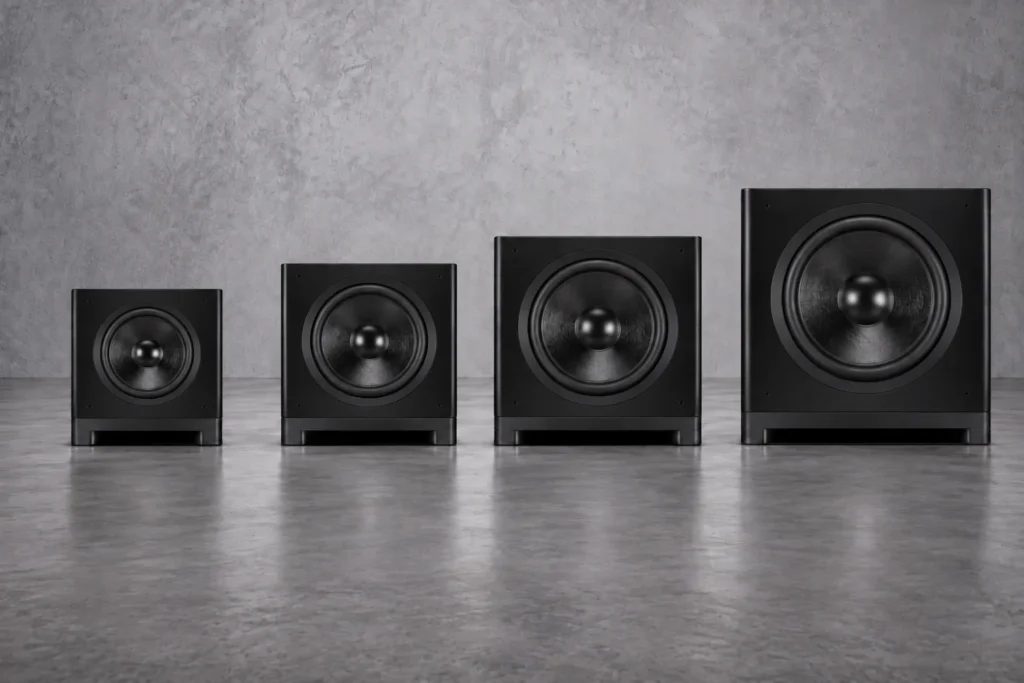
3. Klipsch unveils four new Reference Premier subwoofers and I want one!
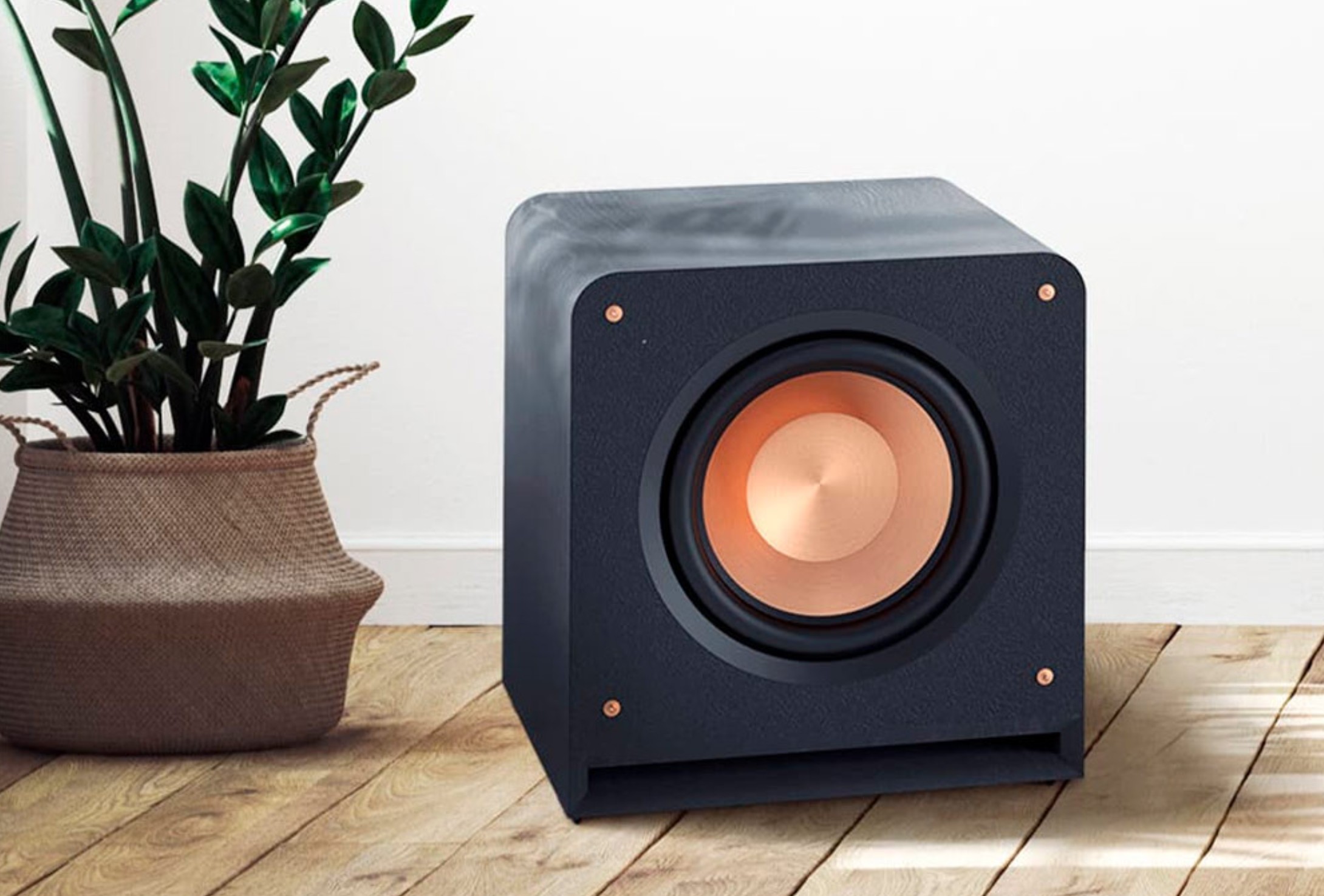
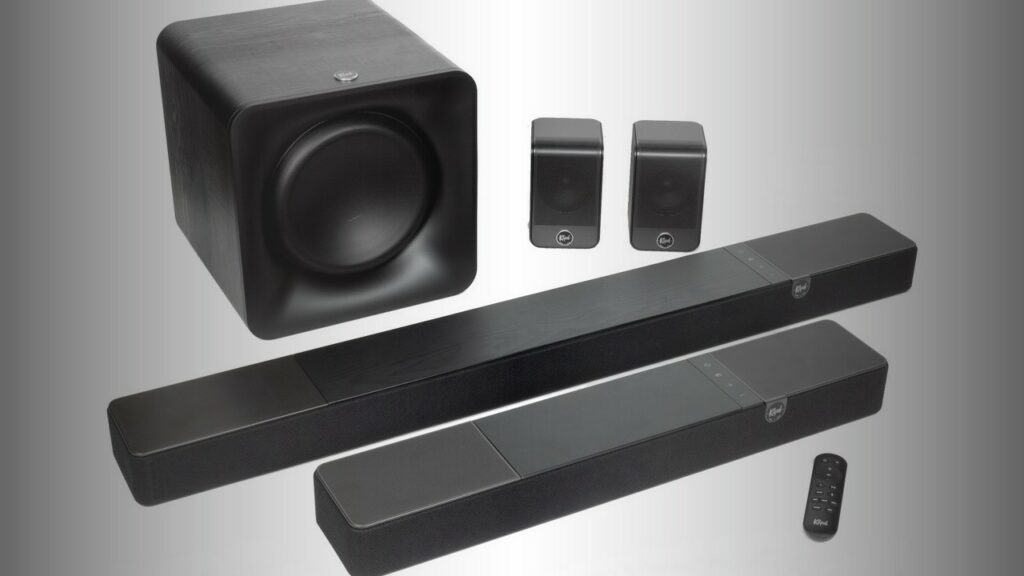
Klipsch Reference Premier active subwoofer range with built-in Class D amplification and front slotted bass-reflex ports.
Klipsch’s Reference Premier subwoofers are included here because each model is an active design with its own Class D amplifier.
The range covers four cabinet and driver sizes, using 10-inch, 12-inch, 14-inch and 16-inch woofers, with amplifier peak capability described from 600 watts in the smallest model to 1.6 kW in the largest.
The subwoofers use Klipsch Cerametallic cones, front-mounted Aerofoil slotted bass-reflex ports and thick MDF cabinets on shock-absorbing feet. Wired RCA connection is supported, while wireless operation is possible with the optional Klipsch WA-2 subwoofer kit. For amplifier buyers, the practical takeaway is simple: bass reinforcement here is self-powered, so the main amplifier does not need to drive the subwoofer directly.
Best for: Systems needing self-powered low-frequency reinforcement
- Active subwoofers with built-in Class D amplification
- Four driver sizes across the range
- RCA connection with optional wireless operation
- Front Aerofoil slotted bass-reflex port design
Verdict: The Reference Premier subwoofers are a straightforward route to powered bass extension without adding extra load to the main stereo amplifier.
4. Boulder 851 & 808 Expand the 800 Series with Compact High-End Performance
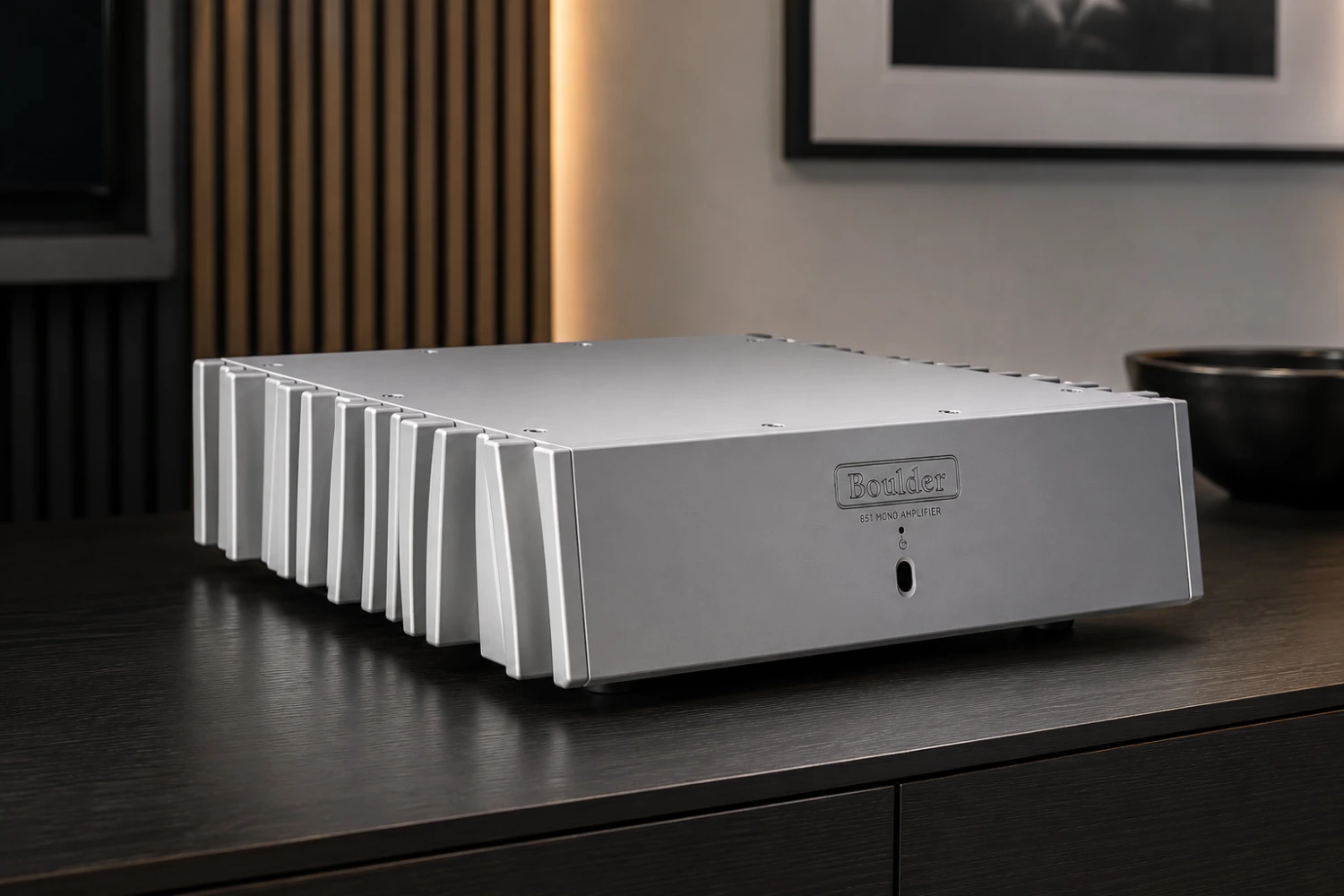
Boulder 851 monoblock power amplifier and 808 MM/MC phono preamplifier designed for compact 800 Series systems.
Boulder’s 851 monoblock power amplifier and 808 MM/MC phono preamplifier extend the company’s 800 Series with compact components intended for high-end systems.
The 851 is a single-channel power amplifier based on engineering principles developed for the Boulder 861 stereo power amplifier, while the 808 serves vinyl users with moving-magnet and moving-coil cartridge support.
The 851 is specified at 100 watts into 8 ohms and 200 watts into 4 ohms, with peak power up to 350 watts into demanding 2-ohm speaker loads. The source also notes Boulder’s Smart Current output stage, described as intended to provide wider bandwidth, lower distortion and improved current delivery. Together, the 851 and 808 speak to buyers building a compact but separates-based high-end system.
Best for: High-end separates systems needing compact monoblock amplification
- Compact 800 Series monoblock format
- Specified at 100 watts into 8 ohms and 200 watts into 4 ohms
- Stable enough for peak power into demanding 2-ohm loads
- Companion 808 phono preamp supports MM and MC cartridges
Verdict: The Boulder 851 is the focused power-amplifier pick for listeners who want one amplifier channel per chassis without moving to oversized components.
5. AVM Expands Evolution Series With PH 3.3 and PH 5.3 Phono Preamps
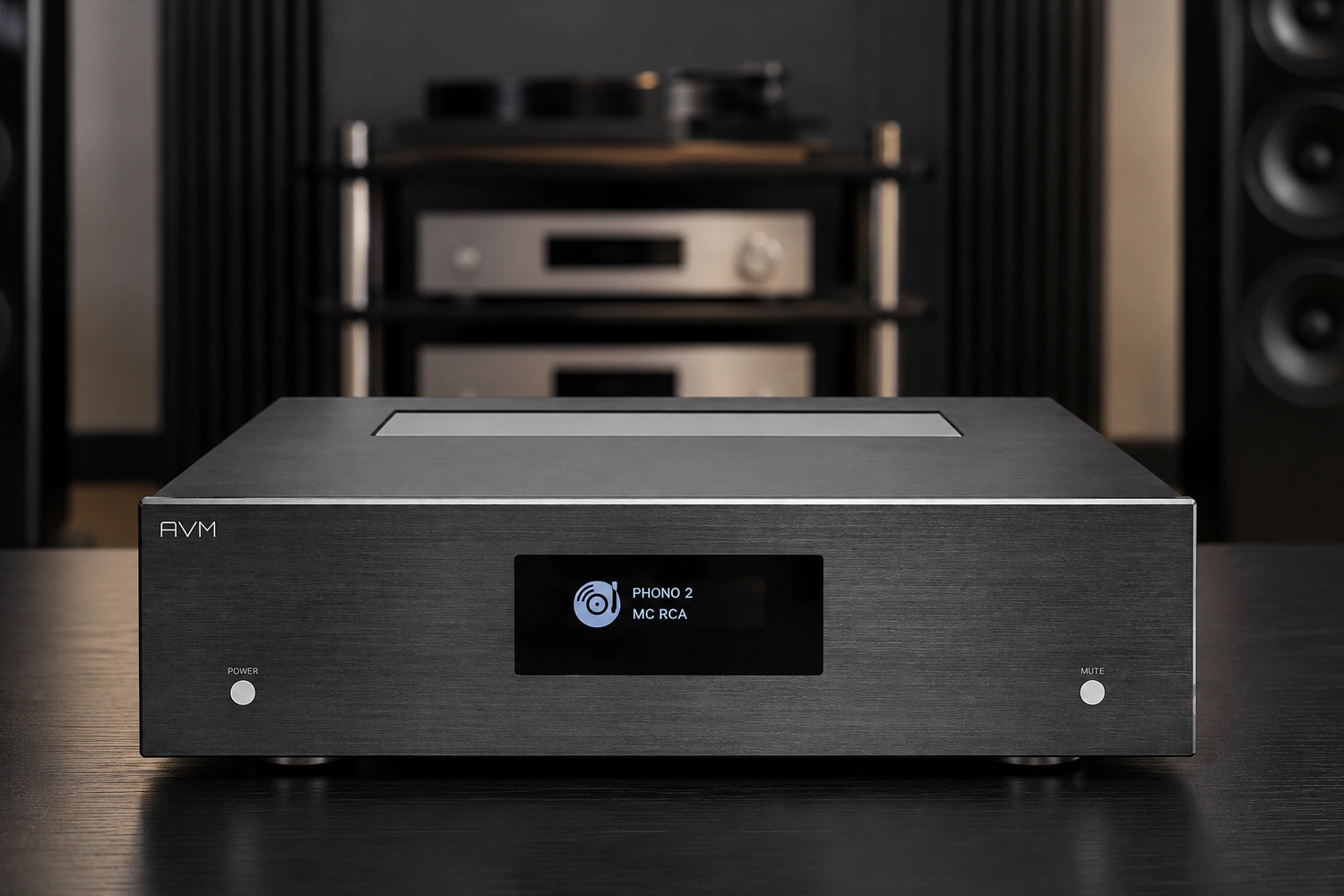
AVM PH 3.3 and PH 5.3 phono preamplifiers with configurable cartridge settings and different final-stage architectures.
AVM’s PH 3.3 and PH 5.3 are phono preamplifiers rather than power amplifiers, but they are central to any vinyl system that needs proper cartridge matching before the signal reaches a line preamp or integrated amplifier.
The two models share core controls, connection options and a modular expansion system, while differing in the final gain stage.
The PH 3.3 uses a transistor-based final stage developed with attention to low noise, while the PH 5.3 uses a tube circuit for final amplification. Both provide five sensitivity settings and allow cartridge-related adjustments from the listening seat. That makes them especially relevant for systems using more than one cartridge type or for listeners who value adjustability without repeated trips to the equipment rack.
Best for: Vinyl listeners needing configurable MM/MC phono amplification
- Choice of transistor or tube final gain stage
- Five sensitivity settings
- Settings can be changed from the listening seat
- Modular expansion system shared by both models
Verdict: The AVM pair offers a clear transistor-versus-tube choice while keeping the same broad adjustment concept across both models.
6. Riviera Audio Labs unveils the APL1 tube preamplifier
Riviera Audio Labs APL1 tube preamplifier with Class A operation, transformer-coupled outputs and remote volume control.
The Riviera Audio Labs APL1 is a tube line preamplifier operating in Class A.
Compared with the more compact APL10, the source notes that the APL1 adds a tape loop and an additional XLR input, while its larger enclosure allows a bigger power supply and a more complex capacitor mix.
Connectivity is generous for a line stage: the APL1 provides two pairs of RCA outputs and one XLR output, all usable simultaneously with the same gain factor. It uses output transformers for both RCA and XLR outputs, offers relay input switching, includes a remote control for volume, and has dimmable front-panel LEDs. The supplied JJ Electronic tubes can be replaced with other matched pairs, though the source notes this may alter tonality.
Best for: Systems needing a Class A tube preamplifier with flexible outputs
- Tube circuit operating in Class A
- Tape loop and additional XLR input compared with APL10
- RCA and XLR outputs can be used simultaneously
- Remote volume control and relay input switching
Verdict: The APL1 is a serious line-stage option for listeners who want tube architecture, balanced connectivity and practical system-control features.
7. PS Audio Expands PMG Signature Line With M400 and M800 Monoblocks
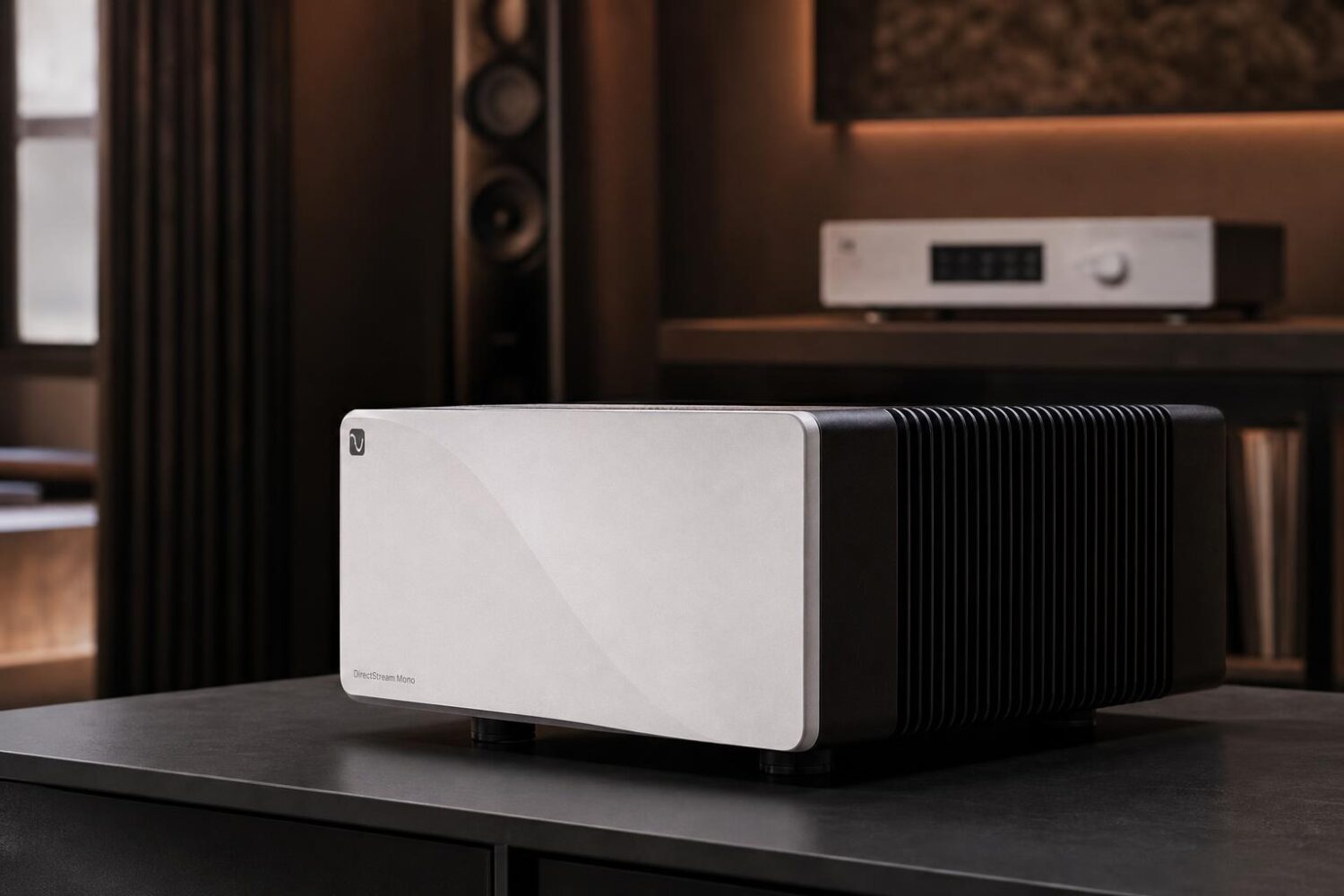
PS Audio Signature PMG M400 and M800 monoblock power amplifiers for one-channel-per-chassis systems.
PS Audio’s Signature PMG M400 and M800 are dedicated mono power amplifiers in the PMG Signature range.
Each chassis drives one channel, giving each loudspeaker its own amplifier rather than sharing a stereo chassis.
They sit alongside the company’s Signature stereo power amplifiers for buyers choosing between stereo and monoblock layouts. The M400 is rated at 1 x 400 watts into 4 ohms and 1 x 200 watts into 8 ohms, while the M800 is rated at 1 x 800 watts into 4 ohms and 1 x 400 watts into 8 ohms. Both models operate in Class A at lower output levels, with the M400 remaining in Class A up to 30 watts and the M800 up to the higher stated Class A operating region described in the source. The supported distinction is clear: the M800 is the higher-output option, while the M400 is the smaller monoblock in the same family.
Best for: Listeners choosing high-power monoblocks for separate left and right channels
- Dedicated monoblock power-amplifier layout
- M400 rated at 200 watts into 8 ohms
- M800 rated at 400 watts into 8 ohms
- Class A operation at lower output levels
Verdict: The PMG Signature M400 and M800 are the obvious choice in this group when the priority is dedicated mono power amplification with clearly tiered output ratings.
8. Hattor Audio Takman REX AMRT: Beautifully crafted preamp

Hattor Audio Takman REX AMRT preamplifier with resistor attenuators, balanced connectivity and switchable active buffer.
The Hattor Audio Takman REX AMRT is a passive and active preamplifier built around two high-precision Takman REX AMRT carbon-film resistor attenuators.
It can operate as a passive preamp and input selector, but also includes an active buffer stage using two OPA2134s.
Connectivity is broad: the source lists two RCA inputs, three XLR inputs, two RCA outputs and two XLR outputs. The active stage can be switched by remote control and offers three gain levels of +3 dB, +6 dB and +9 dB. Separate switchable potentiometers allow left and right channels to be controlled individually or combined with individual levels, which gives this preamp an unusually flexible operating brief.
Best for: Systems needing a flexible line preamp with passive and buffered modes
- Passive and active operation
- Two RCA and three XLR inputs
- Remote-switchable active buffer with three gain levels
- Separate left and right channel level control options
Verdict: The Hattor is a strong fit for experimenters who want input flexibility, selectable gain and both passive and active preamp behavior in one unit.
9. Monitor Audio Hyphn: New Flagship Speakers

Monitor Audio Hyphn flagship loudspeaker with a central mid/high-frequency array between two bass sections.
Monitor Audio Hyphn is a loudspeaker entry rather than an amplifier, so it should not be read as an amplifier recommendation.
Its inclusion is still useful in an amplifier buying context because speakers of this scale can influence the choice of power amplifier, system layout and room planning.
The source describes Hyphn as a flagship speaker system with a mid/high-frequency array linking two bass towers. Each speaker stands almost 140 cm tall, weighs 106.9 kg and uses eleven drivers. The stated frequency range is 18 Hz to 60 kHz. The design includes a third-generation MPD tweeter, six two-inch midrange drivers placed closely around it, and four eight-inch woofers arranged in opposing pairs. No built-in amplifier is specified in the supplied material.
Best for: Readers checking loudspeaker demands before choosing amplification
- Flagship loudspeaker design with eleven drivers per speaker
- Stated frequency range of 18 Hz to 60 kHz
- Third-generation MPD tweeter
- Opposed woofer arrangement described in the source
Verdict: Hyphn is not an amplifier, but it underlines why amplifier selection should be considered alongside speaker scale, driver configuration and room ambitions.
10. Naim Audio NAP 500 DR: Power amplifier with external power supply

Naim Audio NAP 500 DR stereo power amplifier with separate NAP 500 PS power supply.
The Naim Audio NAP 500 DR is a stereo power amplifier from Naim’s reference 500 Series, supplied as a dual-box configuration with the NAP 500 PS power supply.
The source emphasizes careful assembly, high-grade component collaboration and technologies derived from the company’s Statement amplification work.
Its output power is listed at 140 watts per channel into an 8-ohm load, and the amplifier is described as withstanding drops in load resistance down to 2 ohms without noticeable performance impact. The NAP 500 DR uses NA009 output transistors and Naim Audio DR discrete-regulator technology. It also supports bridged power-amplifier configuration, making it a serious separates choice for systems built around dedicated preamplification.
Best for: Naim-based or separates systems needing a reference stereo power amplifier
- 140 watts per channel into 8 ohms
- Dual-box configuration with external power supply
- Designed to tolerate load resistance drops down to 2 ohms
- Uses Naim DR discrete-regulator technology
Verdict: The NAP 500 DR is the classic high-end stereo power-amplifier option here for buyers who value an external power supply and established Naim amplifier architecture.
Quick comparison
These products differ more by role than by simple ranking.
Some are complete integrated solutions, some are dedicated power amplifiers, some are preamplifiers or phono stages, and a few are active or passive loudspeaker products that affect amplification decisions.
| Product | Best for | Verdict |
|---|---|---|
| Mola Mola Kula | A modular integrated amplifier with analog, optional DAC and optional phono capability | Most suitable when one central amplifier needs to manage multiple source types and balanced connections. |
| Noble & Noble Nobilis Sonum 98 | An active loudspeaker system with built-in amplification and DSP | A separate-amplifier alternative for buyers who want speaker, amplifier and processing designed as one system. |
| Klipsch Reference Premier subwoofers | Self-powered bass extension | Useful when low-frequency output should be added without asking the main amplifier to drive a subwoofer. |
| Boulder 851 and 808 | Compact high-end separates with monoblock power and MM/MC phono support | A strong separates route where one-channel power amplification and vinyl support are priorities. |
| AVM PH 3.3 and PH 5.3 | Configurable phono preamplification | Best considered when cartridge matching and a transistor-versus-tube final-stage choice matter more than speaker-driving power. |
| Riviera Audio Labs APL1 | Class A tube line-stage control | A preamp choice for systems needing flexible RCA and XLR outputs, remote volume and tube architecture. |
| PS Audio Signature PMG M400 and M800 | High-power monoblock amplification | The clearest match for buyers who want one power amplifier per loudspeaker with two output tiers. |
| Hattor Audio Takman REX AMRT | Passive and active line-level control | A flexible preamp for systems where selectable gain, balanced connectivity and channel-level adjustment are useful. |
| Monitor Audio Hyphn | Understanding loudspeaker scale before amplifier matching | Not an amplifier, but a reminder that ambitious passive speakers should shape the amplifier decision. |
| Naim Audio NAP 500 DR | Reference stereo power amplification with an external power supply | A dedicated stereo power amplifier for separates systems, especially where Naim’s DR regulation and dual-box layout are valued. |
Frequently asked questions
Should I choose an integrated amplifier or separates?
An integrated amplifier such as the Mola Mola Kula combines preamp and power-amp functions in one chassis and can reduce system complexity.
Separates such as the Boulder 851, PS Audio monoblocks or Naim NAP 500 DR split duties across dedicated components, which can suit buyers who want more specialized system building, one amplifier per channel, or an external power-supply approach.
When do monoblock amplifiers make sense?
Monoblocks make sense when you want each loudspeaker driven by its own amplifier chassis.
The Boulder 851 and PS Audio PMG M400 and M800 are examples from the supplied material.
They are not automatically the right choice for every system, but they are a natural route for buyers prioritizing dedicated left and right channel power amplification.
Do vinyl systems always need a separate phono preamp?
A turntable cartridge needs phono equalization and suitable gain before it can feed a normal line input.
Some amplifiers can add phono capability as an option, as with the Mola Mola Kula, while separate units such as the AVM PH 3.3, AVM PH 5.3 and Boulder 808 provide dedicated phono preamplification with cartridge-focused features.
How should speaker choice affect amplifier choice?
Start with the loudspeaker’s needs and system type.
Active designs such as the Noble & Noble Nobilis Sonum 98 and Klipsch Reference Premier subwoofers include their own amplification for at least part of the system.
Passive speakers, including large flagship designs such as Monitor Audio Hyphn, require external amplification, so amplifier power, load behavior and system layout become more important.
How to choose from these amplifier options
Begin by deciding which job actually needs solving.
If you want one central component for multiple sources, the Mola Mola Kula is the most complete integrated amplifier in the supplied set, especially because its DAC and phono sections are modular options rather than assumptions.
If the system is already built around a preamp and demanding passive loudspeakers, the decision shifts toward power amplification, where the Boulder 851, PS Audio PMG M400 and M800, and Naim NAP 500 DR each represent different separates approaches. For vinyl-first systems, do not overlook the phono stage. AVM’s PH 3.3 and PH 5.3 give a clear choice between transistor and tube final-stage designs while keeping the same adjustment concept, and Boulder’s 808 belongs in the same conversation for compact high-end separates. If the task is line-level control rather than raw power, the Riviera APL1 and Hattor Audio Takman REX AMRT show two very different preamp philosophies: tube Class A design on one side, passive and buffered flexibility on the other. Finally, be honest about loudspeakers. Active products such as the Noble & Noble Nobilis Sonum 98 and Klipsch Reference Premier subwoofers reduce or relocate the amplifier burden, while passive speakers such as Monitor Audio Hyphn make amplifier matching more consequential. The most sensible purchase is not the most powerful or most complex component by default, but the one that fits the system role, connection needs, cartridge or speaker requirements, and the level of flexibility you will actually use.














 VS
VS VS
VS VS
VS VS
VS VS
VS VS
VS VS
VS VS
VS

Share your thoughts on this 0
Keep it civil, relevant and respectful.