

FiiO M21 vs Shanling M7
The FiiO M21 and Shanling M7 are both hi-res digital audio players, but they serve different buyers. The FiiO is the value-focused Android 13 player with long battery life and desktop mode, while the Shanling is the premium ES9038PRO-based option with a larger Full-HD screen, more storage and detailed balanced-output specifications.
The FiiO M21 and Shanling M7 are both portable digital audio players aimed at listeners who want a dedicated hi-res source rather than relying on a phone.
On paper, however, they approach that goal from very different directions.
The FiiO M21 is presented as a compact, accessible player that borrows technology from higher FiiO models, combines Android 13 with streaming convenience, and adds useful home-listening touches such as desktop mode. The Shanling M7 is positioned much further up the ladder, with a higher price, larger screen, more internal memory, a flagship ESS DAC implementation, a heavier body, and a specification set that clearly targets demanding portable hi-fi users. This comparison is based strictly on the two supplied source articles. That means the discussion focuses on documented design, platform, connectivity, battery, amplifier and DAC information, stated output power, and the limited performance claims made in those articles. There are no independent measurements or direct listening notes in the sources, so the fairest conclusion is not a single universal winner, but a decision based on priorities: the FiiO M21 looks like the stronger value and everyday portable choice, while the Shanling M7 offers the more ambitious high-end specification package for users willing to pay substantially more.
At a glance
The FiiO M21 is the more affordable and more portable-feeling option in the supplied information, with a $399.99 recommended retail price, Android 13, a 4.7-inch display, four Cirrus Logic CS43198 DAC chips, up to 15 hours of playback, Bluetooth 5.0 with LDAC and aptX HD, USB and SPDIF outputs, and a desktop mode that can use external power.
The Shanling M7 is much more expensive at $1250, but brings a 5-inch Full-HD screen, Open Android 10, Snapdragon 665, 6GB RAM, 128GB ROM plus microSD, ESS ES9038PRO DAC architecture, 3.5mm and 4.4mm outputs, specified output power of 400mW single-ended and 900mW balanced into 32 ohms, two-way Bluetooth 5.0 with LDAC, LHDC, aptX HD, aptX and SBC, Wi-Fi with DLNA and AirPlay, and a 7000mAh battery rated at up to 10 hours single-ended or 8.5 hours balanced.
In short: FiiO emphasizes value, portability, newer Android and battery life; Shanling emphasizes a more premium specification set, larger display, more memory, stronger balanced output figures, and a flagship ESS DAC implementation.
FiiO M21
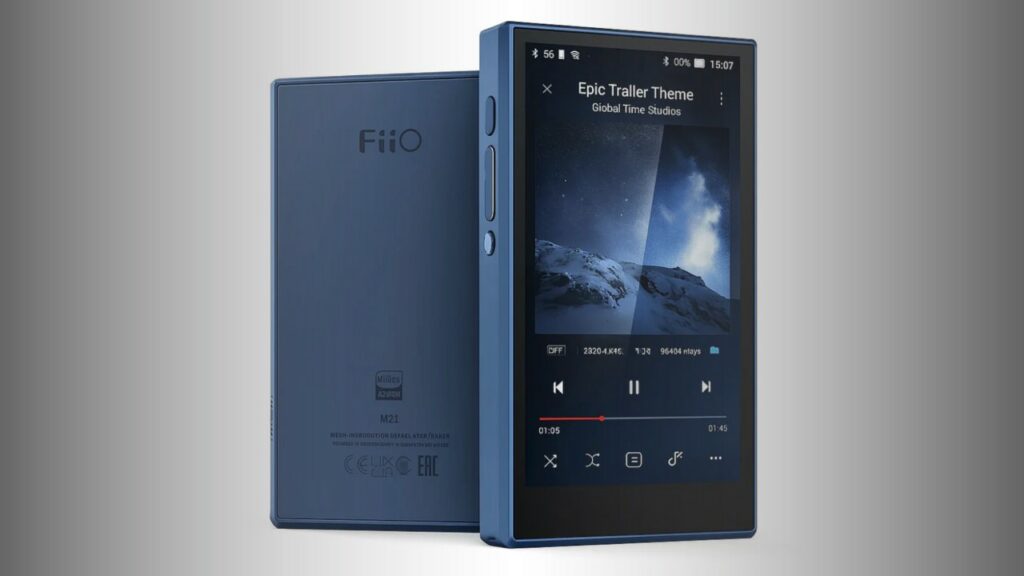
The FiiO M21 is described as a portable high-resolution player designed to combine flagship-inspired sound quality with a more accessible price point.
It uses an aluminum chassis with a matte AG glass back panel, a 4.7-inch display with oleophobic coating, and a compact, lightweight form factor.
A distinctive part of its personality is the supplied protective case styled like an audio cassette, along with a retro user interface and vintage sound effects. Internally, it uses four Cirrus Logic CS43198 DAC chips in a fully differential eight-channel output configuration, paired with a dual-stage headphone amplifier providing voltage and current gain. The article states that desktop mode can deliver high gain, specified as 21Vpp for 300-ohm headphones and 950mW for a 32-ohm load. It runs a customized FiiO version of Android 13 on a Qualcomm Snapdragon 680 processor, supports streaming platforms such as Spotify, Tidal and Qobuz, and includes Bluetooth 5.0 with LDAC and aptX HD, plus USB and SPDIF outputs. A 4000mAh battery is rated for up to 15 hours of playback and supports 20W PD fast charging.
Strengths
- Much lower stated price than the Shanling M7 at $399.99 versus $1250.
- Runs Android 13, which is newer than the Shanling M7's Open Android 10 in the supplied specifications.
- Rated battery life is longer than the Shanling M7 in the supplied articles, with up to 15 hours of playback.
- Desktop mode can use an external power supply to conserve battery life during extended home use.
- Compact design with aluminum chassis, matte AG glass back panel, and 4.7-inch oleophobic display.
- Four Cirrus Logic CS43198 DAC chips and a dual-stage headphone amplifier are specified in the source article.
- Bluetooth 5.0 includes LDAC and aptX HD support.
- USB and SPDIF outputs make it adaptable beyond simple headphone use.
- Retro cassette-style case, retro interface and vintage sound effects give it a distinctive identity.
Considerations
- The source article does not provide internal memory, RAM, display resolution, dimensions, weight, output impedance, or microSD details, limiting direct specification comparison.
- The source article does not specify single-ended and balanced output connector configuration in the same detail provided for the Shanling M7.
- Its Bluetooth codec list is shorter in the supplied information than the Shanling M7's list, which also includes LHDC, aptX and SBC.
- The article frames it as accessible and compact rather than as the more fully specified high-end option.
- No independent measurements or comparative listening impressions are provided in the source article.
Best for: Listeners who want a modern Android-based DAP with strong battery life, streaming support, LDAC and aptX HD Bluetooth, useful home-listening desktop mode, and a far lower stated price than the Shanling M7.
Shanling M7
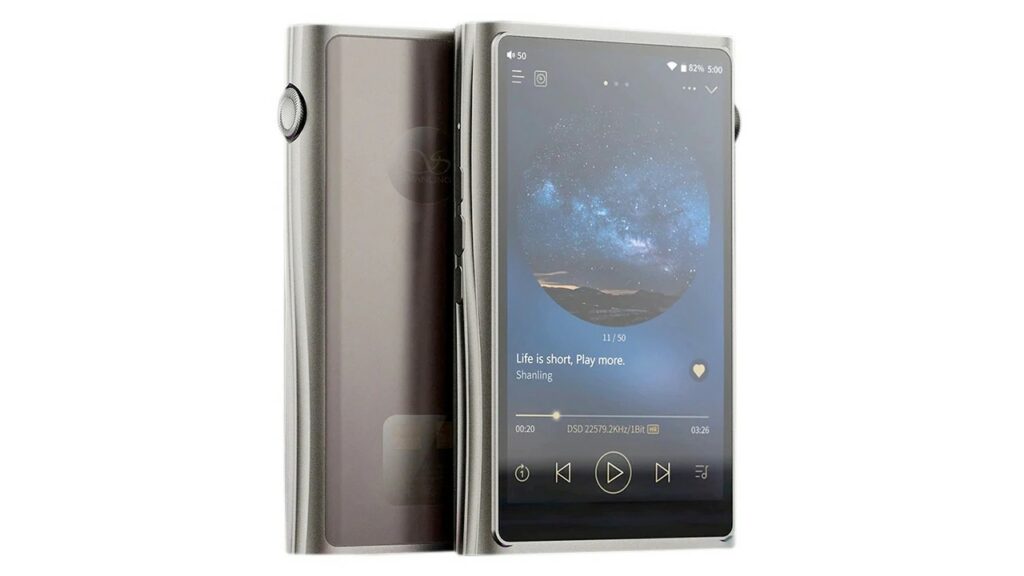
The Shanling M7 is presented as a high-resolution player built around the ESS Sabre ES9038PRO DAC, described in the article as the flagship model of the ESS range.
It uses a 5-inch x 1080 display and a sleeker Wave design, with dimensions of 129 x 78 x 20mm and a weight of 312g.
Internally, the article highlights a unibody aluminum internal casing, a single-board integrated acoustic design, and circuitry influenced by Shanling's M9. The ES9038PRO operates in current mode with an ESS ES9311 voltage regulator, a power circuit adapted from the M9, and Shanling's own I/V conversion stage. Amplification is listed as ADA4896-2 + MUSES8920 + OPA2211 + BUF634, with OP+BUF amplifier architecture optimized for the M7. The player runs Open Android 10 on a Qualcomm Snapdragon 665 processor, with 6GB RAM, 128GB ROM and one microSD card slot. Hi-res support is specified as 32-bit/768kHz, DSD512 and MQA 16X. Connectivity includes two-way Bluetooth 5.0 with LDAC, LHDC, aptX HD, aptX and SBC, plus 2.4GHz/5GHz Wi-Fi, DLNA and AirPlay. Outputs are 3.5mm single-ended and 4.4mm balanced, with output power specified as 400mW into 32 ohms single-ended and 900mW into 32 ohms balanced. Battery capacity is 7000mAh, with 18W fast charging and rated playback of up to 10 hours single-ended or 8.5 hours balanced. The listed price is $1250.
Strengths
- More extensively specified than the FiiO M21 in the supplied article, including RAM, ROM, microSD, dimensions, weight, output impedance and output connector details.
- Uses the ESS ES9038PRO DAC, described in the article as the flagship model of the ESS range.
- Offers a 5-inch x 1080 Full-HD display.
- Includes 6GB RAM, 128GB ROM and one microSD card slot.
- Provides both 3.5mm single-ended and 4.4mm balanced outputs.
- Specified output power is 400mW into 32 ohms single-ended and 900mW into 32 ohms balanced.
- Output impedance is specified as less than 1 ohm.
- Supports 32-bit/768kHz, DSD512 and MQA 16X according to the source specification list.
- Bluetooth support is broad in the supplied article, including LDAC, LHDC, aptX HD, aptX and SBC, with two-way Bluetooth 5.0.
- Wi-Fi features include 2.4GHz/5GHz, DLNA and AirPlay support.
Considerations
- At $1250, it is much more expensive than the FiiO M21's stated $399.99 price.
- Its Open Android 10 platform is older than the FiiO M21's Android 13 in the supplied information.
- Rated battery life is shorter than the FiiO M21, at up to 10 hours single-ended and 8.5 hours balanced versus up to 15 hours for the FiiO.
- It is relatively substantial for a portable player at 312g and 20mm thick.
- The article does not mention a desktop mode comparable to the FiiO M21's external-power desktop mode.
- No independent measurements or comparative listening impressions are provided in the source article.
Best for: Listeners who prioritize a richer high-end specification sheet, a larger Full-HD display, substantial internal storage, microSD expansion, explicitly stated balanced output power, broad Bluetooth codec support and ESS ES9038PRO-based architecture, and who are comfortable with a much higher price.
Head-to-head comparison
Design and build
The FiiO M21 is described as compact and lightweight, with an aluminum chassis and a matte AG glass back panel.
Its 4.7-inch front display has an oleophobic coating, and the supplied cassette-style protective case, retro user interface and vintage sound effects give it a deliberately nostalgic identity.
The source does not provide its exact dimensions or weight, but it repeatedly emphasizes portability. The Shanling M7 is more concretely specified: it has a 5-inch Full-HD display, a Wave design, dimensions of 129 x 78 x 20mm and a weight of 312g. It also uses a unibody aluminum internal casing and a single-board integrated acoustic design, both highlighted as part of its internal construction. In design terms, the FiiO comes across as the more compact and characterful everyday carry, while the Shanling appears more substantial, more display-focused and more explicitly engineered as a premium portable component.
Edge: Depends: FiiO M21 for compact character and retro styling; Shanling M7 for the larger Full-HD screen and more fully documented premium construction.
Features and usability
The FiiO M21 has an important usability advantage in its operating system: it runs a customized FiiO version of Android 13 on a Qualcomm Snapdragon 680 processor.
The article specifically says this setup is intended to provide quick and seamless performance with streaming platforms such as Spotify, Tidal and Qobuz, as well as high-resolution audio files.
It also supports Bluetooth 5.0 with LDAC and aptX HD, USB and SPDIF outputs, 20W PD fast charging, and a desktop mode that can use an external power supply to conserve the battery during extended home use. The Shanling M7 runs Open Android 10 on a Snapdragon 665, with 6GB RAM and 128GB ROM plus one microSD card slot. The Shanling article gives more detailed file and platform specifications, including 32-bit/768kHz, DSD512 and MQA 16X support, as well as two-way Bluetooth 5.0 with LDAC, LHDC, aptX HD, aptX and SBC. It also adds Wi-Fi support on 2.4GHz and 5GHz bands, DLNA and AirPlay. The trade-off is clear: FiiO has the newer Android platform and desktop power concept, while Shanling provides a more complete published storage, codec, wireless and hi-res support list.
Edge: Depends: FiiO M21 for Android 13 and desktop mode; Shanling M7 for broader documented connectivity, storage and hi-res format support.
Sound and performance
The two players use very different digital and amplification architectures.
The FiiO M21 uses four Cirrus Logic CS43198 DAC chips in what the article calls a fully differential eight-channel output arrangement.
Its dual-stage headphone amplifier provides both voltage and current gain, and desktop mode is specified at 21Vpp for 300-ohm headphones and 950mW for a 32-ohm load. The article also says its component choices, including high-precision thin-film resistors and low-impedance tantalum capacitors, are aimed at deep bass, clear mids and natural highs. The Shanling M7 is built around the ESS Sabre ES9038PRO, described as the flagship model of the ESS range. Its implementation includes current-mode operation, an ESS ES9311 voltage regulator, a power circuit adapted from the M9, Shanling's own I/V conversion stage, and OP+BUF amplifier architecture. The M7's listed output power is 400mW into 32 ohms single-ended and 900mW into 32 ohms balanced, with output impedance below 1 ohm. The article describes it as Shanling's best portable measurement player to date. Because the sources do not include direct listening comparisons or independent measurements, it would be misleading to declare one universally better sounding. The Shanling has the more elaborate published architecture and balanced-output specification; the FiiO counters with a four-DAC design, strong desktop-mode figures and a lower price.
Edge: Depends: Shanling M7 has the more premium and fully specified audio architecture on paper; FiiO M21 offers strong stated amplification capability, especially with desktop mode, at a much lower price.
Value
This is the most straightforward difference.
The FiiO M21 is listed at $399.99, while the Shanling M7 is listed at $1250.
The Shanling justifies part of that gap with a larger Full-HD screen, 6GB RAM, 128GB ROM, microSD support, explicitly specified 3.5mm and 4.4mm outputs, broad Bluetooth codec support, Wi-Fi with DLNA and AirPlay, and an ES9038PRO-based audio platform. However, the FiiO still offers Android 13, a quad-CS43198 DAC configuration, Bluetooth 5.0 with LDAC and aptX HD, USB and SPDIF outputs, up to 15 hours of battery life, 20W PD fast charging and a desktop mode. Based on the supplied information, the FiiO M21 delivers the stronger price-to-feature argument for most buyers. The Shanling M7 is better understood as a premium step-up choice rather than a value-first player.
Edge: FiiO M21.
Ideal user
The FiiO M21 is the better fit for someone entering dedicated hi-res players, someone who wants streaming on a modern Android platform, or someone who values long battery life and home/portable flexibility without spending flagship money.
Its retro case and interface touches also suit users who enjoy a more playful portable identity.
The Shanling M7 is aimed at a different listener: someone prepared to pay significantly more for a more extensively specified device, a larger Full-HD display, substantial built-in storage, microSD expansion, 4.4mm balanced output, broad wireless support and a flagship ESS DAC-based design. It is also the clearer fit for users who want the published details of output impedance, output power, RAM, ROM, dimensions and weight before buying.
Edge: Depends: FiiO M21 for the practical value-focused modern DAP user; Shanling M7 for the specification-driven premium DAP buyer.
Final verdict
Winner: Depends
The FiiO M21 vs Shanling M7 decision is not simply about which player has the most impressive specification sheet.
The Shanling M7 is clearly the more premium device in the supplied articles: it costs much more, uses an ES9038PRO DAC architecture, has a larger 5-inch x 1080 display, provides 6GB RAM and 128GB ROM with microSD expansion, supports 32-bit/768kHz, DSD512 and MQA 16X, includes broad Bluetooth codec support plus DLNA and AirPlay, and specifies both 3.5mm single-ended and 4.4mm balanced outputs with less than 1 ohm output impedance.
If you want the more extensively documented high-end player and are comfortable with the $1250 price, the Shanling M7 is the stronger premium choice. The FiiO M21, however, makes a very compelling case for most practical buyers. It is far less expensive at $399.99, runs Android 13, is described as compact and lightweight, offers up to 15 hours of playback, supports 20W PD fast charging, includes LDAC and aptX HD over Bluetooth 5.0, provides USB and SPDIF outputs, and adds a desktop mode that can use external power while delivering high gain. Its four CS43198 DAC chips and dual-stage amplification are also substantial for a player positioned around accessibility. Because the sources do not provide direct comparative listening tests or independent measurements, a single absolute sound-quality winner cannot be responsibly declared. The fairest winner is therefore Depends: choose the FiiO M21 for value, newer Android, battery life and everyday flexibility; choose the Shanling M7 for the more ambitious premium specification set, larger screen, storage, balanced-output details and ES9038PRO-based design.
 VS
VS VS
VS VS
VS VS
VS VS
VS VS
VS VS
VS



Comments 0
Share your experience, questions and perspective with other hi-fi enthusiasts.