T+A PA 2500 R: Integrated Amplification Without Compromise on Flexibility
With substantial power reserves, balanced circuitry, configurable surround integration, and extensive system-control options, the T+A PA 2500 R is designed to serve as the center of an ambitious two-channel system.

The T+A PA 2500 R sits at the top of the company’s R-series integrated-amplifier range. Its appeal is not based on output power alone, although a rated 280 watts per channel into 4 ohms is certainly central to the design. More important is how T+A has combined that capacity with discrete circuitry, extensive connectivity, optional phono support, practical tone controls, and provisions for both home-theater and custom-installation systems. The result is an integrated amplifier intended for owners who want the authority and system-building scope of separates without dividing the core amplification duties among multiple components.
Power reserves for demanding loudspeakers
The PA 2500 R is rated at 140 watts per channel into 8 ohms and 280 watts per channel into 4 ohms. Those figures make it relevant to systems built around speakers that benefit from generous amplifier output or present more difficult electrical loads. Rather than relying only on a high headline rating, T+A equips the amplifier with two power supplies and a total filter-capacitor capacity of 120,000 µF.
That reservoir matters because music does not place a constant demand on an amplifier. Large dynamic changes can require substantial energy over short periods, particularly with less sensitive loudspeakers or at higher playback levels. A robust supply and significant stored energy are therefore useful design choices for maintaining control as the load changes.
The specified damping factor is greater than 65. T+A also provides two sets of substantial speaker terminals, allowing the amplifier to accommodate two pairs of speakers. The terminals are machined from non-magnetic brass, rhodium-plated, and fitted with clear housings and easy-to-grip handles. These details address a practical part of ownership: secure speaker-cable installation without treating the connection hardware as an afterthought.
A discrete, wide-bandwidth signal path
Inside the PA 2500 R, the voltage-gain and current-gain sections are galvanically isolated. Its fully discrete input stage uses selected J-FET transistors, while the intermediate section operates in Class A. MOSFET drivers and high-power bipolar output transistors complete the amplification chain. T+A also specifies mica capacitors, low-inductance resistors, and sealed gold-plated relay switches.
The balanced circuit topology is closely related to that used in T+A’s HV series. As part of that design approach, the discrete stages operate at a higher supply voltage. The specified frequency response extends from 0.5 Hz to 300 kHz for the preamplifier section and from 1 Hz to 150 kHz for the power-amplifier section. These limits extend far beyond the audible band, reflecting an emphasis on wide bandwidth and rapid transient handling rather than an attempt to add an audible feature through processing.
T+A identifies low-negative-feedback output stages as another important element of the amplifier. Together with the dedicated power-supply design, this shows that the PA 2500 R’s output capability is supported by deliberate circuit and power architecture. It is not simply a smaller amplifier platform operated at a more aggressive rating.
Connectivity for a substantial stereo system
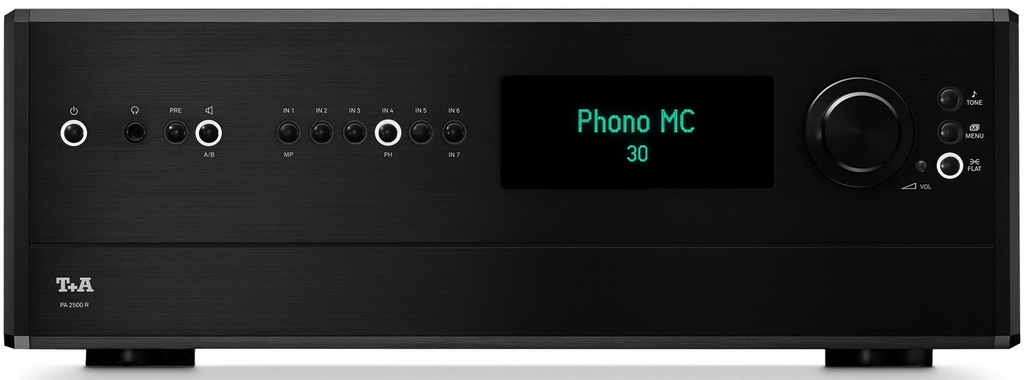
The PA 2500 R provides three balanced XLR inputs and four unbalanced RCA inputs. This gives owners room to connect a mixture of contemporary balanced source components and conventional single-ended equipment without immediately resorting to an external input switcher or separate preamplifier.
Its output facilities include preamplifier connections, a headphone output, and terminals for two pairs of speakers. The preamp outputs increase system flexibility by supporting configurations such as an external power amplifier or other downstream equipment. The two speaker outputs can also be useful in installations with a second pair of speakers, although the electrical suitability of any particular combination still depends on the connected loudspeakers.
For vinyl users, T+A offers an optional internal phono preamplifier compatible with either moving-magnet or moving-coil cartridges. Making phono support optional is a sensible division: record-playing systems can gain a neatly integrated input stage, while owners committed to digital sources or an existing external phono stage do not have to duplicate that hardware.
Designed to bridge stereo and home theater
A notable aspect of the PA 2500 R is its ability to take part in a surround system while remaining the main amplifier for a serious two-channel setup. One XLR input and one RCA input can be configured for home-theater operation with a surround processor. When the relevant surround mode is activated, settings for these inputs are handled independently and retained in memory.
The amplifier also includes a Surround Pass Through mode that can be activated by a trigger signal. In a combined music and cinema system, this allows a surround processor to assume the appropriate level-control role rather than forcing the owner to reproduce a manually chosen volume setting every time. It is a practical answer for listeners who want one pair of main speakers to serve both stereo and multichannel systems.
This integration avoids a common system-design compromise. Owners do not necessarily need to maintain completely separate amplification and front-speaker arrangements for music and movies, nor do they have to abandon a dedicated stereo amplifier simply because a surround processor is part of the room.
Control features that respect different listening habits
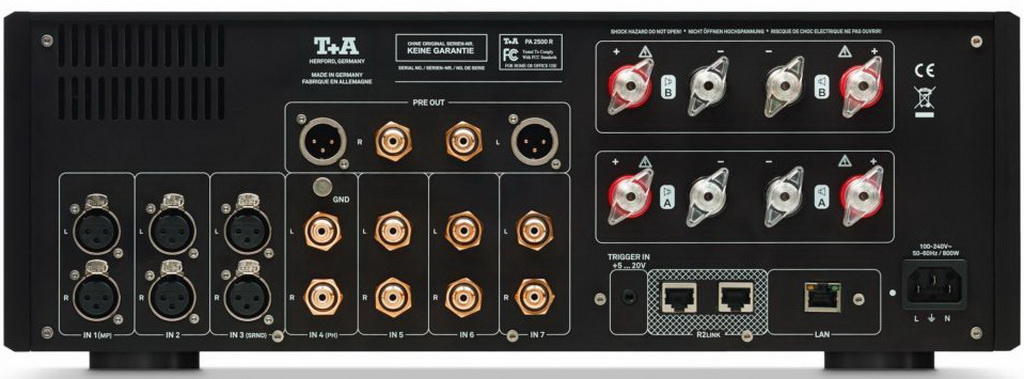
The PA 2500 R includes low- and high-frequency tone controls, each offering adjustment from minus 6 dB to plus 8 dB. Each channel can be adjusted, and a bypass mode is available for users who prefer the shortest available signal path. Adjustable, switchable loudness compensation is also specified.
These controls broaden the amplifier’s usefulness without making them mandatory. Tone adjustment can help account for room conditions, recording balance, speaker placement, or personal preference, while bypass allows the circuitry to be removed from use when no correction is wanted. That combination is more flexible than either permanently active controls or an amplifier that provides no means of adjustment at all.
System integration extends beyond the front panel. The amplifier includes R2-Link input and output connections, with trigger functionality, as well as network and control provisions. AMX and Crestron compatibility is specified for custom-control environments. These facilities make the PA 2500 R relevant not only to a conventional component rack but also to installations in which power, source selection, monitoring, and surround operation need to be coordinated.
Substantial engineering in a relatively slim format
Despite its output capability and large power-supply reserve, the PA 2500 R uses the lower-profile visual format associated with the R series. It measures 460 mm wide, 165 mm high, and 405 mm deep, with a weight of 14.5 kg. It is therefore still a substantial component that requires suitable ventilation and support, but its height is restrained compared with many imposing high-power amplifier designs.
Maximum power consumption is specified at 2,000 watts, while standby consumption is 0.5 watt. Prospective owners planning cabinetry or automated installations should account for the amplifier’s depth, ventilation requirements, and potential mains demand rather than considering only the relatively slim front profile.
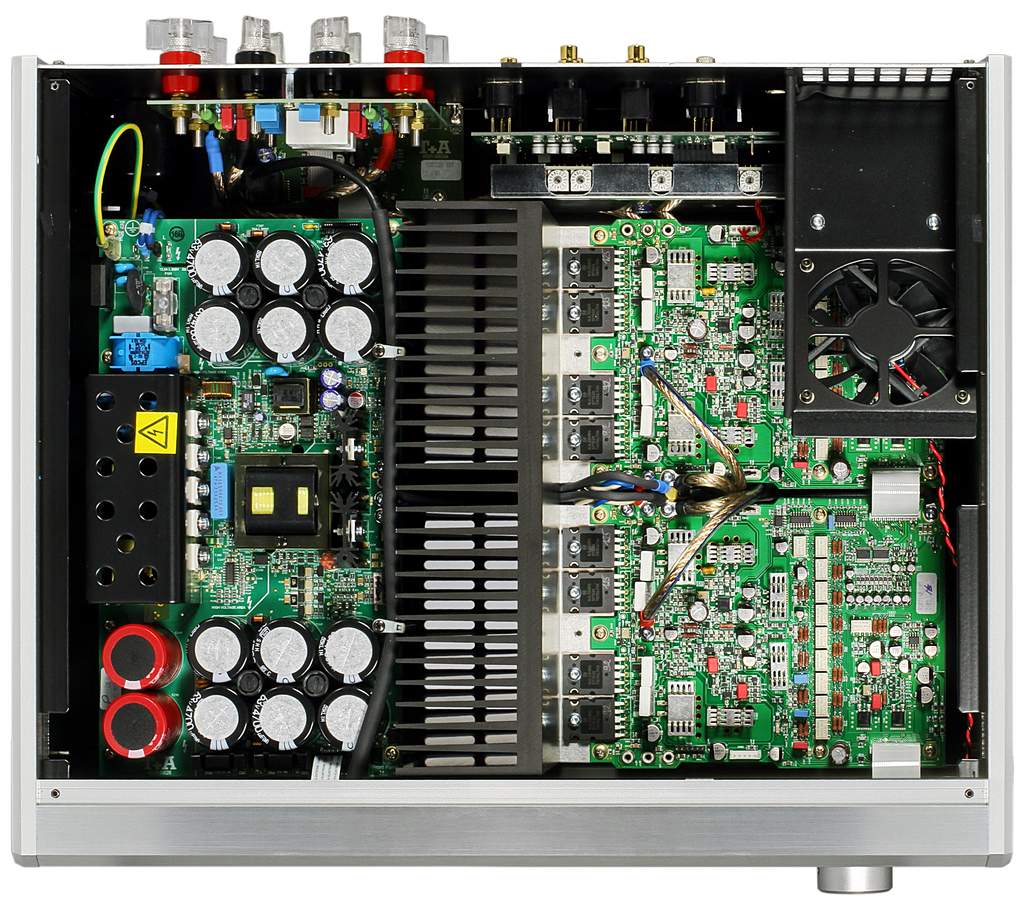
Who the PA 2500 R is most suitable for
The PA 2500 R is aimed at listeners building a premium stereo system around passive loudspeakers, particularly where ample output, balanced source connections, and the ability to handle demanding loads are priorities. It also suits owners who want an integrated amplifier to replace a separate preamplifier and power amplifier without giving up extensive analog connectivity or system-control options.
Its home-theater pass-through facilities make it especially relevant to shared music-and-cinema rooms. Vinyl listeners can add the optional MM or MC phono stage, while custom-installation users can take advantage of trigger, R2-Link, network, AMX, and Crestron provisions.
Conversely, it may be more amplifier than a simple system requires. Someone using efficient speakers in a small room, needing only one source input, or seeking an all-in-one component with built-in digital conversion and streaming may not make full use of its power supply, analog input count, or integration features. Its strongest case is in a system where its output capability and flexibility solve real requirements rather than merely expanding the specification sheet.
Conclusion
The T+A PA 2500 R brings together 140-watt-per-channel output into 8 ohms, 280 watts per channel into 4 ohms, dual power supplies, 120,000 µF of filter capacitance, and a discrete balanced circuit architecture derived from the company’s HV approach. Three XLR inputs, four RCA inputs, optional MM or MC phono support, two speaker outputs, tone-control bypass, surround pass-through, and extensive automation connections give it an unusually broad role for an analog integrated amplifier. Its documented strengths are most meaningful for owners of ambitious passive-speaker systems who need substantial power, adaptable connectivity, and an amplifier capable of anchoring both dedicated stereo listening and a larger integrated installation.