
Our Favorite AV Receiver Choices and Home Theater Partners
A practical Stereoindex guide to AV receivers and related home-theater components, with clear distinctions between true receivers, speaker partners, immersive headphones, and subwoofer setup guidance.
Choosing an AV receiver is rarely just about the receiver itself.
The right decision depends on channel count, room correction, video switching, speaker layout, and the way the rest of the system will be used.
A compact living-room setup, a full immersive theater, and a headphone-based late-night system all place different demands on the electronics. This guide focuses on the AV receivers in the supplied material while also including closely related home-theater components that influence the final result. Some entries are true AV receivers; others are speaker systems, a passive soundbar, immersive headphones, or practical setup guidance that would sit around an AV receiver rather than replace one. That distinction matters, so each recommendation is framed according to what the product actually is. The strongest AV receiver choices here separate themselves by supported surround formats, video handling, room-calibration tools, amplification approach, and installation flexibility. For associated speakers and accessories, the emphasis is compatibility, placement, and the kind of system they help complete.
1. Klipsch RP-440D SB: Perfect Soundbar for a full-fledged home theater

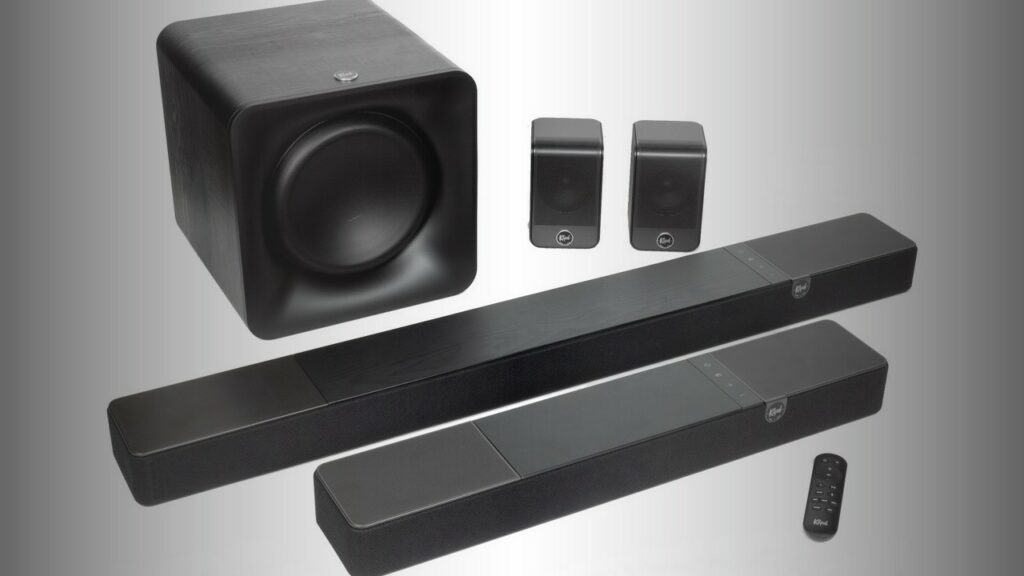
Klipsch RP-440D SB shown as a passive three-channel soundbar intended to form the front channels of a home-theater system.
The Klipsch RP-440D SB is not an AV receiver; it is a passive three-channel soundbar from the Reference Premiere Designer On-Wall line.
Its role is to simplify the front stage of a home theater while still relying on an AV receiver or amplifier for power and processing.
The source material highlights flat, wall-mount-friendly ABS enclosures, magnetic grilles, horizontal or vertical placement across the series, and drivers related to the Reference Premiere family. For rooms where separate front left, center, and right speakers are visually difficult, it is a relevant partner for an AV receiver-based system.
Best for: Discrete front-stage speaker integration
- Passive three-channel front-stage design
- Designed for wall-mounted installations
- Uses Reference Premiere series drivers
- Compatible with modern AV receivers
Verdict: A practical passive soundbar choice for AV receiver systems where wall-friendly design and a cleaner front stage matter.
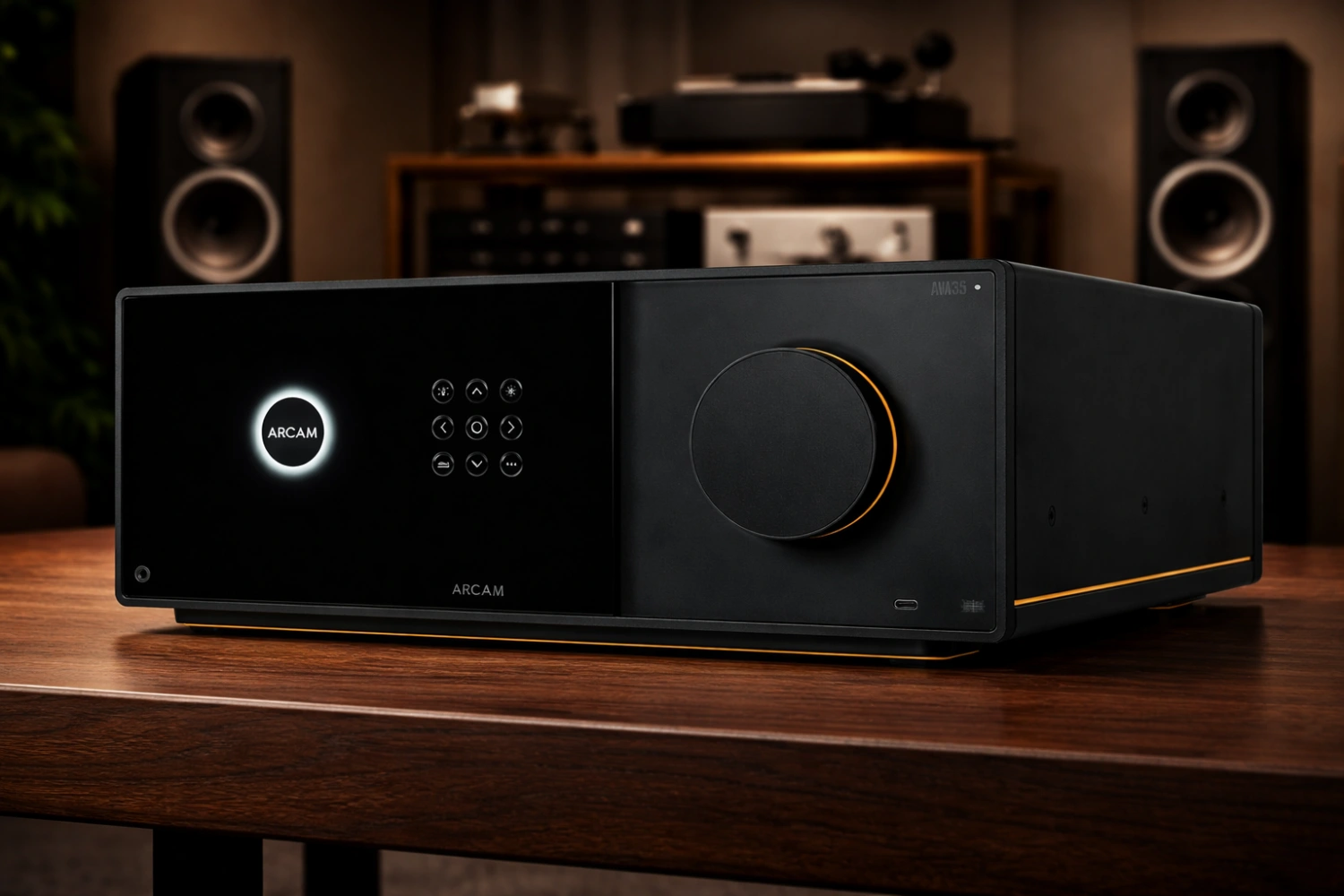
2. Arcam AVA35: Flagship Class G AV Receiver with Dirac Live, 16-Channel Processing & 8K HDMI
Arcam AVA35 positioned as the flagship Radia AV receiver with Class G amplification, Dirac Live, and advanced multichannel processing.
The Arcam AVA35 is presented as the flagship model in Arcam’s Radia AV receiver lineup, with an emphasis on flexibility, sonic power, and advanced processing in one chassis.
Its Class G amplification is specified at 100 watts per channel into 8 ohms across nine channels, and the article connects this amplifier approach with low distortion, control, dynamics, and efficiency.
The AVA35 also brings Dirac Live, 16-channel processing, 8K HDMI, matrix channel assignment, and an ESS Hyperstream IV DAC Pro platform derived from Arcam’s flagship stereo products. Among the receivers in this guide, it is the most clearly aimed at enthusiasts who want ambitious processing and amplification without moving to separates.
Best for: High-flexibility immersive home theaters
- Class G amplification across nine channels
- Dirac Live room correction
- 16-channel processing
- 8K HDMI support
Verdict: A serious one-box AV receiver for users who want advanced processing, substantial amplification, and room correction in the same chassis.
3. Sony STR-DH590: 5.2-channel AV receiver that supports 4K resolution

Sony STR-DH590, a 5.2-channel AV receiver with 4K video support, HDR compatibility, Bluetooth, and automatic speaker calibration.
The Sony STR-DH590 is a 5.2-channel AV receiver aimed at more straightforward home-theater systems.
Its source article emphasizes 4K support, HDR10, HLG, Dolby Vision, and a maximum stated output of 145 watts per channel at 6 ohms with 0.9 percent THD.
It also supports a broad set of Dolby and DTS surround decoders, DSD via HDMI, Bluetooth audio streaming, and Sony’s DCAC automatic speaker calibration. S-Force PRO Front Surround is especially useful when the system is limited to a 2.1-channel configuration but still needs a virtual surround effect.
Best for: Simple 4K home-theater setups
- 5.2-channel receiver layout
- 4K with HDR10, HLG and Dolby Vision
- DCAC automatic speaker calibration
- Bluetooth audio streaming
Verdict: A sensible AV receiver for users building a conventional 5.2-channel or compact virtual-surround system around modern 4K video sources.
4. Canton Smart GLE 9: Active floorstanding speakers made in a traditional form factor

Canton Smart GLE 9 active floorstanding speakers with a traditional cabinet shape and multi-driver configuration.
The Canton Smart GLE 9 is an active floorstanding speaker system rather than an AV receiver.
It belongs in this guide as an alternative direction for buyers who are weighing a traditional receiver-and-passive-speaker setup against active loudspeakers.
The source describes a conventional floorstanding form factor, heavily damped MDF cabinets, a 22.5 mm front panel, and a four-driver arrangement with two 200 mm bass drivers, a 180 mm midrange driver, and a 25 mm metal-dome tweeter set in a small horn. Its understated styling and active architecture make it a different kind of solution from the receiver-based systems elsewhere in the list.
Best for: Active-speaker alternatives to receiver systems
- Active floorstanding design
- Well-damped MDF cabinet construction
- Four-driver speaker layout
- Traditional, understated form factor
Verdict: A relevant option for listeners considering active floorstanders instead of a classic AV receiver and passive speaker chain.
5. JVC XP-EXT1: Headphones that offer immersive 7.1.4 audio

JVC XP-EXT1 system with wireless headphones and an external processor for immersive headphone-based home cinema.
The JVC XP-EXT1 is not an AV receiver, but its processor behaves like a compact home-theater hub for headphone listening.
The system combines wireless closed-back headphones with the XP-EXT1P processor, which has HDMI connectivity, optical input, and an analog stereo RCA input.
The article describes immersive 7.1.4 audio through headphones, a proprietary DSSS radio interface intended to avoid delay, touch-sensitive volume control, and a stated headphone battery life of 12 hours. It can be used alongside an existing AV receiver or independently with sources such as set-top boxes and game consoles.
Best for: Late-night immersive movie listening
- Immersive 7.1.4 headphone presentation
- HDMI-equipped external processor
- Proprietary low-delay wireless link
- Can work independently of an AV receiver
Verdict: A distinctive alternative for users who want surround-style movie sound through headphones rather than speakers.
6. NAD T778: Flagship AV receiver with a modular design

NAD T 778 AV receiver featuring modular MDC slots, hybrid digital amplification, Dirac Live, and immersive-format support.
The NAD T 778 is a flagship AV receiver built around a 9 x 100 W hybrid digital amplifier configuration and a modular MDC architecture with two user-replaceable slots.
The source highlights 4K/Ultra HD video transmission, Dolby Atmos, DTS:X, DTS Master Audio, support for home-theater configurations up to 7.1.4 channels, Dirac Live room correction, and MQA decoding on digital inputs.
Wireless and system integration features include Apple AirPlay 2, Bluetooth with aptX HD, a touchscreen front panel, RS232, infrared remote sensor input with learning function, and trigger input/output. Its clearest strength is long-term system flexibility through modular hardware combined with serious immersive-audio support.
Best for: Flexible immersive theaters with upgrade potential
- Modular MDC design
- 9 x 100 W amplifier configuration
- Dirac Live room correction
- Supports up to 7.1.4-channel layouts
Verdict: A feature-rich AV receiver for users who value modular design, room correction, and substantial multichannel support.
7. McIntosh MHT300: Absolute Hi-End class AV receiver
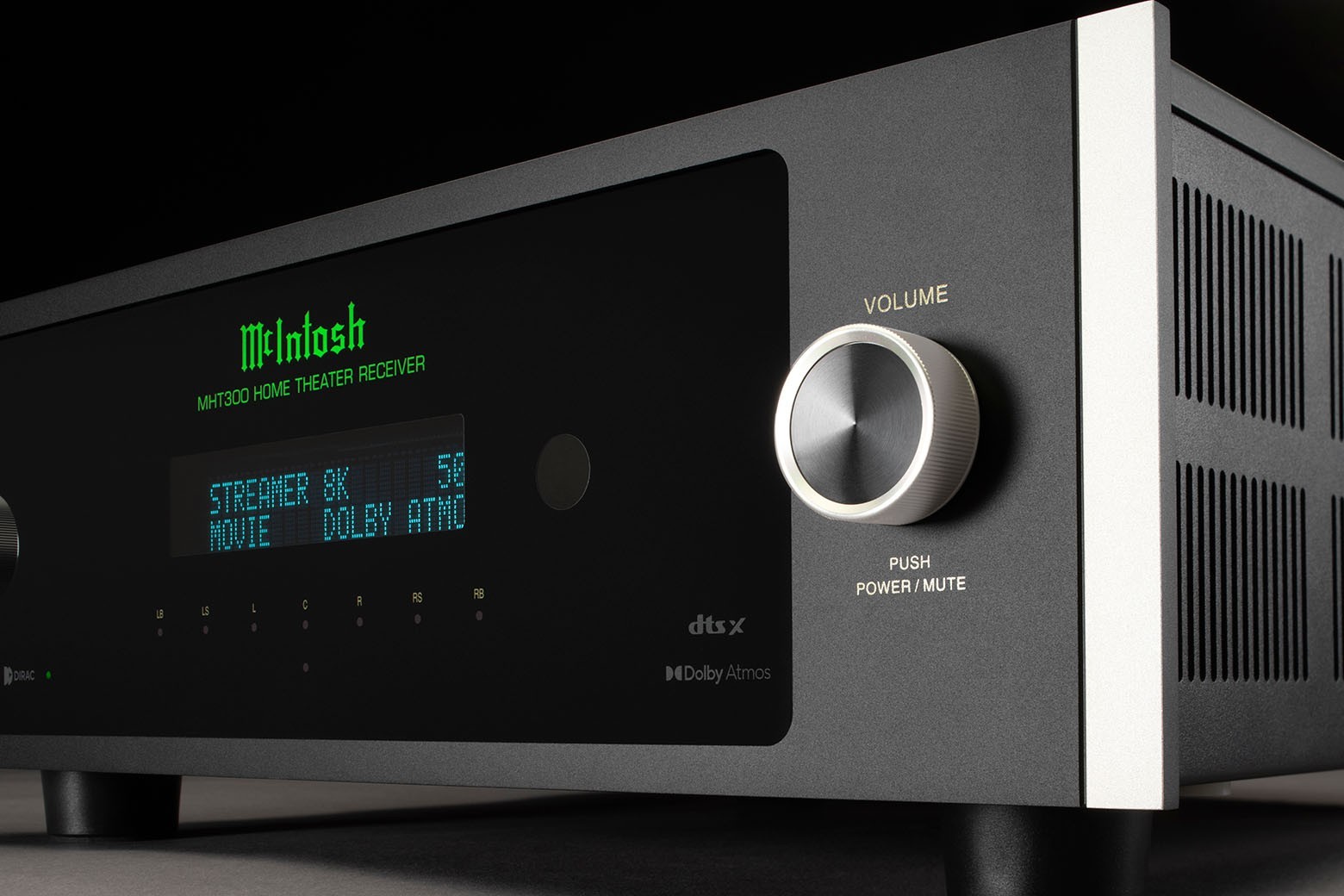
McIntosh MHT300 home-theater receiver with multichannel amplification, immersive-audio support, and pre-outs for expansion.
The McIntosh MHT300 is a high-end home-theater receiver designed to deliver McIntosh-style cinema in a single device rather than through separate processor and amplifier components.
It is described as a 7.2-channel receiver that can also be configured as 5.2.2 for Dolby Atmos and DTS:X, with a stated 7 x 120 watts per channel into 8 ohms.
The source also notes support for UHD 4K at 120 fps and 8K at 60 fps, plus pre-outs that can be combined with an external power amplifier for larger installations. For buyers who want a premium receiver format rather than full separates, it is one of the most distinctive entries here.
Best for: Premium single-box home theaters
- 7.2 or 5.2.2-channel configuration
- Dolby Atmos and DTS:X support
- 7 x 120 W into 8 ohms
- Pre-outs for external amplification
Verdict: A high-end AV receiver for users who want McIntosh home-theater electronics in a more integrated form than separate processor and amplifier stacks.
8. Marantz SR7015: IMAX Enhanced 9.2-channel AV receiver

Marantz SR7015 9.2-channel AV receiver with IMAX Enhanced certification, immersive audio support, and advanced video handling.
The Marantz SR7015 is a 9.2-channel AV receiver with IMAX Enhanced certification and wide immersive-format support.
The source lists DTS:X, Dolby Atmos up to a 7.1.4-channel version with an added stereo amplifier, Auro-3D, and DTS Virtual:X for three-dimensional effects without ceiling speakers.
Its video feature set includes 8K 60 Hz, 8K upscaling, HDR10+, Dolby Vision, Dynamic HDR, HLG, HDR10, 4K at 120 Hz, Quick Frame Transport, and ALLM. On the audio side, it uses HDAM modules, current feedback, 125 W per channel at 8 ohms, a 32-bit AK4458 DAC, Hi-Res playback over network and USB, and Audyssey MultEQ XT32 calibration.
Best for: Format-rich theater systems with advanced video needs
- 9.2-channel AV receiver platform
- IMAX Enhanced certification
- Wide immersive-format support
- Audyssey MultEQ XT32 calibration
Verdict: A broadly equipped AV receiver for users who want extensive surround-format compatibility, strong calibration tools, and comprehensive video support.
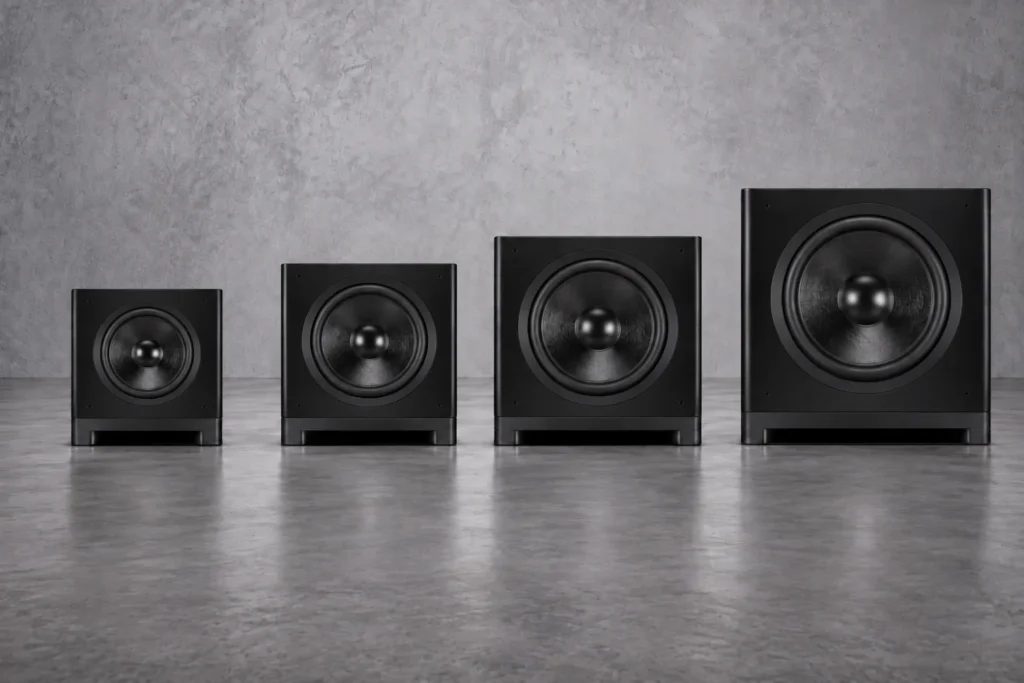
9. The importance of proper subwoofer placement

Subwoofer placement guidance showing why room boundaries and low-frequency reflections matter in home-theater systems.
This entry is setup guidance rather than hardware, but it is highly relevant to any AV receiver system with a subwoofer.
The source explains that subwoofers cover low frequencies that conventional multichannel speaker sets cannot reproduce adequately, with a stated range of 20 to 200 Hz.
It also stresses that room acoustics, furniture, windows, walls, and low-frequency reflections can create booming antinodes or weak dead zones. Even a capable AV receiver and subwoofer will underperform if placement and fine-tuning are neglected.
Best for: Improving bass performance through setup
- Explains low-frequency room effects
- Highlights standing-wave problems
- Supports better home-theater bass setup
- Applies to receiver-based systems
Verdict: Essential practical reading for anyone using an AV receiver with a subwoofer and trying to avoid boomy or uneven bass.
10. Canton Ergo 690: Classic floorstanding speakers

Canton Ergo 690 floorstanding speaker with classic cabinet proportions and traditional passive-speaker construction.
The Canton Ergo 690 is a passive floorstanding speaker, not an AV receiver, and its relevance here is as a speaker partner for traditional receiver-based listening.
The source frames the Ergo line as a long-running Canton classic with wooden cabinets, rounded edges, stamped metal grilles, a narrow front shield, and drivers designed for integration through careful crossover work.
It also notes that the model was revisited in a modern Hi-Res Audio system context. For buyers choosing an AV receiver, the Ergo 690 represents the kind of full-size passive speaker that makes amplifier matching and room placement important.
Best for: Traditional passive-speaker systems
- Classic passive floorstanding design
- Wooden cabinet construction
- Full-size speaker format
- Designed around driver matching and crossover integration
Verdict: A classic passive floorstander to consider as part of a conventional AV receiver and speaker-based system.
Quick comparison
The products below do not all serve the same role.
The AV receivers differ by channel count, room correction, amplification approach, and video support, while the related speakers, headphone system, and setup article help define the system around the receiver.
| Product | Best for | Verdict |
|---|---|---|
| Klipsch RP-440D SB: Perfect Soundbar for a full-fledged home theater | Discrete front-stage speaker integration | A passive three-channel soundbar for AV receiver systems where a clean wall-mounted front stage is preferred. |
| Arcam AVA35: Flagship Class G AV Receiver with Dirac Live, 16-Channel Processing & 8K HDMI | High-flexibility immersive home theaters | The most ambitious processing-focused receiver here, with Class G amplification, Dirac Live, 16-channel processing, and 8K HDMI. |
| Sony STR-DH590: 5.2-channel AV receiver that supports 4K resolution | Simple 4K home-theater setups | A straightforward 5.2-channel AV receiver with 4K HDR support, Bluetooth, and automatic speaker calibration. |
| Canton Smart GLE 9: Active floorstanding speakers made in a traditional form factor | Active-speaker alternatives to receiver systems | An active floorstanding option for buyers considering a system path outside the classic passive-speaker and AV receiver model. |
| JVC XP-EXT1: Headphones that offer immersive 7.1.4 audio | Late-night immersive movie listening | A headphone-based immersive system with an external processor and HDMI connectivity, suitable when speakers are impractical. |
| NAD T778: Flagship AV receiver with a modular design | Flexible immersive theaters with upgrade potential | A modular AV receiver with 9 x 100 W amplification, Dirac Live, and support for layouts up to 7.1.4 channels. |
| McIntosh MHT300: Absolute Hi-End class AV receiver | Premium single-box home theaters | A high-end AV receiver with 7.2 or 5.2.2-channel operation, 7 x 120 W into 8 ohms, and pre-outs for expansion. |
| Marantz SR7015: IMAX Enhanced 9.2-channel AV receiver | Format-rich theater systems with advanced video needs | A highly featured 9.2-channel AV receiver with IMAX Enhanced certification, broad immersive-format support, and Audyssey MultEQ XT32. |
| The importance of proper subwoofer placement | Improving bass performance through setup | A practical setup guide that explains why subwoofer placement can matter as much as hardware choice. |
| Canton Ergo 690: Classic floorstanding speakers | Traditional passive-speaker systems | A passive floorstanding speaker option for conventional AV receiver systems where full-size speakers are desired. |
Frequently asked questions
How many channels should an AV receiver have?
Match the receiver to the speaker layout you realistically plan to use.
A 5.2-channel model such as the Sony STR-DH590 suits simpler systems, while receivers such as the NAD T 778, Marantz SR7015, Arcam AVA35, and McIntosh MHT300 are aimed at more ambitious immersive layouts or expanded installations.
Is room correction important in an AV receiver?
Yes, especially in rooms where speaker placement and bass behavior are difficult to control.
The Sony STR-DH590 includes DCAC calibration, the NAD T 778 and Arcam AVA35 include Dirac Live, and the Marantz SR7015 uses Audyssey MultEQ XT32.
These systems help align the speakers with the room, though careful placement still matters.
Do I need 8K HDMI support in an AV receiver?
That depends on your sources and display.
The Arcam AVA35, McIntosh MHT300, and Marantz SR7015 are described with 8K-related video support, while the Sony STR-DH590 and NAD T 778 focus on 4K or 4K/Ultra HD transmission in the supplied material.
Choose video capability based on the devices you actually connect.
Can headphones or active speakers replace an AV receiver?
In some situations, yes, but they solve different problems.
The JVC XP-EXT1 offers immersive headphone listening with its own processor, useful when speakers are impractical.
The Canton Smart GLE 9 active floorstanders take another path by placing amplification inside the speakers. A traditional AV receiver remains the more direct choice for passive speakers and multichannel speaker layouts.
How to choose from these AV receiver options
Start with the system you want to build, not with the longest feature list.
If the goal is a simple 5.2-channel living-room theater with 4K HDR sources, the Sony STR-DH590 is the most straightforward receiver in this set.
If immersive audio, calibration, and system flexibility matter more, the NAD T 778 offers modular design and support for layouts up to 7.1.4, while the Marantz SR7015 brings a broad surround-format list, IMAX Enhanced certification, Audyssey MultEQ XT32, and extensive video support. For a more ambitious single-box receiver, the Arcam AVA35 stands out for Class G amplification, Dirac Live, 16-channel processing, 8K HDMI, and advanced DAC architecture. The McIntosh MHT300 takes a different premium route, combining 7.2 or 5.2.2-channel operation, Dolby Atmos and DTS:X support, stated 7 x 120 W output into 8 ohms, and expansion through pre-outs. The non-receiver entries should be treated as system-shaping choices. The Klipsch RP-440D SB can simplify the front speaker array in an AV receiver system. The Canton Ergo 690 represents a traditional passive floorstanding route, while the Canton Smart GLE 9 points toward active loudspeakers instead. The JVC XP-EXT1 is useful where immersive listening through speakers is not practical. Finally, do not overlook subwoofer placement: room effects can turn good bass into boomy or uneven bass, regardless of the receiver attached to the system.












 VS
VS VS
VS VS
VS VS
VS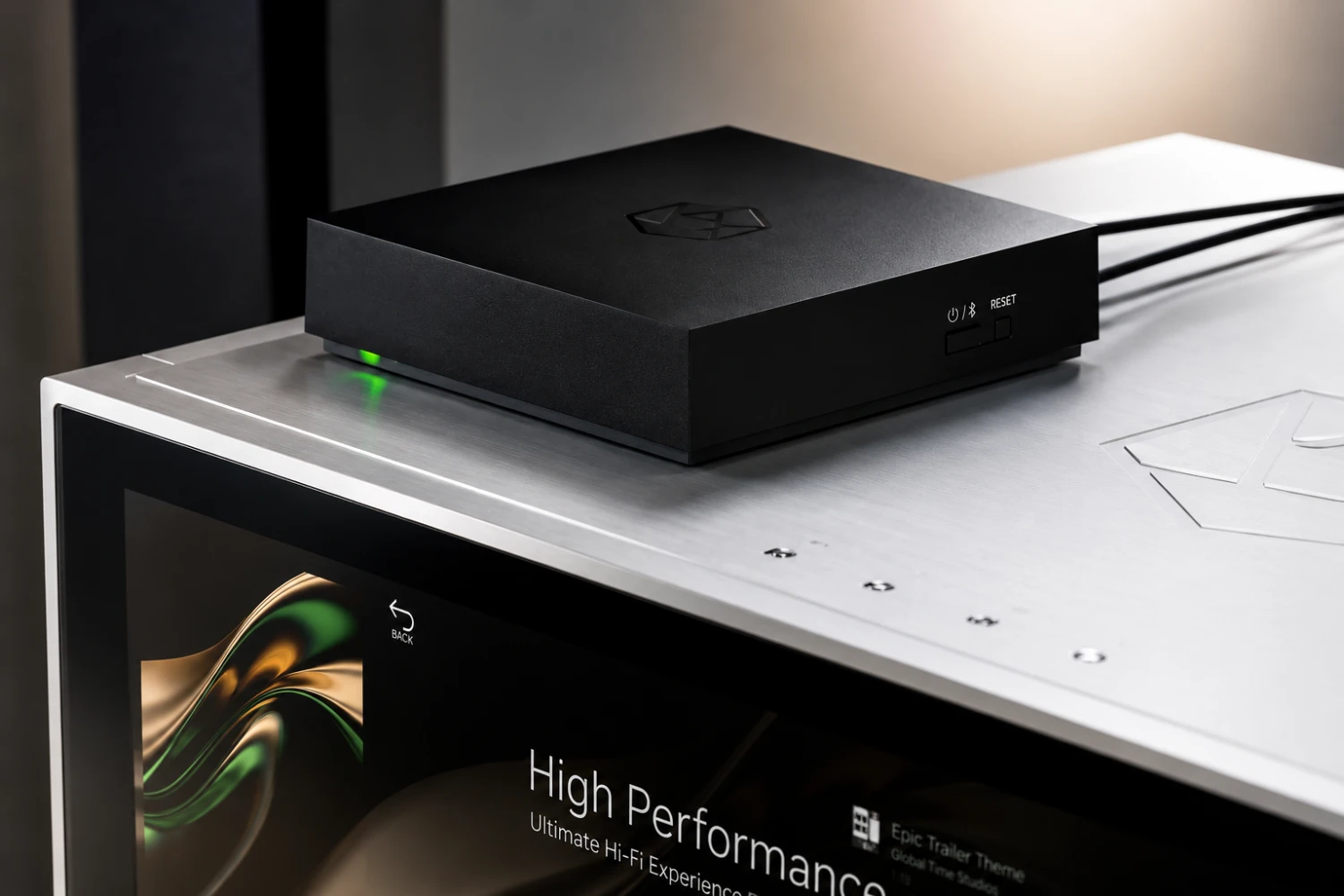 VS
VS VS
VS VS
VS VS
VS

Share your thoughts on this 0
Keep it civil, relevant and respectful.