

Choosing an AV receiver is less about chasing the longest feature list and more about matching the component to the room, speaker layout, and video sources it will actually serve.
The source material here ranges from entry-level five-channel receivers to more ambitious surround processors and brand background pieces, so this guide separates direct receiver recommendations from adjacent home-cinema context.
For most buyers, the useful dividing lines are channel count, surround-format support, room correction, HDMI capability, and whether the system needs built-in amplification at all. A compact 5.2 receiver can be entirely appropriate for a living-room cinema, while a seven-channel receiver opens the door to height effects and more flexible layouts. Processors and disc players, meanwhile, are not substitutes for an AV receiver but may be relevant in a more component-based theater. The recommendations below preserve the supplied order and stay within the information available in the source articles. Where an entry is not a conventional AV receiver, it is identified as such so it can be considered in the right role rather than forced into the wrong shortlist.

1. Denon AVC-S660H: AV Receiver boasting superior surround sound and gaming experiences
Denon AVC-S660H AV amplifier, an S-series entry model with five discrete amplifier channels and no FM tuner.
The Denon AVC-S660H is the clearest entry-level receiver choice in the supplied material.
It sits in Denon’s S series, differs from the AVR-S660H chiefly by omitting an FM tuner, and combines five high-current discrete amplifier channels with support for 8K/60 Hz video.
The source also highlights Dolby TrueHD and DTS-HD Master Audio compatibility, Audyssey MultEQ speaker calibration, Dynamic EQ, Dynamic Volume, network playback, front-panel USB playback, Bluetooth, dual-band Wi-Fi, AirPlay 2, and access to services including Tidal, TuneIn, Deezer, and Spotify Connect.
Best for: A straightforward 5-channel Denon system with strong streaming support
- Entry-level Denon S-series positioning
- Five high-current discrete amplifier channels
- 8K/60 Hz video support
- Audyssey MultEQ with Dynamic EQ and Dynamic Volume
Verdict: A practical starter AV amplifier for users who want modern HDMI handling, calibration, and network audio without paying for unused tuner functionality.

2. Integra
Integra brand coverage, with the source emphasizing its role in custom AV installation and higher-tier home-cinema electronics.
This entry is best treated as brand context rather than a specific product recommendation.
The source explains Integra’s connection to Onkyo’s higher-tier hi-fi and home-cinema electronics, then describes Integra as an independent brand shaped around custom AV installation needs.
It also mentions models such as the DRX-R1.1 and DRX-7, but does not provide a feature set detailed enough to compare them directly with the receiver models in this guide.
Best for: Readers planning an installed home-cinema system and researching brand background
- Custom-installation focus
- Onkyo-related hi-fi and home-cinema heritage
- Associated with higher-tier AV electronics
Verdict: Integra belongs on the radar for installation-focused projects, but the supplied article is not specific enough to rank a particular receiver model by features.

3. Denon AVR-S770H: AV receiver with seven built-in amplification channels
Denon AVR-S770H AV receiver, specified with seven amplification channels and support for 5.2.2 surround layouts.
The Denon AVR-S770H steps up to seven built-in amplification channels and supports Dolby Atmos and DTS:X decoding.
The source frames it as suitable for a 5.2.2 layout in ordinary living rooms, with a virtual surround mode available when height speakers are not installed.
It is also specified with up to 140 W maximum output power, the ability to work with acoustics with complex impedance characteristics, Eco mode, Audyssey MultEQ calibration, and six HDMI inputs, three of which support 8K video.
Best for: Living-room Atmos or DTS:X systems with seven-channel amplification
- Seven built-in amplification channels
- Dolby Atmos and DTS:X decoding
- 5.2.2 layout support
- Audyssey MultEQ room calibration
Verdict: A well-rounded Denon option for buyers who want to move beyond basic surround into a compact height-channel setup.

4. Denon AVR-X3600H: Fully equipped 7-channel AV receiver
Denon AVR-X3600H AV receiver, described in the source as a fully equipped model with extensive HDMI connectivity and Audyssey MultEQ XT32.
The Denon AVR-X3600H is presented as the more ambitious Denon option in the source set.
It supports Dolby Atmos and DTS:X, includes high-current output stages, and is described as capable of driving large floor-standing speakers thanks to its power supply.
The article also points to a 4-core DSP, 32-bit AKM DACs in each channel, Audyssey MultEQ XT32 calibration, eight HDMI inputs, three HDMI outputs, 4K video transmission with HDR, Dolby Vision and HLG, plus signal conversion from analog and digital video sources to 4K resolution.
Best for: More complex Denon-based theaters needing stronger setup and video flexibility
- Dolby Atmos and DTS:X support
- Audyssey MultEQ XT32 calibration
- Eight HDMI inputs and three HDMI outputs
- High-current output stages
Verdict: A feature-rich Denon receiver for users who need more calibration depth, HDMI connectivity, and system ambition than the entry models provide.

5. Best AV Receiver: Choosing the very best for your home cinema
AV receiver buying-guide coverage, with the supplied excerpt highlighting Yamaha RX-V4A connectivity, video support, and channel flexibility.
This supplied article is a buying-guide source rather than a single product profile.
The concrete detail in the excerpt centers on the Yamaha RX-V4A, described with a 5.2 scheme, 5 x 80 W power, Dolby Atmos and DTS:X format support, 8K/60 Hz and 4K/120 Hz video support, HDR formats including HDR10, HDR10+, Dolby Vision and HLG, built-in Bluetooth, Wi-Fi, Apple AirPlay 2, and Yamaha MusicCast.
It also notes that amplification channels can be reconfigured for a second zone or front-speaker bi-amping.
Best for: Shoppers comparing receiver feature sets before choosing a specific model
- 5.2-channel Yamaha RX-V4A example detailed in the source
- Bluetooth, Wi-Fi, AirPlay 2 and MusicCast support
- 8K/60 Hz and 4K/120 Hz video support listed
- Channel reassignment for second zone or front bi-amping
Verdict: Useful as a category overview, though the supplied excerpt offers its strongest usable detail through the Yamaha RX-V4A example.
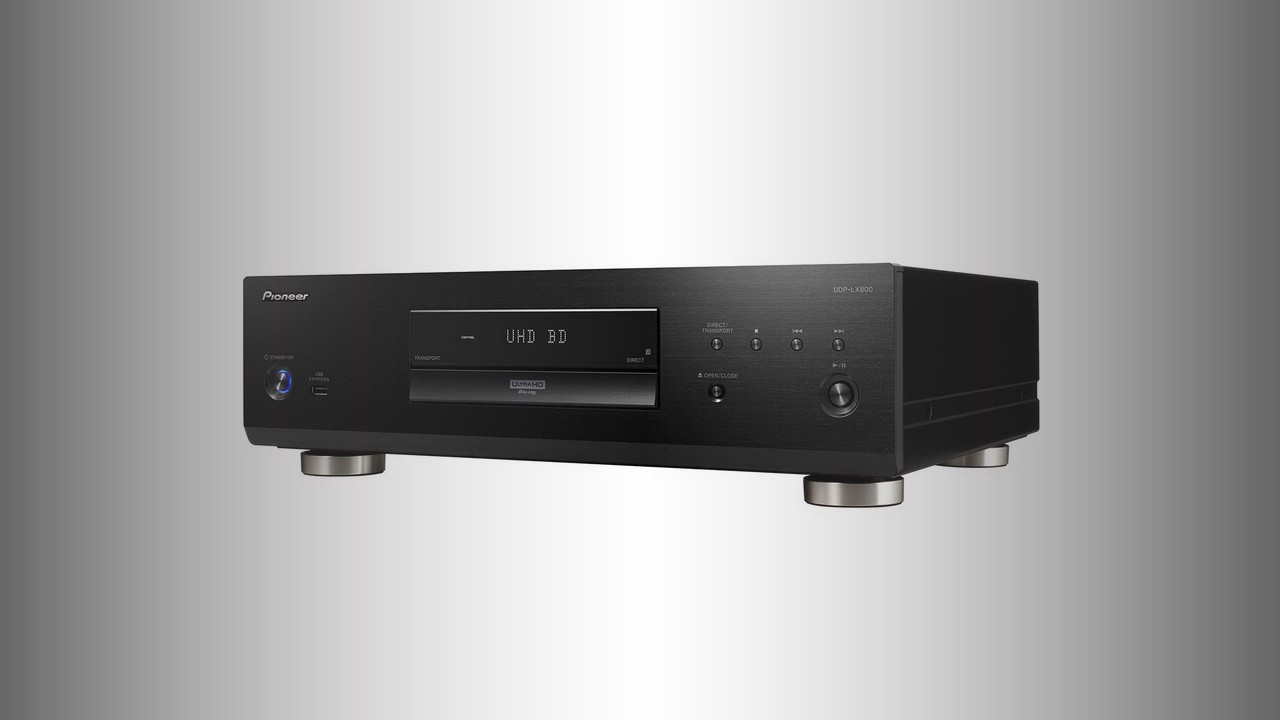
6. Pioneer UDP-LX800: Top-class universal player
Pioneer UDP-LX800 universal player, a disc source with separate HDMI outputs and compatibility features for some Pioneer AV receivers.
The Pioneer UDP-LX800 is not an AV receiver; it is a universal disc player that could serve as a source component in a serious home-cinema system.
The source says it plays CD, DVD, DVD-Audio, DVD-Video, SACD and Ultra HD Blu-ray, supports Dolby Vision and HDR10, uses an anti-vibration construction, and provides two HDMI outputs for separate audio and video streams.
It also mentions PQLS jitter-reduction technology when used with compatible Pioneer AV receivers.
Best for: Disc-focused systems needing a high-grade source component, not receiver amplification
- Plays multiple disc formats including SACD and Ultra HD Blu-ray
- Dolby Vision and HDR10 support
- Separate HDMI outputs for audio and video
- PQLS support with compatible Pioneer AV receivers
Verdict: A serious universal player for physical-media playback, but it should be paired with an AV receiver or processor rather than considered one.

7. Onkyo HT-S3705: Home cinema system with true high-resolution surround sound
Onkyo HT-S3705 article context, with the source describing the TX-SR333 entry-level receiver and its five-channel amplification.
Although the article title names the Onkyo HT-S3705 system, the supplied excerpt focuses heavily on the TX-SR333 receiver.
It describes an entry-level Onkyo receiver with five channels of amplification, WRAT wideband amplification architecture, six HDMI inputs, Bluetooth, HDMI pass-through, Hybrid Standby mode, InstaPrevue, USB high-resolution audio transmission, and support for ultra-high-definition video signals up to 60 Hz.
The source also says it includes decoders for HD-format soundtracks.
Best for: Entry-level Onkyo surround systems built around a compact receiver package
- Five-channel amplification
- WRAT wideband amplification architecture
- Six HDMI inputs
- Built-in Bluetooth
Verdict: A sensible budget-oriented home-cinema route in the supplied material, especially where five-channel surround and practical HDMI connectivity are enough.

8. Yamaha CX-A5200: Ultimate AV processor
Yamaha CX-A5200 AV processor, designed for surround processing and room optimization in separates-based home theaters.
The Yamaha CX-A5200 is an AV processor, not an AV receiver, so it requires separate power amplification.
The source describes it as a preamplifier with real-time signal analysis, seven HDMI inputs, three HDMI outputs, HDCP 2.2, BT. recognition, HDR10, Dolby Vision and HLG support, Dolby Atmos and DTS:X in 7.2.4 variations, updated Cinema DSP HD algorithms, YPAO room optimization, and RSC control of early reflections.
It is therefore relevant for advanced separates-based systems rather than receiver-based setups.
Best for: Advanced theaters using separate processing and power amplification
- Dolby Atmos and DTS:X in 7.2.4 variations
- Seven HDMI inputs and three HDMI outputs
- YPAO room optimization
- RSC early-reflection control
Verdict: A processor-focused alternative for systems that have outgrown an all-in-one AV receiver, provided external amplification is part of the plan.

9. Pioneer VSX-535: Powerful AV receiver that won’t break the bank
Pioneer VSX-535 AV receiver, a lower-profile 5.2 model with Direct Energy amplification and MCACC calibration.
The Pioneer VSX-535 is a compact 5.2 AV receiver with a metal chassis, lower-profile design, and proprietary Direct Energy amplifiers.
The source specifies up to 135 W output power, Dolby Atmos and Dolby Surround decoders within a five-channel configuration, a possible 3.2.1 setup using the front channels, and Dolby Atmos Height Virtualizer mode in a 5.1 arrangement.
It also includes MCACC auto-calibration, which adjusts output according to the speaker type and arrangement, plus a 32-bit Cirrus Logic DSP and AK4438 DAC.
Best for: Compact Pioneer-based systems where virtualized height effects are acceptable
- 5.2-channel receiver layout
- Direct Energy amplifiers
- Dolby Atmos Height Virtualizer mode
- MCACC auto-calibration
Verdict: A space-friendly five-channel receiver with useful calibration and virtual Atmos tools, but not a substitute for a full speaker-based Atmos layout.

10. Technics
Technics brand-history coverage, included here as audio context rather than a specific AV receiver recommendation.
This article is brand history rather than an AV receiver recommendation.
The source focuses on Technics’ place in audio culture, its association with Panasonic and Matsushita Electric, and the founder’s emphasis on innovation in electrical products.
It does not supply a current AV receiver model, channel configuration, HDMI specification, surround processing format, or room-correction system, so it cannot be evaluated as a receiver choice in the same way as the Denon, Pioneer, Onkyo, or Yamaha entries.
Best for: Readers interested in audio-brand heritage rather than AV receiver specifications
- Longstanding Japanese audio brand context
- Association with Panasonic and Matsushita Electric
- Historical emphasis on innovative electronics
Verdict: Useful background reading, but not a practical AV receiver shortlist entry based on the supplied material.
Quick comparison
The most useful comparison is not simply receiver versus receiver, because the supplied material includes standard AV receivers, an AV processor, a universal player, a broad buying guide, and brand-history articles.
The rows below identify each entry’s practical role and the clearest supported distinction.
| Product | Best for | Verdict |
|---|---|---|
| Denon AVC-S660H | Entry-level 5-channel Denon systems with streaming and calibration | Choose it when five amplified channels, 8K/60 Hz support, Audyssey MultEQ, and network audio are the priority. |
| Integra | Custom-installation brand research | Consider it as installation-focused brand context rather than a specific model recommendation from the supplied excerpt. |
| Denon AVR-S770H | Seven-channel living-room surround with Atmos or DTS:X | The strongest fit for buyers wanting a 5.2.2 layout from the supplied receiver profiles. |
| Denon AVR-X3600H | More ambitious Denon theater systems with deeper calibration and HDMI needs | A step up in setup sophistication, with Audyssey MultEQ XT32 and extensive HDMI connectivity. |
| Best AV Receiver: Choosing the very best for your home cinema | General shopping orientation using the Yamaha RX-V4A example in the excerpt | Useful for comparing feature priorities, though the supplied section is not a single-product recommendation. |
| Pioneer UDP-LX800 | Physical-media playback in a component home theater | A source player for disc formats, not an AV receiver or amplifier. |
| Onkyo HT-S3705 | Entry-level Onkyo surround packages and five-channel receiver setups | Relevant where a simple five-channel receiver platform, HDMI inputs, and Bluetooth meet the system brief. |
| Yamaha CX-A5200 | Separates-based theaters using external power amplifiers | A processor choice for advanced systems, not an all-in-one receiver. |
| Pioneer VSX-535 | Compact 5.2 systems with virtual height processing | A practical five-channel Pioneer receiver with MCACC and Dolby Atmos Height Virtualizer. |
| Technics | Audio-brand heritage research | Informative background, but the supplied article does not provide an AV receiver to compare. |
Frequently asked questions
How many channels should an AV receiver have?
Base the choice on the speaker layout you can actually install.
Five-channel receivers such as the Denon AVC-S660H, Pioneer VSX-535, and the Onkyo receiver described in the HT-S3705 article suit simpler surround systems.
Seven-channel receivers such as the Denon AVR-S770H add room for layouts like 5.2.2 when height speakers are part of the plan.
Is room calibration important?
Yes, especially in real living rooms where speaker placement is rarely ideal.
The supplied receivers and processors mention systems such as Audyssey MultEQ, Audyssey MultEQ XT32, MCACC, and YPAO, all intended to adjust sound according to the room and speaker arrangement.
Do I need an AV receiver if I buy an AV processor?
An AV processor such as the Yamaha CX-A5200 handles control, decoding, switching, and room optimization, but it does not replace built-in receiver amplification.
It is intended for systems using separate power amplifiers, while an AV receiver combines processing and amplification in one chassis.
Should HDMI support drive the buying decision?
HDMI capability matters if you use modern video sources, but it should be balanced against speaker needs and room layout.
The supplied Denon and Yamaha-related entries cite support for formats such as 8K/60 Hz, 4K/120 Hz, HDR10, Dolby Vision, HLG, and multiple HDMI inputs, so check the receiver against the sources and display you already own or plan to use.
How to Choose the Right AV Receiver for Your System
Start with the speaker layout, not the spec sheet.
If the room will only ever hold five speakers and one or two subwoofers, a 5.2 receiver such as the Denon AVC-S660H or Pioneer VSX-535 may be the more rational choice.
If height effects are part of the plan, the Denon AVR-S770H is the most clearly supported seven-channel option in the supplied material, with Dolby Atmos and DTS:X decoding and a 5.2.2 use case described directly in the source. Room correction is the next practical divider. Audyssey MultEQ on the Denon AVC-S660H and AVR-S770H, Audyssey MultEQ XT32 on the AVR-X3600H, MCACC on the Pioneer VSX-535, and YPAO on the Yamaha CX-A5200 all indicate that the manufacturer expects the component to be adjusted to the listening space. More advanced calibration and greater HDMI flexibility can justify moving up the range when the room, speakers, and sources are complex enough to benefit. Be clear about component roles. The Pioneer UDP-LX800 is a source player, not a receiver. The Yamaha CX-A5200 is a processor, not an all-in-one amplified unit. Integra and Technics, as supplied here, are better understood as brand-context entries rather than direct receiver picks. For most mainstream home cinemas, the most actionable shortlist from the source material is Denon AVC-S660H for simpler five-channel systems, Denon AVR-S770H for seven-channel Atmos or DTS:X layouts, Denon AVR-X3600H for a more capable Denon hub, and Pioneer VSX-535 where a compact 5.2 receiver with virtual height processing is desired.


Join the discussion
Share your thoughts, listening impressions or product experience.