

Choosing a DAC is not just a question of picking the highest-resolution chip or the most imposing casework.
The models gathered here cover several different jobs: purist digital-to-analog conversion for a full hi-fi system, compact headphone listening, desktop control-center duties, and even CD playback with DAC functionality built in.
Start with the role the DAC must play. If you already have a strong amplifier and only need conversion, a stripped-back standalone DAC can make more sense than a feature-heavy box. If headphones are central to your listening, output power, balanced connections, gain options, and physical format become more important. The source material also shows that implementation varies widely. Power-supply design, interface selection, shielding, onboard controls, and whether the unit is portable or full-width can matter just as much as the DAC chip itself. The recommendations below are organized by the supplied ranking, with each entry focused on what is directly supported by the available product information.

1. Musical Fidelity M3X: A powerful and affordable DAC
Musical Fidelity M3X DAC in a heavy steel chassis, designed as a dedicated digital-to-analog converter rather than a headphone amplifier.
The Musical Fidelity M3X is presented as a DAC in its purest form, with the built-in headphone amplifier omitted to help place it in a lower price class than the M6x DAC that influenced it.
Its conversion stage uses a PCM1795 DAC with a Burr Brown SRC4392 sampling-rate converter, reducing PCM signals to 24-bit/192 kHz.
The source also highlights practical system connectivity through RCA and adjustable outputs, including XLR, along with attention to interference control through toroidal transformers, EMI filtering and a DC blocker.
Best for: Hi-fi systems needing a focused standalone DAC
- Pure DAC design without a headphone amplifier
- PCM signals handled at 24-bit/192 kHz
- RCA and adjustable outputs including XLR
- Interference protection with EMI filtering and DC blocking
Verdict: Choose the M3X if you want a no-frills Musical Fidelity DAC with balanced system integration and an emphasis on power-supply noise control.

2. Shanling UA7: Tiny Tube DAC with ESS Power and 577mW Output
Shanling UA7 compact DAC/headphone amplifier with OLED display, multifunction control and protected internal tube output stage.
The Shanling UA7 is a compact DAC and headphone amplifier with an unusual feature for its size: two JAN6418 tubes in the output stage.
It combines those tubes with an ESS ES9069 DAC supporting PCM up to 32-bit/768 kHz and DSD512.
The UA7 also includes an OLED display, direct access to inputs, filters and gain settings, plus a redesigned aluminum housing with a shock-absorbing structure intended to protect the tubes in mobile use.
Best for: Portable headphone listeners who want tube output in a compact DAC/amp
- Compact DAC and headphone amplifier format
- Tube output stage using two JAN6418 tubes
- ESS ES9069 DAC with PCM up to 32-bit/768 kHz and DSD512
- Balanced 4.4mm output rated up to 577 mW into 32 ohms
Verdict: The UA7 stands out for combining pocketable headphone amplification, high-resolution ESS conversion and a tube output stage in one small device.

3. Rega Saturn-R: DAC and CD player combined
Rega Saturn-R with a top-loading CD transport and built-in DAC section sharing a single chassis.
The Rega Saturn-R is different from the pure DACs in this guide because it combines a top-loading CD transport and a digital-to-analog converter on one chassis.
Its digital section uses two Wolfson WM8742 DACs in parallel, and its interface set includes two optical inputs, two coaxial inputs, an asynchronous USB input and a direct digital output from the CD transport.
All digital interfaces support audio streams up to 24-bit/192 kHz, making it relevant both to disc users and listeners who want external digital inputs.
Best for: Listeners who still use CDs and want DAC inputs in the same component
- Combines CD transport and DAC in one chassis
- Two Wolfson WM8742 DACs connected in parallel
- Two optical, two coaxial and asynchronous USB inputs
- Digital interfaces support up to 24-bit/192 kHz
Verdict: The Saturn-R is the strongest fit here for systems where CD playback remains important but external digital sources also need a capable DAC stage.

4. Audirect Team 1: Portable self-powered DAC and headphone amplifier
Audirect Team 1 portable self-powered DAC and headphone amplifier with Type-C connectivity and balanced headphone output.
The Audirect Team 1 is a portable, self-powered DAC and headphone amplifier built around a 9281AC PRO DAC, a dual TI OPA1612 op-amp and four OPA6863 amplifiers.
It offers 3.5mm single-ended and 4.4mm balanced outputs, with maximum output voltage specified at 2.8 Vrms from 3.5mm and 5.6 Vrms from 4.4mm balanced.
The source also emphasizes iPS Intelligent Power Management, dual Type-C interfaces, an AUX input and expansion options through Audirect accessories.
Best for: Portable users who want a battery-managed DAC/amp with flexible connections
- Self-powered portable DAC/headphone amplifier
- 3.5mm and 4.4mm balanced outputs
- Specified up to 5.6 Vrms from the balanced output
- Dual Type-C interfaces plus AUX input
Verdict: The Team 1 suits listeners who need a compact DAC/headphone amp with its own power management and both balanced and single-ended headphone outputs.

5. Topping DX5 II: Flagship Dual-DAC Headphone Amp for $299
Topping DX5 II desktop DAC/headphone amplifier with dual ESS DAC chips, balanced amplification and interface-driven control features.
The Topping DX5 II is a desktop DAC and headphone amplifier with a fully balanced architecture across both sections.
Its digital conversion uses two ESS ES9039Q2M DAC chips for independent left and right channel decoding, while the X-Hybrid headphone amplifier provides four-channel balanced amplification.
The source specifies a 133 dB dynamic range, THD+N below 0.00006 percent, 1.8 µVrms noise and up to 7.6 W per channel, alongside the Aurora UI and parametric EQ support.
Best for: Desktop headphone systems needing power, balanced design and EQ flexibility
- Dual ESS ES9039Q2M DAC chips
- Fully balanced DAC and headphone amplifier architecture
- Up to 7.6 W per channel specified for the headphone amplifier
- Parametric EQ support
Verdict: The DX5 II is a strong desktop choice for headphone users who want substantial specified output power, dual-DAC conversion and onboard adjustment through PEQ.

6. Hegel D50: Powerful DAC nicknamed The Raven
Hegel D50 The Raven, a dedicated DAC with separate transformer arrangements and a minimalist feature set.
The Hegel D50, nicknamed The Raven, is positioned as a purist digital-to-analog converter rather than a multipurpose streamer or preamp.
Hegel has deliberately avoided streaming capability and volume adjustment, concentrating on DAC conversion.
The supplied information focuses heavily on noise reduction, including two low-noise toroidal transformers, steel shielding, separate power handling for digital and analog-related sections, filtering at the power input and an aluminum chassis with a machined front bezel.
Best for: Systems that already have source control and amplification covered
- Purist DAC without streaming or volume control
- Two low-noise toroidal transformers
- Steel-shielded transformer arrangement
- Aluminum chassis with machined front bezel
Verdict: The D50 is aimed at listeners who want a dedicated Hegel DAC focused on conversion and power-supply isolation rather than extra features.

7. FiiO K19: Powerful and Flexible Desktop Headphone Amplifier/DAC
FiiO K19 desktop headphone amplifier/DAC with extensive digital inputs for use as a desktop audio hub.
The FiiO K19 is described as a desktop headphone amplifier/DAC that can also serve as a central hub for a desktop audio system.
Its input options include optical and coaxial S/PDIF, USB-C for connection to PCs and Macs, USB-C storage support and HDMI.
The source also notes analog output options including two pairs of RCA sockets, making the K19 the most connectivity-led desktop entry in this selection based on the supplied information.
Best for: Desktop systems with multiple digital sources
- Desktop DAC and headphone amplifier format
- Optical and coaxial S/PDIF inputs
- USB-C for PCs, Macs and storage devices
- HDMI input included
Verdict: The K19 is the practical pick for listeners whose DAC must handle a wide spread of desktop digital connections rather than a single source.
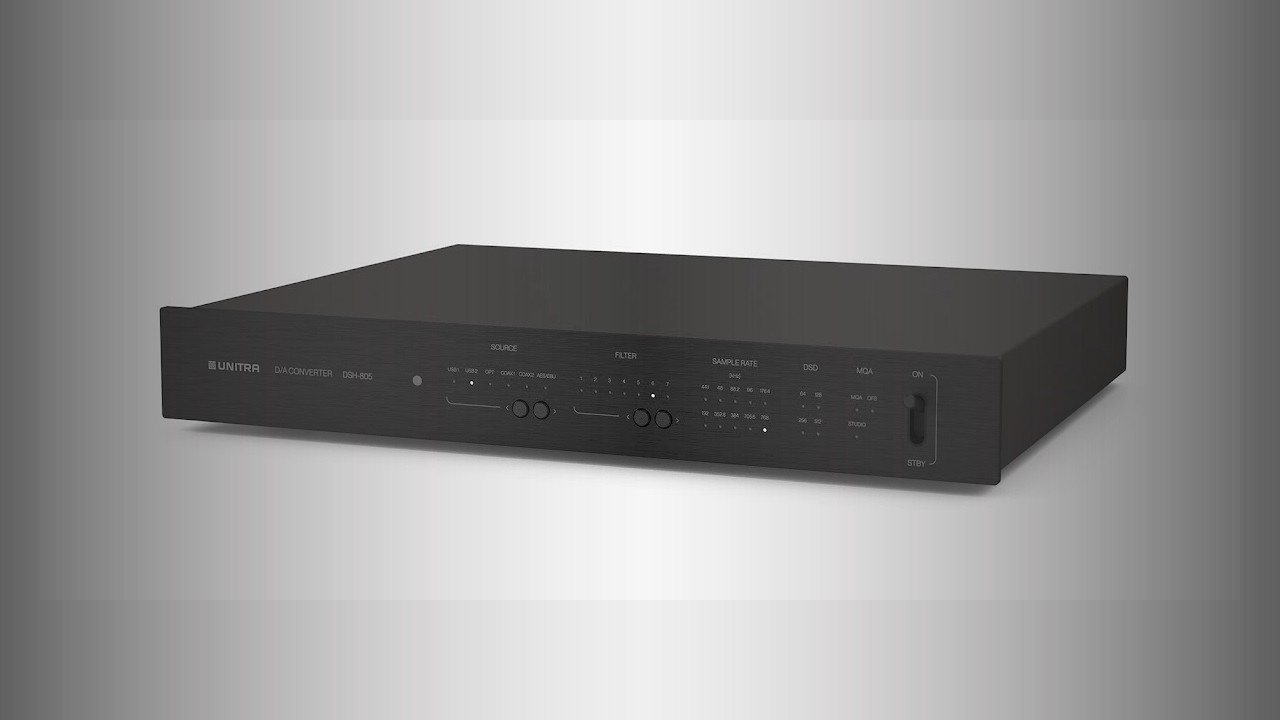
8. Unitra DSH-805 DAC: ESS Sabre ES9039, DSD512 & MQA Support for $3,000
Unitra DSH-805 standalone DAC with metal cabinet, brushed aluminum front panel and power supply designed for separated digital and analog sections.
The Unitra DSH-805 is the company’s first standalone DAC and is presented by its designers as a reference-class model.
It is visually and conceptually linked to the WSH-805 integrated amplifier, with a metal cabinet and brushed aluminum front panel.
Internally, the DSH-805 uses a linear power supply with a transformer designed and manufactured in Poland for this DAC architecture, EMI filtering and five independently regulated secondary voltages to separate digital and analog sections. Conversion is handled by an ESS SABRE ES9039MSPRO DAC chip using eight DACs, four per channel, with Hyperstream IV architecture.
Best for: Systems built around a serious standalone DAC with strong power-supply emphasis
- First standalone DAC from Unitra
- Linear power supply with dedicated transformer
- Five independently regulated secondary voltages
- ESS SABRE ES9039MSPRO with eight DACs
Verdict: The DSH-805 is the premium-leaning choice here for listeners drawn to Unitra’s standalone DAC approach, linear power supply and ESS SABRE implementation.
Quick comparison
These DACs are not interchangeable.
Some are pure converters for established hi-fi systems, others are headphone amplifiers with DAC sections, and one is a CD player with DAC functionality.
The most useful comparison is therefore by role rather than by chip alone.
| Product | Best for | Verdict |
|---|---|---|
| Musical Fidelity M3X | Focused standalone DAC duties in a hi-fi system | A pure DAC with balanced output options and attention to interference control. |
| Shanling UA7 | Compact headphone listening with a distinctive tube output stage | A portable DAC/amp that combines ESS conversion, OLED control and JAN6418 tubes. |
| Rega Saturn-R | CD playback plus external digital inputs | A combined top-loading CD transport and DAC for systems where discs still matter. |
| Audirect Team 1 | Self-powered portable headphone use | A small DAC/amp with 3.5mm and 4.4mm outputs, Type-C connectivity and battery-focused power management. |
| Topping DX5 II | Powerful desktop headphone systems with EQ needs | A balanced desktop DAC/headphone amp with dual ESS DAC chips, strong specified output and PEQ support. |
| Hegel D50 | Purist hi-fi systems that do not need streaming or volume control in the DAC | A dedicated converter focused on power-supply isolation and reduced feature complexity. |
| FiiO K19 | Desktop systems with many digital sources | A connection-rich desktop DAC/headphone amplifier designed to act as a central hub. |
| Unitra DSH-805 | Standalone DAC buyers prioritizing power supply and high-end ESS implementation | A premium-positioned Unitra DAC with a linear supply, separated regulation and ES9039MSPRO conversion. |
Frequently asked questions
Should I choose a pure DAC or a DAC with a headphone amplifier?
Choose a pure DAC if your system already has amplification and volume control, as with the Musical Fidelity M3X or Hegel D50.
Choose a DAC/headphone amplifier if headphones are a main source of listening, as with the Shanling UA7, Audirect Team 1, Topping DX5 II or FiiO K19.
Is a portable DAC enough for home listening?
A portable DAC can be ideal for headphone listening and mobile use, especially when it includes its own power management or a compact display.
For a fixed hi-fi system, a desktop or full-size standalone DAC may offer more suitable outputs, larger power-supply design and easier integration with amplifiers.
Do I need balanced outputs?
Balanced outputs are useful when your amplifier or headphones support them, but they are not automatically required.
In this selection, balanced connectivity appears in different contexts, from the Musical Fidelity M3X’s XLR output options to the 4.4mm headphone outputs on compact units and balanced desktop amplifier designs.
Which option makes sense if I still play CDs?
The Rega Saturn-R is the clear fit from this group because it combines a top-loading CD transport with a DAC and also provides optical, coaxial and asynchronous USB inputs.
If CD playback is not needed, a standalone DAC or DAC/headphone amplifier will usually be the more direct choice.
How to choose the right DAC from this group
Match the DAC to the job before comparing specifications.
For a conventional hi-fi system where the amplifier and source control are already in place, the Musical Fidelity M3X and Hegel D50 are the most directly relevant because they are dedicated DACs rather than all-in-one devices.
The M3X brings a pure DAC layout with balanced output options and interference-control measures, while the D50 takes an even more purist route by omitting streaming and volume adjustment. For headphone listeners, the choice depends on where the listening happens. The Shanling UA7 is the compact option with the most distinctive circuit character on paper, thanks to its JAN6418 tube output stage and ESS ES9069 DAC. The Audirect Team 1 is also portable, but its self-powered design, iPS power management and dual Type-C layout make it especially relevant for users who want battery-managed flexibility. On the desktop, the Topping DX5 II is the more power- and measurement-led headphone choice from the supplied information, while the FiiO K19 is the stronger fit when broad connectivity is the priority. The Rega Saturn-R and Unitra DSH-805 sit slightly apart from the rest. The Rega is for listeners who still value CD replay and want DAC inputs in the same chassis. The Unitra is a standalone DAC aimed at systems where construction, a linear power supply, separated regulation and an ESS SABRE ES9039MSPRO implementation are central to the appeal. A sensible final filter is system fit: check the outputs your amplifier accepts, the headphone connection you actually use, the digital inputs your sources require and whether you need volume, EQ, portability or disc playback. The right DAC is the one that solves those practical questions cleanly without adding features your system will not use.


Join the discussion
Share your thoughts, listening impressions or product experience.