
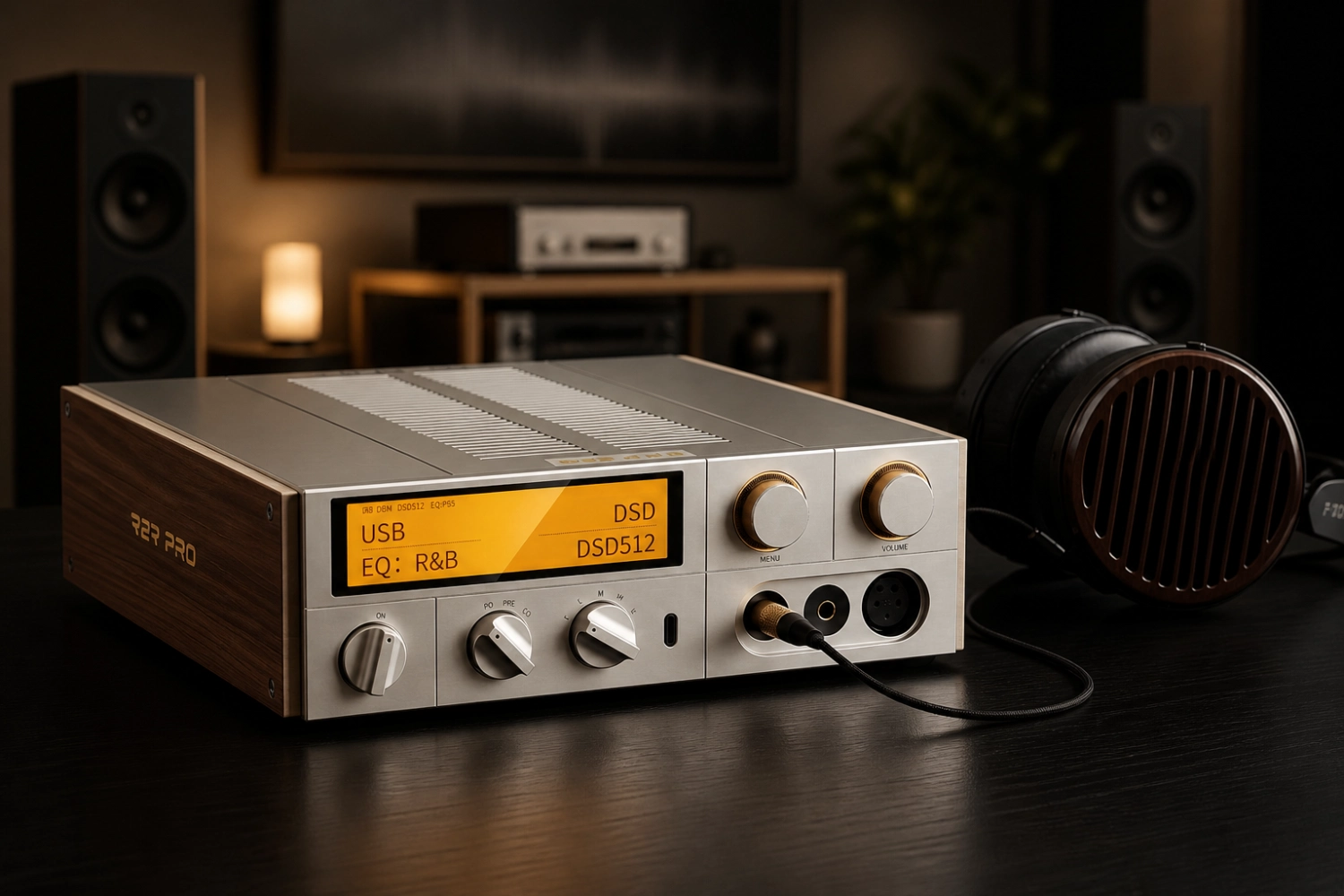
The FiiO K17 R2R Pro and Matrix Element S are being compared because both are network-capable desktop hi-fi components intended to sit at the center of modern digital listening. The important difference is their role: the FiiO K17 R2R Pro is announced as an all-in-one network player, DAC and headphone amplifier, while the Matrix Element S is presented as a versatile streamer with extensive digital outputs for feeding another DAC or hi-fi system.
| Category | FiiO K17 R2R Pro | Matrix Element S |
|---|---|---|
| Product type | Network player, DA converter and headphone amplifier | Streamer / network player |
| DAC approach | FiiO proprietary 5 + 24-bit R2R PRO resistance arrays; NOS and OS modes | Designed to output digital audio to external DACs, including via USB DAC output |
| Headphone amplification | Discrete Class AB transistor headphone amplifier; stated 4000 mW per channel | No headphone amplifier is specified in the source article |
| Network connectivity | Dual-band 2.4G/5G Wi-Fi, Gigabit Ethernet, QPlay support | Gigabit Ethernet, 2.4GHz/5GHz Wi-Fi; DLNA/UPnP, AirPlay 2, Spotify Connect, Tidal Connect; Roon undergoing certification tests at publication |
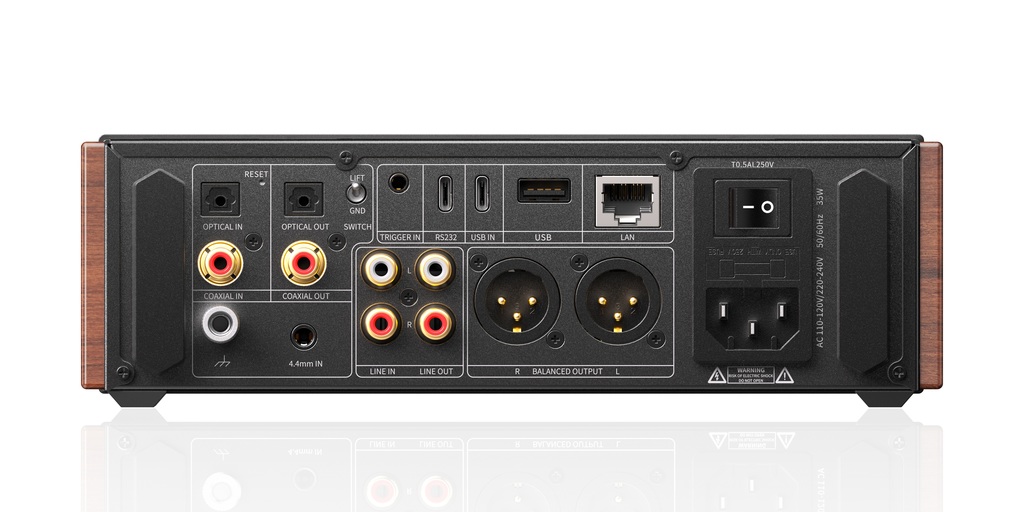
| Digital inputs / outputs | Source confirms streaming, local playback and USB ground loop isolator, but does not list the full input/output panel | Inputs: USB-B, USB-C, RJ45. Outputs: I2S-LVDS, AES/EBU, optical Toslink, coaxial, USB DAC output |
| Control and display | 3.93-inch display, FiiO Control app or web browser for EQ, aluminum alloy infrared remote | 3.46-inch touchscreen, MA Remote app for iOS and Android |
| Sound adjustment | 31-band parametric EQ with Auto EQ | No equalizer is specified in the source article |
| Status / pricing | Announced; official debut planned for early June 2026 at the High End Audio Fair in Vienna; pricing not yet announced | Published as an available Matrix Audio streamer in the 2023 source; price not supplied in the source article |
Design and build: desktop control versus system integration
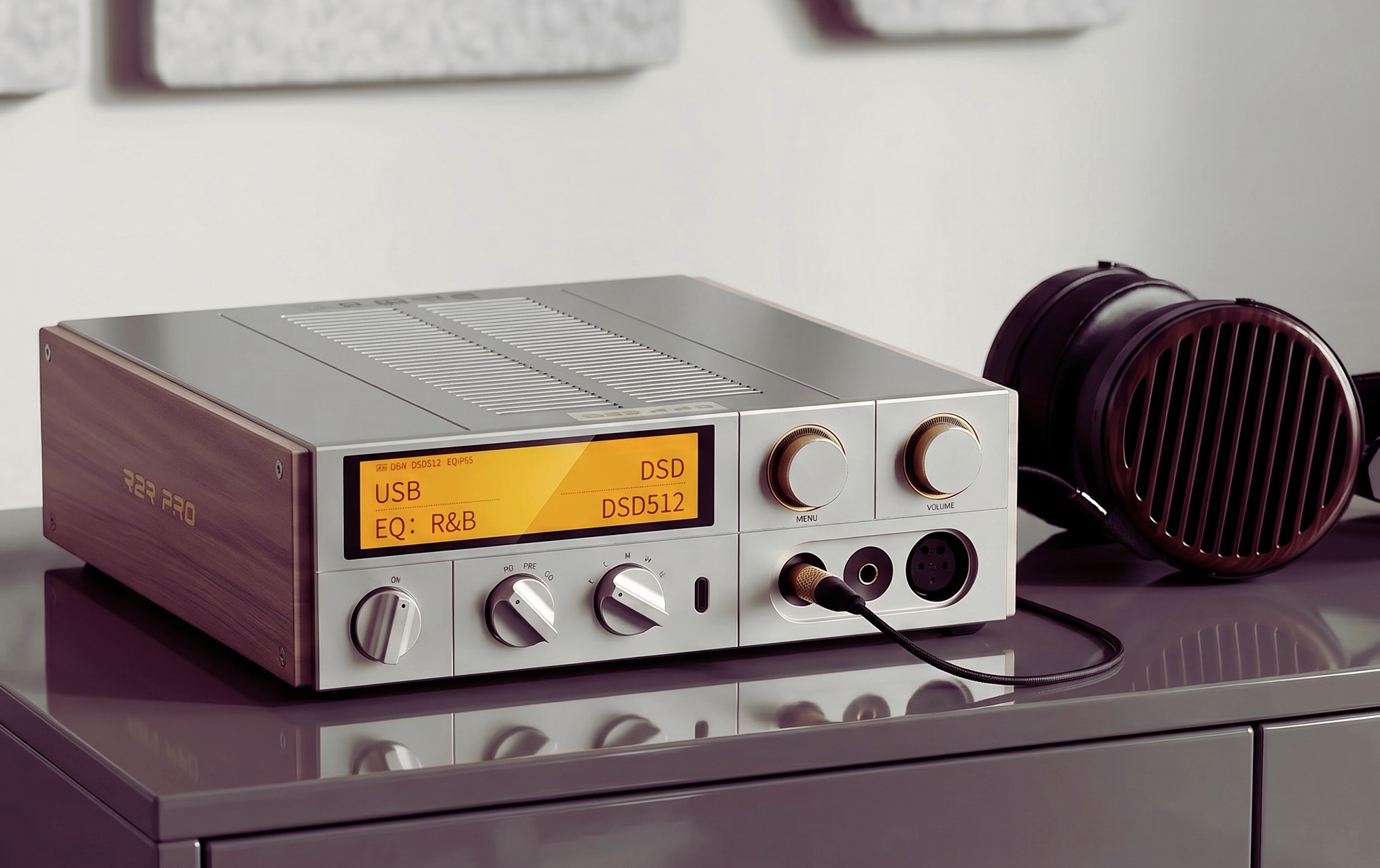
The FiiO K17 R2R Pro is described as a desktop component that can function both as a standalone headphone system and as a central hub within a hi-fi setup. Its front-facing usability is clearly part of the concept: the source confirms a 3.93-inch diagonal display with navigation, real-time settings control, visual themes, VU meters and a clock display. It also ships with an aluminum alloy infrared remote control, which suggests FiiO expects it to be used not only at arm’s length on a desk, but also from across a room.
Internally, FiiO highlights a low-noise 35-watt linear power supply. The source also mentions a USB ground loop isolator intended to reduce unwanted noise and interference when connected to computers or other digital sources. Those are confirmed design details, though their audible effect is not independently measured in the supplied article.
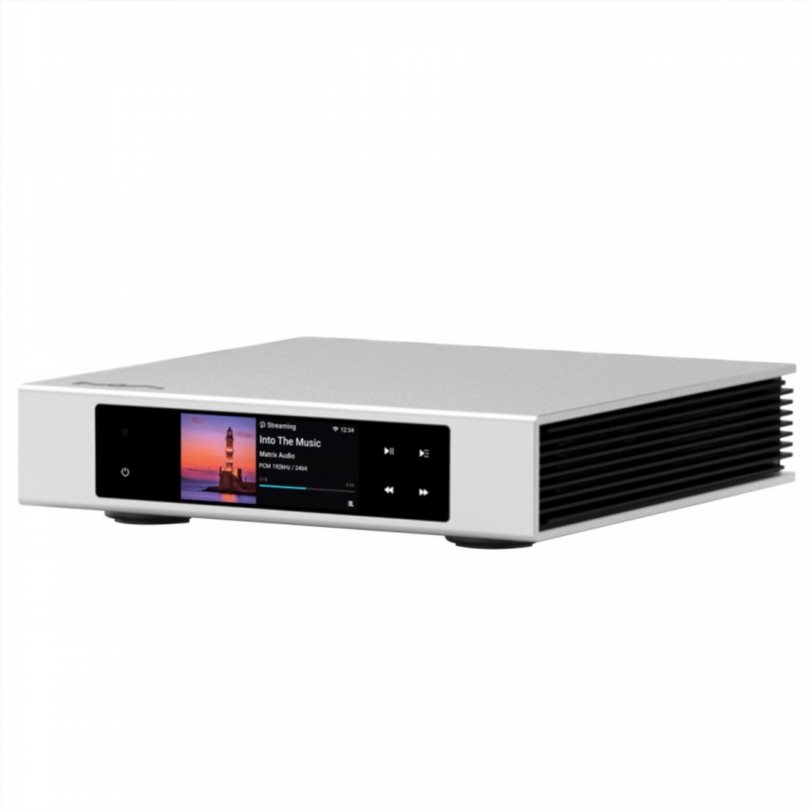
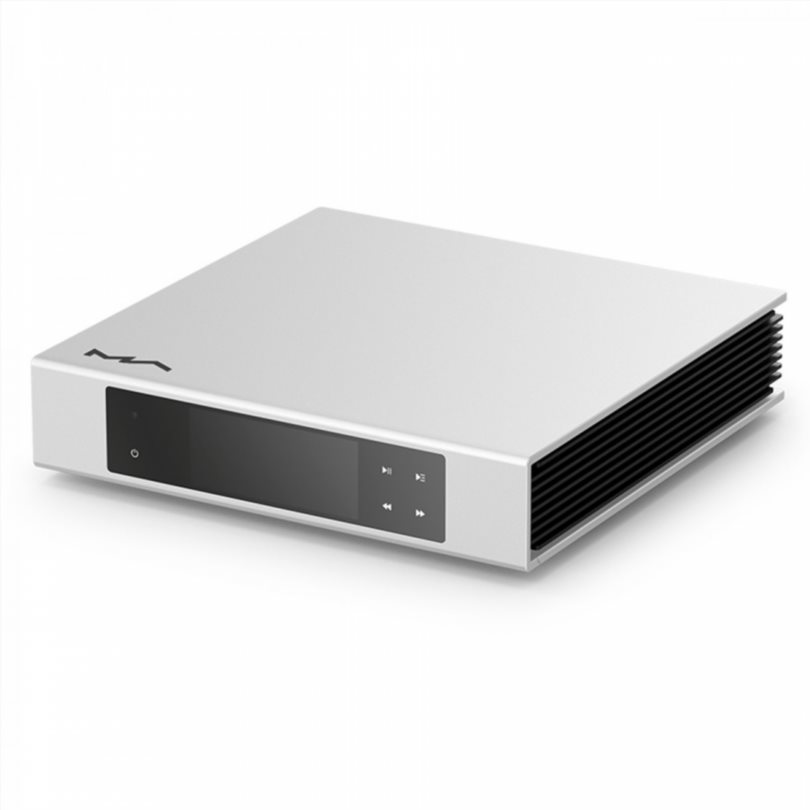
The Matrix Element S takes a more streamer-transport-oriented approach. Its chassis dimensions are specified as 240 x 245 x 58 mm, with a weight of 2.4 kg. It has a 3.46-inch high-resolution touchscreen with an ergonomic interface, and during playback it can show metadata such as cover art, album title, track title and artist name. The overall impression from the source is of a compact network player designed to slot into an existing system rather than replace multiple components.
Features and connectivity: FiiO is broader, Matrix is more output-focused
The K17 R2R Pro’s strongest confirmed advantage is functional breadth. It combines a network player, DAC, headphone amplifier, local playback and streaming reception in one box. Its R2R section uses FiiO’s proprietary 5 + 24-bit R2R PRO resistance arrays, and listeners can switch between NOS, or Non-Oversampling, and OS, or Oversampling, modes. FiiO positions this architecture as aiming for natural tonality, rich harmonic detail and a more analog listening experience, but that is the manufacturer’s characterization rather than an independent listening conclusion from the source.
The Matrix Element S is narrower in one sense, but more explicit about digital routing. The article lists USB-B, USB-C and RJ45 as inputs, and I2S-LVDS, AES/EBU, optical Toslink, coaxial and USB DAC output as outputs. It is also described as the first Matrix Audio network player to feature USB DAC outputs. That makes it especially relevant for owners who already have a DAC they like and want a streaming bridge to feed it.
Network support also differs in how much detail is supplied. For FiiO, the confirmed items are QPlay support, dual-band 2.4G and 5G Wi-Fi and Gigabit Ethernet. For Matrix, the article names DLNA/UPnP, AirPlay 2, Spotify Connect and Tidal Connect, with Roon network protocols described as undergoing certification tests at the time of publication. Matrix also provides file-format support in the source, including MP3, WMA, WAV, AIFC, AIFF, AAC, FLAC, OGG, APE, ALAC, M4A, DSF, DFF and CUE.
Performance and use case: what can be said from the supplied facts
No listening tests or independent measurements are provided in either source, so the fairest comparison is based on stated architecture, formats and intended application.
For headphone users, the FiiO is the more complete product on paper. Its discrete Class AB transistor headphone amplifier is specified at a high output power of 4000 mW per channel, and the source says it is intended to drive a wide range of headphones, from sensitive in-ear monitors to demanding planar headphones, while maintaining clarity and dynamic range. Because that performance language comes from the product announcement, it should be treated as the manufacturer’s claim rather than a review verdict.
The K17 R2R Pro also has a major tuning feature that the Matrix article does not list: a 31-band parametric equalizer with Auto EQ. Settings can be accessed through the FiiO Control app on a smartphone or via a web browser on a computer, then saved on the K17 R2R. For buyers who want to correct headphone response or shape tonal balance without relying entirely on software in a computer, this is a meaningful functional difference.
The Matrix Element S, by contrast, is compelling as a network transport. It uses Matrix Audio’s MA Player software architecture for playback and management, controlled through the MA Remote app on iOS and Android. The source specifies support for high-resolution PCM and DSD routing: USB audio input supports PCM up to 32-bit/768kHz, Native DSD up to DSD512 and DSD DoP up to DSD256. Coaxial, optical and AES outputs support PCM up to 24-bit/192kHz and DSD DoP up to DSD64, while I2S LVDS supports PCM up to 32-bit/768kHz, Native DSD up to DSD512 and DSD DoP up to DSD256. It also uses two Accusilicon ultra-low phase-noise femtosecond clocks, with an FPGA coordinating clocks and controlling frequencies. The source states this contributes to very low jitter.
Software and daily operation
FiiO gives users several control paths. The display handles navigation and visual feedback, the infrared remote provides room-based control, and the FiiO Control app or web browser is used for the parametric EQ. The ability to store EQ settings on the device is useful if the K17 R2R Pro is moved between sources or used without a computer controlling everything. The confirmed display extras, including VU meters and clock display, may appeal to users who like an informative desktop interface.
Matrix leans on the MA Remote app and touchscreen. Through the app, users can browse and play local library content, access streaming services and web radio stations, and update the Element S. The MA Player architecture is described as Matrix Audio’s own high-quality digital audio playback and management system. For everyday use, the Matrix source gives more detail about streaming ecosystem compatibility, especially AirPlay 2, Spotify Connect, Tidal Connect and DLNA/UPnP.
Ownership considerations: timing, pricing and system matching
The biggest practical caveat for the FiiO K17 R2R Pro is availability and price. The source says it will make its official debut in early June 2026 at the High End Audio Fair in Vienna, and pricing information had not yet been announced. That means a buyer cannot fully judge value from the supplied information alone. The feature list is strong, but value depends heavily on final pricing and real-world availability.
The Matrix Element S source is older, published in 2023, and supplies a fuller specification sheet. It gives power details too: 100–240 V, 50/60 Hz supply voltage, maximum consumption below 30 W and standby consumption below 5 W. However, the source does not provide a price either, so direct value comparison is still not possible.
System matching is the clearer deciding factor. If you need a headphone amplifier and DAC in the same chassis, the Matrix Element S is not presented as that product. If you already own a DAC and want multiple digital outputs from a network streamer, the FiiO source does not provide the same output detail that Matrix does.
Pros and cons
FiiO K17 R2R Pro pros:
- All-in-one network player, DAC and headphone amplifier.
- Proprietary R2R DAC architecture with NOS and OS modes.
- 31-band parametric EQ with Auto EQ, controlled by app or web browser.
- Discrete Class AB headphone amplifier with stated 4000 mW per channel output.
- Gigabit Ethernet, dual-band Wi-Fi, display and infrared remote control.
FiiO K17 R2R Pro cons:
- Pricing is not announced in the source.
- Official debut is scheduled for June 2026, so availability is a consideration.
- The source does not list the complete physical input/output panel.
- Sound-quality descriptions are manufacturer claims, not independent review findings.
Matrix Element S pros:
- Clear role as a dedicated streamer for existing DAC-based systems.
- Extensive digital outputs: I2S-LVDS, AES/EBU, optical, coaxial and USB DAC output.
- Strong network protocol list including DLNA/UPnP, AirPlay 2, Spotify Connect and Tidal Connect.
- Detailed high-resolution PCM and DSD support across several outputs.
- MA Remote app, touchscreen interface and metadata display.
Matrix Element S cons:
- No built-in headphone amplifier is specified.
- No onboard EQ is specified in the source article.
- Roon support was described as undergoing certification tests at publication, not confirmed as final in the supplied source.
- Price is not supplied in the source article.
Who should buy each?
Choose the FiiO K17 R2R Pro if your main system is headphone-based or desktop-based and you want one component to handle streaming, digital conversion, headphone drive and detailed tonal adjustment. It is especially attractive if the 31-band parametric EQ and Auto EQ matter to you, or if you are specifically interested in an R2R DAC with selectable NOS and OS modes. The editorial inference is simple: FiiO is the more self-contained solution, provided its eventual price and availability suit your budget.
Choose the Matrix Element S if you already own a DAC, integrated amplifier or digital-input system and want a network streamer with flexible digital outputs. Its specification sheet is more transport-focused, and its USB DAC output, I2S-LVDS, AES/EBU, coaxial and optical outputs make it easier to integrate into a traditional component system. It is less suitable if you need direct headphone driving or onboard EQ, because those are not specified in the source.
Final verdict
The more versatile single-box product is the FiiO K17 R2R Pro. Based on the supplied facts, it covers more jobs: streamer, DAC, R2R platform, headphone amplifier and EQ engine. For a headphone-first buyer starting from scratch, it is the more compelling concept, with the major caveat that price and final market availability are still unknown.
The Matrix Element S remains the cleaner choice for an established hi-fi system built around an external DAC. It gives more confirmed detail about digital outputs, supported formats, network protocols and physical specifications. If your goal is to add streaming without replacing your DAC or amplifier, Matrix is the more focused tool.
So the nuanced winner depends on system type: FiiO wins as the broader all-in-one headphone and desktop hub; Matrix wins as the dedicated streamer transport for existing digital hi-fi systems.