

Choosing a digital-to-analogue converter starts with deciding where and how it will be used.
A pocket dongle powered by a phone solves a different problem from a desktop DAC with analogue volume control, while a component designed for a full hi-fi system may prioritize input flexibility, channel separation and preamplifier functions.
The selection below reflects that breadth. It includes lightweight mobile adapters, battery-powered wireless models, compact desktop DAC and headphone amplifiers, and ambitious converters built around dual-mono or otherwise highly separated signal paths. Some emphasize simple operation; others provide extensive format support, filtering choices or system-control duties. Specifications are useful for checking compatibility, but they should not determine the decision alone. Pay particular attention to the required inputs, headphone connections, power arrangement and volume-control design. Those practical distinctions will usually narrow the field more effectively than chasing the highest supported sample rate.
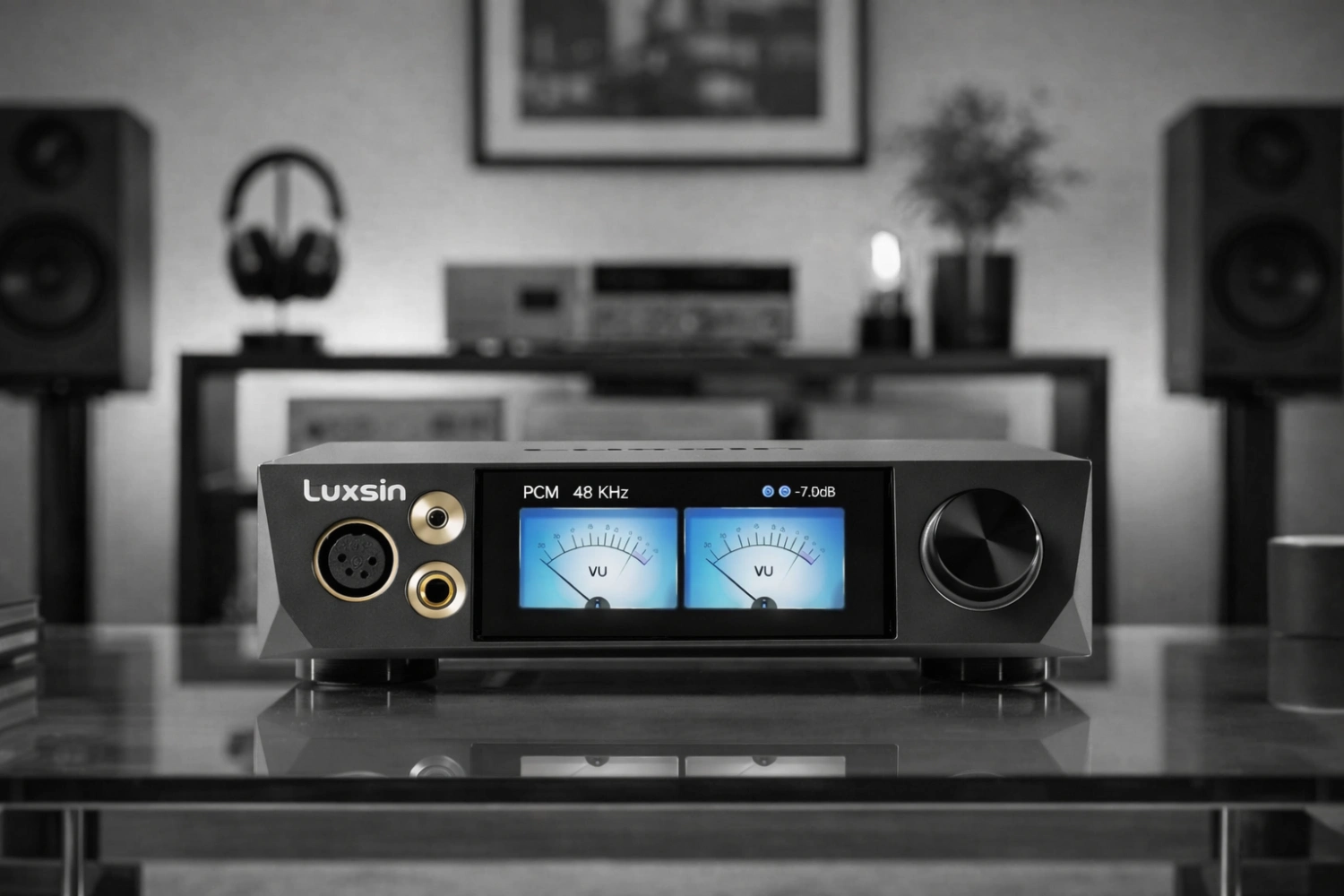
1. Luxsin X8
Luxsin X8 desktop DAC and headphone amplifier with an eight-chip dual-mono conversion stage.
The Luxsin X8 is a desktop DAC and headphone amplifier built around eight Cirrus Logic CS43198 chips.
Four converters operate in parallel for each channel within a true dual-mono architecture, with separate signal paths and power delivery for the left and right channels.
Dedicated buffering, shared clock distribution and individual DAC shielding are intended to maintain timing consistency and limit noise. Nearly 5 watts per channel of stated output power gives the amplifier section substantial scope, while the separated linear power supply reinforces the X8’s emphasis on hardware design and personalized operation.
Best for: Feature-led desktop headphone systems
- Eight-DAC dual-mono architecture
- Nearly 5 watts per channel of stated output
- Separated linear power supply
- Dedicated clock distribution and shielding
Verdict: The X8 combines unusually elaborate conversion hardware with powerful headphone amplification and extensive personalization.

2. xDuoo Link10
xDuoo Link10 portable USB DAC and headphone amplifier in its compact aluminium enclosure.
The xDuoo Link10 packages two CS43131 DAC chips and a headphone amplifier into a 25-gram aluminium body.
It accepts PCM up to 32-bit/384 kHz and DSD256, offers 60-step digital volume control, and provides both 3.5 mm and balanced 4.4 mm outputs.
Its two USB Audio modes extend compatibility to phones, computers, audio players and supported game consoles. Power comes from the connected source, so there is no internal battery to charge, although that also means the host device supplies its operating power.
Best for: Lightweight wired listening from multiple USB sources
- 25-gram aluminium body
- 3.5 mm and 4.4 mm outputs
- PCM up to 32-bit/384 kHz and DSD256
- UAC 1.0 and 2.0 support
Verdict: The Link10 is a compact, versatile dongle for listeners who need dual headphone outputs and broad USB compatibility.

3. Métronome Le DAC 3
Métronome Le DAC 3 high-end digital-to-analogue converter with optional streaming capability.
Métronome’s Le DAC 3 is aimed at high-end systems in which conversion quality and digital-source flexibility take priority over portability.
It supports PCM up to 32-bit/768 kHz and native DSD up to DSD1024, giving owners of extensive high-resolution libraries considerable format headroom.
USB, AES/EBU, coaxial S/PDIF and optical Toslink inputs cover common computer, streamer and disc-transport connections. Optional streaming provides a route to a more integrated digital front end without changing the DAC’s core system role.
Best for: High-end systems with varied digital sources
- PCM support up to 32-bit/768 kHz
- Native DSD support up to DSD1024
- USB, AES/EBU, coaxial and optical inputs
- Optional streaming
Verdict: Le DAC 3 is a format-flexible standalone converter for listeners building an ambitious digital front end.

4. Portable DACs: Pocket Hi-Fi Done Right
A selection of pocket-sized DAC and headphone amplifiers intended for wired mobile listening.
This source article considers portable DAC and headphone amplifiers as compact alternatives to a dedicated digital audio player.
Such devices can connect wired headphones to phones and computers that lack a conventional headphone socket while also handling conversion and amplification.
The FiiO KA11 is identified as the accessible starting point in the source, but the broader distinction is between simple dongles and more ambitious portable designs. This entry is therefore most useful as category guidance rather than as a recommendation of one specific model.
Best for: Understanding the portable DAC category
- Covers pocket-sized DAC and amplifier options
- Addresses phones without headphone sockets
- Includes the compact FiiO KA11
- Considers alternatives to a separate audio player
Verdict: This overview is a useful primer for deciding whether a small dongle can replace a larger portable source.

5. 7HZ Artemis39
7HZ Artemis39 battery-powered DAC and headphone amplifier with wired and Bluetooth connectivity.
The Artemis39 is 7Hertz’s first combined DAC and headphone amplifier.
Unlike host-powered dongles, it contains a 1100 mAh battery rated for eight to ten hours of continuous playback.
Its metal body houses 3.5 mm and balanced 4.4 mm headphone connections, along with a 4.4 mm line output. Stated maximum output is 320 mW from 3.5 mm and 405 mW from 4.4 mm. Bluetooth adds wireless-source flexibility, making the Artemis39 a more self-contained portable option than a basic USB adapter.
Best for: Battery-powered portable and wireless listening
- Eight to ten hours of stated playback
- 3.5 mm and 4.4 mm headphone outputs
- Dedicated 4.4 mm line output
- Wired and Bluetooth operation
Verdict: The Artemis39 suits listeners who want balanced output, Bluetooth and an internal battery in one portable unit.

6. TEAC UD-301-X
TEAC UD-301-X desktop USB DAC with headphone amplification and balanced XLR outputs.
The TEAC UD-301-X is a desktop USB DAC with an integrated headphone amplifier and a dual-mono circuit.
It uses one Burr-Brown PCM1795 converter per channel, Muses operational amplifiers and a power supply built around a toroidal transformer.
USB playback covers DSD at 2.8 and 5.6 MHz and PCM up to 24-bit/192 kHz, while optical and coaxial inputs also accept PCM up to 24-bit/192 kHz. RCA and XLR analogue outputs make it suitable for both conventional and balanced systems. Optional upsampling to 192 kHz can be enabled or bypassed.
Best for: Traditional desktop and hi-fi systems
- Dual-mono PCM1795 conversion
- USB, optical and coaxial inputs
- RCA and XLR analogue outputs
- Switchable upsampling to 192 kHz
Verdict: The UD-301-X is a practical desktop DAC for systems needing headphone playback, balanced outputs and several conventional digital inputs.

7. T+A DAC 200
T+A DAC 200 converter and Class A preamplifier with its distinctive front-panel meter.
The T+A DAC 200 handles PCM and DSD through separate conversion arrangements: a double symmetrical differential design using four 32-bit Burr-Brown chips per channel for PCM, and T+A’s true one-bit path for DSD.
It supports PCM up to 32-bit/768 kHz and DSD1024.
Four proprietary oversampling filter settings and a non-oversampling mode allow the processing approach to be adjusted. Galvanic isolation, separated digital and analogue paths, and an in-house second-generation de-jitter system address incoming noise and timing. A discrete, dual-mono Class A preamplifier with relay volume control also allows it to serve as a system hub.
Best for: Advanced systems requiring DAC and preamplifier functions
- Separate PCM and DSD conversion paths
- PCM up to 32-bit/768 kHz and DSD1024
- Multiple oversampling filters plus NOS
- Discrete Class A preamplifier
Verdict: The DAC 200 stands out for its separate conversion paths, configurable filtering and serious analogue preamplifier section.

8. CVJ VVT-1
CVJ VVT-1 wireless DAC and headphone amplifier in an anodized aluminium enclosure.
The CVJ VVT-1 is a battery-powered wireless DAC and headphone amplifier based on Qualcomm’s QCC5125 Bluetooth 5.3 platform and two ESS conversion chips.
Codec support includes LDAC, AAC, SBC, aptX variants and LHDC, providing several options for compatible wireless sources.
Its lithium battery is rated for about seven hours under standard conditions, and the unit can be charged while operating. An anodized aluminium shell gives the portable design a more durable enclosure than a basic plastic receiver.
Best for: Wireless headphone listening with codec flexibility
- Bluetooth 5.3 connectivity
- Broad selection of supported codecs
- About seven hours of stated battery life
- Charging supported during use
Verdict: The VVT-1 is most relevant to listeners seeking a portable Bluetooth DAC and amplifier with broad codec support.

9. Shanling EH1
Shanling EH1 compact desktop DAC and headphone amplifier with front-panel rotary controls.
The Shanling EH1 is a compact desktop DAC and headphone amplifier designed around straightforward physical operation.
It omits a display in favor of buttons and rotary controls, reducing menu dependence.
The front panel includes a volume encoder as well as bass and tone controls, giving users direct access to everyday adjustments. Its aluminium chassis is available in black or silver, and the footprint is smaller than Shanling’s EH3. The EH1 is a sensible candidate where simplicity and desktop space matter more than an elaborate interface.
Best for: Simple, space-conscious desktop setups
- Compact desktop format
- Direct physical controls
- Dedicated bass and tone adjustment
- Black or silver aluminium chassis
Verdict: The EH1 offers an approachable desktop layout for listeners who prefer direct controls and minimal interface complexity.

10. D&A Alpha
D&A Alpha compact dual-mono DAC, balanced headphone amplifier and analogue preamplifier.
The D&A Alpha combines DAC, analogue preamplifier and headphone-amplifier duties in a compact desktop chassis.
Two ES9039Q2M converters operate in a dual-mono layout with independent clocking and signal paths.
A fully discrete four-channel balanced amplifier stage is designed for low output impedance and high current delivery across sensitive earphones, high-impedance dynamic headphones and planar-magnetic models. Analogue volume control through an NJU72315 chip allows the Alpha to function as a preamplifier without relying on digital attenuation. Femtosecond oscillators and a two-stage PLL system address clock stability.
Best for: Compact balanced desktop systems
- Dual-mono ES9039Q2M architecture
- Fully discrete balanced amplifier stage
- Analogue volume control
- DAC, preamplifier and headphone-amplifier operation
Verdict: The Alpha is a flexible control center for listeners who want balanced headphone drive and genuine analogue preamplifier operation.
Quick comparison
The clearest differences are physical format, source connectivity and system role.
The Link10 represents the lightest host-powered approach, while the Artemis39 and VVT-1 add batteries and wireless flexibility.
The EH1, UD-301-X, X8 and Alpha are desktop DAC and amplifier combinations with different priorities, whereas the Le DAC 3 and DAC 200 are conceived for more ambitious component systems.
| Product | Best for | Verdict |
|---|---|---|
| Luxsin X8 | Feature-led desktop headphone systems | Eight-DAC dual-mono conversion and powerful headphone amplification distinguish this ambitious desktop design. |
| xDuoo Link10 | Lightweight wired listening from multiple USB sources | A 25-gram host-powered dongle with 3.5 mm and balanced 4.4 mm outputs. |
| Métronome Le DAC 3 | High-end systems with varied digital sources | A standalone high-resolution DAC with a comprehensive conventional input array and optional streaming. |
| Portable DACs: Pocket Hi-Fi Done Right | Understanding the portable DAC category | A category overview that explains the role of dongles and highlights the FiiO KA11 as an entry point. |
| 7HZ Artemis39 | Battery-powered portable and wireless listening | A portable DAC and amplifier with Bluetooth, balanced output and an eight-to-ten-hour battery rating. |
| TEAC UD-301-X | Traditional desktop and hi-fi systems | A dual-mono desktop DAC with headphone amplification, switchable upsampling and RCA or XLR output. |
| T+A DAC 200 | Advanced systems requiring DAC and preamplifier functions | Separate PCM and DSD paths combine with selectable filtering and a discrete Class A preamplifier. |
| CVJ VVT-1 | Wireless headphone listening with codec flexibility | A battery-powered Bluetooth 5.3 DAC and amplifier supporting several high-quality codec families. |
| Shanling EH1 | Simple, space-conscious desktop setups | A compact display-free DAC and amplifier with direct volume, bass and tone controls. |
| D&A Alpha | Compact balanced desktop systems | A dual-mono DAC, discrete balanced headphone amplifier and analogue preamplifier in one chassis. |
Frequently asked questions
Should I choose a portable or desktop DAC?
Choose according to the main source and listening location.
A host-powered dongle such as the Link10 minimizes weight, while battery models such as the Artemis39 and VVT-1 add independence or Bluetooth.
Desktop units are more appropriate when permanent inputs, analogue outputs, physical controls or preamplifier duties are required.
Do I need a balanced headphone output?
Only if the headphones use a compatible balanced cable and the DAC’s balanced connection serves a practical purpose in your setup.
Several models here provide 4.4 mm output, but a well-matched 3.5 mm connection remains sufficient for many portable headphones and earphones.
Never connect an incompatible plug through an improvised adapter.
How important is maximum PCM or DSD support?
Format support matters only when it matches the files and sources you actually use.
The Le DAC 3 and DAC 200 accommodate very high-rate PCM and DSD, but conventional 24-bit/192 kHz support may be entirely adequate for many libraries.
Check input-specific limits because USB, optical and coaxial connections may not accept the same formats.
When should a DAC include preamplifier functions?
A preamplifier function is useful when the DAC will connect directly to a power amplifier or active speakers and control listening level.
The DAC 200 includes a discrete Class A preamplifier, while the D&A Alpha uses analogue volume control for this role.
If an integrated amplifier already controls volume, a fixed-level DAC output may be simpler.
How to choose the right DAC
Begin with connections rather than converter-chip counts.
List every source you intend to use, including USB computers or phones, optical-equipped televisions, coaxial transports and Bluetooth devices.
Then check the required output: 3.5 mm or 4.4 mm for headphones, RCA or XLR for an amplifier, or a variable analogue output for active speakers and power amplifiers. Power arrangements matter in portable use. The Link10 draws power from its host and avoids another battery, whereas the Artemis39 and VVT-1 can operate from their own internal cells. For desktop listening, consider whether direct bass and tone controls, as on the Shanling EH1, are more valuable than advanced filtering, extensive format support or a dual-mono circuit. Headphone users should match the amplifier section as carefully as the DAC. Confirm connector compatibility and consider the demands of the intended headphones rather than assuming that the highest stated output is automatically preferable. System builders should also decide whether they need a pure converter or a component capable of volume control and preamplifier duties. The T+A DAC 200 and D&A Alpha explicitly address the latter role, while the Métronome Le DAC 3 is positioned as a dedicated high-end digital source component. The strongest choice is the model whose inputs, outputs, power arrangement and controls fit the system without unnecessary duplication. High sample-rate ceilings and elaborate architectures can be relevant, but practical compatibility should remain the first filter.



Join the discussion
Share your thoughts, listening impressions or product experience.