

Serious vinyl listening does not lead every buyer to the same kind of turntable.
Some listeners want a manually operated deck with a carefully isolated chassis, while others need automatic cueing, Bluetooth transmission or a built-in phono stage.
At the specialist end, construction methods, resonance control and balanced signal transmission become central considerations. The products gathered here cover that broad spectrum, from accessible record players to ambitious flagship engineering. Two entries require particular clarification: the Wilson Benesch Graviton Ti is a separately available tonearm rather than a complete turntable, while the Andover Audio SpinBase 2 is a compact speaker base designed to sit beneath a turntable. They remain relevant to serious vinyl systems, but they serve different roles from the complete decks in the list. Choose according to the system you actually intend to build. Setup demands, cartridge compatibility, phono amplification, isolation, automation and wireless connectivity can matter more in daily use than an isolated feature or an elaborate finish.

1. Wilson Benesch Graviton Ti Tonearm
The Wilson Benesch Graviton Ti combines a graphene-reinforced carbon-fiber arm tube with selectively laser-sintered titanium parts.
The Graviton Ti is a specialist tonearm derived from the arm used in Wilson Benesch’s flagship GMT One System turntable.
It is also available separately and was specifically designed for compatibility with the Dohmann Helix One Mk3, so it should be considered as part of a carefully matched high-end analog system rather than as a general-purpose turntable purchase.
Its molded carbon-fiber arm tube uses a graphene-epoxy matrix, a Rohacell core and a quadruple-helix layer to pursue rigidity and damping. Wilson Benesch also worked with academic partners to apply selective laser sintering to the arm’s titanium components.
Best for: Reference-level systems requiring a specialist tonearm
- Graphene-reinforced carbon-fiber arm tube
- Rohacell core and quadruple-helix construction
- Selectively laser-sintered titanium components
- Designed for the Dohmann Helix One Mk3
Verdict: A technically ambitious tonearm for highly specialized analog systems, not a complete turntable or a universal upgrade.
2. Music Hall MMF 2.3
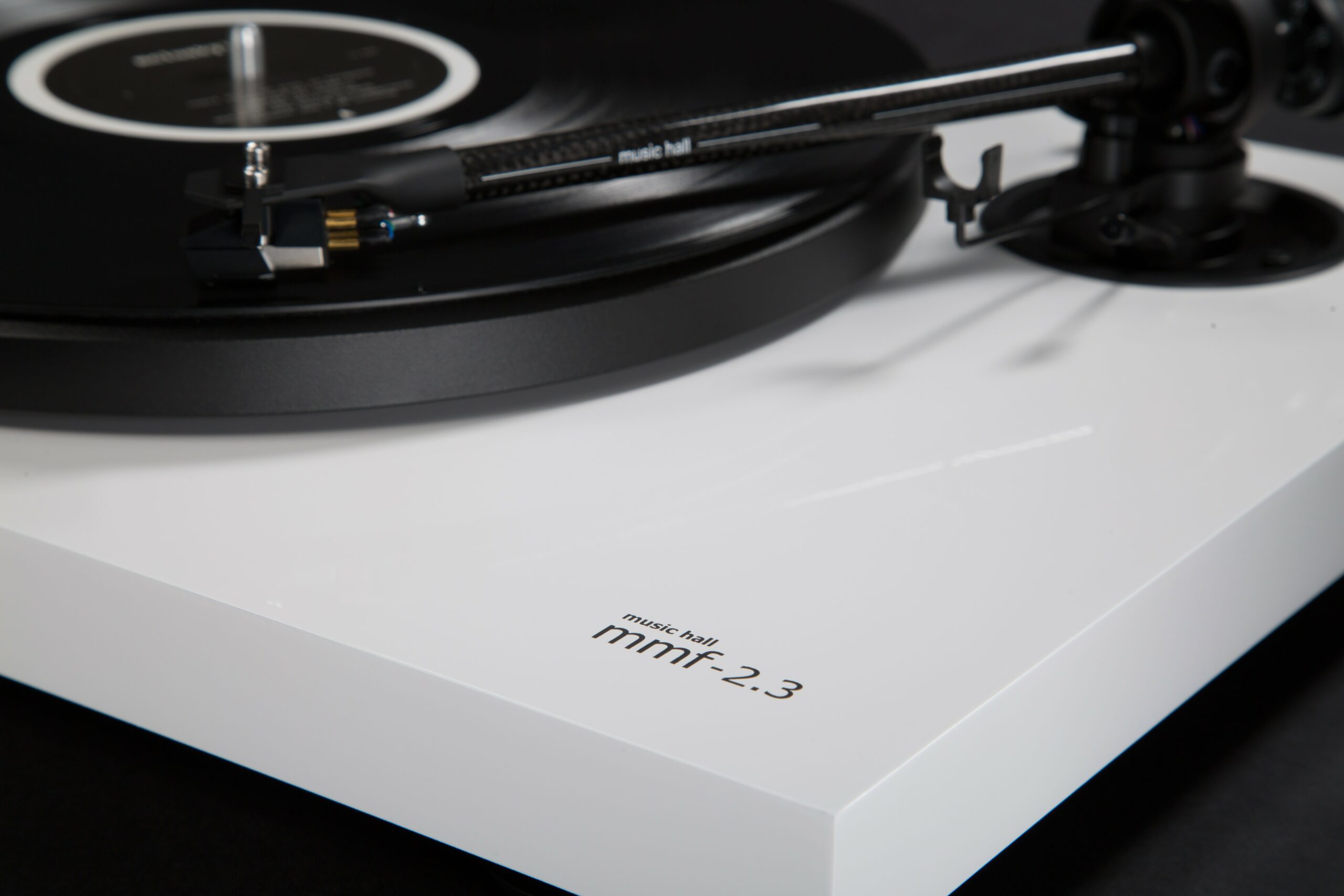
The Music Hall MMF 2.3 uses a fiberboard chassis, separate sub-platter and felt-covered main platter in a classic manual design.
The Music Hall MMF 2.3 is the entry model in its range, but its construction follows established manual hi-fi practice.
A smaller sub-platter receives drive from the motor, while the main platter supports the record on a felt mat.
The stainless-steel spindle runs in a bronze bearing. A thick fiberboard chassis with a piano-lacquer finish contributes to resonance control. The deck arrives partially disassembled and requires careful setup, making it better suited to buyers willing to follow the supplied instructions than to those seeking push-button operation.
Best for: Budget-conscious listeners comfortable with manual setup
- Traditional manual hi-fi design
- Stainless-steel spindle and bronze bearing
- Thick fiberboard chassis
- Detailed assembly instructions supplied
Verdict: A straightforward entry into traditional hi-fi vinyl playback for buyers prepared to assemble and adjust their deck correctly.
3. Pro-Ject X2 B
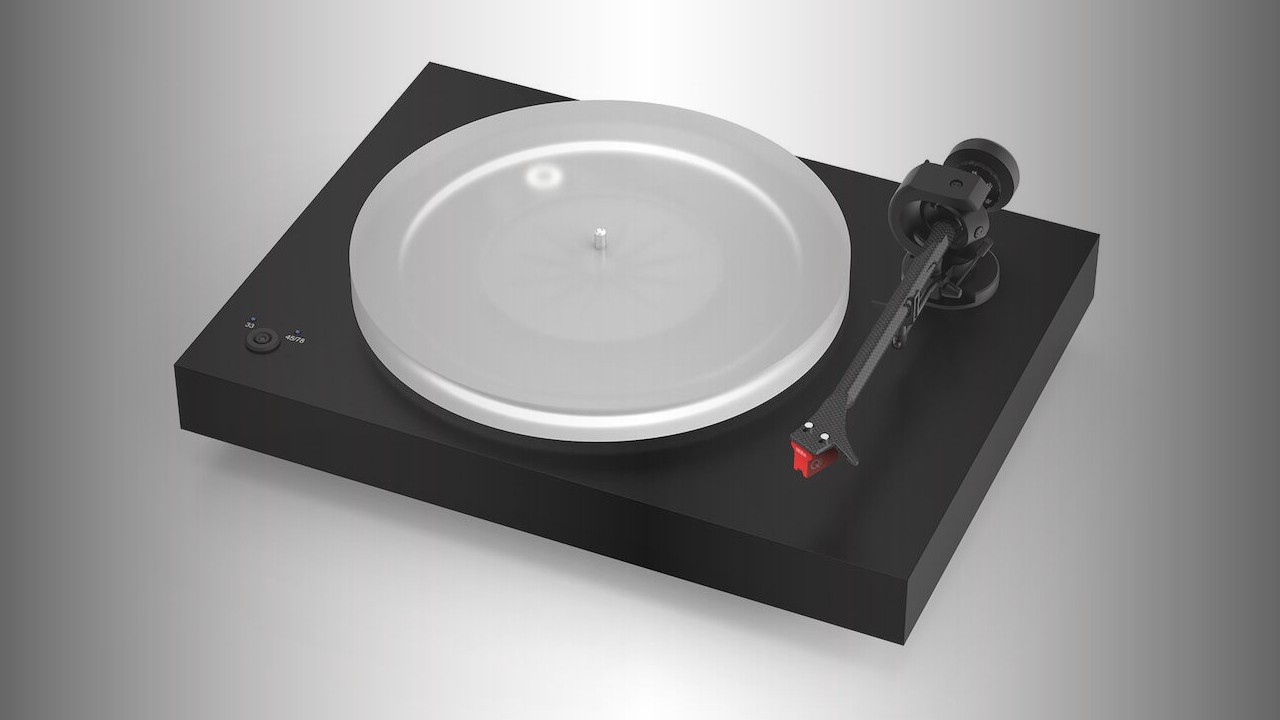
The Pro-Ject X2 B is designed around a True Balanced signal path that can be used with a compatible cartridge and balanced RIAA amplifier.
The Pro-Ject X2 B stands apart through its True Balanced signal path.
When used with a suitable moving-coil cartridge and compatible balanced RIAA phono amplifier, this arrangement is intended to reduce radiated noise around the cartridge’s delicate output signal.
A matching balanced Phono Box S3 B is optional rather than mandatory. The turntable can still be used without that additional purchase, giving owners a path into balanced vinyl replay without making it a requirement from the outset.
Best for: Listeners planning a balanced moving-coil vinyl system
- Fully balanced True Balanced signal path
- Suitable for use with moving-coil cartridges
- Compatible with a matching balanced phono stage
- Can be used without a balanced phono amplifier
Verdict: A focused choice for buyers who want the option of balanced cartridge-to-phono-stage operation without making it compulsory.
4. TEAC TN-400BTX/TB
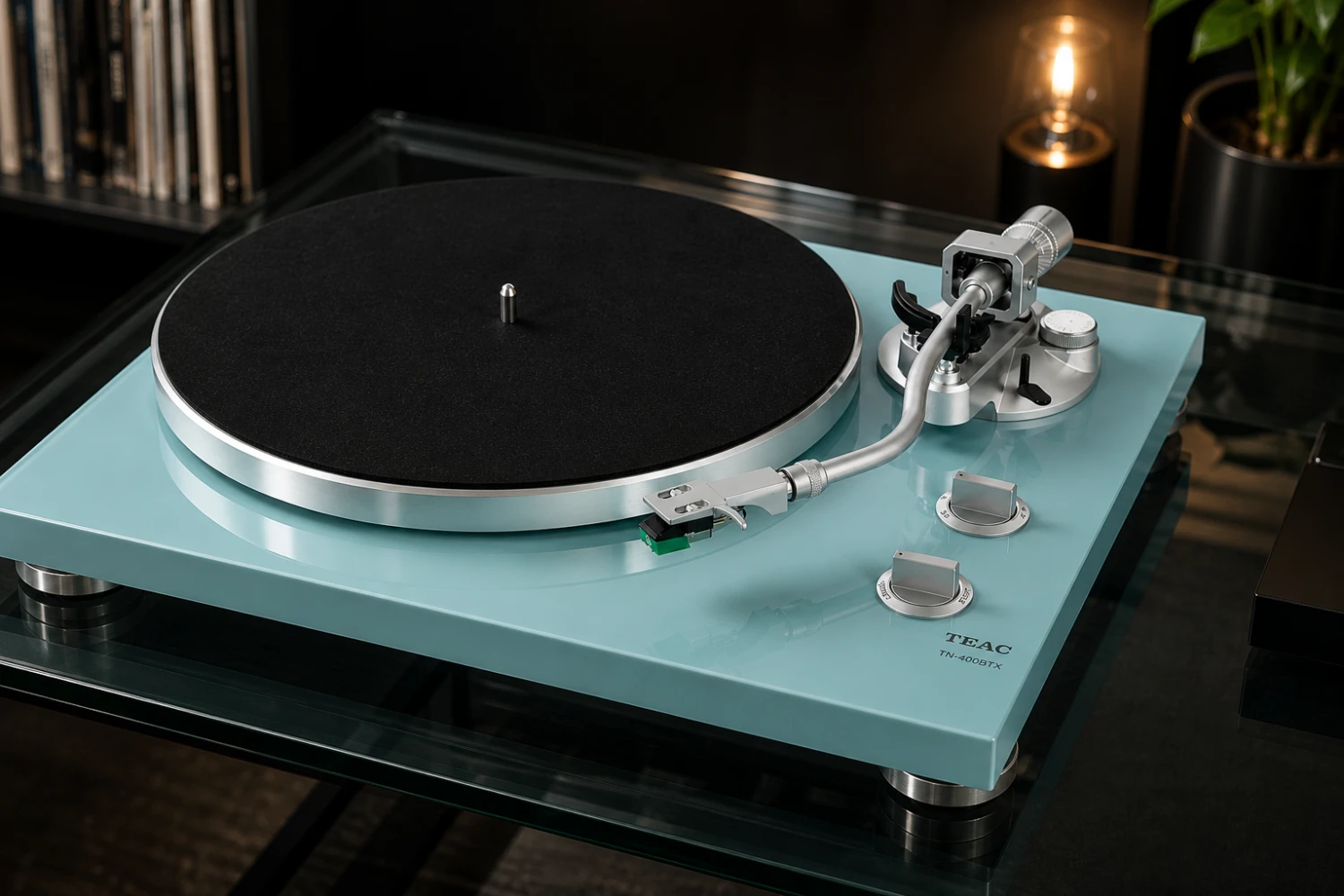
The limited-edition TEAC TN-400BTX/TB pairs a Turquoise Blue lacquer finish with an S-shaped tonearm and cast-aluminum platter.
The limited-edition TN-400BTX/TB combines a traditional belt drive with modern connection options.
Its cast-aluminum platter is designed to provide rotational inertia, while an S-shaped, statically balanced tonearm carries a factory-mounted Audio-Technica AT95E cartridge.
A switchable built-in phono stage supports direct connection to suitable active speakers or amplifiers, and Bluetooth transmission with aptX Adaptive can send playback to compatible wireless headphones or speakers. The Turquoise Blue high-gloss lacquer distinguishes this edition from the walnut-finished version.
Best for: Modern systems needing wired and wireless flexibility
- Factory-mounted Audio-Technica AT95E cartridge
- Switchable built-in phono stage
- Bluetooth transmission with aptX Adaptive
- Distinctive Turquoise Blue lacquer finish
Verdict: A visually distinctive belt-drive turntable that combines a ready-fitted cartridge with practical phono and Bluetooth connectivity.

5. Andover Audio SpinBase 2
The Andover Audio SpinBase 2 is designed to support a turntable directly above its integrated stereo speaker system.
The SpinBase 2 is not a turntable; it is a compact stereo audio system that doubles as a platform for one.
Andover Audio’s patented IsoGroove technology is intended to isolate vibration so a record player can sit directly on the speaker base without compromising playback.
This second-generation version adds a marl fabric finish and Andover’s signature control knob. Its appeal lies in consolidating a vinyl system into a small footprint rather than replacing the turntable itself.
Best for: Space-conscious vinyl systems needing integrated speakers
- Functions as both speaker system and turntable stand
- IsoGroove vibration-isolation technology
- Compact all-in-one system approach
- Updated control knob and marl fabric finish
Verdict: A practical supporting component for building a compact turntable system, provided buyers understand that the record player is separate.

6. SteinMusic Arco 40 Limited Edition
The SteinMusic Arco 40 Limited Edition features a violin-bow tonearm and a cherry-veneered wood-and-metal platter.
The SteinMusic Arco 40 Limited Edition takes an unconventional approach to material selection.
Its 10-inch tonearm is made from part of a violin bow, while the platter combines wood and metal beneath a cherry-wood veneer.
A precision double bearing is used to support rotational stability. The hand-built tonearm cable uses copper more than half a century old and avoids plastic insulation. Production is restricted to 20 units worldwide, making availability a defining consideration alongside the unusual engineering.
Best for: Collectors drawn to rare, craft-led analog design
- 10-inch tonearm made from a violin bow section
- Wood-and-metal composite platter
- Precision double-bearing design
- Limited to 20 units worldwide
Verdict: An extremely limited turntable whose distinctive materials and construction will appeal most to specialist collectors.

7. Music Hall MMF 5.3
The Music Hall MMF 5.3 separates its platter and tonearm from the motor through a two-layer chassis with conical isolators.
The Music Hall MMF 5.3 addresses vibration through a dual-layer fiberboard chassis.
Conical shock-absorbing inserts separate the upper panel, which supports the bearing and tonearm, from the lower panel carrying the synchronous AC motor and electrical components.
Its two speeds are selected manually by moving the drive belt between pulley steps. A dynamically balanced alloy platter, steel bearing in a Teflon cup, felt mat, screw-down record clamp and built-in bubble level support careful installation and operation.
Best for: Manual-vinyl enthusiasts prioritizing mechanical isolation
- Dual-layer vibration-isolating chassis
- Dynamically balanced alloy platter
- Screw-down record clamp included
- Built-in bubble level for alignment
Verdict: A thoughtfully isolated manual turntable for listeners willing to handle belt changes and careful leveling.
8. Yamaha GT-5000
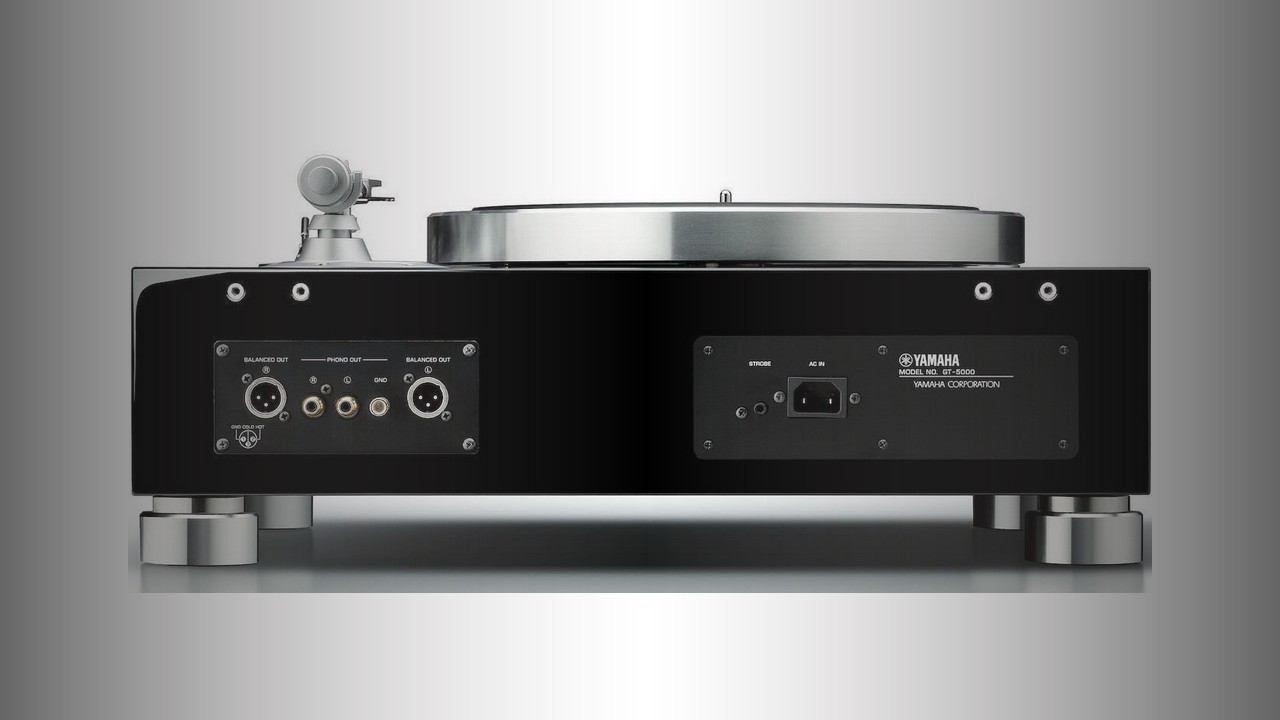
The Yamaha GT-5000 draws on the company’s GT heritage with a heavy wooden cabinet, massive platter and short straight tonearm.
The Yamaha GT-5000 revisits the substantial construction associated with the company’s earlier GT turntables.
A heavy wooden cabinet and massive platter use internal mass to help control vibration and feedback, while a belt-drive mechanism separates motor vibration from the record-playing assembly.
Its short, straight tonearm is designed around rigidity, stability and balanced mechanical properties. Balanced signal transmission is also part of the design, making system matching an important consideration for buyers interested in exploiting that connection approach.
Best for: Flagship systems favoring substantial, heritage-led construction
- Heavy wooden cabinet and massive platter
- Short, straight tonearm
- Belt drive intended to reduce motor-vibration effects
- Balanced signal transmission
Verdict: A large-scale flagship design that combines Yamaha’s GT heritage with a short straight arm and balanced signal architecture.

9. Dual CS 529
The Dual CS 529 combines fully automatic cueing with a gimballed aluminum tonearm, cast-aluminum platter and damped sub-chassis.
The Dual CS 529 brings full automation to a three-speed belt-drive design.
At the press of a button, its tonearm lifts, moves into position and lowers onto the record.
Control is available from the deck or through a compatible smart device, while Bluetooth can also transmit the music signal. Its MDF structure uses a damped sub-chassis, and optical speed control is included. The aluminum tonearm employs precision ball bearings and dual gimbal joints, while the cast-aluminum platter carries a heavy rubber mat to help manage resonance.
Best for: Listeners wanting automation without abandoning upgrade potential
- Fully automatic tonearm operation
- Three-speed belt drive
- Bluetooth control and audio transmission
- Damped sub-chassis with optical speed control
Verdict: A feature-rich automatic deck that combines easy operation with a damped chassis and replaceable-cartridge design.

10. Sharp RP-TT100
The Sharp RP-TT100 includes a factory-fitted Audio-Technica cartridge, automatic tonearm and Bluetooth and USB-C connectivity.
The Sharp RP-TT100 is an economical, fully automatic turntable supplied with an Audio-Technica AT-3600L cartridge.
Its aluminum platter, metal tonearm, matte-black cabinet and tinted dust cover form a ready-to-use package intended to keep setup uncomplicated.
Bluetooth supports wireless playback through compatible powered speakers or headphones, while the switchable phono amplifier offers three gain settings. A USB-C connection is provided for digitizing records, and the automatic functions include pause, repeat, fast forward and rewind, with remote control also supplied.
Best for: First-time buyers seeking automation and broad connectivity
- Fully automatic operation
- Bluetooth audio transmission
- Switchable phono amplifier with three gain settings
- USB-C connection for record digitization
Verdict: An accessible, convenience-led turntable with automatic playback, wireless output and a route to digitizing a record collection.
Quick comparison
These products span very different roles and priorities.
The Wilson Benesch is a tonearm, and the Andover Audio is a supporting speaker platform; neither is a complete turntable.
Among the full record players, the clearest distinctions concern manual versus automatic operation, traditional versus wireless connectivity, balanced signal support, chassis isolation and limited-edition construction.
| Product | Best for | Verdict |
|---|---|---|
| Wilson Benesch Graviton Ti Tonearm | Specialist reference-level tonearm installations | Advanced composite and titanium construction for a narrowly defined high-end application. |
| Music Hall MMF 2.3 | Affordable manual hi-fi systems | A traditional deck that rewards careful assembly and setup. |
| Pro-Ject X2 B | Balanced moving-coil systems | Its principal distinction is an optional route to fully balanced vinyl replay. |
| TEAC TN-400BTX/TB | Stylish wired and wireless systems | A belt-drive model with a fitted cartridge, switchable phono stage and aptX Adaptive Bluetooth. |
| Andover Audio SpinBase 2 | Compact systems needing speakers and a turntable platform | A space-saving speaker base rather than a record player. |
| SteinMusic Arco 40 Limited Edition | Collectors seeking rare construction | A 20-unit edition defined by its violin-bow tonearm and composite platter. |
| Music Hall MMF 5.3 | Manual systems emphasizing vibration control | A dual-layer chassis and comprehensive setup accessories distinguish this enthusiast deck. |
| Yamaha GT-5000 | Substantial flagship analog systems | Heavy construction, belt drive and balanced transmission underpin its heritage-led approach. |
| Dual CS 529 | Automatic playback with three-speed versatility | Full automation, Bluetooth and a damped sub-chassis make it the convenience-focused enthusiast option. |
| Sharp RP-TT100 | Entry-level automatic and wireless playback | An economical ready-to-use model with Bluetooth, a phono stage and USB-C digitization. |
Frequently asked questions
Should I choose a manual or fully automatic turntable?
Choose manual operation if you are comfortable cueing the arm, changing speeds as required and spending time on setup.
A fully automatic model such as the Dual CS 529 or Sharp RP-TT100 is more suitable when push-button starting, stopping and repeatable daily convenience take priority.
Do I need a separate phono amplifier?
That depends on both the turntable and the rest of the system.
The TEAC TN-400BTX/TB and Sharp RP-TT100 include switchable phono stages, whereas specialist models may need an external phono amplifier.
The Pro-Ject X2 B requires a compatible balanced RIAA stage if you want to use its balanced signal path fully.
Does Bluetooth replace a wired connection?
Bluetooth provides convenient playback through compatible wireless speakers or headphones, as offered by the TEAC, Dual and Sharp models.
Buyers focused on a conventional hi-fi system should also check the available wired outputs and phono-stage requirements rather than treating wireless support as the only connection criterion.
How important are setup and isolation?
Correct leveling, cartridge setup and stable support are fundamental considerations for a mechanical record-playing system.
The Music Hall models explicitly reward careful installation, while designs such as the MMF 5.3 and Dual CS 529 incorporate chassis isolation to help control vibration.
The SpinBase 2 addresses the specific challenge of placing a turntable directly above an integrated speaker system.
How to Choose the Right Turntable or Vinyl Component
Begin by separating essential requirements from attractive extras.
Decide whether you want manual involvement or automatic operation, then confirm speed support, cartridge provision and the type of phono amplification your system needs.
A built-in phono stage can simplify connection to active speakers or an amplifier without a phono input, while a switchable design leaves room for an external stage later. System matching matters more as the equipment becomes specialized. The balanced architecture of the Pro-Ject X2 B and Yamaha GT-5000 is most relevant when the adjoining equipment supports it. The Wilson Benesch Graviton Ti demands even closer attention because it is a separate tonearm designed around a specific high-end turntable application. Likewise, the SpinBase 2 should be viewed as a compact speaker platform for an existing turntable rather than as the source itself. Practical ownership should guide the final decision. The Music Hall decks suit listeners comfortable with manual setup and operation, while the Dual and Sharp models reduce handling through automation. TEAC adds a useful middle ground with traditional belt-drive engineering, a fitted cartridge, a switchable phono stage and wireless transmission. Limited editions from TEAC and SteinMusic add visual or collectible appeal, but availability and system suitability should still take precedence over rarity.

Join the discussion
Share your thoughts, listening impressions or product experience.