



Choosing speakers for focused listening starts with the system you want to build, not with a single specification.
This selection spans passive loudspeakers, active systems, subwoofers, a network speaker and historically significant boomboxes, so the products answer markedly different needs.
The conventional options range from Avantgarde Acoustics’ compact horn design and Elac’s flexible Solano family to Scansonic’s three-model floorstanding series. Buyers seeking fewer separate components can instead consider active designs from Triangle and Teufel, while the SVS and Wilson Audio subwoofers address bass extension and integration rather than full-range playback on their own. Several performance statements in the source material come directly from manufacturers, so they should be treated as starting points rather than substitutes for an audition. Room size, placement, connectivity, system matching and the practical demands of each design remain central to a sensible decision.

1. Avantgarde Acoustics Colibri C2
The compact Avantgarde Acoustics Colibri C2 with its prominent central spherical horn.
The Colibri C2 brings Avantgarde Acoustics’ horn approach to a smaller and lighter two-way enclosure than the company’s traditionally imposing designs.
Its central spherical horn covers a claimed range from 700 Hz to 19 kHz and uses a 2.2-gram diaphragm, while a 6.5-inch driver handles frequencies below 700 Hz and is specified to operate from 70 Hz.
Avantgarde states sensitivity of up to 98 dB and a maximum sound-pressure level of 117 dB. Buyers wanting a more substantial bass foundation can consider the matching C18 subwoofer suggested by the manufacturer.
Best for: Listeners seeking compact horn loudspeakers
- Compact, lighter horn-based design
- Claimed sensitivity of up to 98 dB
- Wide operating range for the central horn
- Optional C18 subwoofer for added bass support
Verdict: The Colibri C2 is a distinctive route into Avantgarde’s horn technology, with unusually compact proportions and the option of separate bass reinforcement.

2. SVS 1000 Pro
An SVS 1000 Pro subwoofer featuring app-controlled adjustment and a redesigned long-excursion driver.
The SVS 1000 Pro series is intended to add controlled low-frequency support to an existing speaker system.
Its Sledge STA-325D amplifier is rated at 325 watts RMS and more than 820 watts peak, combining discrete MOSFET output devices with Class D operation.
An Analog Devices 50 MHz, 56-bit audio processor handles DSP, while Bluetooth connectivity allows adjustment through a mobile app. The newly designed driver uses a double ferrite magnet, long-travel parabolic suspension and a ventilated aluminum cone with a composite-fiber dust cap.
Best for: Systems needing an adjustable powered subwoofer
- Bluetooth app-based adjustment
- 325-watt RMS amplifier rating
- DSP-based signal processing
- New long-excursion driver design
Verdict: The 1000 Pro combines substantial amplifier power with app-based tuning that can simplify subwoofer integration.
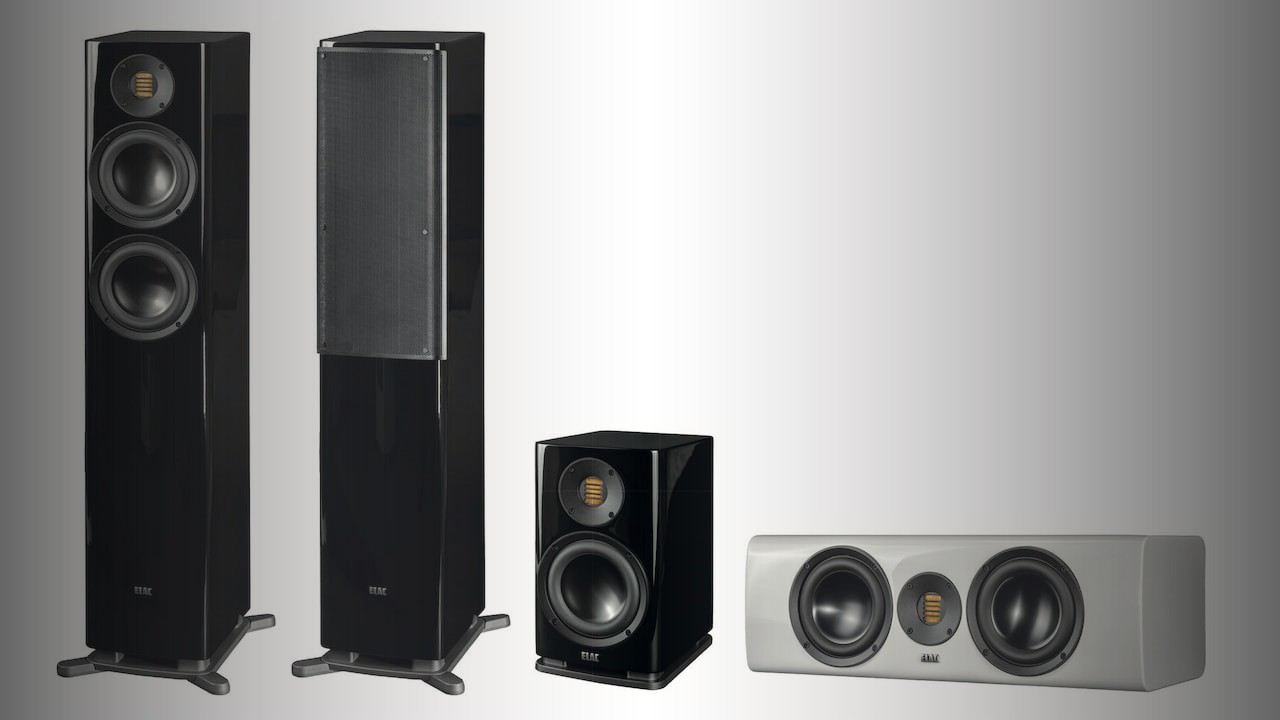
3. Elac Solano 2.0
The Elac Solano 2.0 family, comprising monitor, floorstanding and center-channel models.
Elac’s renewed Solano range covers stereo and multichannel installations with the BS283.2 monitor, FS287.2 floorstander and CC281.2 center speaker.
Every model uses the JET 6 Air Motion Transformer tweeter, which Elac specifies as reaching 50 kHz, alongside 150 mm aluminum-cone sandwich drivers.
The BS283.2 is a two-way design with one woofer, while the floorstanding and center models use two drivers in 2.5-way configurations. Reinforced MDF cabinets are offered in glossy black or white.
Best for: Building a coordinated stereo or home-cinema system
- Models for stereo and multichannel systems
- JET 6 Air Motion Transformer tweeter
- Internally reinforced MDF cabinets
- Matching monitor, floorstander and center options
Verdict: Solano 2.0 is the most system-oriented choice here, offering matching speakers for both two-channel listening and multichannel expansion.

4. Node Hylixa Signature
The spherical Node Hylixa Signature on its solid stainless-steel disc base.
The Hylixa Signature develops Node’s spherical loudspeaker concept through revised structural parts, crossover components and manufacturing methods.
A stainless-steel disc replaces the earlier tripod base to reduce unwanted vibrational energy, while the redesigned support column uses laser-welded, glass-filled nylon in place of extruded aluminum.
Upgraded Mundorf capacitors and Duelund internal wiring feature in the crossover, and the enclosures are produced using laser 3D printing. Extensive paint, precious-metal cladding and base-finish choices make visual specification an integral part of the design.
Best for: Design-led systems requiring extensive visual customization
- Heavy stainless-steel disc base
- Upgraded crossover components and wiring
- Laser 3D-printed enclosure construction
- Extensive finish customization
Verdict: The Hylixa Signature pairs an unconventional spherical form with extensive structural revisions and unusually broad finish options.

5. Triangle Borea Connect
Triangle Borea Connect active speakers, designed for direct connection to televisions, computers and turntables.
Triangle’s Borea BR02 Connect and BR03 Connect are active speakers designed to reduce the number of separate components in a music, television or desktop system.
HDMI permits direct TV connection and control through either the supplied remote or a compatible television remote, while USB-B supports a direct computer connection.
An integrated phono preamplifier accommodates a turntable without a separate phono stage. The smaller BR02 Connect is particularly relevant where desk or shelf space is limited.
Best for: Compact TV, computer and turntable systems
- HDMI connection for television audio
- USB-B input for computers
- Integrated phono preamplifier
- Compact BR02 Connect option
Verdict: Borea Connect is a practical active-speaker option for listeners who want television, computer and vinyl connectivity in a streamlined setup.

6. Wilson Audio LōKē
The Wilson Audio LōKē, the company’s smallest active bass module, with a 500-watt amplifier.
The LōKē is the smallest active bass module in Wilson Audio’s range, although its specified dimensions of 52.7 by 35.2 by 55.2 cm and unpacked weight of 49.9 kg still demand careful planning.
Its built-in amplifier is rated at 500 watts.
Wilson Audio’s ActivXO crossover provides adjustment of cutoff frequency, slope, gain and signal phase, giving installers the controls needed to integrate the subwoofer with a main speaker system. Multiple finishes are available to coordinate it with other loudspeakers.
Best for: Wilson Audio systems needing configurable bass support
- 500-watt built-in amplifier
- Adjustable cutoff frequency and slope
- Gain and phase controls
- Multiple finish choices
Verdict: LōKē is compact only by Wilson Audio’s standards, but its crossover controls provide useful flexibility for serious bass integration.

7. Teufel Ultima 40 Active 3
The three-way Teufel Ultima 40 Active 3 floorstanding system with integrated amplification and AV connectivity.
The Ultima 40 Active 3 combines three-way floorstanding speakers with amplification and AV functions, removing the need for a separate receiver in a basic system.
Its driver complement includes two woofers, a Kevlar-cone midrange with a phase plug and a 25 mm tweeter with a waveguide.
The built-in amplifier is rated at 260 watts. HDMI ARC, optical, USB-C and auxiliary inputs are joined by Bluetooth, Dolby Digital support, a subwoofer output and Teufel’s Dynamore Virtual Center processing. Optional Effekt 2 rear speakers provide an expansion path.
Best for: A simplified music and television floorstanding system
- Integrated amplification and AV functions
- HDMI ARC and multiple wired inputs
- Bluetooth and Dolby Digital support
- Expandable with rear speakers and a subwoofer
Verdict: The Ultima 40 Active 3 offers a broad connection set and home-cinema expansion without requiring a separate AV receiver.

8. Rarest and Most Awesome Boomboxes of the 1980s
A selection of rare component-style boomboxes produced by established hi-fi manufacturers during the 1980s.
This historical survey is a collector-focused diversion from the modern speakers elsewhere in the guide.
It examines unusual portable cassette systems made when established hi-fi companies briefly entered the boombox market.
The Rotel RPM-10, for example, was a three-piece system with separate two-way speakers, a 15-watt-per-channel amplifier and support for Dolby and metal cassette tapes. The Sansui CP-7 adopted a four-part component layout with separate speakers, tuner-amplifier and cassette deck. Surviving examples are presented as rare artifacts rather than straightforward alternatives to current loudspeakers.
Best for: Collectors exploring vintage portable hi-fi
- Covers rare hi-fi-brand boomboxes
- Includes component-style portable systems
- Provides technical detail on the Rotel RPM-10
Verdict: This is useful historical reading for collectors, but its rare cassette systems belong in a different buying category from contemporary serious-listening speakers.

9. Triangle AIO 3 Bluetooth Speaker
The compact Triangle AIO 3 network speaker, which can operate alone or as part of a stereo pair.
The Triangle AIO 3 is a lifestyle-oriented network speaker intended for rooms of up to 20 square metres according to the manufacturer.
It uses two 3.9-inch woofers, two 1-inch tweeters and amplification rated at 45 watts per channel, together with a discrete crossover.
Network access is available over Wi-Fi or wired Ethernet, with support for internet radio, multiple streaming services, DLNA and UPnP playback. Bluetooth 5.0 supports SBC, AAC and aptX, while two AIO 3 units can be configured as a stereo pair through the control app.
Best for: Network audio in a compact lifestyle system
- Wi-Fi and wired Ethernet networking
- Bluetooth 5.0 with aptX support
- Can be paired for stereo playback
- DLNA and UPnP compatibility
Verdict: The AIO 3 prioritizes streaming flexibility and room-friendly packaging, with stereo pairing available for buyers who want wider channel separation.

10. Scansonic Q3, Q8 and Q10
The Scansonic Q3, Q8 and Q10 floorstanders, all fitted with quasi-ribbon tweeters.
Scansonic’s Q series offers three floorstanding models built around rigid cabinets, quasi-ribbon tweeters and woven carbon-fiber cone drivers.
The Q3 is a 2.5-way design using two 5.25-inch drivers.
The three-way Q8 adds an 8-inch woofer and a 5.25-inch midrange unit, while the flagship Q10 uses two 8-inch woofers. All three employ Scansonic crossovers and are available in black or natural walnut veneer, allowing buyers to select the scale and bass-driver complement appropriate to their system.
Best for: Listeners comparing progressively larger passive floorstanders
- Three floorstanding models at different scales
- Quasi-ribbon tweeters across the range
- Woven carbon-fiber cone drivers
- Black or natural walnut veneer finishes
Verdict: The Q series provides a clear progression from the relatively compact 2.5-way Q3 to the dual-woofer, three-way Q10.
Quick comparison
These products are not direct equivalents.
The comparison below separates complete speaker systems from bass modules, network speakers and collector material so that each can be judged by its intended role rather than by specifications alone.
| Product | Best for | Verdict |
|---|---|---|
| Avantgarde Acoustics Colibri C2 | Compact horn-based listening systems | A smaller, lighter two-way Avantgarde design with high claimed sensitivity and optional subwoofer support. |
| SVS 1000 Pro | App-adjustable bass reinforcement | A powered subwoofer series with Bluetooth tuning, DSP and a 325-watt RMS amplifier rating. |
| Elac Solano 2.0 | Coordinated stereo or multichannel systems | A matching monitor, floorstander and center range built around Elac’s JET 6 tweeter. |
| Node Hylixa Signature | Customized design-led installations | A spherical loudspeaker with revised structural parts, upgraded crossover components and extensive finish choices. |
| Triangle Borea Connect | TV, desktop and vinyl playback | Compact active speakers with HDMI, USB-B and an integrated phono preamplifier. |
| Wilson Audio LōKē | Configurable bass in Wilson Audio systems | A 500-watt active bass module with adjustable crossover, gain and phase controls. |
| Teufel Ultima 40 Active 3 | Receiver-free music and television systems | An active three-way floorstanding system with HDMI ARC, Bluetooth and optional surround expansion. |
| Rarest and Most Awesome Boomboxes of the 1980s | Vintage portable-audio collectors | A historical survey of rare component-style cassette systems rather than a modern speaker recommendation. |
| Triangle AIO 3 Bluetooth Speaker | Compact network and multiroom audio | A Wi-Fi, Ethernet and Bluetooth speaker that can be combined with a second unit for stereo. |
| Scansonic Q3, Q8 and Q10 | Passive floorstanding systems at different scales | A three-model range sharing quasi-ribbon tweeters and carbon-fiber cone drivers. |
Frequently asked questions
Should I choose active or passive speakers?
Active models such as the Triangle Borea Connect and Teufel Ultima 40 Active 3 include amplification and can reduce the need for separate electronics.
Passive choices such as the Elac Solano and Scansonic Q ranges require suitable amplification but offer greater freedom to select and change system components.
When does a subwoofer make sense?
Consider a subwoofer when the main speakers do not provide the bass extension or weight required in your room.
Models such as the SVS 1000 Pro and Wilson Audio LōKē include adjustment facilities, but placement and careful matching of level, phase and crossover settings remain important.
Which connections matter for a television, computer or turntable?
For television use, HDMI ARC offers straightforward connection and control on models such as the Triangle Borea Connect and Teufel Ultima 40 Active 3.
USB-B is useful for a direct computer connection, while a built-in phono preamplifier allows a compatible turntable to be used without a separate phono stage.
How should room size affect the choice?
Start with the physical space available, sensible placement and the listening distance rather than assuming that a larger speaker is automatically preferable.
Compact models may suit desks and shelves, while floorstanders and substantial subwoofers require more floor area; the Wilson Audio LōKē’s dimensions and 49.9 kg weight show why practical planning matters.
How to Choose the Right Speaker System
First decide whether you need a complete loudspeaker system, a powered all-in-one solution or a subwoofer to support speakers you already own.
That distinction immediately separates products such as the passive Scansonic and Elac models from the active Triangle and Teufel systems, and from bass-only options by SVS and Wilson Audio.
Next, map every intended source before comparing driver layouts or headline specifications. HDMI ARC is valuable for television use, USB can simplify computer audio, a phono stage supports vinyl playback, and network connectivity matters when streaming is central. Connectivity that goes unused should not outweigh enclosure size, placement flexibility or compatibility with the rest of the system. Room demands also deserve close attention. Check whether the speakers can be positioned without obstructing living space, whether a heavy subwoofer can be accommodated safely and whether a compact speaker needs separate bass reinforcement. Manufacturer figures for sensitivity, output and frequency range can help narrow the field, but they do not establish how a speaker will interact with a particular room. Finally, audition the most relevant candidates with familiar recordings where possible. Listen for balanced integration across the drivers, clear voices, stable imaging and bass that is controlled rather than merely prominent. The strongest choice will be the design that fits the room, sources and system plan with the fewest compromises, not necessarily the largest or most elaborate model.

Join the discussion
Share your thoughts, listening impressions or product experience.