

Choosing a DAC begins with a practical question: where will it be used?
A dedicated home converter such as the Merason DAC 2 or Denafrips Enyo 15TH is designed to feed an existing amplifier, while compact USB models such as the iFi Audio Go Link 2 combine conversion and headphone output for portable listening.
Desktop DAC/amps sit between those categories, adding system connections and headphone-driving capability in one enclosure. Architecture and connectivity provide the clearest points of differentiation. This selection includes conventional chip-based converters, R2R ladder designs, balanced and single-ended outputs, Bluetooth reception, high-resolution USB support and devices built specifically around balanced headphones. Format limits matter, but they should be considered alongside the inputs, outputs and controls that a system actually requires. The recommendations below retain their supplied order rather than presenting one design as universally superior. Each serves a different role, from a focused component DAC to a pocket-sized headphone adapter or a multifunction desktop hub.
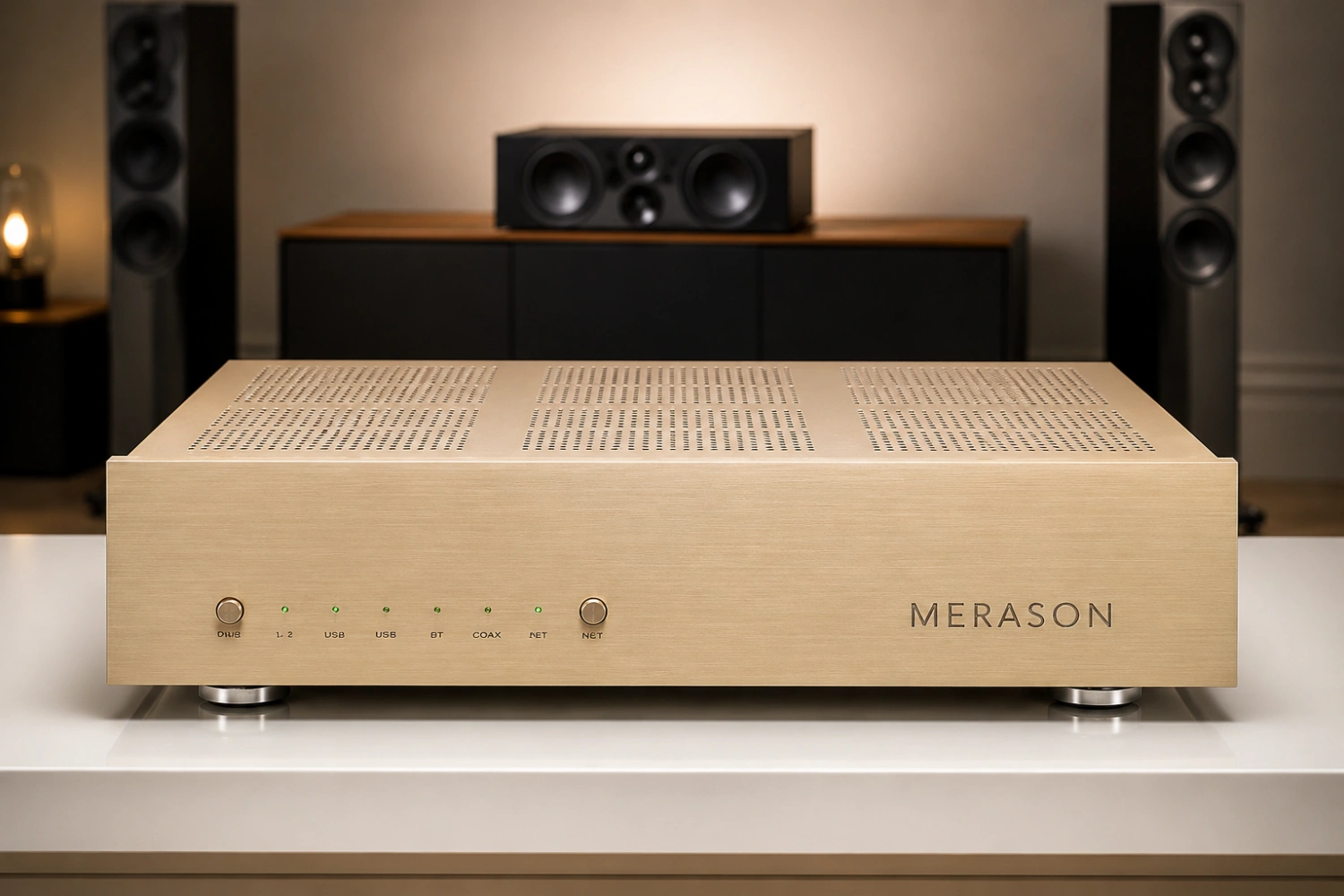
1. Merason DAC 2
Merason DAC 2, a dedicated digital-to-analog converter without volume control or an integrated headphone amplifier.
The Merason DAC 2 is for systems that already have volume control and amplification covered.
It is a dedicated converter with no preamplifier controls or headphone amplifier, so its role is simply to pass an analog signal to an external preamplifier or integrated amplifier.
Conversion is handled by two Burr-Brown PCM1794A chips in a differential configuration. By omitting unrelated functions, Merason keeps the design focused on digital-to-analog conversion and its associated analog stages.
Best for: A separates-based home audio system
- Focused DAC-only architecture
- Dual Burr-Brown PCM1794A conversion
- Designed for use with external amplification
Verdict: Choose the DAC 2 when a focused source component is more useful than integrated volume, streaming or headphone functions.

2. Astell&Kern AK HC5
Astell&Kern AK HC5 portable USB DAC and headphone amplifier with flagship-derived conversion architecture.
The Astell&Kern AK HC5 brings the brand’s AK4499EX DAC and AK4191EQ digital-processing arrangement to a portable USB DAC and headphone amplifier.
The architecture handles digital and analog signal processing separately and was previously associated with the company’s high-end digital audio players.
Its cable-sized format makes it the portable option for listeners who want a headphone output without adding a larger battery-powered player or desktop component.
Best for: Portable headphone listening with a premium DAC architecture
- AK4499EX and AK4191EQ architecture
- Portable USB dongle format
- Integrated headphone amplification
Verdict: The AK HC5 combines Astell&Kern’s separated digital and analog processing approach with the convenience of a USB dongle.

3. Kiwi Ears Allegro
Kiwi Ears Allegro portable DAC/amp with gamepad-inspired styling and two headphone outputs.
The Kiwi Ears Allegro is a portable DAC and headphone amplifier built around the ES9028Q2M chip.
Its two headphone connections cover a conventional 3.5 mm plug and a balanced 4.4 mm connection, making it easier to use with different portable headphones and cables.
USB-C connectivity supports compatible Android devices, while format handling extends to 32-bit/384 kHz PCM and DSD256. The gamepad-inspired design gives it a more distinctive identity than a typical rectangular dongle.
Best for: Portable users who need both common headphone outputs
- 3.5 mm and balanced 4.4 mm outputs
- Supports PCM up to 32-bit/384 kHz and DSD256
- USB-C connection for compatible Android devices
- Distinctive gamepad-inspired design
Verdict: The Allegro is a flexible USB-C DAC/amp for listeners switching between 3.5 mm and balanced 4.4 mm headphones.

4. Shanling EH2
Shanling EH2 stationary DAC/headphone amplifier featuring a proprietary R2R ladder converter.
The Shanling EH2 is a stationary DAC and headphone amplifier positioned between the simpler EH1 and the more extensively equipped EH3.
Its defining feature is Shanling’s proprietary 24-bit R2R ladder DAC, an alternative to the converter chips used by many desktop rivals.
This makes the EH2 relevant to buyers who want an integrated desktop DAC/amp while specifically seeking an R2R architecture, rather than a basic entry-level unit or a fully loaded flagship model.
Best for: A desktop system built around an R2R DAC/amp
- Proprietary 24-bit R2R ladder DAC
- Integrated desktop DAC and headphone amplifier
- Positioned between Shanling’s EH1 and EH3
Verdict: The EH2 fills the middle of Shanling’s desktop range with a distinctive 24-bit R2R conversion design.

5. Audiolab D7
Audiolab D7 high-resolution DAC with multiple digital inputs and balanced XLR analog outputs.
The Audiolab D7 is the connectivity-focused choice in this group.
It provides coaxial, optical, USB-B and USB storage inputs, Bluetooth reception, digital outputs, analog RCA connections and balanced XLR outputs, allowing it to serve as a central conversion hub for several sources.
Its ES9038Q2M DAC supports up to 32-bit/768 kHz PCM and DSD512 over USB, while S/PDIF accepts up to 24-bit/192 kHz PCM. Full MQA decoding and selectable upsampling to 352.8 or 384 kHz further broaden its digital processing options.
Best for: A home system with several digital sources
- Wide selection of wired and Bluetooth inputs
- Balanced XLR and unbalanced RCA outputs
- Supports up to 32-bit/768 kHz PCM and DSD512 over USB
- Full MQA decoding
Verdict: The D7 stands out as a versatile digital hub with extensive input, output and format support.

6. iFi Audio Go Link 2
iFi Audio Go Link 2 compact USB DAC for connecting wired headphones to mobile devices and computers.
The iFi Audio Go Link 2 is a compact way to bypass the internal converter in a phone, tablet or computer.
It runs over USB without a separate setup process or driver installation and includes the headphone output needed for everyday wired listening.
Its ESS Sabre DAC handles up to 32-bit/384 kHz PCM and native DSD256. The iFi Nexis app adds digital-filter selection and over-the-air updates, while the company’s S-Balanced output design is intended to reduce channel crosstalk.
Best for: A simple portable upgrade for phones, tablets and laptops
- Compact plug-and-play USB design
- Supports 32-bit/384 kHz PCM and native DSD256
- App-selectable digital filters
- Over-the-air update support
Verdict: The Go Link 2 packages broad format support and app-based adjustment into a small everyday USB DAC.

7. E1DA 9039S
E1DA 9039S USB-C DAC/headphone amplifier with a balanced 2.5 mm output and no internal battery.
The E1DA 9039S is a USB-powered DAC and headphone amplifier built specifically around a balanced 2.5 mm output.
It supports PCM up to 32-bit/384 kHz and DSD256 and has no internal battery, drawing power from its USB-C connection.
Its quoted output exceeds 400 mW per channel into 32 ohms and 680 mW per channel into 16 ohms at 1 kHz and 1% THD. Compatibility requires care: the source explicitly warns against using an unbalanced adapter because doing so may damage the DAC, and it does not recommend long two- to three-metre cables.
Best for: Balanced 2.5 mm headphones and informed system matching
- Balanced 2.5 mm headphone output
- Supports PCM up to 32-bit/384 kHz and DSD256
- More than 400 mW per channel into 32 ohms at the stated test condition
- USB powered with no internal battery
Verdict: The 9039S offers substantial specified output in a compact balanced-only design, but its adapter and cable restrictions must be respected.

8. Denafrips Enyo 15TH
Denafrips Enyo 15TH balanced R2R DAC with USB-B, I2S, coaxial and optical inputs.
The Denafrips Enyo 15TH is a balanced R2R DAC for a home separates system.
Its resistor ladder is assembled from resistors that are machine-selected and then tested by people, reflecting a different conversion approach from conventional DAC chips.
Inputs include coaxial, optical, USB-B and I2S, while analog output is available through RCA and balanced XLR. USB supports PCM up to 1536 kHz and DSD1024; the unit also offers non-oversampling and oversampling modes plus slow and sharp filter choices.
Best for: A balanced separates system requiring an R2R DAC
- R2R resistor-ladder conversion
- RCA and balanced XLR outputs
- Coaxial, optical, USB-B and I2S inputs
- Selectable NOS, oversampling and filter modes
Verdict: The Enyo 15TH combines R2R conversion with balanced outputs, several digital interfaces and selectable processing modes.

9. Audiolab D9 DAC
Audiolab D9 DAC with a color display, balanced outputs, Bluetooth reception and an integrated headphone amplifier.
The Audiolab D9 is a multifunction DAC built around the ES9038PRO, using four decoding streams per channel in a balanced configuration.
Its linear power supply employs a toroidal transformer and separate discrete regulators for different areas of the digital and analog circuitry.
Compared with a straightforward converter, the D9 offers broader system control. It includes AES3/EBU, Bluetooth with LDAC, aptX HD, AAC and SBC, balanced XLR and unbalanced RCA outputs, fixed or variable analog output operation, and an integrated headphone amplifier. A 2.8-inch color display provides front-panel information.
Best for: A feature-rich desktop or main-system digital hub
- ES9038PRO in a balanced configuration
- LDAC, aptX HD, AAC and SBC Bluetooth support
- Fixed or variable analog output
- Integrated headphone amplifier
Verdict: The D9 is the multifunction option for buyers who need broad connectivity, variable output and headphone amplification in one component.

10. EPZ TP35
EPZ TP35 portable DAC/headphone amplifier with dual CS43198 converters and a transparent component window.
The EPZ TP35 is a portable DAC and headphone amplifier based on two CS43198 converters.
It supports 32-bit/384 kHz PCM and DSD256 and provides both a 3.5 mm single-ended output and a balanced 4.4 mm output.
Low- and high-gain modes help match different headphones, while five digital filters provide a choice of processing options. Specified output is 65 mW into 32 ohms from the 3.5 mm connection and up to 150 mW into 32 ohms from the balanced output. The USB-C connection uses a detachable two-pin cable.
Best for: Portable listeners who want gain and filter adjustment
- Dual CS43198 DAC chips
- 3.5 mm and balanced 4.4 mm outputs
- Switchable low and high gain
- Five selectable digital filters
Verdict: The TP35 offers useful headphone-matching controls and two output types in a portable USB-C design.
Quick comparison
The main dividing lines are form factor, amplification and connection type.
Dedicated DACs suit systems that already have volume control and amplification, whereas portable and desktop DAC/amps can drive headphones directly.
Check the required analog output, digital input and headphone connector before comparing maximum file formats.
| Product | Best for | Verdict |
|---|---|---|
| Merason DAC 2 | A separates-based home audio system | A focused dual-chip converter without volume control or headphone amplification. |
| Astell&Kern AK HC5 | Portable headphone listening with a premium DAC architecture | A cable-sized USB DAC/amp using Astell&Kern’s AK4499EX and AK4191EQ arrangement. |
| Kiwi Ears Allegro | Portable users who need both common headphone outputs | A USB-C DAC/amp with 3.5 mm and balanced 4.4 mm connections. |
| Shanling EH2 | A desktop system built around an R2R DAC/amp | A stationary headphone DAC/amp distinguished by Shanling’s proprietary 24-bit R2R ladder. |
| Audiolab D7 | A home system with several digital sources | An extensively connected DAC with wired inputs, Bluetooth and balanced outputs. |
| iFi Audio Go Link 2 | A simple portable upgrade for phones, tablets and laptops | A small plug-and-play USB DAC with app-adjustable filters and high-resolution support. |
| E1DA 9039S | Balanced 2.5 mm headphones and informed system matching | A USB-powered balanced-only DAC/amp that must not be used with an unbalanced adapter. |
| Denafrips Enyo 15TH | A balanced separates system requiring an R2R DAC | A dedicated R2R DAC with RCA, XLR and selectable oversampling modes. |
| Audiolab D9 DAC | A feature-rich desktop or main-system digital hub | A multifunction ES9038PRO DAC with Bluetooth, variable output and headphone amplification. |
| EPZ TP35 | Portable listeners who want gain and filter adjustment | A dual-CS43198 portable DAC/amp with two output types and selectable gain. |
Frequently asked questions
Do I need a dedicated DAC or a DAC/headphone amplifier?
Choose a dedicated DAC if your preamplifier or integrated amplifier already handles volume and power, as with the Merason DAC 2 or Denafrips Enyo 15TH.
For direct headphone listening, select a model with an integrated headphone amplifier, such as the portable dongles or desktop DAC/amps in this guide.
Should maximum PCM and DSD rates decide which DAC I buy?
Not by themselves.
Confirm that the DAC supports the formats you use, then give equal attention to input compatibility, analog outputs, headphone connections, gain options and volume control.
Very high maximum rates offer little practical benefit if the device cannot connect properly to the rest of the system.
Do I need balanced outputs?
Balanced XLR outputs are relevant when the amplifier accepts them, while balanced 4.4 mm or 2.5 mm connections require suitably terminated headphones.
Never assume an adapter is safe: the E1DA 9039S specifically warns that an unbalanced adapter may damage the DAC.
Which connection should I check first?
Start with the source device.
Computers commonly use USB, televisions and disc transports may use optical or coaxial S/PDIF, and some systems benefit from Bluetooth.
Then confirm that the DAC’s analog or headphone output matches the next component without relying on unsuitable adapters.
How to choose the right DAC for your setup
Begin with the signal path rather than the converter chip.
List every source you plan to connect, identify whether the next component needs RCA, XLR or a headphone output, and decide where volume will be controlled.
That exercise will quickly separate focused home DACs from portable dongles and multifunction desktop models. For an established separates system, the Merason DAC 2 offers a deliberately narrow DAC-only brief, while the Denafrips Enyo 15TH adds R2R conversion, balanced outputs and selectable processing modes. The Audiolab D7 is better suited to a system with several wired and wireless digital sources, and the D9 adds variable output, a headphone amplifier and a wider set of system features. The Shanling EH2 provides another R2R route in an integrated desktop DAC/amp format. Portable buyers should match the connector and controls to their headphones. The Kiwi Ears Allegro and EPZ TP35 support both 3.5 mm and balanced 4.4 mm plugs, with the TP35 adding selectable gain and filters. The Go Link 2 emphasizes compact plug-and-play use and app-based adjustment, while the AK HC5 centers on Astell&Kern’s separated DAC and digital-processing architecture. The balanced-only E1DA 9039S is more specialized and should be chosen only after noting its explicit restrictions on unbalanced adapters and long cables. Finally, avoid paying for specifications that do not solve a real system need. Input coverage, output compatibility, volume architecture and headphone matching are more consequential than choosing the largest supported sample-rate figure.


Join the discussion
Share your thoughts, listening impressions or product experience.