
The Curious Listener’s Guide to Remarkable DACs
A practical, source-grounded guide to notable DACs, covering compact desktop hubs, Mac mini integration, network players, HDMI ARC, balanced architectures, DSP options, and purist high-end designs.

A digital-to-analog converter can be a simple bridge between a source and an amplifier, but the models gathered here show how wide the category has become.
Some are desktop hubs with Bluetooth and USB inputs, some are network players with advanced internal clocking, and others are purist high-end components built around discrete conversion, separate power supplies, or carefully isolated analog stages.
The useful question is not which DAC has the longest specification sheet, but which design fits the way a system is actually used. A computer-based desk setup has different needs from a full-size separates system, a television audio path, or a network-first listening room. Inputs, output types, volume control, streaming support, physical size, and upgrade path can matter as much as headline file support. These recommendations are based only on the supplied product information. Where manufacturers make technical claims about clocks, filtering, isolation, distortion, or power-supply design, the descriptions below keep those claims in context and focus on practical distinctions rather than unsupported listening judgments.
1. Audiolab D7

Audiolab D7 is positioned as a versatile digital hub with USB, S/PDIF, Bluetooth, RCA, and balanced XLR connectivity.
The Audiolab D7 is presented as a compact but highly connected DAC, with two coaxial and two optical S/PDIF inputs, USB Type-B for computers and mobile devices, a USB HDD input for external flash drives, and Bluetooth 5.1 reception.
Its output options cover coaxial, optical, unbalanced RCA, and fully balanced XLR, making it unusually flexible for a smaller digital hub.
The digital section is built around the ESS ES9038Q2M DAC chip, with Audiolab’s implementation adding proprietary circuitry, time-domain jitter reduction, selectable reconstruction filtering, upsampling to 352.8 kHz or 384 kHz, and full MQA decoding. High-resolution support is broad via USB, including PCM up to 32-bit/768 kHz and DSD512, while S/PDIF accepts PCM up to 24-bit/192 kHz.
Best for: Listeners who want a compact DAC to act as a flexible digital hub
- Four S/PDIF inputs plus USB Type-B and USB HDD input
- Balanced XLR and unbalanced RCA outputs
- Full MQA decoding performed internally
- Supports PCM up to 32-bit/768 kHz and DSD512 via USB
Verdict: The D7 stands out for combining extensive wired and wireless connectivity with high-resolution support in a desktop-friendly format.
2. SMSL DAC MINI

SMSL DAC MINI is shaped to stack neatly with a Mac mini while adding DAC, headphone amplifier, and USB hub functions.
The SMSL DAC MINI is designed specifically to sit beneath a Mac mini, matching its footprint and using a CNC-milled aluminum enclosure intended to add rigidity, reduce resonance, and help with passive heat dissipation.
Its most distinctive practical feature is mechanical power integration: pressing the DAC MINI’s front button can wake the Mac mini without scripts or software workarounds.
Internally, the source material identifies an ESS ES9039Q2M DAC chip, and the unit also serves as a headphone amplifier and USB hub, giving it a broader desktop role than a conventional standalone DAC.
Best for: Mac mini users building a clean desktop audio setup
- Designed to match the Mac mini footprint
- CNC-milled aluminum enclosure
- Front power button can wake a Mac mini mechanically
- Combines DAC, balanced headphone amplifier, and USB hub roles
Verdict: The DAC MINI is the most system-specific choice here, appealing because its physical design and control concept are tailored around the Mac mini.
3. Esoteric N-01XE
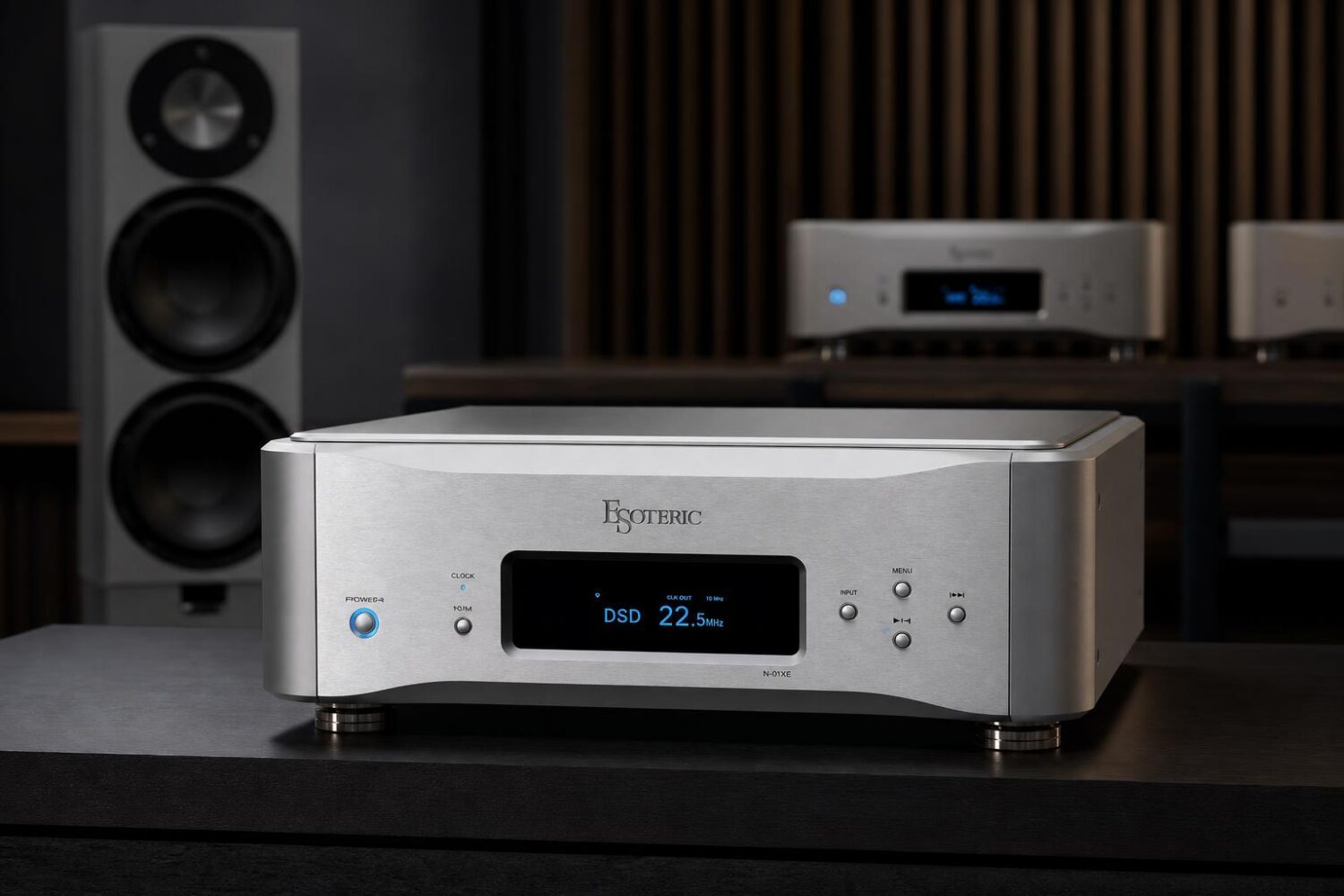
Esoteric N-01XE combines a network player platform with the company’s Master Sound Discrete DAC G2 architecture.
The Esoteric N-01XE is both a network player and a digital-to-analog converter for Esoteric’s 01 Series, drawing on technology developed for the Grandioso N1.
Rather than using an off-the-shelf DAC chip, it employs Esoteric’s second-generation Master Sound Discrete DAC, an FPGA-based multilayer delta-sigma architecture with selected discrete components.
The dual-mono DAC circuit uses 32 elements per channel and separates clock drivers, logic circuits, capacitors, and resistors. The N-01XE also integrates the fourth-generation Esoteric Network Engine G4, supports up to 22.5 MHz DSD and 768 kHz PCM depending on input, and offers selectable digital filters plus PCM-to-DSD conversion.
Best for: High-end systems where network playback and discrete DAC design are priorities
- Discrete FPGA-based DAC architecture instead of a conventional DAC chip
- Dual-mono circuit with 32 elements per channel
- Integrated fourth-generation Esoteric Network Engine G4
- Selectable filters and PCM-to-DSD conversion
Verdict: The N-01XE is the most ambitious network-DAC design in this selection, built around Esoteric’s own discrete conversion platform rather than a standard DAC chip.
4. Hegel HD30

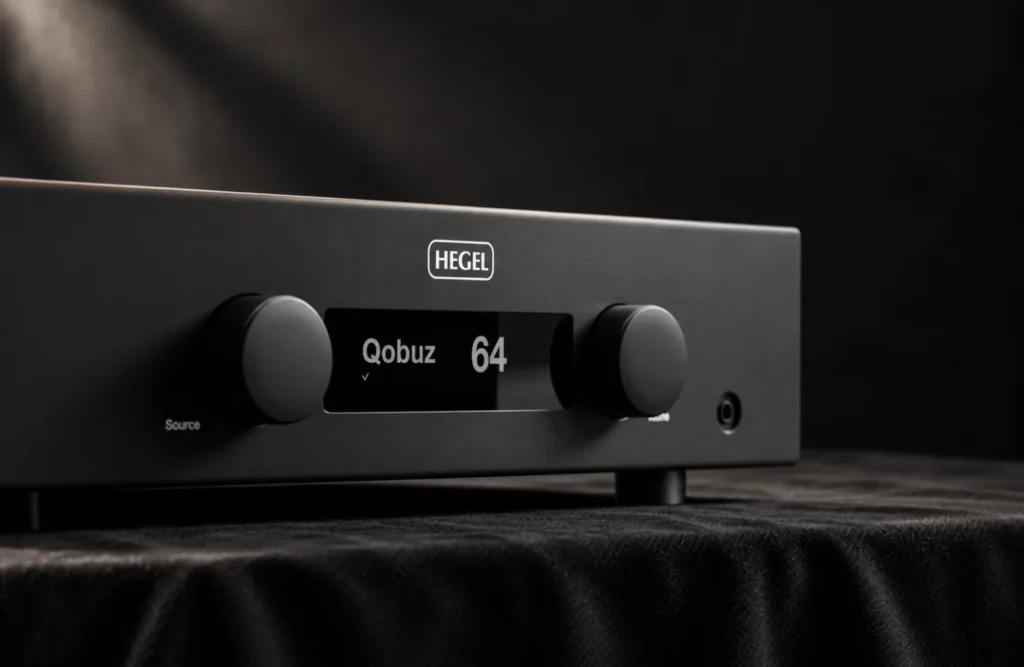
Hegel HD30 uses a full-size chassis with display, input selection, and volume control for digital system management.
The Hegel HD30 is a full-size DAC with streaming support and built-in AirPlay.
It is designed to operate as a digital control center, with a front-panel display showing source, volume level, and sampling frequency.
Its stepped volume attenuator allows use with a power amplifier or active speakers, while a bypass mode lets it behave as a fixed-output DAC when required. Conversion is handled by two AK4490EQ chips, one per channel, with an AK4137EQ chip used for sample-rate conversion. The source material also highlights a clock generator, separate toroidal transformers for digital and analog circuits, large reservoir capacitance, and Hegel’s SoundEngine analog output stage.
Best for: Systems needing a DAC that can also function as a digital preamp-style control center
- Built-in AirPlay streaming
- Stepped volume control for direct connection to power amps or active speakers
- Bypass mode for fixed-output use
- Separate power supplies for digital and analog circuits
Verdict: The HD30 is a practical choice for listeners who want source selection, volume control, AirPlay, and full-size system integration in one DAC.
5. Audiolab D7 and D9

Audiolab’s D7 and D9 are presented as standalone DACs for desktop and full-size hi-fi systems respectively.
Audiolab’s D7 and D9 mark the brand’s return to standalone digital-to-analog converters, positioned as successors to the M-DAC line.
The smaller D7 is described as suitable for desktop applications, while the larger D9 is intended for integration with other high-fidelity components.
Both models are offered in silver and black finishes. The article provides the most detailed technical information for the D7, including its ESS ES9038Q2M-based architecture, precision master clock, proprietary Class A post-DAC filtering, multiple USB and S/PDIF inputs, Bluetooth 5.1 with aptX HD, MQA support, selectable filters, and upsampling options.
Best for: Buyers choosing between a compact desktop DAC and a larger hi-fi component
- Two model sizes aimed at different system types
- D7 is designed for desktop use
- D9 is positioned for full hi-fi component integration
- Silver and black finish options
Verdict: This two-model Audiolab range is useful because it frames the D7 and D9 around different installation needs rather than treating every DAC as the same kind of box.
6. McIntosh MDA200

McIntosh MDA200 combines the DA2 digital audio module with the brand’s black-glass front panel and illuminated logo styling.
The McIntosh MDA200 is an upgradeable DAC built around the company’s DA2 digital audio module, technology also used in several higher-level McIntosh components cited in the source material.
It uses a quad balanced 8-channel 32-bit digital-to-analog converter and provides seven digital inputs: two coaxial, two optical, USB, an MCT input for compatible McIntosh SACD/CD transports, and HDMI Audio Return Channel for audio from a television.
Balanced and unbalanced analog outputs are included, and the unit is Roon Tested. Through USB it supports native DSD up to DSD512 and DXD up to 384 kHz, while coaxial and optical inputs support up to 24-bit/192 kHz.
Best for: McIntosh-based systems or setups needing TV audio, computer audio, and transport connectivity in one DAC
- Seven digital inputs including HDMI ARC and MCT
- Balanced and unbalanced analog outputs
- Roon Tested certification
- USB supports native DSD512 and DXD up to 384 kHz
Verdict: The MDA200 is the most integration-minded McIntosh option here, notable for HDMI ARC, MCT support, Roon Tested status, and an upgradeable digital-module platform.
7. Gustard X26 III

Gustard X26 III emphasizes dual-mono-style ESS conversion, clocking hardware, USB support, and network playback compatibility.
The Gustard X26 III is a flagship DAC built around dual ESS ES9039PRO chips, with the left and right channels kept separate to reduce mutual interference.
It supports high-resolution formats up to 32-bit/768 kHz PCM and DSD512, and the source also lists MQA decoding.
Jitter management is a major part of the design brief, with a femtosecond clock generator, FPGA controller, and Gustard’s GCLK-02 clock module. The USB interface is based on an XMOS XU216 chip and supports ASIO and DoP. Network-oriented compatibility is also listed, including Roon, AirPlay, Spotify, Tidal, DLNA, and UPnP.
Best for: Listeners who want a feature-rich DAC with high-resolution, clocking, USB, and network compatibility
- Dual ESS ES9039PRO DAC chips
- Supports PCM up to 32-bit/768 kHz and DSD512
- MQA decoding included
- Network compatibility includes Roon, AirPlay, Spotify, Tidal, DLNA, and UPnP
Verdict: The X26 III is a specification-rich DAC distinguished by dual ES9039PRO conversion, extensive format support, and broad network-related compatibility.
8. HiFi Rose RD160

HiFi Rose RD160 is described as a balanced dual-mono DAC with separate linear supplies and proprietary isolation technologies.
The HiFi Rose RD160 is a high-end external DAC built around a fully balanced, dual-mono architecture.
The supplied material highlights separate power arrangements, with three linear power supplies independently feeding the digital section and the left and right analog amplification channels.
HiFi Rose also uses several proprietary design blocks: ROSE DPC for digital-stream synchronization at the DAC input with a high-precision OCXO clock generator, ROSE CIM for isolating digital and analog paths with two separate DAC chips for each channel, and ROSE NRA filtering for low-frequency response stability. The listed connectivity includes two coaxial and one optical input, with the source excerpt ending before the full input set is described.
Best for: Full-size systems where power-supply separation and channel isolation are key priorities
- Fully balanced dual-mono architecture
- Three linear power supplies for digital, left analog, and right analog sections
- OCXO-based digital synchronization through ROSE DPC
- Digital and analog path isolation through ROSE CIM
Verdict: The RD160 is differentiated by its emphasis on balanced architecture, separate linear power supplies, proprietary digital processing, and physical isolation strategies.
9. Soundaware DAM1 15TH

Soundaware DAM1 15TH pairs multiple digital inputs with balanced and unbalanced outputs plus a selectable external power supply.
The Soundaware DAM1 15TH is a commemorative DAC that updates the company’s original DAC concept with enhancements to its proprietary Jingling DSP system.
It provides five digital input options: USB with the PA1 filter module, optical, coaxial, AES/EBU, and I2S.
Both balanced XLR and unbalanced RCA outputs are included. A distinctive part of the design is its external power-supply approach, allowing use with either the LP1 15TH or LPX 15TH external power unit. The Jingling DSP has been in development for four years according to the source, and supports bit-depth and sampling-rate adjustment, proprietary filtering, and multiple operating modes.
Best for: Audiophiles interested in DSP-based filtering and external power-supply flexibility
- Five digital inputs including AES/EBU and I2S
- Balanced XLR and unbalanced RCA outputs
- Choice of LP1 15TH or LPX 15TH external power units
- Proprietary Jingling DSP with bit-depth and sampling-rate adjustment
Verdict: The DAM1 15TH is notable for its proprietary DSP platform, broad digital input set, and configurable external power-supply concept.
10. SPEC RMP-DAC3X
SPEC RMP-DAC3X is presented as a dual-case Japanese DAC focused on component selection and output-stage power delivery.
The SPEC RMP-DAC3X is described as the Japanese manufacturer’s first DAC and uses a dual-case design.
SPEC’s own positioning emphasizes realistic tonal character and the reproduction of subtle timbral information, especially the overtones that help distinguish acoustic instruments.
The source material also underlines the company’s attention to component selection, particularly capacitors, and notes the use of a specialized R-core transformer intended to supply the output stage with ample drive current. Compared with the more feature-heavy DACs in this guide, the RMP-DAC3X is presented in more purist terms, with emphasis placed on parts choice, power delivery, and tonal expression.
Best for: Listeners drawn to purist Japanese component design and tonal realism claims
- Dual-case DAC design
- SPEC’s first digital-to-analog converter
- Specialized R-core transformer for the output stage
- Strong emphasis on component and capacitor selection
Verdict: The RMP-DAC3X is the purist outlier, defined less by streaming features and more by SPEC’s focus on power supply, components, and timbral reproduction.
Quick comparison
The main differences are not simply resolution figures.
Some models prioritize desktop integration, some serve as digital control centers, some add network playback or television audio, and others focus on discrete conversion, dual-mono construction, or external power supplies.
| Product | Best for | Verdict |
|---|---|---|
| Audiolab D7 | Compact digital hub duties | Most clearly differentiated by its mix of S/PDIF, USB, USB HDD, Bluetooth, MQA, RCA, and balanced XLR connectivity. |
| SMSL DAC MINI | Mac mini desktop systems | The most physically specialized model, designed to stack with and wake a Mac mini while adding DAC, headphone amplifier, and USB hub functions. |
| Esoteric N-01XE | Network-first high-end systems | The strongest fit for those prioritizing Esoteric’s discrete DAC architecture and integrated network engine. |
| Hegel HD30 | Digital control center use | Best suited to systems needing AirPlay, source display, volume control, and bypass flexibility in a full-size DAC. |
| Audiolab D7 and D9 | Choosing between desktop and component-size Audiolab DACs | Useful as a range because the compact D7 and larger D9 address different installation needs. |
| McIntosh MDA200 | McIntosh integration and TV audio | Stands out through HDMI ARC, MCT transport input, Roon Tested status, and an upgradeable DA2 module platform. |
| Gustard X26 III | Feature-rich high-resolution playback | A broad-specification option with dual ES9039PRO chips, MQA, high-resolution USB, and network compatibility. |
| HiFi Rose RD160 | Balanced dual-mono hi-fi systems | Distinguished by separate linear power supplies, proprietary synchronization, and digital-to-analog isolation strategies. |
| Soundaware DAM1 15TH | DSP and power-supply experimentation | Notable for Jingling DSP, multiple digital inputs, balanced outputs, and a choice of external power units. |
| SPEC RMP-DAC3X | Purist systems focused on tonal character | Defined by dual-case construction, component selection, and an R-core transformer rather than by streaming features. |
Frequently asked questions
How should I choose between a desktop DAC and a full-size hi-fi DAC?
Start with placement and system role.
The SMSL DAC MINI is physically designed around a Mac mini, and the Audiolab D7 is described as compact and desktop-friendly.
Full-size or component-oriented choices such as the Hegel HD30, McIntosh MDA200, HiFi Rose RD160, Esoteric N-01XE, and SPEC RMP-DAC3X make more sense when the DAC is part of a larger separates system.
Do I need balanced XLR outputs?
Balanced outputs are useful when the partnering amplifier, active speaker, or preamp accepts them, especially in more complex systems.
The Audiolab D7, McIntosh MDA200, Soundaware DAM1 15TH, and several higher-end designs here include balanced connectivity or balanced architecture, but RCA outputs remain important if the rest of the system is unbalanced.
Which input types matter most in a DAC?
Match inputs to sources before comparing chips or file rates.
USB is important for computers, S/PDIF coaxial and optical suit many transports and TVs, HDMI ARC on the McIntosh MDA200 is specifically useful for television audio, and I2S or AES/EBU on the Soundaware DAM1 15TH may matter in more specialized digital systems.
Bluetooth and AirPlay add convenience when supported.
Are high-resolution formats and MQA support essential?
They are useful only if the music library or streaming chain requires them.
Several models support very high PCM and DSD rates, including the Audiolab D7, McIntosh MDA200, Gustard X26 III, and Esoteric N-01XE.
MQA is specifically listed for the Audiolab D7 and Gustard X26 III, but input compatibility, output type, and system integration may be more important for many buyers.
How to choose the right DAC from this group
The safest way to choose a DAC is to define the job before studying the specification table.
For a compact desktop system, the Audiolab D7 offers unusually broad connectivity, while the SMSL DAC MINI is much more narrowly but cleverly aimed at Mac mini users.
If the DAC must act as a control point, the Hegel HD30 adds volume control, display feedback, AirPlay, and bypass operation. If television sound or McIntosh transport integration matters, the MDA200 is the obvious fit among the models listed here because it includes HDMI ARC and an MCT input. For network-first listening, the Esoteric N-01XE and Gustard X26 III approach the problem differently: Esoteric emphasizes its own discrete conversion architecture and network engine, while Gustard combines dual ESS conversion, high-resolution support, MQA, clocking hardware, and compatibility with services and protocols including Roon, AirPlay, Spotify, Tidal, DLNA, and UPnP. The HiFi Rose RD160 moves the emphasis toward balanced dual-mono construction, isolated signal paths, and separate linear power supplies. The remaining choices speak to more specialized priorities. Soundaware’s DAM1 15TH is for listeners interested in proprietary DSP, multiple digital inputs, balanced outputs, and external power-supply options. SPEC’s RMP-DAC3X is the most purist entry, presented around dual-case construction, component selection, an R-core transformer, and the company’s focus on tonal realism. None of these directions is universally correct; the right DAC is the one whose inputs, outputs, control scheme, physical design, and engineering priorities align with the rest of the system.






 VS
VS VS
VS VS
VS VS
VS VS
VS VS
VS VS
VS VS
VS

Share your thoughts on this 0
Keep it civil, relevant and respectful.