
Choosing an AV Receiver Without Buying the Wrong Box
A practical guide to AV receiver choices, separating true multichannel receivers from source components, stereo amplifiers, active speakers and home-theater support products.

An AV receiver is often the control center of a home theater, but the right choice depends on the system you are actually building.
Channel count, HDMI support, room calibration, surround decoding, streaming, and physical size all matter, and not every product sold into a home-cinema system is an AV receiver.
This guide separates full AV receivers from closely related components in the supplied selection. Some entries are true multichannel receivers, while others are disc transports, network amplifiers, active speakers, or home-theater support products. Those distinctions are important: buying a universal player or active speaker pair when you need HDMI switching and multichannel amplification will not solve the same problem. The recommendations below preserve the supplied order and focus only on documented features. Where a product is not an AV receiver, the explanation makes that clear so it can be considered as an alternative or companion component rather than a direct substitute.
1. Cambridge Audio CXUHD: Reference digital player

Cambridge Audio CXUHD universal digital transport for UHD disc playback and HDMI audio output.
The Cambridge Audio CXUHD is not an AV receiver; it is a universal digital transport designed for disc playback and network media duties.
Its strength is source handling: it supports UHD resolution, plays a very wide range of discs including UHD Blu-ray, DVD-Audio and SACD, and sends advanced audio formats over HDMI rather than converting them internally.
Cambridge Audio deliberately omits an onboard DAC, with the stated aim of avoiding distortion and interference introduced into the AV signal by built-in conversion. For a system that already has a capable receiver or processor, it is a serious source component rather than the hub itself.
Best for: Disc-heavy systems that already have an AV receiver or processor
- Plays UHD Blu-ray, DVD-Audio and SACD
- Supports HDR and Dolby Vision
- Passes Dolby Atmos and DTS:X over HDMI
- Designed as a digital transport without an onboard DAC
Verdict: Choose the CXUHD as a high-spec digital source, not as the receiver that powers and switches the whole theater system.
2. Block CVR-200 AV: Powerful AV Receiver with BluRay transport and streaming functions

Block CVR-200 AV receiver with built-in BluRay transport, streaming functions and seven amplifier channels.
The Block CVR-200 AV is a genuine AV receiver with an unusually broad all-in-one approach.
It combines seven amplifier channels with an integrated BluRay drive, DVD and CD playback, analog and digital inputs, internet streaming functions, radio options, and bidirectional Bluetooth.
Its network connection is wireless only, but the feature set is notably comprehensive for listeners who want passive speakers, multichannel movie sound, disc playback, and streaming in a single chassis.
Best for: All-in-one home-theater systems with passive speakers
- Seven amplifier channels
- Integrated BluRay drive with DVD and CD playback
- UPnP, Spotify, Spotify Connect and Deezer support
- Bidirectional Bluetooth for source or headphone use
Verdict: The CVR-200 AV is the most integrated option here for buyers who want an AV receiver, disc player, streaming access, and radio in one unit.
3. Yamaha RX-A3080: Fully equipped flagship AV Receiver

Yamaha RX-A3080 AVENTAGE AV receiver with nine-channel amplification and anti-resonance chassis design.
The Yamaha RX-A3080 is presented as a premium AVENTAGE receiver with a strong emphasis on engineering.
Its architecture combines advanced digital processing with a traditional class AB power amplifier section, nine amplifier channels, a substantial power supply, dual heat sinks, and Yamaha’s anti-resonance ART chassis with a fifth support to mechanically decouple the transformer.
The source highlights ESS SABRE ES9026PRO DAC chips and a rated 150 watts per channel in stereo at 8 ohms across 20 Hz to 20 kHz, positioning it as a serious full-size receiver for demanding installations.
Best for: Full-size systems that prioritize substantial receiver engineering
- Nine-channel receiver architecture
- ESS SABRE ES9026PRO DAC chips
- Class AB power amplifier design
- Anti-resonance ART chassis with fifth support
Verdict: The RX-A3080 suits buyers who want a heavily built flagship-style AV receiver rather than a slim or simplified home-cinema hub.
4. Yamaha WXA-50: Network Integrated Multiroom Amplifier

Yamaha WXA-50 network integrated amplifier for MusicCast multiroom and stereo playback.
The Yamaha WXA-50 is not an AV receiver, but it may be relevant for buyers who realize they need networked stereo amplification rather than multichannel surround.
Its compact, minimalist design houses MusicCast multiroom functions, Direct Mode for playback up to 24-bit/192 kHz without additional processing, adaptive EQ, Advanced Bass Extension for compact bookshelf speakers, and Compressed Music Enhancer for mobile sources.
It can receive music over a network or Bluetooth and can fit into a broader MusicCast system alongside other Yamaha components.
Best for: Networked stereo rooms rather than surround theaters
- MusicCast multiroom support
- Direct Mode supports up to 24-bit/192 kHz playback
- Adaptive EQ and Advanced Bass Extension
- Bluetooth streaming into a MusicCast system
Verdict: The WXA-50 is a compact multiroom stereo amplifier for music-first systems, not a substitute for an AV receiver with HDMI switching and surround amplification.
5. Marantz SR8015: 11.2-channel flagship AV Receiver

Marantz SR8015 11.2-channel AV receiver with immersive-audio decoding and Audyssey room correction.
The Marantz SR8015 is a true flagship-style AV receiver with 11.2-channel capability, object-based surround decoding and extensive room-correction support.
The source describes a copper-plated chassis, massive shielded toroidal transformer, selected components, discrete HDAM amplifier modules with current feedback, and high-capacity power-supply capacitors.
It can decode Dolby Atmos, DTS:X and Auro-3D, supports a 7.1.4-channel Dolby Atmos layout without an additional amplifier, uses four SHARC DSPs, scales video to 4K resolution, and includes Audyssey MultEQ XT32 with additional Audyssey processing for volume, EQ, low-frequency containment and dual-subwoofer correction.
Best for: Large immersive systems needing many powered channels
- 11.2-channel flagship configuration
- Dolby Atmos, DTS:X and Auro-3D decoding
- 7.1.4-channel Atmos without an external amplifier
- Audyssey MultEQ XT32 with dual-subwoofer correction
Verdict: The SR8015 is the strongest fit here for a complex immersive theater that needs extensive channel support and advanced calibration in one receiver.
6. Onkyo TX-NR7100: AV receiver that guarantees high quality sound

Onkyo TX-NR7100 nine-channel AV receiver with THX certification and Dolby Atmos/DTS:X support.
The Onkyo TX-NR7100 is a nine-channel AV receiver aimed at installed home-theater systems.
The supplied material notes THX certification, proprietary Dynamic Amplification circuitry, a custom transformer, low-resonance aluminum heat sinks, and decoding for common surround formats including Dolby Atmos and DTS:X.
It can support 3D speaker layouts up to 5.2.4 without external amplification, while Dolby Atmos Height Virtualizer can help when physical height speakers are not installed. Correct processing of IMAX content is also specified.
Best for: Immersive home theaters that need nine powered channels
- Nine-channel AV receiver configuration
- THX certification
- Dolby Atmos and DTS:X decoding
- Supports up to 5.2.4 without external amplifiers
Verdict: The TX-NR7100 is a practical middle ground for buyers who want real height-channel capability without moving into the largest receiver class.
7. Marantz Cinema 70s: Modern 7.2-channel AV receiver
Marantz Cinema 70s slim 7.2-channel AV receiver with modern HDMI support and immersive-audio processing.
The Marantz Cinema 70s is a low-profile 7.2-channel AV receiver designed for modern HDMI and compact installation needs.
It supports 8K/60 Hz through three of its six HDMI inputs, along with 4K/120 Hz video, 8K upscaling, HDR10+ with Dynamic Tone Mapping, Dynamic HDR, VRR, QMS, ALLM and QFT.
On the audio side it supports DTS:X and Dolby Atmos in a 5.1.2-channel layout, plus DTS Virtual:X and Dolby Atmos Height Virtualization for systems without dedicated height speakers. Its discrete amplifiers are rated at 50 watts per channel at 8 ohms, and Audyssey MultEQ works with Dynamic Volume and Dynamic EQ for room and playback optimization.
Best for: Slim installations and smaller immersive systems
- Low-profile 7.2-channel design
- Three HDMI inputs support 8K/60 Hz
- 4K/120 Hz video and 8K upscaling
- Dolby Atmos, DTS:X and virtual height modes
Verdict: The Cinema 70s is the clearest choice here when cabinet height, current HDMI features and a modest 5.1.2 layout matter more than maximum channel count.
8. Klipsch R-41PM: Reference active speakers

Klipsch R-41PM active bookshelf speakers with built-in amplification, Bluetooth and phono input.
The Klipsch R-41PM is not an AV receiver; it is a compact active speaker system intended to work directly with sources such as a TV, computer, Bluetooth device or vinyl turntable.
The supplied article specifically notes that it can save space and avoid the need for a bulky AV receiver in some setups.
Each speaker uses built-in amplification, with a phono preamplifier housed in the right speaker and Bluetooth with aptX support. This makes it a stereo alternative for simple rooms, but it does not provide surround processing or multichannel receiver functions.
Best for: Simple stereo TV, desktop or vinyl setups
- Works with TV, computer, Bluetooth sources and vinyl
- Built-in phono preamplifier
- Bluetooth with aptX support
- Space-saving active-speaker design
Verdict: The R-41PM is a useful receiver-free stereo solution, but it is not suitable for buyers who need multichannel home-theater decoding and amplification.
9. Onkyo TX-SR494: AV receiver equipped with an automatic calibration system

Onkyo TX-SR494 seven-channel AV receiver with virtual height processing and 4K HDMI support.
The Onkyo TX-SR494 is a seven-channel AV receiver positioned as an approachable route into a modern small-room home theater.
It adds channels over the related TX-SR393 and supports Dolby Atmos Height Virtualizer and DTS Virtual:X, allowing a three-dimensional sound field to be simulated without physical height speakers.
The receiver includes four HDMI inputs and one output, with 4K UHD signal transmission including Dolby Vision, HDR10 and HLG. The supplied article also emphasizes easy setup and use, gaming, movie and music suitability, and an automatic calibration system.
Best for: Small-room home theaters with straightforward setup needs
- Seven-channel AV receiver design
- Dolby Atmos Height Virtualizer and DTS Virtual:X
- Four HDMI inputs and one output
- 4K UHD passthrough with Dolby Vision, HDR10 and HLG
Verdict: The TX-SR494 is the sensible entry point here for a compact AV system that needs surround flexibility without a large receiver budget or complex speaker plan.
10. Sunfire

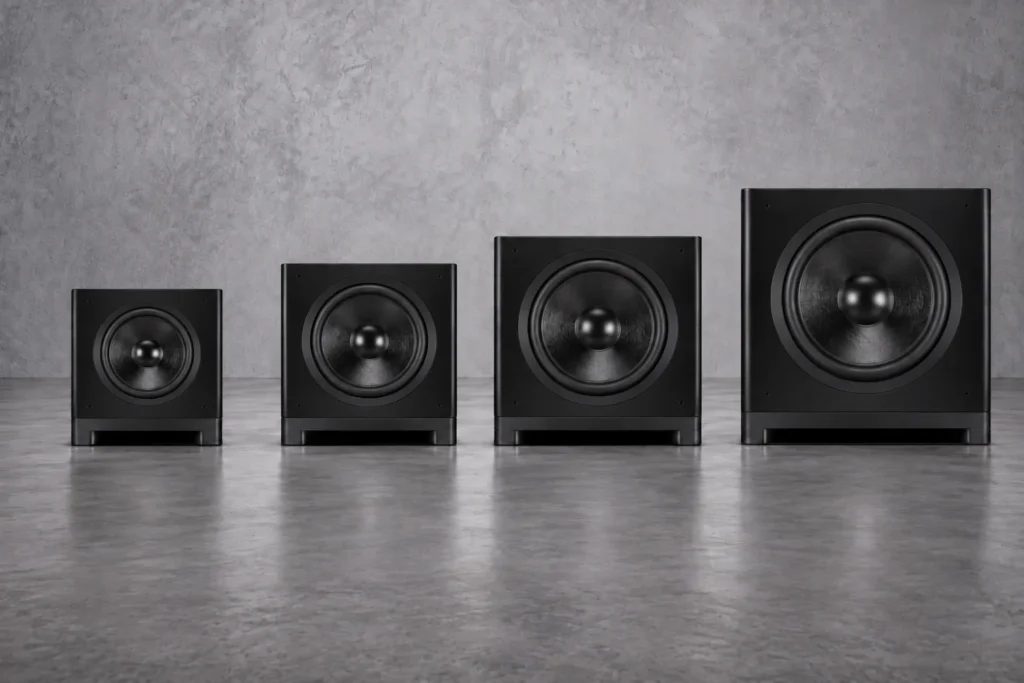
Sunfire is represented here by its home-theater subwoofer and amplifier-technology heritage rather than a specific AV receiver.
Sunfire is a brand article rather than a specific AV receiver recommendation.
In the supplied material, its relevance to home theater comes through subwoofers and amplifier technology associated with Bob Carver.
Sunfire is described as influential in compact, powerful true subwoofers capable of high sound pressure, using long driver excursion to move significant air for home-theater effects. The article also highlights Tracking Downconverter power supplies for amplifiers, designed to monitor load and deliver the required energy efficiently with low distortion of the useful signal.
Best for: Home-theater bass support and amplifier-technology context
- Strong association with home-theater subwoofers
- Compact true subwoofer concept emphasized
- High sound pressure capability described
- Tracking Downconverter amplifier power-supply technology
Verdict: Sunfire should be treated as supporting home-theater context, especially for subwoofers, not as an AV receiver choice in this selection.
Quick comparison
The main distinction is whether a product is actually an AV receiver.
The Block, Yamaha RX-A3080, Marantz SR8015, Onkyo TX-NR7100, Marantz Cinema 70s and Onkyo TX-SR494 are receiver choices with different channel counts and feature priorities.
The Cambridge Audio CXUHD, Yamaha WXA-50, Klipsch R-41PM and Sunfire entry belong in a system discussion, but they solve different problems.
| Product | Best for | Verdict |
|---|---|---|
| Cambridge Audio CXUHD: Reference digital player | Disc playback into an existing AV system | A universal digital transport with UHD, broad disc support and HDMI audio output, but no receiver amplification. |
| Block CVR-200 AV: Powerful AV Receiver with BluRay transport and streaming functions | One-box receiver, disc and streaming systems | A seven-channel AV receiver with built-in BluRay playback, streaming, radio and bidirectional Bluetooth. |
| Yamaha RX-A3080: Fully equipped flagship AV Receiver | Substantial full-size receiver installations | A premium nine-channel receiver distinguished by class AB amplification, ESS DACs and anti-resonance chassis engineering. |
| Yamaha WXA-50: Network Integrated Multiroom Amplifier | MusicCast stereo and multiroom audio | A compact network stereo amplifier, useful for music rooms but not a multichannel AV receiver. |
| Marantz SR8015: 11.2-channel flagship AV Receiver | Large immersive home theaters | An 11.2-channel receiver with Dolby Atmos, DTS:X, Auro-3D and Audyssey MultEQ XT32 for advanced theater layouts. |
| Onkyo TX-NR7100: AV receiver that guarantees high quality sound | Nine-channel Atmos and DTS:X systems | A THX-certified receiver capable of up to 5.2.4 playback without external amplification. |
| Marantz Cinema 70s: Modern 7.2-channel AV receiver | Slim cabinets and modern HDMI needs | A low-profile 7.2-channel receiver with 8K/60 Hz HDMI support, 4K/120 Hz video and 5.1.2 immersive-audio capability. |
| Klipsch R-41PM: Reference active speakers | Receiver-free stereo setups | Active bookshelf speakers with Bluetooth, phono input and TV/computer compatibility, but no surround receiver role. |
| Onkyo TX-SR494: AV receiver equipped with an automatic calibration system | Small-room surround systems | A seven-channel AV receiver with virtual height processing and 4K HDMI passthrough for straightforward home theater. |
| Sunfire | Subwoofer and amplifier-technology context | A home-theater brand article focused on true subwoofers and amplifier power-supply design rather than an AV receiver. |
Frequently asked questions
How many channels should an AV receiver have?
Match the receiver to the speaker layout you plan to use.
A seven-channel model such as the Onkyo TX-SR494 or Marantz Cinema 70s can suit smaller surround systems, while nine-channel and 11.2-channel models such as the Onkyo TX-NR7100 and Marantz SR8015 support more immersive layouts with height channels.
Do I need real height speakers for Dolby Atmos or DTS:X?
Not always.
Several receivers here support virtual height processing, including the Onkyo TX-SR494 with Dolby Atmos Height Virtualizer and DTS Virtual:X, the Onkyo TX-NR7100 with Dolby Atmos Height Virtualizer, and the Marantz Cinema 70s with DTS Virtual:X and Dolby Atmos Height Virtualization.
Physical height speakers remain necessary for the full layouts described in the source material.
Is a BluRay player built into an AV receiver useful?
It can be useful if you want fewer separate components.
The Block CVR-200 AV combines an AV receiver with a BluRay drive, DVD and CD playback, streaming functions and radio.
A separate transport such as the Cambridge Audio CXUHD makes more sense if you already have a capable receiver or processor and want broader disc-source capability.
Can active speakers replace an AV receiver?
Only in a simple stereo system.
The Klipsch R-41PM can connect directly to sources such as a TV, computer, Bluetooth device or turntable and avoids a bulky receiver, but it does not provide multichannel surround decoding, HDMI switching or powered speaker outputs for a home-theater speaker array.
Final buying advice
Start by deciding whether you need a real AV receiver at all.
If your goal is multichannel home theater with passive speakers, focus on the Block CVR-200 AV, Yamaha RX-A3080, Marantz SR8015, Onkyo TX-NR7100, Marantz Cinema 70s or Onkyo TX-SR494.
If you only need a source, stereo amplifier, active speakers or subwoofer context, the Cambridge Audio CXUHD, Yamaha WXA-50, Klipsch R-41PM and Sunfire entry belong in a different part of the system plan. For the most ambitious immersive layout in this selection, the Marantz SR8015 stands out through its 11.2-channel configuration, 7.1.4 Dolby Atmos capability without an additional amplifier, Auro-3D support and Audyssey MultEQ XT32. The Onkyo TX-NR7100 is the more moderate nine-channel route, with THX certification and up to 5.2.4 playback without external amplification. The Marantz Cinema 70s is the slim, HDMI-forward option for buyers who want a compact 7.2-channel receiver with modern video features and 5.1.2 immersive audio. The Onkyo TX-SR494 is the practical small-room choice when easy setup, seven channels, 4K HDMI passthrough and virtual height processing are enough. The Block CVR-200 AV is the outlier among the receivers because it integrates a BluRay transport, streaming, radio and bidirectional Bluetooth in one chassis. That makes it attractive for a simplified passive-speaker system, provided wireless-only network connection suits the room. The Yamaha RX-A3080 is better framed as a substantial full-size receiver for buyers who value its nine-channel AVENTAGE engineering, class AB amplification and ESS DAC implementation. Avoid buying by feature count alone. Choose the receiver that matches your speaker layout, cabinet space, video sources and setup complexity. A slim seven-channel unit can be a better fit than a flagship if the room will never use more speakers, while a larger receiver is justified when the supplied channel count, calibration system and immersive-audio support directly serve the system you are building.







 VS
VS VS
VS VS
VS VS
VS VS
VS VS
VS VS
VS VS
VS

Share your thoughts on this 0
Keep it civil, relevant and respectful.