

Amplifier buying is rarely about choosing the biggest number on a specification sheet.
The right component depends on the shape of the system: a dedicated power amplifier for an existing preamp, an integrated amplifier for a simpler two-channel setup, a preamplifier for a separates chain, or even an active speaker system where amplification is already built in.
This curated selection covers several approaches represented in Stereoindex’s amplifier coverage, from bridgeable class AB and monoblock power amplifiers to hybrid, tube, and feature-rich integrated designs. It also includes preamplifiers and active-speaker-related entries where the amplification choice is inseparable from the system architecture. The emphasis is on supported, practical distinctions: connectivity, circuit type, expandability, power configuration, and intended use. Rather than treating every product as interchangeable, the guide explains where each one fits and what kind of listener or system builder should pay attention.

1. Eversolo AMP-F10: Bridgeable class AB stereo power amplifier
Eversolo AMP-F10 class AB power amplifier with aluminum casework, side cooling fins, and bridgeable output stages.
The Eversolo AMP-F10 is a class AB stereo power amplifier aimed at systems that need serious output capability and flexible configuration.
It is specified at 200 watts per channel into 8 ohms and 320 watts into 4 ohms, and its output stages can be bridged for mono operation with substantially higher RMS figures.
Eversolo also emphasizes stable operation with a specified damping factor of 600 at 8 ohms at 1 kHz. The design mirrors the DMP-A10 network player, making it a logical match for listeners building around that Eversolo source component.
Best for: High-power separates systems
- Bridgeable stereo or mono operation
- 200 watts per channel into 8 ohms
- Linear power supply with toroidal transformer
- Design matched to the Eversolo DMP-A10
Verdict: A strong choice for listeners who want a dedicated class AB power amplifier with bridging flexibility and a matching Eversolo ecosystem option.

2. Vincent SV-737: Flagship Class-A Hybrid Integrated Amplifier
Vincent SV-737 hybrid integrated amplifier combining tube-based voltage gain with WiFi, Bluetooth, and NAS playback support.
The Vincent SV-737 is a hybrid integrated amplifier that combines preamplifier and power amplifier sections with network-aware convenience.
Its distinguishing feature within Vincent’s Tube Line is wireless connectivity via WiFi and Bluetooth, including streaming and playback from music files stored on a NAS when connected to a home network.
The circuit design uses two dual triodes per channel, with voltage gain handled by 6N2P-EV tubes. For buyers who want tube involvement without giving up modern streaming access, it occupies a useful middle ground.
Best for: Hybrid integrated systems with streaming needs
- Hybrid integrated amplifier design
- WiFi and Bluetooth connectivity
- NAS music playback support
- Four 6N2P-EV tubes across both channels
Verdict: The SV-737 suits listeners who want a tube-based Vincent integrated amplifier with built-in wireless and network playback capability.
3. Exposure 5510: Pure British Hi-Fi Without the Gimmicks
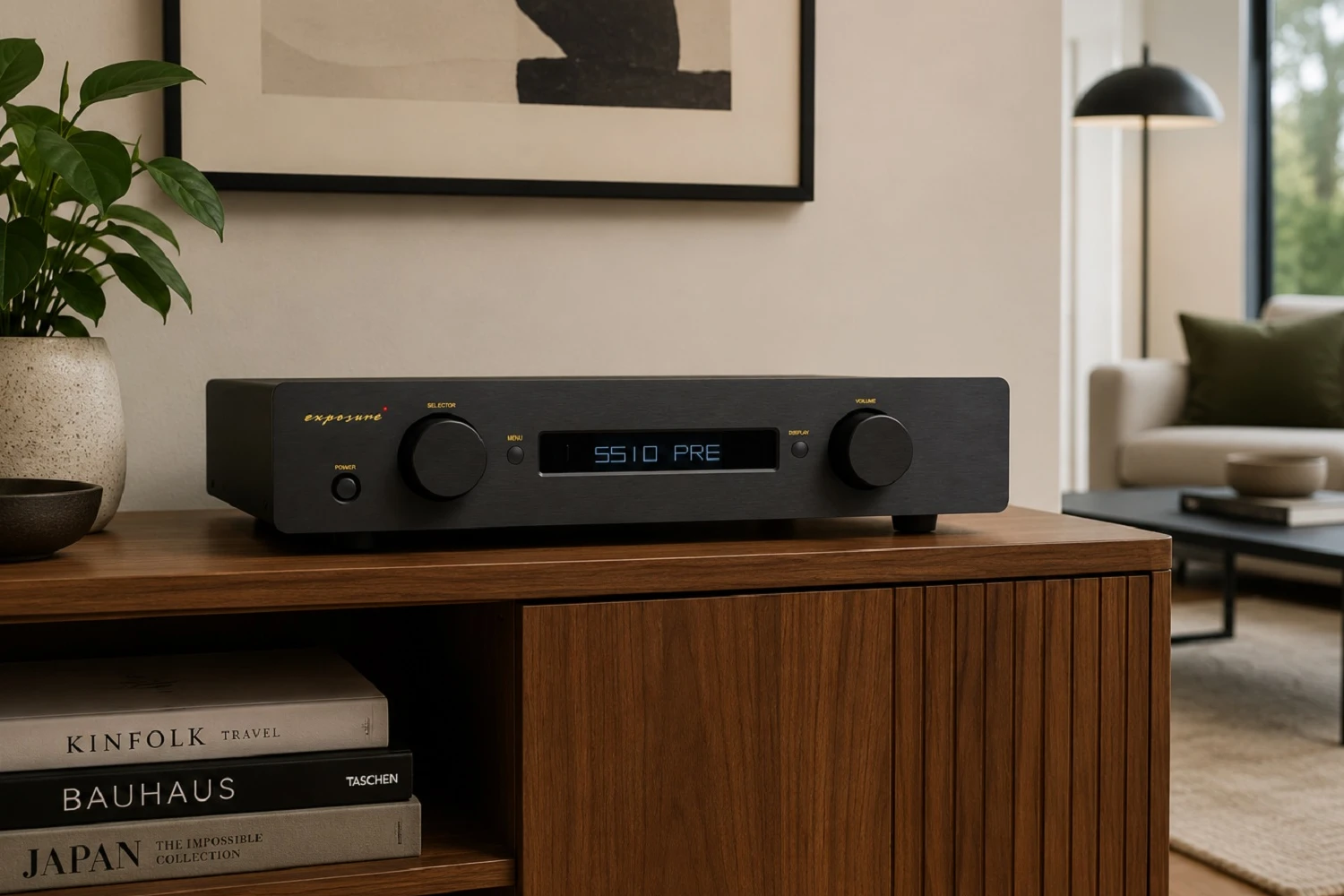
Exposure 5510 preamplifier with minimalist controls, six line inputs, and balanced and unbalanced output options.
The Exposure 5510 is a preamplifier rather than an integrated amplifier, and its appeal lies in a stripped-back approach to system control.
Exposure presents it as a serious two-channel control center without touchscreens, complex software, or trend-led extras.
The specification is practical: six line inputs, balanced XLR and unbalanced RCA outputs, an ultra-quiet power supply with a specially wound toroidal transformer, and a relay-controlled 99-step volume system for repeatable adjustment and channel matching. Optional expansion modules add flexibility for different systems.
Best for: Separation-based two-channel systems
- Six line inputs
- Balanced XLR and RCA outputs
- Relay-controlled 99-step volume system
- Optional module expansion
Verdict: The 5510 is for listeners who want a focused preamplifier with practical connectivity, precise volume control, and room to adapt through modules.

4. Schiit Audio Tyr: 200W of Pure Control, Power, and Precision
Schiit Audio Tyr monoblock power amplifier with perforated chassiswork and side heatsinks for heat dissipation.
The Schiit Audio Tyr is a full-size monoblock power amplifier, meaning each channel requires its own amplifier chassis.
It sits at the top of Schiit’s speaker amplifier lineup and is presented as a more ambitious design than the brand’s compact components.
The industrial chassis is built around heat management, with extensive top and side perforations plus substantial heatsinks on both flanks. For buyers considering monoblocks, its appeal is straightforward: dedicated amplification per channel in a thermally purposeful enclosure.
Best for: Dedicated monoblock power amplification
- True monoblock configuration
- 200W power amplifier article focus
- Extensive chassis ventilation
- Substantial side heatsinks
Verdict: Tyr is the Schiit option for systems where one amplifier per speaker channel and robust thermal design are central priorities.

5. Mission 778X: High quality integrated stereo amplifier
Mission 778X integrated stereo amplifier with modern digital inputs, analogue connections, MM phono, Bluetooth, and pre-outs.
The Mission 778X is a compact integrated stereo amplifier built around broad source compatibility.
It covers digital and analogue inputs, including asynchronous USB Type B, three S/PDIF inputs, stereo RCA line inputs, and an MM phono input for turntables.
It also includes optical and coaxial digital outputs, pre-out jacks for use with an external power amplifier, and Bluetooth with aptX and AAC codec support. For many systems, that combination makes it a convenient hub without requiring a stack of extra boxes.
Best for: Compact integrated systems with mixed sources
- USB, S/PDIF, RCA, and MM phono inputs
- Bluetooth with aptX and AAC
- Digital outputs included
- Pre-out jacks for external power amplification
Verdict: The 778X is a practical integrated amplifier for listeners who need vinyl, digital, wireless, and external power-amp options in one component.
6. McIntosh MA8900: Massive integrated Amplifier
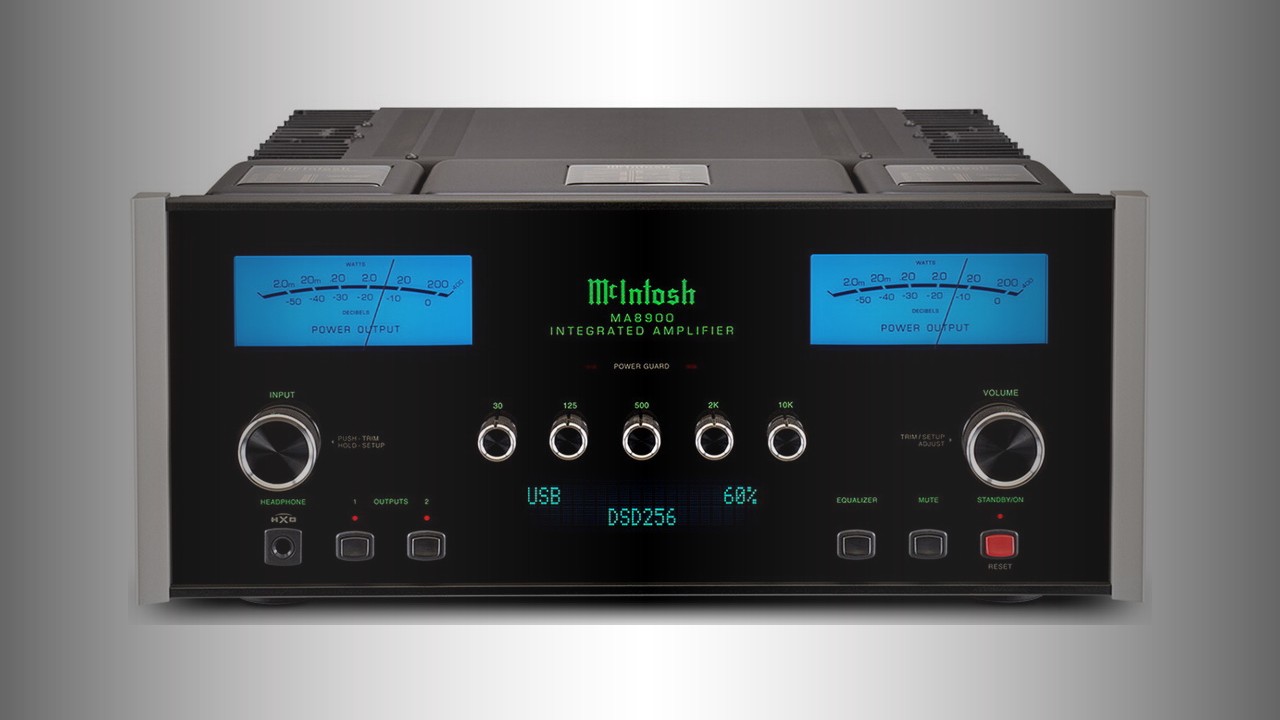
McIntosh MA8900 integrated amplifier with glass front panel, illuminated meters, output autotransformers, and logo-shaped heatsinks.
The McIntosh MA8900 is a substantial integrated amplifier with the brand’s familiar visual language and a specified output of 200 watts per channel.
Its construction uses stainless steel and aluminum, with a glass front panel, illuminated power indicators, output autotransformers, and a power transformer visible on the upper platform.
The amplifier also introduces McIntosh logo-shaped heatsinks connected to high-precision output transistors, along with a redesigned grille for improved heat dissipation. Front-panel controls include input selection, volume, protection indicators, and five discrete equalizer knobs.
Best for: High-output integrated amplification with hands-on control
- 200 watts per channel
- Output autotransformers
- McIntosh logo-shaped heatsinks
- Five discrete equalizer controls
Verdict: The MA8900 is a full-scale integrated amplifier for buyers who want McIntosh power, thermal engineering, and front-panel tone adjustment in one chassis.

7. 7 awesome speakers made from unusual materials
Unusual-material speaker designs, including a compact concrete wireless speaker with a built-in class D amplifier.
This entry is not a conventional amplifier recommendation, but it is useful context for amplifier buyers considering active speakers or system alternatives.
The source article focuses on loudspeakers made from unusual materials, including a compact concrete wireless speaker with a built-in 20-watt class D amplifier and an internal battery rated for 8 hours.
It also highlights more ambitious concrete loudspeaker construction from BetonArt. For someone weighing separates against active designs, the article illustrates how amplification can be integrated directly into the loudspeaker rather than chosen as an external component.
Best for: Readers comparing active speakers with separate amplifiers
- Highlights active speaker amplification
- Includes a built-in 20-watt class D example
- Covers unconventional cabinet materials
- Useful context for active versus separates choices
Verdict: Treat this as system-planning context rather than a standalone amplifier pick, especially if active speakers are under consideration.

8. Klipsch ProMedia Heritage 2.1: Desktop Bluetooth Triphonic
Klipsch ProMedia Heritage 2.1 active desktop system with powered satellites, subwoofer, Bluetooth, USB, and RCA input.
The Klipsch ProMedia Heritage 2.1 is an active desktop audio system rather than a separate amplifier, but its amplification is central to the product.
The system uses built-in class D amplifiers rated at 2 x 35 watts for the satellites and 150 watts for the subwoofer.
Connectivity includes USB, Bluetooth, and analogue RCA input, making it a self-contained desktop or multimedia solution. Its 2.1 layout pairs compact satellites with a larger 8-inch subwoofer, while the satellites use Klipsch Tractrix Horn waveguides with 1-inch polymer compression tweeters.
Best for: Desktop systems where amplification is built in
- Fully active 2.1 system
- Class D amplification built in
- USB, Bluetooth, and RCA inputs
- 150-watt subwoofer amplifier rating
Verdict: The ProMedia Heritage 2.1 is relevant for buyers who want a complete powered desktop system instead of separate amplifier and speaker components.

9. Soulution 757 and 727: Extreme precision preamplifiers
Soulution 727 and 757 preamplifier products focused on ultra-low-noise line-stage performance and advanced analogue correction.
The Soulution 727 and 757 are top-of-the-line preamplifier products with a focus on precision signal handling.
The 727 is described with a signal-to-noise ratio of -170 dB, expanded bandwidth to 20 MHz, improved channel separation, and distortion reduced to undetectable levels.
The 757 is a correction amplifier for turntables that can work with MM, MC, and DS Audio optical cartridges, and it can also process signals directly from analog tape recorder playback heads. This is specialist preamplification for systems where source-level accuracy and format support matter more than integrated convenience.
Best for: Ultra-specialized preamplifier and analogue source systems
- 727 specified at -170 dB signal-to-noise ratio
- 727 bandwidth expanded to 20 MHz
- 757 supports MM, MC, and DS Audio optical cartridges
- 757 can process tape head signals
Verdict: The Soulution pair is for highly specialized systems needing extreme preamplifier precision and broad analogue correction capability.

10. Jadis Óde: Pure Class A Tube Amplifier with KT88 Power & French Craftsmanship
Jadis Óde Class A integrated tube amplifier with KT88 output tubes, French assembly, and 30-watt-per-channel specification.
The Jadis Óde is a pure Class A integrated tube amplifier built around KT88 output tubes in a push-pull configuration.
It is hand-assembled in France, with selected components and individually tested vacuum tubes, and is specified at 30 watts per channel.
Jadis also supports KT120 tubes for those seeking a different tube option. The source presents the Óde as an amplifier centered on musicality rather than raw output power, making it more about tube character and craftsmanship than maximum wattage.
Best for: Tube-focused two-channel listening
- Pure Class A integrated tube design
- KT88 push-pull output stage
- 30 watts per channel
- KT120 tube support
Verdict: The Jadis Óde is for listeners who prioritize a handcrafted Class A tube integrated amplifier over high-power solid-state specifications.
Quick comparison
These products do not all solve the same problem.
Some are power amplifiers that require a preamplifier, some are integrated amplifiers that can anchor a system alone, others are preamplifiers for separates, and two entries are active speaker systems or speaker-focused context where amplification is built into the product.
| Product | Best for | Verdict |
|---|---|---|
| Eversolo AMP-F10 | High-power class AB separates | Choose it when a bridgeable stereo power amplifier and Eversolo system matching are priorities. |
| Vincent SV-737 | Hybrid integrated amplification with streaming | Choose it for a tube-influenced integrated amplifier with WiFi, Bluetooth, and NAS playback support. |
| Exposure 5510 | Minimalist preamplifier control | Choose it when precise volume control, multiple line inputs, and XLR/RCA outputs matter more than built-in streaming. |
| Schiit Audio Tyr | Monoblock power amplifier systems | Choose it when one amplifier per channel and substantial thermal design fit the system plan. |
| Mission 778X | Mixed digital, analogue, vinyl, and Bluetooth sources | Choose it for an integrated amplifier that can handle many source types without extra boxes. |
| McIntosh MA8900 | High-output integrated amplification | Choose it for 200 watts per channel, McIntosh autotransformer design, and front-panel equalizer control. |
| 7 awesome speakers made from unusual materials | Active-speaker and material-design context | Use it as a reference when deciding whether a powered speaker approach may suit the system better than separates. |
| Klipsch ProMedia Heritage 2.1 | Powered desktop audio | Choose it when the preferred solution is a complete active 2.1 system with built-in amplification. |
| Soulution 757 and 727 | Precision preamplification and analogue correction | Choose them for advanced preamplifier duties, especially demanding line-stage, phono, or tape-head applications. |
| Jadis Óde | Class A tube integrated amplification | Choose it when tube topology, KT88 operation, and handcrafted construction are more important than maximum power. |
Frequently asked questions
Should I choose an integrated amplifier or separate preamp and power amp?
An integrated amplifier such as the Mission 778X, Vincent SV-737, McIntosh MA8900, or Jadis Óde combines system control and power amplification in one chassis.
A separates approach, such as the Exposure 5510 with a power amplifier or monoblocks like Schiit Tyr, gives more flexibility but requires more components, cables, and matching decisions.
When does a power amplifier make more sense than an integrated amplifier?
A dedicated power amplifier makes sense if you already have a preamplifier, streamer with volume control, or system architecture built around separates.
The Eversolo AMP-F10 and Schiit Audio Tyr are examples of power-amplifier choices, while the AMP-F10 also adds bridging flexibility for mono use.
Are tube amplifiers only for low-power systems?
Not necessarily, but tube amplifiers should be chosen with realistic expectations about output and speaker matching.
The Jadis Óde is specified at 30 watts per channel in pure Class A, while the Vincent SV-737 uses tubes in a hybrid integrated design and also adds WiFi, Bluetooth, and NAS playback capability.
Do active speaker systems remove the need for an amplifier?
They remove the need for a separate external amplifier because amplification is built in.
The Klipsch ProMedia Heritage 2.1, for example, includes class D amplification for its satellites and subwoofer.
Active speakers can simplify a desktop or compact system, but they are less flexible than separate amplifier and passive speaker combinations.
How to choose from this amplifier selection
Start by deciding what role the component must play.
If the system already has a preamplifier or source with suitable volume control, a power amplifier such as the Eversolo AMP-F10 or Schiit Audio Tyr may be the relevant category.
The Eversolo adds stereo or bridged mono flexibility, while the Schiit is a true monoblock concept built around one amplifier per channel. If simplicity matters, an integrated amplifier is usually the cleaner route. The Mission 778X is the broadest everyday hub in this selection, with USB, S/PDIF, RCA, MM phono, Bluetooth, digital outputs, and pre-outs. The Vincent SV-737 adds hybrid tube circuitry and network playback features. The McIntosh MA8900 is the large-format, high-output integrated choice with 200 watts per channel and equalizer controls. The Jadis Óde is the specialist tube integrated option, focused on pure Class A operation, KT88 tubes, and handcrafted construction. For separates, do not overlook the preamplifier. The Exposure 5510 is designed as a focused two-channel control center with six line inputs, balanced and unbalanced outputs, relay-controlled volume, and optional modules. The Soulution 727 and 757 sit in a more specialized territory, aimed at precision line-stage performance and advanced analogue correction, including cartridge and tape-head applications. Finally, be clear about whether you want a traditional hi-fi chain at all. Active systems such as the Klipsch ProMedia Heritage 2.1 include their own amplification and can be the more practical answer for desktop use. Speaker-focused entries such as the unusual-materials article are not amplifier substitutes, but they help frame the active-versus-separates decision. The most suitable amplifier is the one that fits the system’s architecture, sources, loudspeakers, and upgrade path without adding complexity you do not need.


Join the discussion
Share your thoughts, listening impressions or product experience.