
A great amplifier is more than a box that makes speakers louder.
It determines how a system is controlled, what sources can be connected, and how confidently loudspeakers are driven.
The strongest choices here span compact Class D designs, traditional Class A/B integrated amplifiers, ambitious valve electronics, dedicated power amplification, headphone listening and preamplifier control. The recommendations below are drawn only from the supplied product material, so the emphasis is on confirmed design, connectivity and use case rather than unsupported listening claims. Some are complete integrated solutions, while others are specialist components that belong in carefully matched systems.

1. Arcam SA10: Class A/B integrated amplifier
Arcam SA10 integrated amplifier with Class A/B output stages and built-in ESS DAC.
The Arcam SA10 is a conventional integrated stereo amplifier built around Class A/B amplification and rated at 50 W into 8 ohms.
Its appeal lies in a balanced specification: an ESS9016K2M DAC for direct digital-source connection, a toroidal-transformer power supply, and circuit-board layout work intended to shorten the audio signal path and reduce crosstalk.
The source material also notes isolated power circuits and current headroom intended to help with speakers that present more complex impedance loads. Control is flexible, with a backlit infrared remote plus IP, MusicLife app and RS232 options. For listeners who want a serious but straightforward integrated amplifier with onboard digital conversion, the SA10 is one of the more complete traditional choices in this group.
Best for: Traditional stereo systems needing an integrated amplifier with digital input support
- Class A/B integrated design
- 50 W into 8 ohms
- ESS9016K2M DAC for digital sources
- Remote, IP, app and RS232 control options
Verdict: A well-rounded Class A/B integrated amplifier with sensible power, onboard DAC functionality and unusually broad control options.

2. Aiyima A07 MAX: Class D amplifier that works in both stereo and mono mode
Aiyima A07 MAX compact Class D amplifier with RCA input, speaker outputs and AUX output.
The Aiyima A07 MAX is a compact Class D amplifier built around the TI TPA3255 IC and designed for flexible deployment.
It can operate in stereo or mono mode, allowing multiple units to be chained for additional power configurations.
The supplied specifications state 2 x 225 W into 4 ohms in stereo or 1 x 450 W into 4 ohms in mono, while the AUX output can feed another amplifier in mono mode or an active subwoofer. Internally, the amplifier uses NE5532 op-amps in DIP8 packages, so they are easily replaceable, and the parts list includes WIMA and Rubycon capacitors plus a TI364 power-management IC. Connectivity is deliberately simple: RCA line input, speaker terminals and a 3.5 mm AUX output.
Best for: Compact systems, desktop setups and users experimenting with mono amplifier configurations
- Stereo and mono operating modes
- TI TPA3255 Class D amplifier chip
- Replaceable DIP8 NE5532 op-amps
- AUX output for another amplifier or active subwoofer
Verdict: A small Class D amplifier with unusually flexible stereo and mono operation for its format.

3. Westend Monaco: A No-Compromise German Tube Integrated Amplifier
Westend Monaco tube integrated amplifier built around a push-pull Class AB valve output stage.
The Westend Monaco is presented as a statement tube integrated amplifier from a Munich manufacturer focused on one ambitious product at a time.
Unlike smaller low-power valve amplifiers, the Monaco is described as a tube-only signal-path design with 100 W per channel into 4 ohms in push-pull Class AB configuration.
The source frames it as behaving more like a separate preamplifier and power-amplifier combination than a conventional integrated, with the authority to control demanding loudspeakers while retaining the fluidity and tonal density associated with tube designs. Four E130L tubes per unit sit at the heart of the design, a tube type originally developed for military applications and noted in the source for stability and long service life.
Best for: High-end systems seeking a powerful integrated tube amplifier
- Tube-only signal path
- 100 W per channel into 4 ohms
- Push-pull Class AB configuration
- Uses E130L tubes originally developed for military applications
Verdict: A serious valve integrated amplifier designed for listeners who want tube architecture with substantial output capability.

4. Luxman SQ-N150: High-quality Tube integrated amplifier
Luxman SQ-N150 tube integrated amplifier with front-panel level meters and removable tube cage.
The Luxman SQ-N150 brings the company’s NeoClassica approach into a compact tube integrated amplifier with unmistakably retro styling.
It is based on the SQ-5A heritage cited in the source, with dial signal-level indicators on the front panel and a removable mechanical casing over the tubes.
EL84 output tubes work with a wideband transformer to deliver 10 W per channel into 6 ohms, while ECC83 tubes are used in the preamp stage. The SQ-N150 also includes Luxman tone controls for adjusting the presentation when recordings call for it, and that tone-control circuit can be bypassed for direct signal transmission. An electrically driven volume control and remote add day-to-day convenience to the classic valve format.
Best for: Efficient-speaker systems and listeners wanting a classic Luxman tube integrated amplifier
- EL84 output tubes
- 10 W per channel into 6 ohms
- Bypassable tone-control circuit
- Remote-controlled electrically driven volume
Verdict: A compact, characterful tube integrated amplifier with practical tone adjustment and classic Luxman styling.

5. Parasound HINT 6: Integrated amplifier that delivers exceptional sound quality
Parasound HINT 6 integrated amplifier with analog volume control, phono stage and digital connectivity.
The Parasound HINT 6 is an integrated amplifier built around a power-amplification stage designed by John Curl.
Its amplification operates in Class A/AB mode, running in Class A at lower volume levels before transitioning to Class AB as output rises.
The feature set is notably broad: a Burr-Brown analog volume-control unit with display, USB Type B input for computer audio, a switchable MM/MC phono preamplifier, a tone block, and an input that allows compatible third-party components to use it in home-theater systems for front-channel drive. The supplied material also notes increased MC cartridge gain and improved channel separation in the phono section compared with the model lineage described. It is a strong all-in-one candidate for systems with analog, digital and theater demands.
Best for: Mixed music and home-theater systems needing a versatile integrated amplifier
- John Curl-designed power amplification stage
- Class A/AB operation
- Switchable MM/MC phono preamplifier
- Home-theater integration input for front channels
Verdict: A feature-rich integrated amplifier with serious analog facilities and useful system-integration options.

6. Topping PA7 Plus: Powerful balanced amplifier
Topping PA7 Plus Class D amplifier with balanced and single-ended input options.
The Topping PA7 Plus is a Class D amplifier with a balanced design and a strong measurement-led specification.
The source highlights effective transmission-noise suppression from its balanced architecture, significant output capability, and very low distortion before clipping.
Input options include a balanced XLR/TRS combo connection and a single-ended stereo RCA input, giving it compatibility with both balanced and conventional sources. A 12 V trigger input supports system auto-on and auto-off behavior when paired with compatible components. The PA7 Plus also includes a volume control, but that control can be bypassed so the unit functions as a power amplifier with an external preamplifier.
Best for: Systems using balanced sources or an external preamplifier
- Balanced XLR/TRS combo input
- Single-ended RCA input
- 12 V trigger input
- Bypassable volume control for power-amplifier use
Verdict: A compact Class D amplifier aimed at clean system integration and balanced signal transmission.
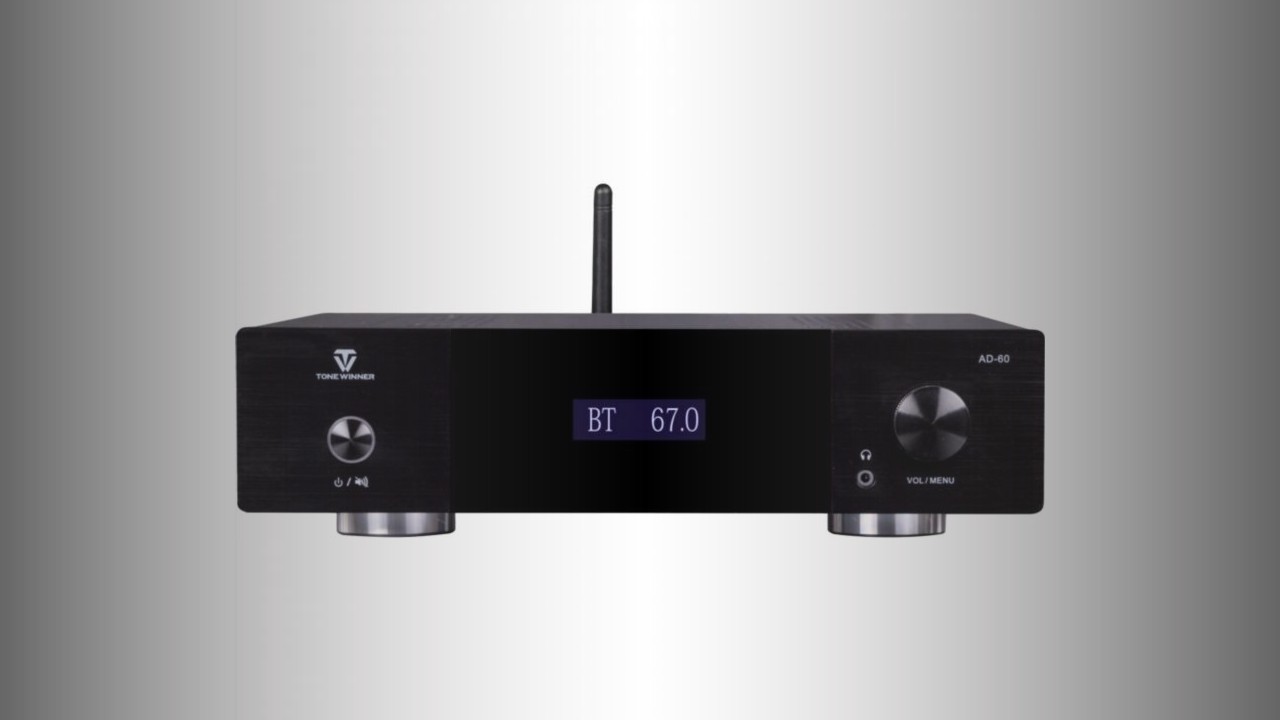
7. Tonewinner AD-60: Class AB integrated power amplifier
Tonewinner AD-60 integrated amplifier with HDMI ARC, digital inputs, Bluetooth and subwoofer output.
The Tonewinner AD-60 is a Class AB integrated amplifier designed for wide connectivity rather than purist minimalism.
It is rated at 2 x 80 W into 4 ohms and 2 x 50 W into 8 ohms, with the source quoting total harmonic distortion of 0.025 percent at 1 kHz and a 20 Hz to 100 kHz frequency response.
A toroidal transformer of up to 100 W and high-performance capacitors are specified for the power supply. The main draw is its input range: USB-A, USB-C, TF card slot, HDMI ARC, optical, coaxial, stereo RCA and Bluetooth 5.0. Outputs include stereo speaker terminals, a 3.5 mm headphone output and a subwoofer output, making it suitable for compact systems that need several modern source options.
Best for: Modern compact systems needing many input types in one amplifier
- Class AB integrated design
- 80 W into 4 ohms and 50 W into 8 ohms
- HDMI ARC, optical, coaxial, USB and Bluetooth inputs
- Headphone and subwoofer outputs
Verdict: A connectivity-rich Class AB integrated amplifier suited to systems that combine TV, digital, wireless and analog sources.

8. Accuphase P-4600: New impressive power amplifier launched
Accuphase P-4600 power amplifier with front-panel meters and balanced input connectivity.
The Accuphase P-4600 is a dedicated power amplifier rather than an integrated amplifier, so it requires a separate preamplifier or suitable source with volume control.
It follows the company’s recognizable visual language, with a thick golden front panel, large dial indicators, input-sensitivity control and speaker switching.
The rear panel includes two pairs of RCA and XLR inputs, two pairs of speaker terminals, and switching for bridge mode and dual-mono operation, the latter allowing use in bi-amping systems. The power supply uses a large toroidal transformer and 50,000 microfarads of total filter-capacitor capacity. Output is quoted at 150 W into 8 ohms and 300 W into 4 ohms, with bridge-mode ratings also supplied in the source.
Best for: Systems built around separate preamplifier and power-amplifier components
- Dedicated stereo power amplifier
- RCA and XLR inputs
- Bridge and dual-mono modes
- 150 W into 8 ohms and 300 W into 4 ohms
Verdict: A substantial Accuphase power amplifier for users who want separate-component flexibility and high rated output.

9. Hidizs S9 Pro Plus Martha: DAC/headphone amplifier on ES9038Q2M
Hidizs S9 Pro Plus Martha DAC/headphone amplifier with balanced 4.4 mm headphone output.
The Hidizs S9 Pro Plus Martha is a DAC with an integrated headphone amplifier, so it belongs to personal audio rather than loudspeaker amplification.
It uses a fully balanced circuit architecture built around four blocks: USB interface processor, DAC, independent headphone amplifier and POP noise-reduction system.
The DAC chip is the ES9038Q2M, using ESS Technology’s 32-bit HyperStream II QUADDAC architecture and time-domain jitter-elimination system as described in the source. Headphone outputs are provided on 3.5 mm and 4.4 mm connectors, and output power is listed as 180 mW into 32-ohm headphones from the balanced output. For listeners who need a compact DAC/headphone amplifier rather than a speaker amp, it is the relevant specialist entry here.
Best for: Portable or desktop headphone listening with USB DAC functionality
- ES9038Q2M DAC chip
- 3.5 mm and 4.4 mm headphone outputs
- 180 mW into 32 ohms from balanced output
- Fully balanced internal circuit architecture
Verdict: A compact DAC/headphone amplifier for personal listening rather than driving passive loudspeakers.

10. McIntosh C2800: Roon Tested Vacuum Tube Preamplifier
McIntosh C2800 vacuum-tube preamplifier with analog, digital, phono and subwoofer connectivity.
The McIntosh C2800 is a vacuum-tube preamplifier, not an integrated amplifier, and must be partnered with power amplification.
It uses four vacuum tubes: three 12AX7A tubes and one 12AT7.
Its role is system control, and the supplied material confirms 16 inputs in total, divided between analog and digital connections, including two phono inputs and seven digital inputs supporting up to 24-bit/192 kHz resolution. It also supports DSD512 files and is Roon Tested. Output flexibility is broad, with three pairs each of balanced and unbalanced outputs, a dedicated subwoofer output, bi-amping compatibility and a headphone jack with HXD technology. Bass and treble can be adjusted electronically in 1 dB steps, and the processor loop allows external equalizers or signal processors to be inserted.
Best for: Advanced separate-component systems needing tube preamplifier control
- Vacuum-tube preamplifier with four tubes
- 16 total inputs including phono and digital
- Balanced, unbalanced and subwoofer outputs
- Processor loop and app control support
Verdict: A comprehensively equipped tube preamplifier for systems that require extensive input, output and processing flexibility.
Quick comparison
The products divide into clear groups: integrated amplifiers that can anchor a full stereo system, dedicated power or preamplifier components for separates, compact Class D options, valve designs and a personal-audio DAC/headphone amplifier.
The right choice depends less on brand hierarchy than on whether the component matches the loudspeakers, sources and control structure of the system.
| Product | Best for | Verdict |
|---|---|---|
| Arcam SA10 | Traditional stereo systems with digital sources | Class A/B integrated amplifier with 50 W into 8 ohms and an ESS DAC. |
| Aiyima A07 MAX | Compact setups and stereo or mono Class D configurations | Small amplifier with stereo and mono modes built around the TI TPA3255 chip. |
| Westend Monaco | High-end tube integrated systems needing substantial output | Tube-only integrated amplifier rated at 100 W per channel into 4 ohms. |
| Luxman SQ-N150 | Classic tube systems with efficient speakers | EL84-based integrated amplifier with 10 W per channel and bypassable tone controls. |
| Parasound HINT 6 | Versatile music and home-theater systems | Integrated amplifier with Class A/AB operation, phono stage, USB input and theater integration. |
| Topping PA7 Plus | Balanced-source systems and external preamp setups | Class D amplifier with balanced input, RCA input, 12 V trigger and bypassable volume control. |
| Tonewinner AD-60 | Compact systems with TV, digital and wireless sources | Class AB integrated amplifier with HDMI ARC, Bluetooth, digital inputs and subwoofer output. |
| Accuphase P-4600 | Separate-component systems needing a dedicated power amplifier | Power amplifier with RCA/XLR inputs, bridge mode, dual-mono mode and high rated output. |
| Hidizs S9 Pro Plus Martha | Headphone listeners needing a compact DAC/amplifier | USB DAC/headphone amplifier with ES9038Q2M DAC and 3.5 mm plus 4.4 mm outputs. |
| McIntosh C2800 | Advanced separates systems needing tube preamplifier control | Vacuum-tube preamplifier with extensive analog, digital, phono and output connectivity. |
Frequently asked questions
Should I choose an integrated amplifier, power amplifier or preamplifier?
Choose an integrated amplifier if you want source switching, volume control and speaker drive in one unit, as with the Arcam SA10, Luxman SQ-N150, Parasound HINT 6 or Tonewinner AD-60.
Choose a power amplifier such as the Accuphase P-4600 when you already have, or plan to add, a separate preamplifier.
Choose a preamplifier such as the McIntosh C2800 when you need system control and will use separate power amplification.
Do Class A/B, Class D and tube designs suit different systems?
They can.
The supplied amplifiers show different priorities: Class A/B models such as the Arcam SA10 and Tonewinner AD-60 follow a traditional integrated-amplifier route, Class D models such as the Aiyima A07 MAX and Topping PA7 Plus offer compact high-efficiency amplification, and tube models such as the Westend Monaco and Luxman SQ-N150 focus on valve-based signal paths.
The correct choice still depends on speaker requirements, sources and desired system layout.
How much amplifier power do I need?
Start with the loudspeakers.
The Luxman SQ-N150 is rated at 10 W per channel into 6 ohms and is best considered with suitable efficient speakers, while the Arcam SA10 offers 50 W into 8 ohms.
More powerful options in the supplied material include the Parasound HINT 6, Tonewinner AD-60, Westend Monaco and Accuphase P-4600, but power figures alone do not guarantee compatibility. Impedance, room size and intended listening levels all matter.
Which features are worth prioritizing?
Prioritize the features your system will actually use.
A built-in DAC matters if you connect digital sources, as with the Arcam SA10, McIntosh C2800 or Hidizs S9 Pro Plus Martha.
A phono stage is important for turntables, as noted on the Parasound HINT 6 and McIntosh C2800. HDMI ARC and Bluetooth make the Tonewinner AD-60 more convenient for TV and wireless sources, while balanced inputs are central to the Topping PA7 Plus and Accuphase P-4600.
How to choose the right amplifier from this group
Begin by deciding what job the amplifier must perform.
For a conventional two-channel system, an integrated amplifier is usually the most direct route.
The Arcam SA10 is the cleanest traditional option here for listeners wanting Class A/B amplification with an onboard DAC and practical control features. The Parasound HINT 6 is the broader system hub, adding phono support, USB input and home-theater integration. The Tonewinner AD-60 is the most source-flexible integrated choice, especially where HDMI ARC, Bluetooth and multiple digital inputs are useful. For valve systems, match expectations carefully. The Luxman SQ-N150 offers a compact EL84-based integrated approach with modest rated power and tone-control flexibility, making speaker matching especially important. The Westend Monaco sits in a different class of ambition, combining a tube-only signal path with a quoted 100 W per channel into 4 ohms. If your system is built from separates, the Accuphase P-4600 and McIntosh C2800 address different ends of the chain: the Accuphase is the power amplifier, while the McIntosh is the tube preamplifier and control center. The Topping PA7 Plus also fits separates-style systems thanks to balanced input options and a bypassable volume control. The Aiyima A07 MAX is the compact experimenter’s choice, particularly where stereo and mono operation are useful. The Hidizs S9 Pro Plus Martha should be considered only for headphone systems, where its DAC and headphone outputs are the relevant strengths. The safest buying approach is to map the signal path before comparing specifications: sources first, then control, then amplification, then loudspeaker or headphone load. Once those requirements are clear, the strongest choice is the amplifier that solves the system’s practical needs without adding unnecessary complexity.



Sound Off
0Join the discussion if you have something to add.