



A digital-to-analog converter may perform a narrowly defined task, but the products gathered here approach it in markedly different ways.
Some are compact desktop components, some combine conversion with headphone amplification or preamplifier control, and others are full-size digital hubs intended to sit at the center of an ambitious hi-fi system.
Converter architecture is another important dividing line. This selection includes conventional chip-based designs, discrete R-2R ladders, a dedicated 1-bit DSD implementation and a tube-equipped DAC. Features range from Bluetooth and parametric equalization to streaming, clock inputs and balanced analog outputs. The right choice therefore depends less on headline resolution figures than on system fit. Consider the digital sources you need to connect, whether you require headphone or volume control, and whether conveniences such as wireless playback, streaming or tonal adjustment matter in daily use. Several products are newly introduced or described primarily through manufacturer information, so their technical distinctions should not be treated as substitutes for comparative listening.
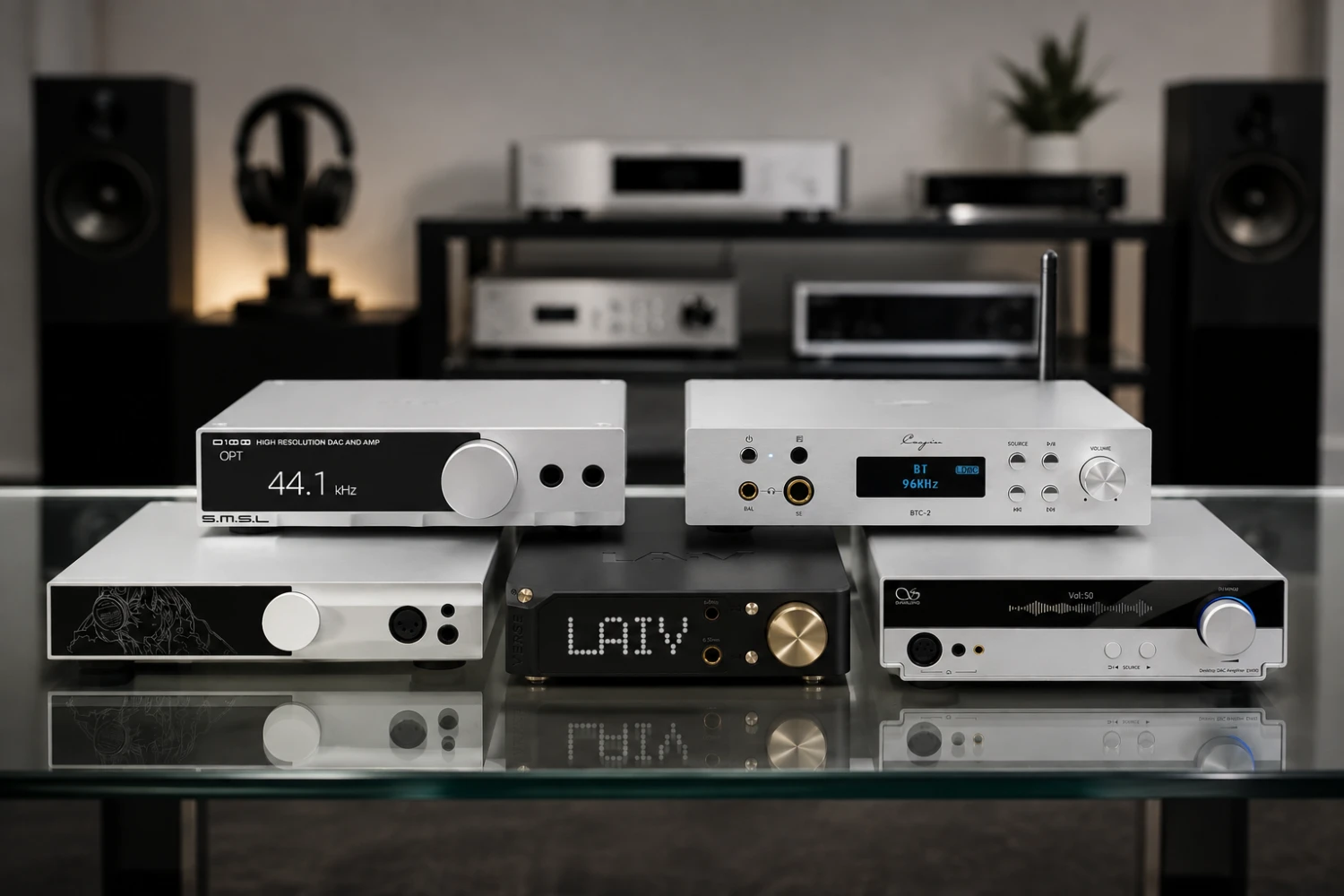
1. Best Headphone DAC/Amps in: 7 Desktop Models Worth Considering
Desktop DAC/headphone amplifiers combine digital inputs, volume control and wired headphone outputs in a compact system role.
This overview focuses on desktop components that combine digital conversion with headphone amplification, and in some cases preamplifier duties.
The category spans affordable compact units, balanced amplifiers suited to more demanding headphones, R-2R converters and models offering Bluetooth or digital processing.
Among the examples detailed in the source, the SMSL D100 combines an ESS ES9081 DAC, XMOS XU-316 USB interface, 6.35mm and balanced 4.4mm headphone outputs, and USB-C, optical and coaxial inputs. Its balanced output is rated at up to 400mW per channel into 32 ohms, so prospective buyers should check power requirements carefully rather than choosing on features alone.
Best for: Comparing desktop DAC and headphone-amplifier combinations
- Integrated DAC and headphone-amplifier options
- Broad range of desktop form factors and architectures
- Balanced outputs available on selected models
- USB audio and digital processing represented
Verdict: A useful starting point for listeners who want conversion and headphone amplification in one chassis, provided each model’s output power is matched to the intended headphones.

2. Musical Fidelity M6S DAC
The Musical Fidelity M6S DAC combines balanced conversion, multiple wired digital inputs and an integrated headphone amplifier.
The Musical Fidelity M6S DAC is a full-size converter built around a dual-mono, fully balanced circuit using four 32-bit stereo DACs.
It accepts PCM through three coaxial inputs, three optical inputs and USB, supports DSD64 and DSD128, and upsamples incoming PCM to 32-bit/768kHz.
A built-in headphone amplifier expands its usefulness, while balanced and unbalanced outputs can operate at fixed or variable level, allowing connection to an integrated amplifier, active speakers or a power amplifier. Data resynchronization is included to reduce jitter, and the quoted specifications include a signal-to-noise ratio of at least 119dB.
Best for: A full-size DAC serving several wired digital sources
- Dual-mono, fully balanced topology
- Three coaxial and three optical inputs
- Fixed or variable analog outputs
- Built-in headphone amplifier
Verdict: The M6S DAC is a versatile system hub for buyers who need plentiful digital inputs, headphone listening and direct level control from one component.

3. Topping D90 III Discrete
The Topping D90 III Discrete pairs discrete conversion modules with Bluetooth reception, profile-based PEQ and system triggers.
The Topping D90 III Discrete replaces a conventional integrated conversion stage with a fully discrete design using a PSRM module for each channel.
It supports PCM up to 32-bit/768kHz and DSD512, while a Qualcomm QCC5125 Bluetooth 5.1 receiver handles aptX, aptX HD, aptX Adaptive and LDAC.
Its most distinctive facility is a 10-band parametric equalizer managed through the Topping Tune application for Windows. Users can adjust frequency response, gain and bandwidth, import curves, generate compensation curves and save multiple profiles. Rear-panel 12V trigger input and output further support integration into a coordinated system.
Best for: Listeners who want detailed software-based tonal adjustment
- Fully discrete conversion modules
- 10-band parametric equalizer
- LDAC and aptX-family Bluetooth support
- 12V trigger input and output
Verdict: The D90 III Discrete stands out for combining high-resolution conversion and broad Bluetooth codec support with unusually flexible parametric equalization.
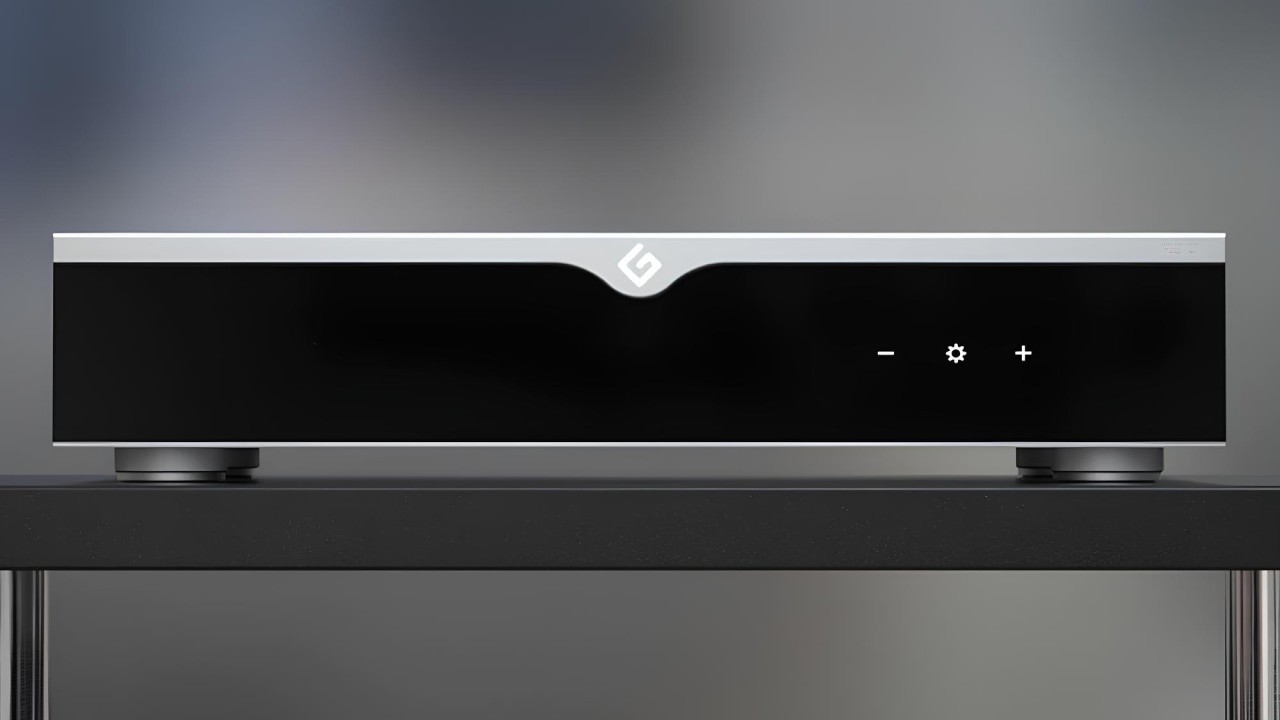
4. Gustard R30
The Gustard R30 uses a discrete R-2R matrix for PCM, a dedicated 1-bit path for DSD and separately supplied digital and analog sections.
The Gustard R30 takes a specialist approach to PCM and DSD.
PCM conversion is handled by a discrete R-2R resistor matrix, while DSD uses Gustard’s own True 1-Bit converter and supports signals up to DSD1024 without intermediate conversion to PCM.
Clocking is built around an SC-Cut OCXO generator and GCLK-02 module, with provision for an external clock. Separate toroidal transformers supply the digital and analog circuits, reducing interaction between those sections. The combination makes the R30 particularly relevant to buyers who prioritize discrete conversion architecture, native DSD handling and clock-system flexibility.
Best for: Systems centered on discrete conversion and high-rate DSD
- Discrete R-2R PCM conversion
- Dedicated 1-bit DSD conversion up to DSD1024
- External clock connection
- Separate transformers for digital and analog sections
Verdict: The R30 is the technically ambitious choice here for listeners specifically seeking separate R-2R PCM and 1-bit DSD conversion paths.

5. HiFiMAN EF500
The HiFiMAN EF500 integrates Hymalaya LE ladder conversion with balanced and single-ended headphone connections.
The HiFiMAN EF500 combines the company’s Hymalaya LE R-2R ladder DAC with a substantial desktop headphone amplifier.
Its front-panel connections include a 3.5mm single-ended output and four-pin balanced XLR output, while RCA line outputs allow it to feed another amplifier.
USB-C, USB-B and coaxial connections are listed among the inputs and operating options. Maximum headphone output is specified at 4.5W per channel into 32 ohms through the balanced connection and 1.32W per channel into 32 ohms unbalanced. That power distinction makes the balanced output especially relevant when assessing compatibility with less sensitive headphones.
Best for: Desktop use with headphones that benefit from substantial amplifier power
- Hymalaya LE R-2R ladder DAC
- Balanced and single-ended headphone outputs
- Rated at 4.5W per channel into 32 ohms balanced
- RCA line outputs
Verdict: The EF500 is a focused DAC/amplifier for listeners who want R-2R conversion and considerably more balanced headphone power than a basic desktop unit provides.

6. Millennia Imersiv D-1 HDR-A
Millennia’s Imersiv D-1 applies the company’s HDR-A conversion architecture and pro-audio design philosophy to digital playback.
The Imersiv D-1 HDR-A is presented as a new digital-to-analog converter from Millennia Music & Media Systems, a company rooted in professional recording equipment.
Its central feature is the manufacturer’s HDR-A conversion architecture, developed with accuracy, neutrality and dynamic stability as stated design priorities.
Millennia makes unusually strong claims for signal-to-noise ratio and distortion, but the supplied material does not include independent measurements or a complete connection list. It is therefore best regarded as a technically intriguing pro-audio-derived design whose performance claims still require external verification.
Best for: Buyers following accuracy-led converter designs from pro-audio specialists
- Purpose-developed HDR-A conversion architecture
- Designed by an established pro-audio manufacturer
- Accuracy and neutrality are explicit design priorities
Verdict: The Imersiv D-1 is a promising accuracy-focused concept, but its exceptional manufacturer claims should be assessed alongside complete specifications and independent evidence.

7. FiiO Warmer R2R
The FiiO Warmer R2R combines four E88CC tubes, R-2R conversion, a toroidal transformer and prominent analog VU meters.
The FiiO Warmer R2R combines a patented R-2R conversion architecture with four JJ Electronic E88CC tubes, making it the most deliberately retro-styled DAC in this selection.
USB accepts PCM up to 32-bit/384kHz and supports UAC 1.0 and 2.0, while RCA and XLR outputs accommodate desktop and conventional hi-fi systems.
A 46W toroidal transformer supplies the linear power section, and the tubes and power supply sit beneath a perforated metal cover intended to aid heat dissipation. Large analog VU meters provide visual level feedback as well as defining the product’s appearance.
Best for: Listeners seeking tube-based R-2R conversion and retro styling
- R-2R conversion with four E88CC tubes
- RCA and XLR analog outputs
- UAC 1.0 and 2.0 support
- Toroidal transformer and linear power supply
Verdict: The Warmer R2R is the characterful option for systems where tube circuitry, balanced connectivity and physical presentation matter as much as format support.

8. Gustard DAC-X30
The Gustard DAC-X30 integrates four ESS converter chips, CelWare network playback and relay-based volume adjustment.
The Gustard DAC-X30 combines conversion, network playback and volume control in a single component.
Four ESS ES9039SPRO DAC chips are used in a fully balanced arrangement, with two chips assigned to each channel and separate power and grounding.
Volume is adjusted by an R-2R relay attenuator, allowing the unit to connect directly to active monitors or power amplifiers and be controlled remotely. Digital processing includes FPGA-based clock management and PCM/DSD handling, while a SHARC-platform DSP filter applies Gustard’s noise-reduction algorithms. The CelWare playback system uses an optimized Linux kernel as the foundation for its streaming functions.
Best for: A streaming DAC with direct system-level volume control
- Four ES9039SPRO DAC chips in a balanced architecture
- Integrated CelWare network playback
- R-2R relay volume control
- Direct connection to active speakers or power amplifiers
Verdict: The DAC-X30 is the broadest all-in-one digital source here, combining network playback, balanced conversion and relay-controlled output level.

9. Topping E50 II
The compact Topping E50 II combines an AKM converter, XMOS USB interface and LDAC-compatible Bluetooth reception.
The compact Topping E50 II is designed to work on a desktop or within a conventional hi-fi system.
It uses an AKM AK4497S DAC with an XMOS XU316 USB controller, supporting PCM up to 32-bit/768kHz and DSD512.
Integrated Bluetooth adds LDAC compatibility for wireless playback. Internally, Topping’s FPGA-based TopSync platform and PLL clock generation work with its JitterNull timing-error reduction system across the digital inputs. The resulting feature set balances high-rate wired playback with the convenience of Bluetooth, without moving into the larger streaming-DAC category.
Best for: Compact systems needing both USB and wireless playback
- Compact desktop and hi-fi form factor
- PCM up to 32-bit/768kHz and DSD512
- LDAC-compatible Bluetooth
- XMOS XU316 USB interface
Verdict: The E50 II is a practical compact DAC for buyers who want high-resolution USB support and LDAC without the complexity of an integrated network streamer.

10. Van Medevoort Audio vM DA470
The Van Medevoort vM DA470 provides multiple S/PDIF, USB and Q-Link I2S inputs for use as a central digital hub.
The vM DA470 is conceived as the digital hub of a larger audio system.
It supports PCM up to 768kHz and native DSD512, with incoming signals upsampled by an asynchronous sample-rate converter before reaching separate converter chips for the left and right channels.
Two vM superclocks provide eight buffered clock outputs for different circuit sections and formats. Connectivity includes coaxial, balanced XLR and optical S/PDIF, USB for a computer or streamer, and two Q-Link I2S inputs. One Q-Link input is designed to work with Van Medevoort CD transports, giving the DA470 particular relevance within the manufacturer’s own component ecosystem.
Best for: A wired digital hub with extensive source connectivity
- Broad coaxial, XLR, optical, USB and I2S connectivity
- Separate converter chip for each channel
- PCM up to 768kHz and native DSD512
- Dedicated Q-Link connection for compatible CD transports
Verdict: The vM DA470 is a system-oriented DAC for users with numerous wired sources, especially those considering compatible Van Medevoort transports.
Quick comparison
These products differ more in system role than their maximum file rates suggest.
The comparison below highlights the clearest distinctions supported by the source material, from headphone-focused desktop units to streaming hubs and specialist discrete converters.
| Product | Best for | Verdict |
|---|---|---|
| Desktop Headphone DAC/Amps overview | Comparing integrated desktop DAC/amplifier options | A broad category guide that emphasizes convenience, headphone connectivity and the need to check amplifier power. |
| Musical Fidelity M6S DAC | Multiple wired sources, headphones and variable output | A fully balanced, dual-mono DAC with plentiful optical and coaxial inputs. |
| Topping D90 III Discrete | Parametric equalization and Bluetooth flexibility | A discrete DAC distinguished by 10-band PEQ, profile management and broad Bluetooth codec support. |
| Gustard R30 | Discrete PCM conversion and native high-rate DSD | A specialist design with separate R-2R PCM and 1-bit DSD conversion paths. |
| HiFiMAN EF500 | Powerful balanced desktop headphone systems | An R-2R DAC/amplifier rated to deliver 4.5W per channel into 32 ohms from its balanced output. |
| Millennia Imersiv D-1 HDR-A | Accuracy-focused, pro-audio-derived conversion | An intriguing HDR-A design accompanied by ambitious manufacturer claims that require verification. |
| FiiO Warmer R2R | Tube circuitry and retro presentation | An R-2R tube DAC with balanced outputs, a linear power supply and analog VU meters. |
| Gustard DAC-X30 | Streaming, conversion and direct volume control | A network-capable digital hub with four ESS DAC chips and R-2R relay attenuation. |
| Topping E50 II | Compact USB and LDAC-based systems | A small-format AKM DAC that combines high-rate wired playback with wireless convenience. |
| Van Medevoort Audio vM DA470 | Connecting numerous wired digital sources | A highly connected system DAC with USB, several S/PDIF formats and two Q-Link I2S inputs. |
Frequently asked questions
Should I buy a standalone DAC or a DAC/headphone amplifier?
Choose a DAC/headphone amplifier if wired headphones are a primary source and the unit’s output power suits their impedance and sensitivity.
A standalone DAC is more appropriate when you already own suitable amplification or need a dedicated source for an integrated amplifier, active speakers or power amplifier.
Do very high PCM and DSD limits guarantee better sound?
No.
Maximum file support confirms compatibility, not audible superiority.
Input selection, output configuration, volume control, amplifier power, implementation and compatibility with your existing sources are usually more useful buying criteria.
When are balanced connections useful?
Balanced headphone outputs can provide more power on products such as the HiFiMAN EF500, while balanced line outputs may suit compatible amplifiers, active speakers and longer cable runs.
They are not automatically preferable if the rest of the system is single-ended or the product’s balanced implementation offers no practical benefit for your setup.
Is Bluetooth a substitute for a network streamer?
Not necessarily.
Bluetooth models such as the Topping D90 III Discrete and E50 II receive audio directly from a nearby device, while the Gustard DAC-X30 includes a dedicated network playback platform.
Choose according to how you want to browse, control and deliver music rather than codec names alone.
How to choose the right DAC for your system
Begin with connections.
List every source you intend to use, including computers, CD transports, televisions, streamers and mobile devices, then check that the DAC has the required USB, optical, coaxial, balanced digital or I2S inputs.
Do not assume that a large input count guarantees compatibility: I2S implementations and manufacturer-specific connections such as Q-Link deserve particular attention. Next, decide which additional components the DAC must replace. The Musical Fidelity M6S DAC adds headphone amplification and variable outputs, the HiFiMAN EF500 prioritizes headphone power, and the Gustard DAC-X30 combines network playback with relay-controlled volume. A simpler model such as the Topping E50 II may be more appropriate when an existing amplifier already provides input selection and level control. Architecture should follow practical requirements rather than dictate them. Discrete R-2R, 1-bit DSD, delta-sigma chips and tube stages are meaningful engineering distinctions, but the supplied material does not establish that one approach is universally superior. Likewise, PCM and DSD ceilings indicate format support rather than overall quality. Features such as the D90 III Discrete’s parametric equalizer may produce a more useful system improvement for some listeners than support for files they never play. Finally, verify output behavior before connecting a DAC directly to active speakers or a power amplifier. Confirm that volume control applies to the intended outputs, establish a safe startup level and check whether fixed and variable modes can be locked. Headphone users should compare the amplifier’s rated output with the needs of their headphones, while buyers considering newly announced designs should seek complete specifications and independent evaluation before treating manufacturer claims as settled fact.


Join the discussion
Share your thoughts, listening impressions or product experience.