

A strong home cinema does not have to follow one template.
Some rooms need a full multi-channel AV receiver, others are better served by a compact surround package, a high-output projector, a serious media player, or even a two-channel receiver with HDMI for people who value simplicity over surround effects.
This Stereoindex selection brings together home-cinema-related products and guides that solve different parts of the system-building puzzle. The list includes AV receivers, speakers, subwoofers, players, and projection hardware, with each recommendation based only on the details supplied in the source material. The emphasis here is practical matching. Rather than ranking everything as if it served the same purpose, each entry explains where the product or article fits, what its supported strengths are, and what kind of buyer should shortlist it.

1. Onkyo TX-8470: Two-channel receiver with an abundance of functions
The Onkyo TX-8470 combines stereo amplification with HDMI, network streaming, digital inputs, and a phono input for a simplified entertainment setup.
The Onkyo TX-8470 is an unusual fit for home cinema because it is not a surround receiver.
Instead, it is a two-channel receiver designed for music lovers and movie enthusiasts who do not need multi-channel sound.
The appeal is its combination of stereo amplification with unusually broad connectivity, including HDMI, analogue and digital inputs, a turntable input, network access, Wi-Fi, Bluetooth, Google Chromecast, and Apple AirPlay. With four HDMI connections, HDMI-ARC, and 8K/40 Gbps video support, it suits a simplified TV-based system where clean two-speaker playback matters more than surround formats.
Best for: Stereo-focused TV rooms
- Two-channel design for simpler music and movie systems
- Four HDMI connections with HDMI-ARC
- Turntable, analogue, and digital inputs
- Network, Wi-Fi, Bluetooth, Chromecast, and AirPlay support
Verdict: Choose the TX-8470 if you want a feature-rich stereo receiver that can sit at the heart of a simple home-cinema and music system without moving into surround sound.
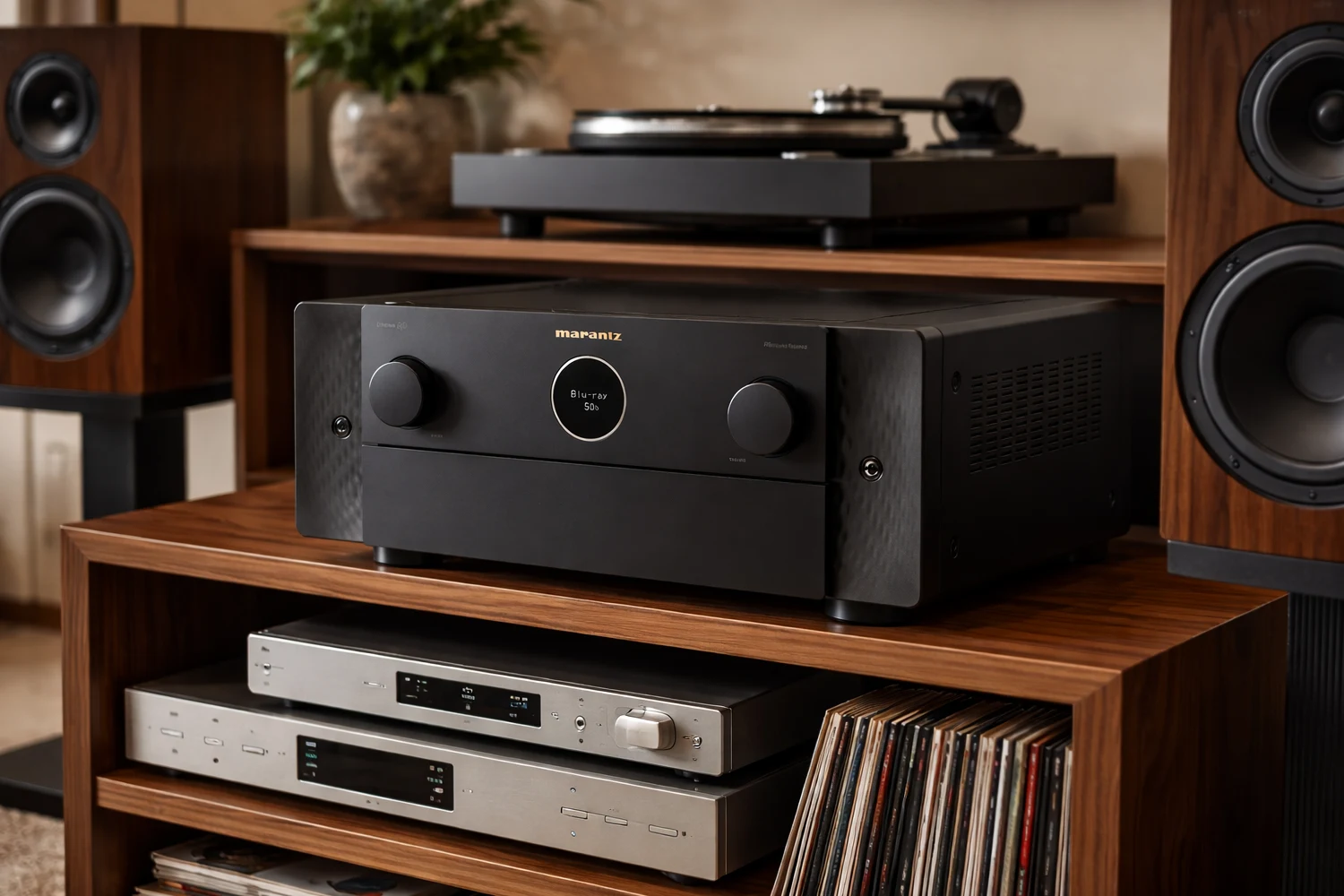
2. Marantz CINEMA 40: High-End 9.4-Channel AV Receiver with Real Hi-Fi Power
The Marantz CINEMA 40 is positioned as a high-end AV receiver with a premium front panel, 9.4-channel capability, and a music-first presentation.
The Marantz CINEMA 40 is presented as a premium AV receiver for systems where build, appearance, music playback, and movie impact all matter.
It is a 9.4-channel receiver rated in the source at 125 watts per channel and described with a brushed-aluminum front panel, the familiar round Marantz display, hidden buttons, and soft side lighting.
The article places particular emphasis on its musical character, noting warm, present vocals and convincing instrumental body alongside its ability to handle cinema effects.
Best for: Premium surround systems with hi-fi priorities
- 9.4-channel AV receiver architecture
- Rated at 125 watts per channel in the source
- Brushed-aluminum front panel and distinctive Marantz display
- Described as strong for both music and cinema
Verdict: The CINEMA 40 is the most appropriate shortlist choice here for buyers who want a serious surround receiver that still treats music reproduction as a central priority.

3. Grimani CinemaFive Ensemble: A compact but very powerful home cinema system
The Grimani CinemaFive Ensemble uses active Rixos S satellites and Epsilon subwoofers for a discreet 5.4 home-cinema installation.
The Grimani CinemaFive Ensemble is not a conventional receiver-and-speaker bundle.
It is an active 5.4 surround system made up of five active two-way Rixos S satellite speakers and four active Epsilon subwoofers, with the source listing a total power output of 2,160 watts.
Its slim enclosures are intended for discreet installation in walls or niches, and the manufacturer states suitability for home cinemas from 14 to 28 square meters. Integrated DSP, room equalization, IP-based calibration, diagnostics, and monitoring make it a highly installation-oriented solution.
Best for: Dedicated compact cinema rooms
- Active 5.4 system with five satellites and four subwoofers
- Slim enclosures for discreet wall or niche installation
- Integrated DSP and room equalization
- Manufacturer-stated suitability for 14 to 28 square meter rooms
Verdict: The CinemaFive Ensemble is for purpose-built rooms where hidden installation, active speaker control, and compact surround coverage are more important than component-by-component flexibility.

4. Viewsonic unveils V57-4K Laser Home Cinema Projector
The Viewsonic V57-4K laser projector combines 4K UHD projection, RGB laser technology, wide color coverage, and installation adjustments.
The Viewsonic V57-4K is a home-entertainment projector built around RGB laser technology, 4K UHD resolution, and HDR/HLG support.
The source highlights full BT. color-gamut coverage, 5,200 lumens of brightness, and a lamp-free, mercury-free laser light source with a stated 30,000-hour lifespan.
Installation flexibility is another focus, with 1.6x optical zoom, vertical lens shift, side projection options, keystone correction, and four-corner adjustment. For gaming-oriented rooms, the article also notes a Created for Xbox designation and compatibility with 1440p at 120 Hz.
Best for: Large-screen rooms and gaming-friendly setups
- RGB laser light source with full BT. coverage
- 4K UHD with HDR/HLG support
- 5,200 lumens brightness stated in the source
- 1.6x optical zoom and vertical lens shift
Verdict: The V57-4K is the display pick for home-cinema builders who want a bright laser projector with wide color support and flexible setup tools.

5. Choosing the perfect sub for your home theater experience
The subwoofer guide compares bass modules such as the Klipsch Flexus Sub 100 and Polk Audio Monitor XT10 for home-theater use.
This Stereoindex subwoofer guide is useful because bass needs vary widely by room, system, and budget.
The source article compares multiple bass modules and gives examples ranging from compact affordable designs to more ambitious models.
Among the highlighted details are the Klipsch Flexus Sub 100 with wireless activation and pairable operation, the Polk Audio Monitor XT10 with a 10-inch Dynamic Balance driver and low-frequency extension down to 24 Hz, and the REL HT1205 MK II as one of the listed step-up choices. For readers building or upgrading a cinema system, the value is in treating the subwoofer as a system-matching decision rather than an afterthought.
Best for: Subwoofer shortlisting and bass upgrades
- Covers several subwoofer options across different budgets
- Includes wireless-placement flexibility with Klipsch Flexus Sub 100
- Highlights Polk Monitor XT10 low-frequency extension to 24 Hz
- Focuses specifically on bass for music and home theater
Verdict: Use this guide when the main weakness in your home cinema is bass weight, placement flexibility, or choosing an appropriate subwoofer class.

6. Pioneer VSX-934: Next-Gen AV Receiver with Advanced Network Features and Virtual Height Sound
The Pioneer VSX-934 AV receiver is presented with broad streaming, multi-room, ecosystem, and HDMI connectivity.
The Pioneer VSX-934 is positioned around AV receiver functionality with extensive network and ecosystem support.
The source article points to compatibility with streaming services such as Tidal, Spotify, and Deezer, UPnP/DLNA, Bluetooth, AirPlay, FlareConnect multi-room integration, DTS Play-Fi, Sonos support, and AirPlay 2.
It also notes six HDMI inputs, making it a practical hub for multiple sources. For buyers who expect an AV receiver to handle both home-cinema switching and modern music access, the VSX-934’s strongest distinction is its network feature set.
Best for: Network-focused AV systems
- Supports services including Tidal, Spotify, and Deezer
- UPnP/DLNA, Bluetooth, and AirPlay support
- Sonos and AirPlay 2 ecosystem support noted
- Six HDMI inputs
Verdict: The VSX-934 suits buyers who want an AV receiver that is as much a connected music hub as it is a cinema control center.

7. Denon DBT-3313UD: Blu-ray and network player combined
The Denon DBT-3313UD combines universal disc playback, network media access, USB input, and dual HDMI outputs.
The Denon DBT-3313UD is a universal disc player for systems that still rely on physical media while also needing network playback.
It supports Blu-ray, DVD, DVD-Audio, SACD, and CD, and can also read popular audio and video files from a PC or NAS, including FLAC at 24-bit/192 kHz as stated in the source.
The player meets BD Profile 2.0 requirements, supports 3D video, includes a front USB connector, and offers two HDMI outputs for separate image and sound output or for feeding two displays. Denon Link HD is also described as a way to reduce jitter when paired with compatible Denon receivers.
Best for: Disc-based systems with network playback
- Plays Blu-ray, DVD, DVD-Audio, SACD, and CD
- Works as a network media player
- Two HDMI outputs for flexible AV connection
- Front USB input for portable storage
Verdict: The DBT-3313UD remains a relevant type of source component for listeners and viewers who want one player to handle discs, files, and AV integration.

8. Arcam AVR20: AV receiver equipped with a powerful toroidal transformer
The Arcam AVR20 combines surround decoding, Dirac calibration, streaming options, and a toroidal-transformer-based amplifier section.
The Arcam AVR20 is a 7.1-channel AV receiver aimed at serious cinema and stereo listening.
The source states support for Dolby Atmos in a 5.1.2-channel configuration, with expansion to 7.1.4 possible by adding external power amplification.
It also supports major codecs including DTS-HD Master Audio, Dolby TrueHD, DTS:X, and IMAX Enhanced. Full 16-channel Dirac calibration, Apple AirPlay 2, Google Chromecast, a powerful toroidal transformer, and a stated 7 x 90 W at 8 ohms make it a particularly interesting option for buyers who value calibration and amplifier engineering.
Best for: Calibration-minded surround systems
- Dolby Atmos support in 5.1.2 configuration
- Expandable to 7.1.4 with external amplification
- Full 16-channel Dirac calibration
- Apple AirPlay 2 and Google Chromecast streaming
Verdict: The AVR20 is a strong fit when room correction, codec support, and traditional amplifier design are higher priorities than keeping the system minimal.

9. Yamaha NS-P41 5.1: Home Theater Sound with Advanced YST II Subwoofer
The Yamaha NS-P41 package includes compact surround speakers and an Advanced YST II subwoofer for a traditional 5.1 setup.
The Yamaha NS-P41 is a traditional 5.1-channel speaker package intended to deliver surround sound from a compact speaker set and powered subwoofer.
The source highlights Advanced YST II technology in the subwoofer, a Linear Port bass-reflex design to reduce external noise, and speakers tuned for crisp, clear sound over long listening sessions.
Its glossy black enclosures are intended to suit modern flat-screen TVs, and rear mounting holes allow the speakers to be wall-mounted. This is the most straightforward speaker-system option in the selection.
Best for: Simple 5.1 speaker setups
- Traditional 5.1-channel speaker package
- Advanced YST II subwoofer technology
- Linear Port bass-reflex design
- Wall-mounting holes on the speakers
Verdict: The NS-P41 is the practical pick for buyers who want a compact, conventional 5.1 speaker package rather than separate speaker shopping.

10. Zidoo UHD8000: New player with 8K picture, Amlogic S928X-K processor and two disk slots
The Zidoo UHD8000 media player features dual drive bays, network connectivity, analogue outputs, and separate HDMI options for audio and video.
The Zidoo UHD8000 is a high-spec media player for systems built around stored video, high-resolution audio, and broad playback connectivity.
The source describes two hard-drive slots with storage expandable to 32 TB, Wi-Fi 6, Bluetooth 5.2, DLNA, and access to services including Tidal, Qobuz, Amazon Music, Deezer, and KKbox.
It also includes a USB DAC input, RCA and XLR analogue outputs, HDMI Audio Only output, and separate HDMI handling for audio and video. Video support is listed up to 8K60p over HDMI 2.1, while audio support is stated up to DSD512 and PCM 32-bit/768 kHz.
Best for: Stored-media and high-resolution playback systems
- Two hard-drive slots with storage expandable to 32 TB
- Wi-Fi 6 and Bluetooth 5.2 support
- RCA and XLR analogue outputs
- Separate HDMI handling for audio and video
Verdict: The UHD8000 is the source-component choice for users who keep large media libraries and want extensive audio and video connectivity in one player.
Quick comparison
These products serve different roles, so the most useful comparison is not which is universally superior, but which solves the right problem in a home-cinema system.
Use the table to separate amplification, speakers, projection, source playback, and bass-upgrade decisions.
| Product | Best for | Verdict |
|---|---|---|
| Onkyo TX-8470 | Stereo-focused TV rooms | A two-channel receiver with unusually broad HDMI, network, analogue, digital, and phono connectivity for buyers who do not need surround sound. |
| Marantz CINEMA 40 | Premium surround systems with hi-fi priorities | A 9.4-channel AV receiver option where premium build, cinema scale, and music reproduction are central concerns. |
| Grimani CinemaFive Ensemble | Dedicated compact cinema rooms | An active 5.4 system designed for discreet installation and manufacturer-stated room sizes from 14 to 28 square meters. |
| Viewsonic V57-4K | Large-screen rooms and gaming-friendly setups | A 4K RGB laser projector with high stated brightness, wide color-gamut support, and flexible installation adjustments. |
| Choosing the perfect sub for your home theater experience | Subwoofer shortlisting and bass upgrades | A practical bass-focused guide that helps narrow subwoofer options by placement flexibility, extension, and budget level. |
| Pioneer VSX-934 | Network-focused AV systems | An AV receiver choice for users who value streaming services, multi-room protocols, ecosystem compatibility, and multiple HDMI inputs. |
| Denon DBT-3313UD | Disc-based systems with network playback | A universal player for Blu-ray, DVD, SACD, CD, network files, USB media, and flexible HDMI output arrangements. |
| Arcam AVR20 | Calibration-minded surround systems | A 7.1-channel AV receiver with Atmos support, Dirac calibration, major codec support, and streaming options. |
| Yamaha NS-P41 5.1 | Simple 5.1 speaker setups | A compact 5.1 speaker package with an Advanced YST II subwoofer and wall-mountable speakers. |
| Zidoo UHD8000 | Stored-media and high-resolution playback systems | A media player with dual drive bays, extensive digital and analogue connectivity, and high-resolution audio/video support. |
Frequently asked questions
Should I choose a stereo receiver or a surround AV receiver for home cinema?
Choose a stereo receiver such as the Onkyo TX-8470 if you want TV sound, music playback, HDMI convenience, and a simpler two-speaker system.
Choose a surround AV receiver such as the Marantz CINEMA 40, Pioneer VSX-934, or Arcam AVR20 if you want multi-channel speaker layouts, cinema decoding, and a more immersive room setup.
What matters most when matching speakers and electronics?
Start with the speaker layout you actually want to install.
A Yamaha NS-P41 package is a straightforward 5.1 route, while the Grimani CinemaFive Ensemble is an active 5.4 installation system.
Receiver choices should then follow the channel count, connectivity, calibration needs, and sources you plan to use.
When is a dedicated subwoofer upgrade worthwhile?
A subwoofer upgrade is worth considering when explosions, music bass lines, and low-frequency effects lack weight or control.
The supplied subwoofer guide shows that priorities can include wireless placement, deep extension, compact size, and budget, so the right model depends on room and system needs rather than bass output alone.
Do I still need a disc or media player in a streaming-focused system?
You may not need one if all viewing is handled by built-in apps or external streaming boxes.
A player such as the Denon DBT-3313UD makes sense for disc collections and network files, while the Zidoo UHD8000 is more appropriate for large stored-media libraries and systems that need extensive audio and video outputs.
How to Choose the Right Home Cinema Component
Begin with the role you need to fill.
If the display is the weak point, the Viewsonic V57-4K belongs on the shortlist for a bright 4K laser-projection setup with wide color support and flexible adjustment tools.
If the system lacks amplification and switching, decide first between stereo simplicity and surround immersion: the Onkyo TX-8470 keeps the system two-channel but highly connected, while the Marantz CINEMA 40, Pioneer VSX-934, and Arcam AVR20 address different kinds of AV-receiver buyer. For speakers, the Yamaha NS-P41 is the straightforward compact 5.1 route, while the Grimani CinemaFive Ensemble is a more installation-led active 5.4 system for a dedicated room of the manufacturer-stated size range. These are not interchangeable products: one is a conventional speaker package, the other is a designed system with active speakers, multiple subwoofers, DSP, and room-focused setup tools. Source components should be chosen around your media habits. The Denon DBT-3313UD is appropriate for disc users who also want network media playback and dual HDMI flexibility. The Zidoo UHD8000 is better aligned with stored media libraries, large internal storage expansion, and extensive audio-output options. If low-frequency performance is the missing piece, use the subwoofer guide as a starting point and pay close attention to placement, driver size, extension, and whether wireless operation matters in your room. The safest buying approach is to avoid solving the wrong problem. A premium AV receiver will not replace a subwoofer, a laser projector will not fix poor speaker placement, and a powerful media player is unnecessary if the system only needs HDMI switching. Identify the bottleneck first, then choose the component in this list that directly addresses it.



Join the discussion
Share your thoughts, listening impressions or product experience.