Wilson Benesch GMT One: A Statement Turntable Built Around Precision Control
The Wilson Benesch GMT One is less a conventional record player than a complete precision platform, combining a large magnetic motor, microprocessor control, advanced tonearms, and remote adjustment systems.
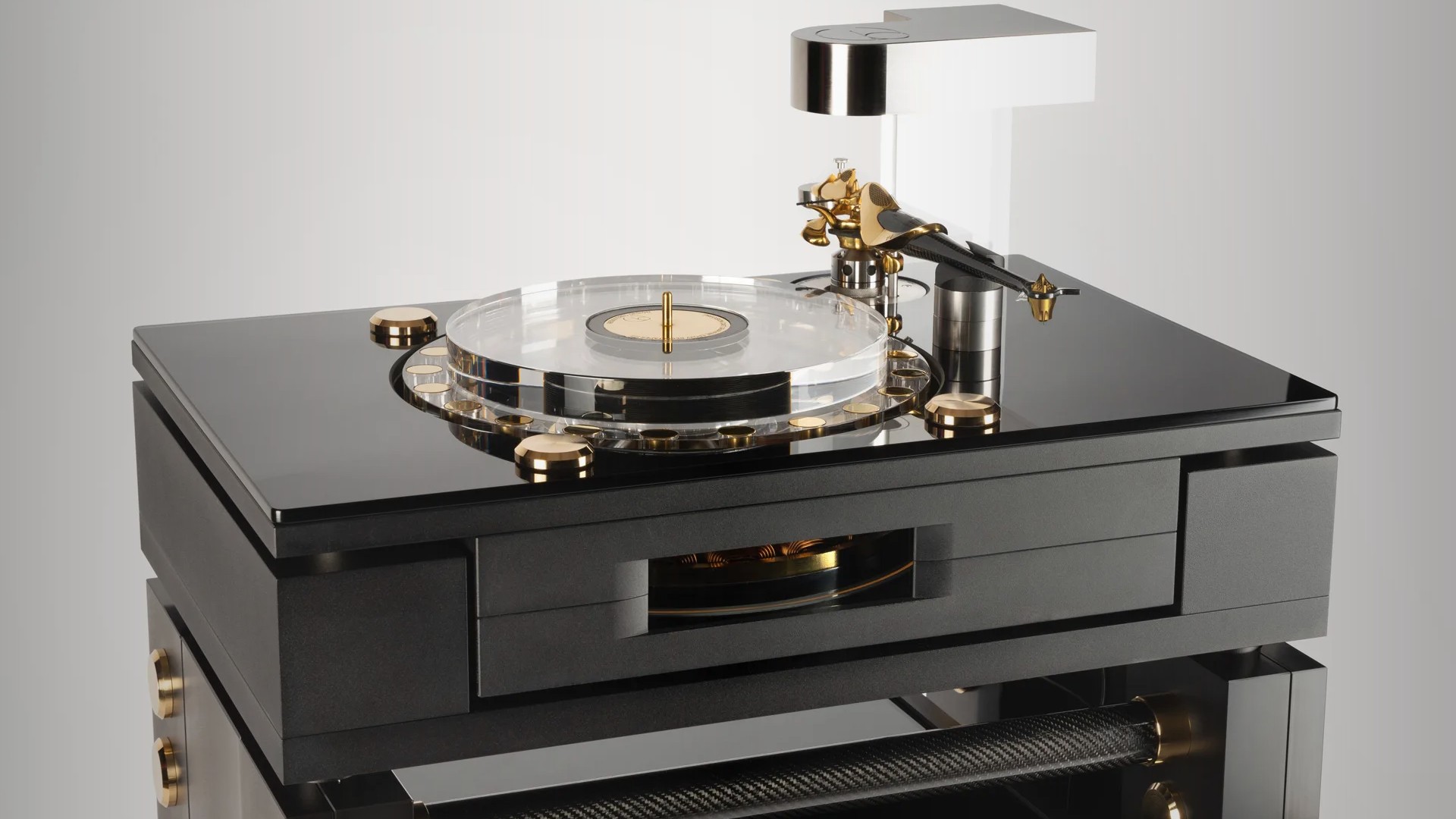
The Wilson Benesch GMT One occupies an unusual place in the analogue world. Introduced as a 30th-anniversary project and now in serial production, it is a turntable conceived not simply as a plinth, platter, and arm combination, but as a deeply engineered system built around speed control, structural design, and remote adjustment. Its scale alone makes it exceptional: the complete system is specified at 370 kg, with a stated ownership price of $370,000. Yet the more interesting story is not only its size or cost, but the way Wilson Benesch has approached some of vinyl playback’s most demanding mechanical problems. The GMT One brings together patented and patent-pending developments, a proprietary magnetic drive, dedicated electronic control, new tonearm options, and app-based operation. For prospective owners considering a turntable at this level, its appeal lies in its integration: the drive system, arm architecture, VTA adjustment, and control interface are designed as parts of a single platform rather than as isolated accessories.
A turntable conceived as a complete engineering platform
The GMT One was first presented as a special model marking Wilson Benesch’s 30th anniversary. Its path to production has been unusually long, but that delay also reflects the scale of the project. The company describes the system as incorporating more than 30 innovations protected by international patents or in the process of registration. Wilson Benesch also retains the intellectual property associated with the project, including the GMT and GRAVITON trademarks.
The name GMT refers to Greenwich Mean Time, a long-standing global reference for timekeeping. In the context of a turntable, the name is clearly intended to draw attention to speed accuracy and rotational stability. Vinyl replay depends on controlled motion: the record must rotate at the intended speed, with as little disturbance as possible from the drive system. The GMT One’s design places that challenge at the center of the product rather than treating it as a background specification.
Omega Drive and the move away from conventional drive layouts
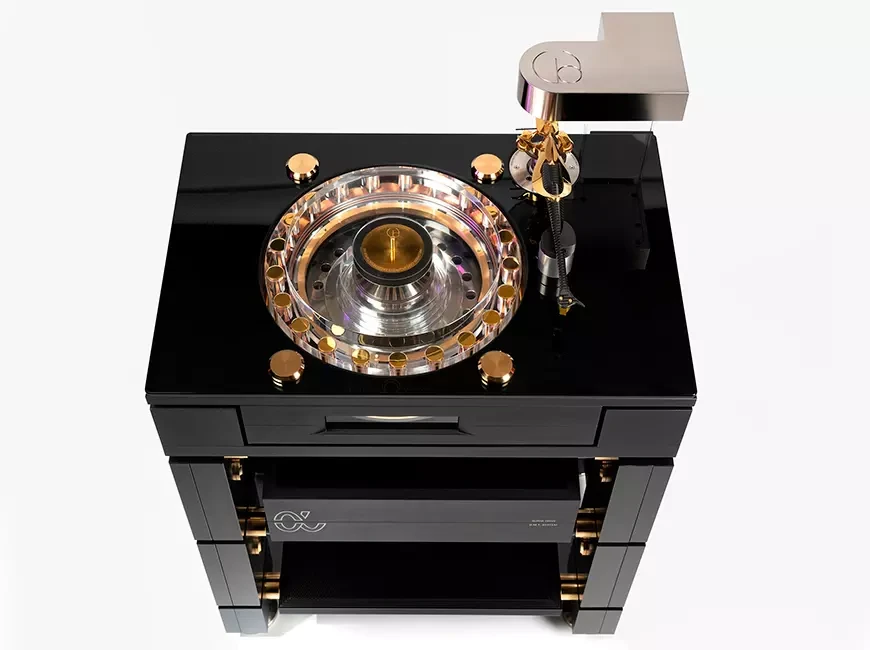
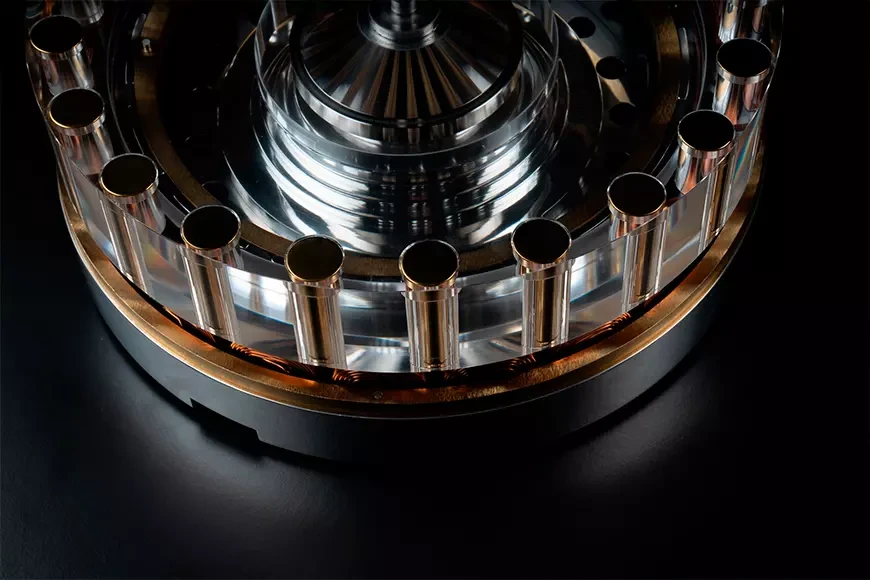
One of the GMT One’s most distinctive elements is its Omega Drive. Instead of using a conventional belt, roller, or direct-drive arrangement, Wilson Benesch has developed a magnetic drive system built around a synchronous motor. The design is intended to reduce torque ripple and maintain consistent speed stability, with the RMS torque ripple specified at 0.001342 Nm.
The scale of the motor is notable. The Omega Drive is specified at 15 inches in diameter and 14 kg in weight. Wilson Benesch contrasts this with the 3.07-inch size of a commonly used direct-drive motor format, emphasizing the much larger physical architecture adopted here. For a prospective owner, the significance is not simply that the motor is large, but that the design gives the manufacturer greater scope to manage magnetic geometry, rotor dimensions, moving mass, bearing design, and current delivery as part of a dedicated system.
During development, Wilson Benesch used finite element modeling to define rotor dimensions and the arrangement of NDFeB magnets. That matters because a motor in a turntable is not judged only by whether it spins; it must do so in a way that avoids introducing unwanted mechanical behavior into the playback chain. Coil arrangement, magnet positioning, magnetic flux, and bearing design all influence how smoothly energy is transferred into platter rotation. The GMT One’s drive system is therefore aimed at a very specific analogue objective: controlling motion at the source.
Alpha Drive electronic control and quartz-referenced operation
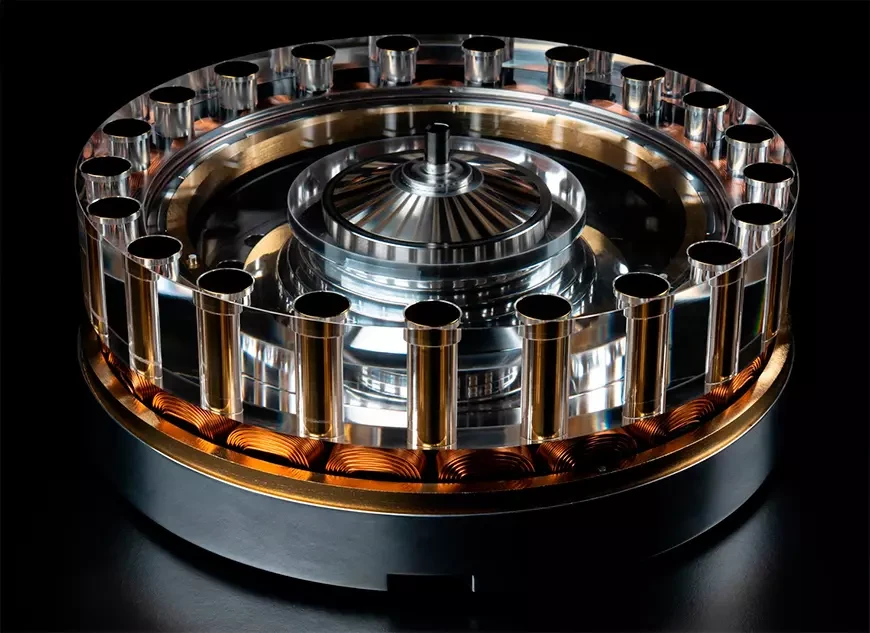
The Omega Drive motor is partnered with Alpha Drive electronics. This control system is designed to deliver low torque and reduce torque pulsation, a known issue in motor-drive applications. The presence of a microprocessor is important because the Omega Drive has a substantial air gap between stator and rotor, requiring a dedicated start-up algorithm rather than a generic motor-control approach.
Once the motor reaches the correct operating speed, the Alpha Drive maintains rotation by delivering three pure sine waves through three Class A linear amplifiers to the 21 magnetic poles of the Omega Drive. The sine-wave precision is referenced by an integrated 11.2896 MHz quartz crystal. In practical ownership terms, this means the turntable’s rotational behavior is managed by a purpose-built electronic system rather than relying solely on passive mechanical inertia or basic motor regulation.
This integration between motor and controller is one of the GMT One’s more compelling design choices. It suggests a product developed as an interdependent set of mechanical and electronic systems: the motor geometry, start-up behavior, speed regulation, and user adjustment all operate within one defined architecture. For users who value repeatability and fine adjustment, that level of control is central to the appeal.
Three tonearm options led by the GRAVITON Ti
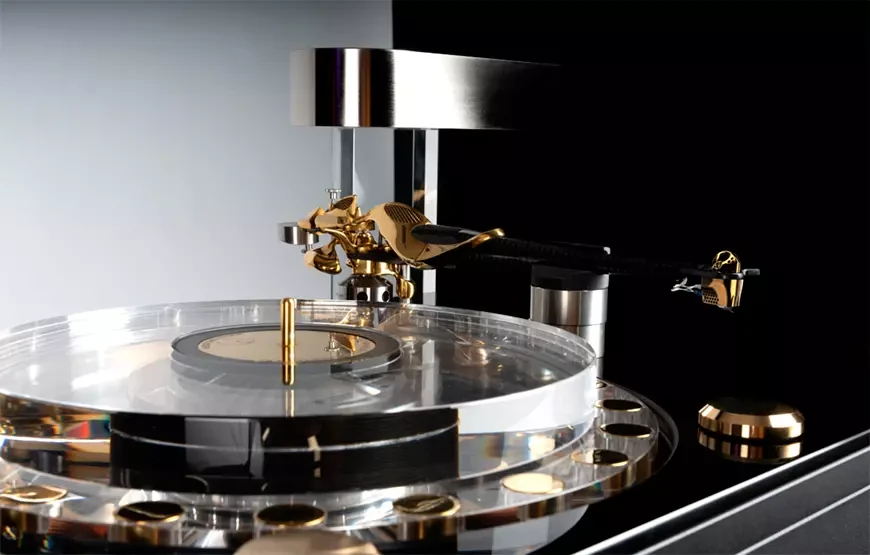
Wilson Benesch has also developed three tonearms for the GMT One. The flagship is the GRAVITON Ti, joined by the lightweight Moment and the mid-range CTi-30. The availability of multiple arms gives the system a degree of flexibility, allowing different configurations within the manufacturer’s own design ecosystem.
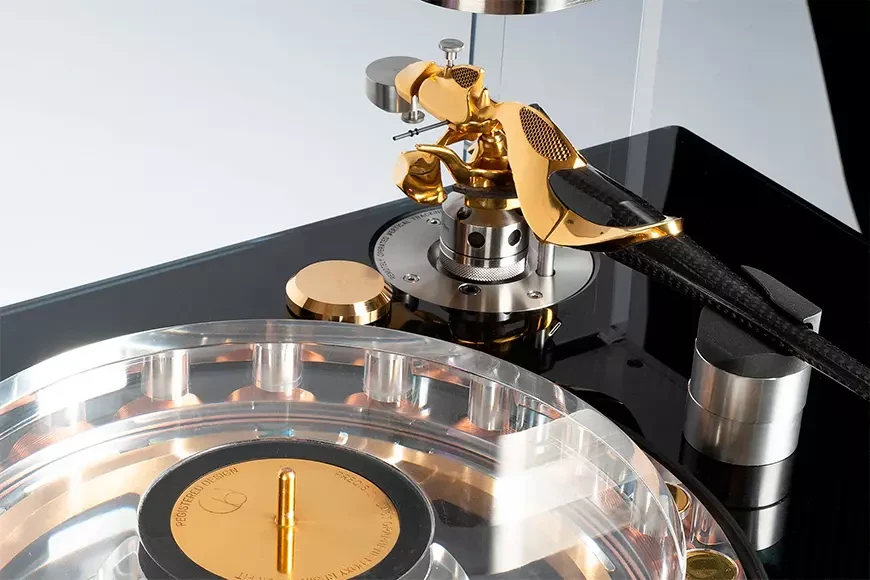
The GRAVITON Ti is built around a single-piece molded conical carbon-fiber tube strengthened with a graphene epoxy matrix. Its tube geometry is derived from earlier Wilson Benesch tonearms but updated with unidirectional carbon fiber and a Rohacell sandwich structure. These material choices are relevant because a tonearm has to combine low mass, stiffness, and controlled behavior while holding the cartridge in a stable relationship to the groove. The documented construction indicates that Wilson Benesch is treating the arm as a structural component of the overall system rather than as an interchangeable afterthought.
For an owner, the benefit of this approach is coherence. A turntable at this level is often assembled from separate specialist parts, but the GMT One’s arm options are designed specifically within the same project. That does not remove the need for careful cartridge matching and setup, but it does mean the system has been developed around a shared mechanical philosophy.
Remote Piezo VTA adjustment for unusually fine setup control
One of the GMT One’s most technically interesting features is its Piezo VTA system. VTA, or Vertical Tracking Angle, affects the relationship between stylus, cartridge, tonearm, and record surface. Traditionally, adjusting VTA involves mechanical screw threads or manual arm-height changes. The GMT One instead uses a system based on the patented Eco-Grip cartridge and a linear piezo actuator.
The documented adjustment accuracy is striking: remote VTA changes can be made with accuracy up to 2.5 microns, while the piezo actuator itself allows movement with precision down to 1 nanometer. The comparison often used to illustrate this scale is the diameter of a human hair, typically around 80,000 to 100,000 nanometers. Without making claims about audible outcomes, the engineering implication is clear: the GMT One gives the user an exceptionally fine tool for repeatable cartridge-height adjustment.
This feature may matter most to users who own many records of varying thicknesses, who use advanced cartridges, or who simply want precise and repeatable setup control without physically handling the arm assembly each time. It also reflects a wider theme of the GMT One: replacing traditional manual adjustments with controlled, instrument-like mechanisms.

WB GMT Control app and networked operation
The GMT One is supplied with a dedicated mobile application called WB GMT Control. The system also includes a pre-configured network router intended to connect the smart device running the app with the turntable system. This is a notable choice for a high-end analogue product, because it brings software-based control into an area often associated with purely mechanical operation.
Through the app, users can start and stop the Omega Drive, adjust drive speed for different recording formats, and make speed changes in 0.01 rpm increments. The app also allows control of the GRAVITON Ti armwand height and fine adjustment of the Piezo VTA system in increments as small as 1 nanometer. The practical advantage is not convenience alone, although remote operation is clearly useful. More importantly, the app creates a single control point for functions that would otherwise require separate tools, manual access, or more approximate mechanical adjustments.
This level of control will appeal to owners who enjoy careful setup and repeatable parameter changes. It may be less relevant to listeners who prefer a simpler, more traditional interaction with a turntable. The GMT One’s interface is therefore part of its identity: it is analogue playback managed through a modern control layer.
Who the Wilson Benesch GMT One is most suitable for
The GMT One is most suitable for a very specific type of analogue enthusiast: someone building a no-compromise vinyl front end around precision engineering, system integration, and advanced adjustability. Its 370 kg weight and $370,000 price place it far outside conventional ownership, and it is likely to make sense only in a dedicated high-end system with appropriate space, support, partnering electronics, and setup expertise.
It is also best suited to users who value configurability. The magnetic drive, quartz-referenced control, app operation, multiple tonearm options, and remote VTA adjustment point toward an owner who wants to engage deeply with setup parameters. This is not a minimalist plug-and-play deck, nor is it aimed at casual vinyl playback. Its strengths are most relevant to collectors and system builders who see the turntable as a precision instrument and who appreciate the ability to adjust and monitor key functions with unusual granularity.
At the same time, its complexity and scale mean it will not be the right choice for every high-end listener. Some may prefer simpler mechanical solutions, lower mass designs, or more traditional manual interaction. The GMT One’s attraction depends on whether the owner values Wilson Benesch’s integrated approach to motor control, tonearm design, and remote adjustment.
Conclusion
The Wilson Benesch GMT One stands out because it treats vinyl playback as a complete precision-control problem. Its documented strengths include the large Omega Drive magnetic motor, Alpha Drive electronic regulation, quartz-referenced sine-wave control, purpose-developed tonearms, remote Piezo VTA adjustment, and the WB GMT Control app for fine system management. At 370 kg and $370,000, it is an uncompromising specialist product for owners with the space, system context, and interest to make use of its engineering depth. Its ideal audience is the serious analogue collector or high-end system builder who wants a highly integrated turntable platform focused on speed control, structural design, and repeatable adjustment rather than a conventional record player experience.