Fuse Audio GLD: A Vertical Turntable Built Around Display, Simplicity and System Convenience
The Fuse Audio GLD is a vertical record player with an ash-veneer, mid-century look, built-in amplification, Bluetooth connectivity and matching bookshelf speakers. Its appeal lies in combining vinyl playback, display-friendly design and a ready-to-use system format.

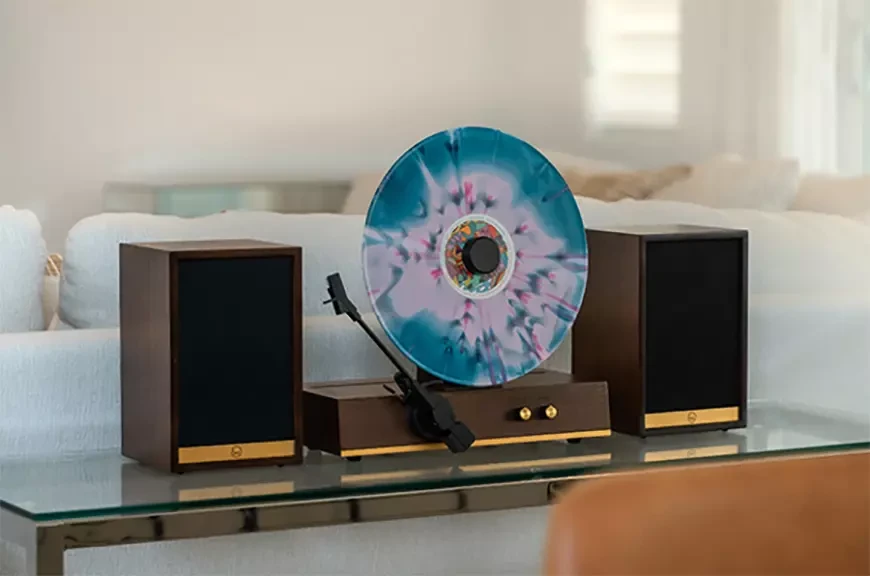
The Fuse Audio GLD approaches vinyl playback from a different angle, quite literally. Instead of hiding a record on a horizontal platter, it presents the disc vertically, turning playback into a visual part of the room. Introduced by American company Fuse Audio, the GLD is not just a turntable; it is a compact record-playing system that combines a vertical deck, built-in stereo amplification, Bluetooth connectivity and a pair of bookshelf speakers. That makes it particularly interesting for listeners who want vinyl to be both usable and visible, without assembling a full stack of separate hi-fi components.
A vertical format with a clear design purpose
The defining feature of the Fuse Audio GLD is its vertical record orientation. This is not simply a novelty in appearance; it changes how the product lives in a room. A conventional turntable usually needs a flat, stable surface with enough depth for the plinth and dust cover. A vertical player has a more display-oriented character, placing the record face-forward where album artwork and the spinning disc become part of the experience.
For prospective owners, that can matter as much as the audio function. Vinyl is a tactile format, and many listeners value the ritual of choosing a record, placing it on the player and watching it turn. The GLD leans into that ritual by making the record visible from across the room. For smaller apartments, offices, bedrooms or design-conscious living spaces, the vertical presentation may also feel less like conventional equipment and more like an object intended to be seen.
This format will naturally appeal most to people who want their audio system to have a strong visual identity. It is not positioned as a hidden component for a large rack; it is intended to be part of the room’s atmosphere. The combination of vertical playback and a vintage-influenced cabinet gives the GLD a distinctive place among modern lifestyle-oriented vinyl systems.
Vintage styling without abandoning modern convenience
Fuse Audio gives the GLD a mid-century-inspired aesthetic, finished in ash veneer and offered in black and gold versions. That choice is important because the product’s vertical layout already draws attention; the finish and proportions help determine whether it feels like a gadget or a piece of furniture. Ash veneer and restrained color options suggest a design meant to sit comfortably alongside wood, metal, bookshelves and domestic interiors rather than looking like purely technical equipment.
The GLD’s styling also fits the broader appeal of vinyl itself. Many buyers are drawn to records because they provide a slower, more physical alternative to purely digital listening. A vintage-influenced design reinforces that sense of occasion while still including features expected from a modern compact system. The result is a product that acknowledges the nostalgia surrounding records without being limited to a fully old-fashioned operating concept.
The availability of black and gold finishes gives some flexibility in system matching and interior placement. Black can suit more understated rooms or existing audio gear, while gold offers a warmer, more decorative look. In either case, the GLD is clearly designed to be left on display rather than treated as a utilitarian source component.
An all-in-one vinyl system rather than just a deck
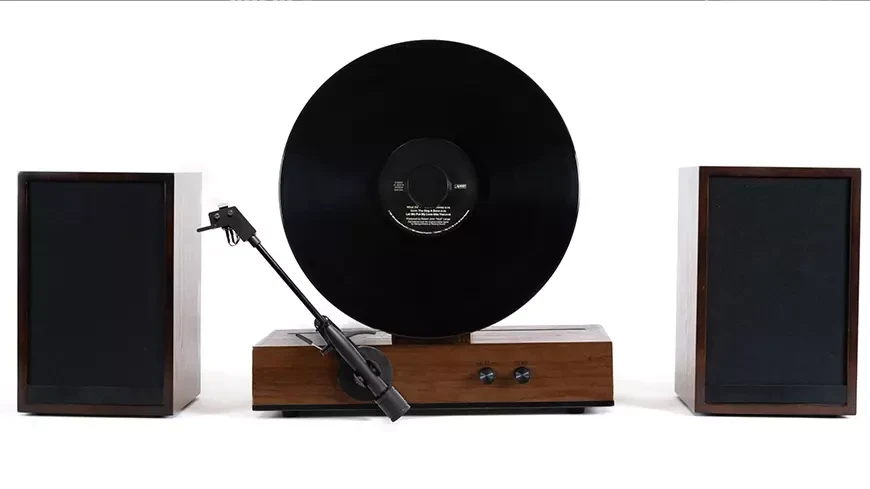
One of the GLD’s most useful documented strengths is that it is not merely a turntable requiring immediate partnering with an amplifier and speakers. It includes a 36-watt amplifier for each channel and is supplied with two bookshelf speakers. Each speaker uses a one-inch tweeter and a four-inch midrange/low-frequency driver, giving the system a defined two-speaker stereo layout rather than relying on a single built-in speaker enclosure.
That integrated approach lowers the number of decisions a new owner has to make. Traditional turntable setup can involve choosing a phono stage, amplifier, speakers, cables and furniture, and then ensuring everything works together. The GLD is positioned for someone who wants a more direct route: put the system in place, connect the supplied speakers and power supply, and use it as a self-contained record player.
The inclusion of separate bookshelf speakers is also notable from a usability standpoint. Speakers can be placed to the left and right of the player, allowing a more conventional stereo arrangement than a single-box record player can offer. While room placement and setup will still matter, the supplied speaker format gives owners more flexibility in where the sound originates within the listening space.
Bluetooth adds flexibility beyond records
The GLD supports Bluetooth wireless connectivity, which broadens its usefulness beyond vinyl playback. For many households, a record player is not the only music source. Phones, tablets and computers are often used for casual listening, podcasts, playlists or background music. Bluetooth means the GLD system can serve as a general audio hub as well as a vertical turntable.
This matters because an all-in-one vinyl system competes for space. If a product can only play records, it may be used less often, especially in rooms where convenience is important. Bluetooth support allows the same amplifier and speakers to handle wireless audio when records are not being played. That can make the GLD more practical for everyday use and easier to justify as a compact room system.
The key appeal is flexibility. A prospective owner might use records for focused listening sessions and Bluetooth for quick playback from a mobile device. The GLD’s feature set recognizes that many modern vinyl buyers move between physical and wireless sources, rather than choosing one format exclusively.
Support for 33, 45 and 78 rpm playback
The Fuse Audio GLD supports 33, 45 and 78 rpm playback speeds. That gives it compatibility with the main record-speed categories buyers are likely to encounter: standard LPs, many singles and older 78 rpm discs. For a compact lifestyle-oriented product, including all three speeds is a useful practical detail.
For most users, 33 and 45 rpm will cover the majority of modern collections. The addition of 78 rpm may be relevant for listeners who own older shellac-era records or who want the option to explore them. As always with 78 rpm records, cartridge and stylus suitability should be considered, but the speed support itself adds flexibility to the GLD’s basic playback platform.
Speed selection is one of those features that can seem minor until a listener needs it. A player limited to one or two speeds can become restrictive as a collection grows. By supporting three speeds, the GLD is better prepared for mixed libraries and for owners who do not want their record choices narrowed by the turntable’s basic operating range.
Tonearm and cartridge details that show ongoing refinement
Fuse Audio reports that the GLD’s tonearm has been enhanced from the original design developed for the project. According to the company, more than six months of design and testing led to a new tonearm intended to provide improved tracking-force balance. The design also includes a slightly adjusted headshell angle for the included Audio-Technica AT3600L cartridge.
Those details are important because vertical playback places particular emphasis on the relationship between the tonearm, cartridge and record surface. Tracking force balance and headshell geometry are central to stable playback in any turntable design, and they become especially visible considerations in a format that departs from the familiar horizontal layout. Fuse Audio’s documented adjustments suggest attention to the mechanical aspects behind the GLD’s unusual presentation.
The included Audio-Technica AT3600L cartridge is another practical point. It means the system is supplied with a known cartridge model rather than leaving the buyer to source one separately before first use. For the GLD’s intended audience, that supports the broader all-in-one approach: fewer setup decisions, a clearer out-of-box path and a more accessible entry into record playback.
Power, placement and system matching considerations
The GLD comes with an external 15V power supply. Using an external supply is common in compact audio products and helps keep the main unit’s physical design cleaner and easier to place. Because the system includes amplification and speakers, owners will still need to plan for speaker placement, cable routing and a stable location for the vertical turntable itself.
The supplied bookshelf speakers make the system relatively self-contained, but placement remains part of the experience. Separating the speakers can create a broader stereo presentation than positioning them immediately beside the player, while keeping them close may suit smaller spaces or desktops. The GLD’s appeal is that it gives users those basic placement choices without requiring a separate amplifier or speaker purchase at the outset.
At a recommended retail price of $349, the GLD sits in a part of the market where convenience, design and completeness are central to the value proposition. The combination of vertical playback, amplification, speakers, Bluetooth and a supplied cartridge is what defines the package. Buyers considering it should think less in terms of a single turntable component and more in terms of a compact, lifestyle-focused vinyl system.
Conclusion
The Fuse Audio GLD is most suitable for listeners who want vinyl playback to be approachable, visible and integrated into everyday living space. Its strongest documented qualities are its vertical record presentation, ash-veneer vintage styling, included stereo amplification, supplied bookshelf speakers, Bluetooth connectivity, three-speed playback and refined tonearm design with an Audio-Technica AT3600L cartridge. It is likely to make the most sense for new or casual vinyl owners, design-conscious listeners, small-space users and anyone seeking a self-contained record system rather than a traditional component-by-component hi-fi setup. Those who already own a separate amplifier, speakers and turntable may not need its integrated format, but for buyers prioritizing simplicity and visual character, the GLD offers a distinctive route into record playback.