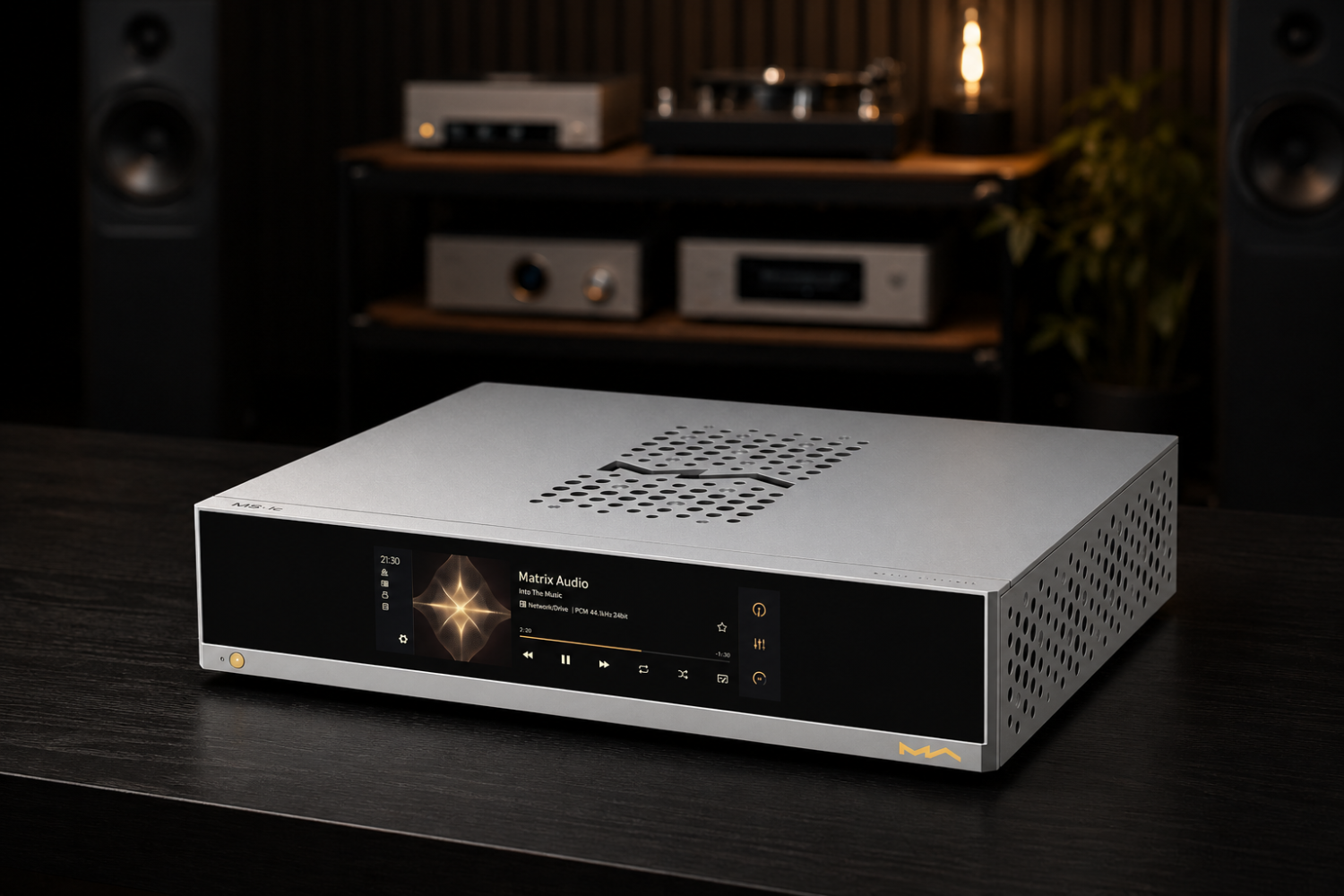

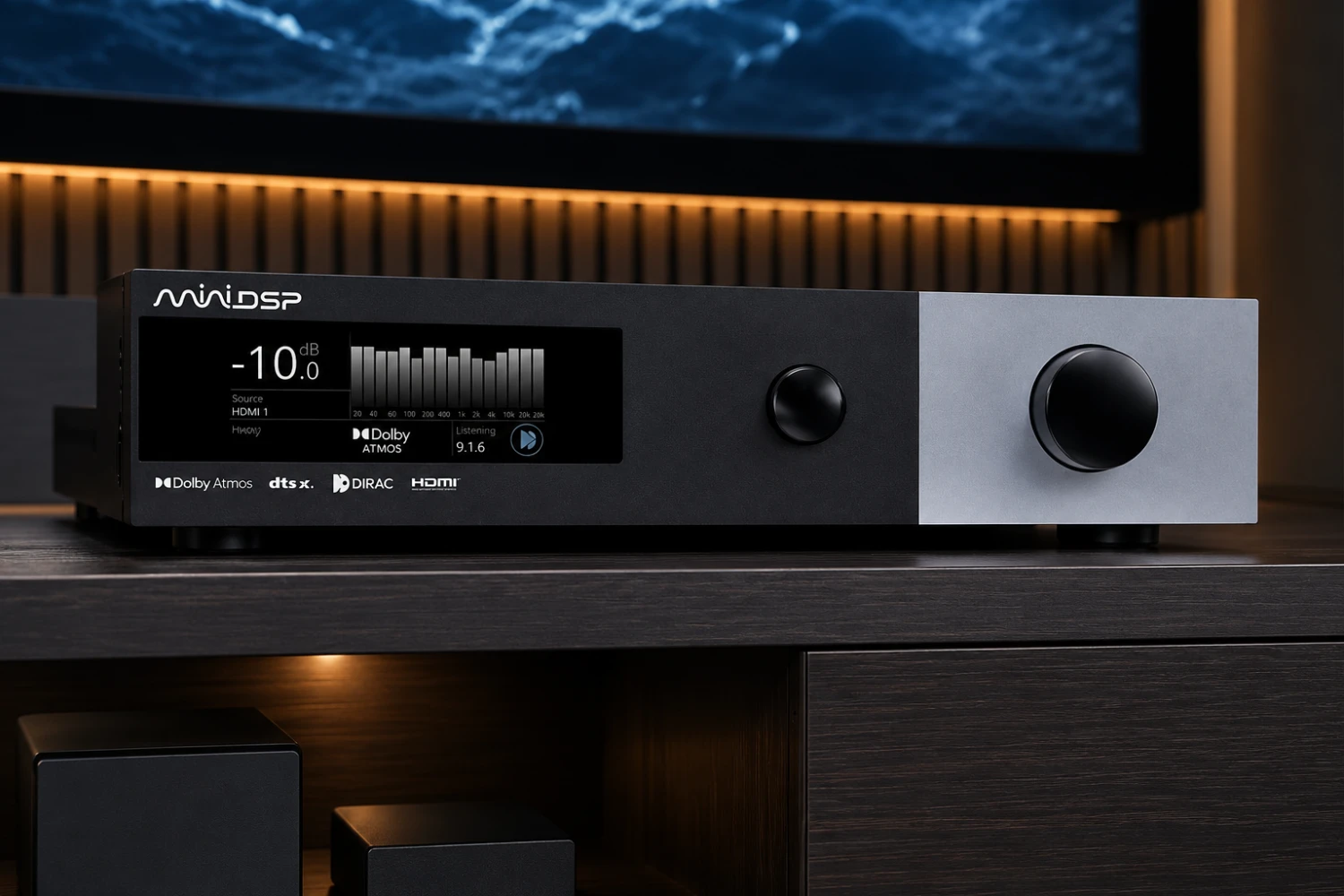
The miniDSP Tide16 and SMSL SH-X are being compared because both sit in the enthusiast hi-fi category and both are designed as specialist electronics rather than all-in-one consumer products. The comparison is not about which one performs the same job better: it is about whether your next system upgrade should be an advanced home-theater processor with Dirac room correction, or a powerful desktop headphone amplifier built around balanced and unbalanced headphone use.
| Category | miniDSP Tide16 | SMSL SH-X |
|---|---|---|
| Product type | Dedicated AV processor for immersive home theater | Desktop hi-fi headphone amplifier and preamp |
| Core purpose | 16-channel Dolby Atmos and DTS:X processing with Dirac correction | High-power headphone amplification for IEMs and over-ear headphones |
| Channels / output power | Up to 16 channels of processing; supports layouts up to 9.1.6 | 11.5W x2 at 16Ω; 5.5W x2 at 32Ω; 600mW x2 at 300Ω; 300mW x2 at 600Ω |
| Key technology | Dirac Live Room Correction, Dirac Live Bass Control, Dirac Live Active Room Treatment | 80 low-noise op-amps in parallel circuitry, three gain modes, HD IPS color display |
| Notable connectivity | 16 balanced XLR outputs, 3 HDMI inputs, HDMI eARC output, USB Audio, Bluetooth with LDAC and aptX HD, XLR/RCA analog inputs, 4 S/PDIF inputs | Balanced and unbalanced inputs, 4.4mm headphone output, balanced XLR headphone output, 6.35mm single-ended output, balanced and unbalanced pre-outs |
| Amplification included? | No built-in amplification; requires external power amps or active speakers | Yes, headphone amplifier; also includes preamp outputs |
| Published price | $3,500 recommended retail price | $699 |
| Original coverage | Read the miniDSP Tide16 article | Read the SMSL SH-X article |
Design and system role
The most important difference is structural. The miniDSP Tide16 is not an AV receiver and not a headphone amplifier. It is a dedicated AV processor aimed at serious home cinemas, custom installations, and users who want to choose their own external amplification or active loudspeakers. The source article explicitly notes that the Tide16 has no built-in amplification, which is central to its appeal and also central to its limitation. It belongs in a system with separate power amplifiers, active speakers, multiple subwoofers, or a combination of those.
The SMSL SH-X is much narrower in physical and system ambition. It is a desktop hi-fi headphone amplifier designed for use with the SMSL SU-X DAC, according to the source article, though the listed balanced and unbalanced inputs mean its role is not described as limited only to that DAC. It is intended for a desktop headphone system where space matters, and its compact dimensions of 9.84 inches wide, 2.01 inches high, and 7.56 inches deep support that use case. At 2.42kg, it is not a featherweight portable device; it is a desk component.
Editorially, the Tide16 is the more ambitious system hub, while the SH-X is the more focused personal-audio component. That is an inference from their stated categories and connections, not a claim about sound quality.
Features and connectivity
The Tide16 is built around immersive audio processing and room correction. It supports Dolby Atmos and DTS:X, can decode up to 16 channels, and can handle speaker layouts up to 9.1.6 channels. Its connectivity list is extensive: sixteen balanced XLR outputs, three HDMI inputs, HDMI eARC output, USB Audio, Bluetooth streaming with LDAC and aptX HD support, balanced XLR and RCA analog inputs, and four digital S/PDIF inputs. For a processor, that makes it a flexible switching and processing center for complex theater systems.
The SMSL SH-X offers a very different connection set. It has balanced and unbalanced inputs, headphone outputs on 4.4mm, balanced XLR, and single-ended 6.35mm, plus balanced and unbalanced pre-outs. Those pre-outs matter because they allow the SH-X to function beyond headphone listening, although the source describes this in general terms as integration into an existing audio system. Its display is an HD IPS color screen, and the unit carries JAS Hi-Res certification.
If you need HDMI, multichannel decoding, subwoofer integration, and speaker-room management, the SH-X is not the relevant product. If you need high-power headphone outputs, gain flexibility, and a desktop-friendly analog component, the Tide16 is not the relevant product either.
Room correction versus headphone amplification
The Tide16’s defining feature is the inclusion of the full Dirac ecosystem without additional licensing costs, as reported in the source: Dirac Live Room Correction, Dirac Live Bass Control, and Dirac Live Active Room Treatment. The most significant of these is Dirac Live ART. Unlike traditional room-correction systems that largely treat speakers independently, ART uses MIMO processing so compatible speakers and subwoofers can work together as an active acoustic network. The goal described in the source is to control bass energy, reduce resonances and standing waves, and improve bass consistency across multiple seating positions.
That makes the Tide16 especially relevant to rooms where low-frequency behavior is difficult: larger theaters, systems with several subwoofers, and installations with many surround channels. The source states that ART has the potential to improve immersion and low-frequency realism in such systems, but it also makes clear that calibration and system design still matter. Speaker positioning, subwoofer placement, room treatment, and proper calibration remain essential. miniDSP recommends UMIK-1 or UMIK-2 USB measurement microphones for setup and measurement.
The SH-X approaches performance from the opposite direction. Its headline specification is output power: 11.5W x2 into 16 ohms and 5.5W x2 into 32 ohms, with lower stated outputs into 300-ohm and 600-ohm loads. The source also highlights 40 low-noise op-amps per channel, for 80 total in parallel circuitry, and lists SNR and dynamic range at 137dB, THD+N at 0.00006%, frequency response from 20Hz to 100,000Hz, and amplifier output impedance of about 0 ohms. These are manufacturer-style technical claims from the supplied article, not independently verified measurements here.
Gain, calibration, and day-to-day usability
The SH-X’s three gain modes are a practical advantage for headphone users with different loads and sensitivities. The source says Low Gain is ideal for IEM enthusiasts because it avoids overloading low-impedance headphones. The listed gain settings are different for balanced and unbalanced operation: balanced gain is -2dB, 6dB, and 23dB, while unbalanced gain is -8dB, 0dB, and 17dB. That tells us the SH-X is designed to accommodate a range of headphones rather than only hard-to-drive models.
The Tide16’s day-to-day usability depends more heavily on system setup. It gives the owner serious tools, but those tools require measurement and configuration. Dirac Live ART is not presented as a replacement for good placement or room treatment. Buyers should understand that the Tide16 is likely to reward careful installation more than casual plug-and-play use. In return, it offers a rare combination in the source material: 16-channel immersive processing plus the complete Dirac software suite at the stated $3,500 price.
Ownership considerations and value
At $3,500, the Tide16 is much more expensive than the $699 SH-X, but the price comparison only makes sense if the intended systems are understood. The Tide16 is not only a component purchase; it implies ownership of, or plans for, a broader theater system with external amplification or active speakers. Because it has no built-in amplifiers, the total system cost can be far higher than the processor price alone. That is not a flaw for its target buyer, but it is a clear ownership requirement.
The SMSL SH-X is easier to place in a smaller system. It consumes less than 50W and less than 0.5W in standby, according to the technical list. It also has preamp outputs, so it can serve a dual role in a desktop chain, feeding headphones directly and potentially connecting onward to another audio system. The source article presents it as designed for limited space, which gives it a practical advantage for listeners who do not have a dedicated room.
On value, the Tide16’s strongest argument is that the complete Dirac package is included without additional licensing costs. The SH-X’s value argument is high specified power, multiple headphone outputs, gain flexibility, and preamp functionality at $699. They are not value rivals in the same category; they are value propositions for different buyers.
Pros and cons: miniDSP Tide16
- Pros: Supports up to 16 channels and layouts up to 9.1.6 for Dolby Atmos and DTS:X systems.
- Pros: Includes Dirac Live Room Correction, Dirac Live Bass Control, and Dirac Live ART without additional licensing costs, according to the source.
- Pros: Strong connectivity for advanced theaters, including 16 balanced XLR outputs, HDMI inputs, HDMI eARC, USB Audio, Bluetooth with LDAC and aptX HD, analog inputs, and S/PDIF inputs.
- Pros: Designed for flexible integration with external power amplifiers or active loudspeakers.
- Cons: No built-in amplification, so it cannot drive passive speakers on its own.
- Cons: Best results depend on speaker placement, subwoofer placement, room treatment, measurement, and calibration.
- Cons: At $3,500 before amplification and speakers, it is aimed at committed home-theater buyers rather than casual users.
Pros and cons: SMSL SH-X
- Pros: High stated output power, including 11.5W x2 at 16Ω and 5.5W x2 at 32Ω.
- Pros: Multiple headphone outputs: 4.4mm, balanced XLR, and single-ended 6.35mm.
- Pros: Three gain modes support use with IEMs as well as more demanding over-ear headphones.
- Pros: Balanced and unbalanced pre-outs add flexibility beyond headphone listening.
- Pros: Compact desktop dimensions and HD IPS color display.
- Cons: It is not a DAC, streamer, AV processor, or room-correction device based on the supplied source.
- Cons: The article describes it as designed for use with the SMSL SU-X DAC, so buyers planning a complete chain should account for a source/DAC separately.
- Cons: Its strengths are headphone-focused; it is not a substitute for multichannel theater electronics.
Who should buy each?
Buy the miniDSP Tide16 if you are building or upgrading a serious home theater and want immersive decoding, extensive balanced output connectivity, and advanced room correction in one processor. It is especially compelling if your system includes multiple speakers and subwoofers, and if you are prepared to measure, calibrate, and optimize the room rather than expecting the processor to fix every acoustic problem automatically.
Buy the SMSL SH-X if your priority is headphone listening at a desk and you want a powerful amplifier with balanced and unbalanced connectivity, multiple headphone outputs, selectable gain, and preamp outputs. It is the more sensible choice for listeners using IEMs, over-ear headphones, or a compact desktop audio chain where multichannel processing and HDMI switching are irrelevant.
Final verdict
There is no honest single-category winner because the miniDSP Tide16 and SMSL SH-X do not compete directly. The Tide16 is the clear choice for advanced home theater: it offers 16-channel immersive processing, Dolby Atmos and DTS:X support, extensive system connectivity, and the complete Dirac suite including Dirac Live ART. Its limitation is that it demands the rest of a serious system around it.
The SMSL SH-X is the clear choice for desktop headphone users: it provides high specified output power, multiple headphone connections, three gain modes, and preamp outputs at a far lower stated price. Its limitation is equally obvious: it does not address room correction, HDMI-based theater switching, or multichannel speaker processing.
If the decision is about transforming a cinema room, choose the miniDSP Tide16. If the decision is about driving headphones from a compact desktop system, choose the SMSL SH-X. The better purchase is the one that matches the system you actually use.