
The Matrix Audio MS-1c and Singxer SDA-6 PRO2 are worth comparing because both sit in the serious digital front-end category and both are built around AKM conversion technology. The practical difference is much larger than the chip-family overlap suggests: the Matrix Audio MS-1c is a network streamer-DAC designed to be the source, while the Singxer SDA-6 PRO2 is a balanced DAC designed to receive signals from other digital transports.
| Category | Matrix Audio MS-1c | Singxer SDA-6 PRO2 |
|---|---|---|
| Product type | Network music streamer with DAC | Balanced standalone DAC |
| DAC platform | AK4191 and AK4499-based DAC section | Two AKM AK4499EX DAC chips with AK4191 digital filter |
| Streaming | Qobuz and Tidal via MA Remote app; also usable with Roon Labs software | Not specified as a streamer |
| Local storage | Optional internal SSD via NVMe slot on underside | Not specified |
| Digital inputs | None | I2S LVDS HDMI, USB-B, Optical Toslink, Coaxial, AES/EBU, BNC, CLK via BNC |
| Digital outputs | AES/EBU, SPDIF RCA, Toslink, IIS-LVDS, USB Audio | Not specified |
| Analog outputs | Selectable conventional directly coupled output or Lundahl transformer-coupled output | Stereo XLR balanced and stereo RCA unbalanced |
| Supported rates | Not specified in source | USB/I2S: PCM up to 32-bit/768 kHz, native DSD up to DSD512; SPDIF/AES: PCM up to 24-bit/192 kHz, DSD DoP up to DSD64 |
| Controls | Front touchscreen and MA Remote app | Digital preamp functions: volume control, analog gain up/down, screen brightness and screen-free playback |
| Finish / price | Silver or black; recommended retail price $5,799 | Black; price not stated in source |
Design and build: integrated front end versus compact DAC chassis
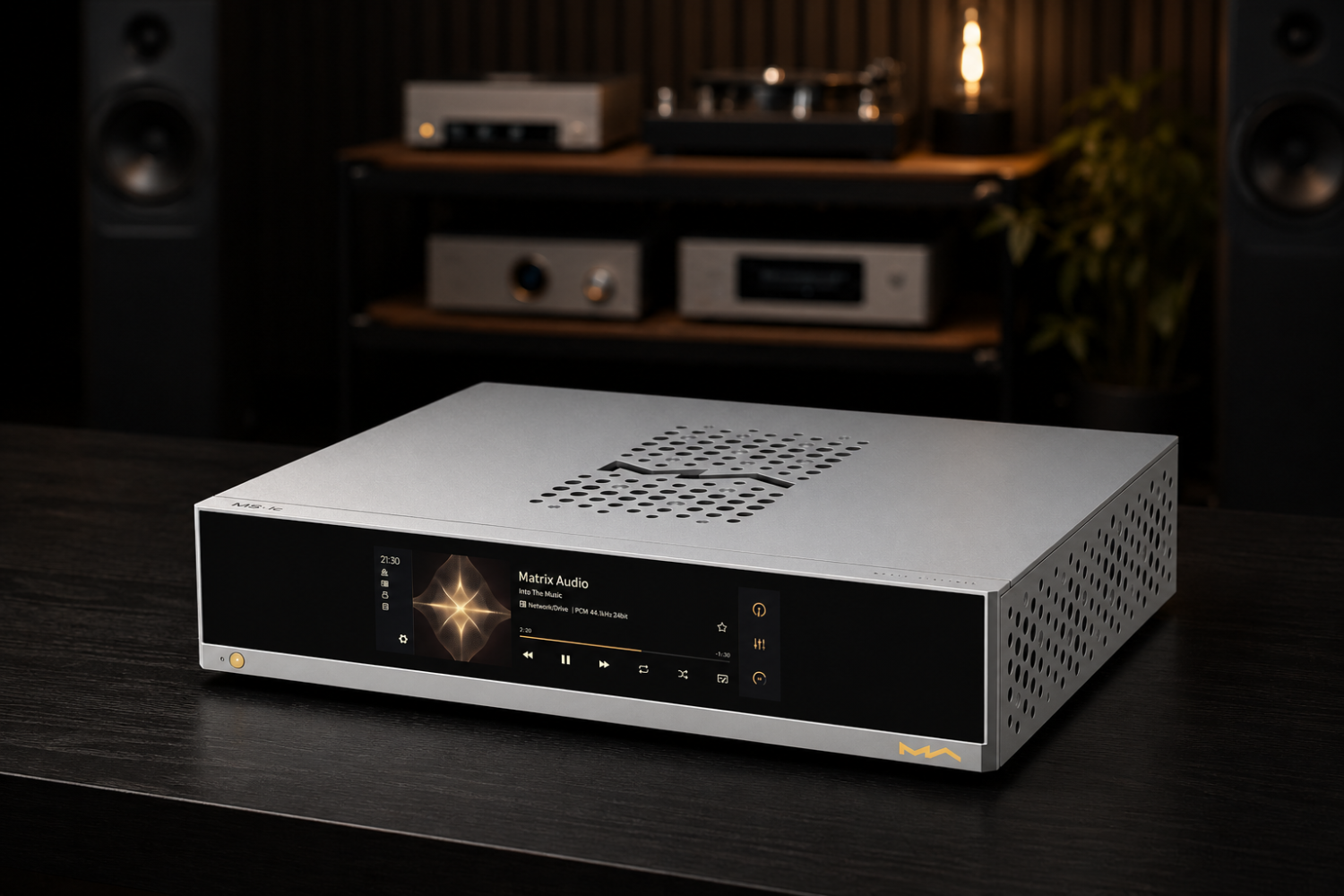
The MS-1c closely resembles Matrix Audio’s existing MS-1 Streamer DAC, but the source article notes two visible and commercial distinctions: the MS-1c is also available in black, and it carries a significantly lower price tag than the top model. Matrix Audio uses the “c” to mean “classic”, which is not just a naming detail; it frames the product’s intent as a smoother, richer alternative to DACs focused primarily on extreme detail.
The physical user interface is central to the Matrix proposition. The front touchscreen and MA Remote app are described as part of a wider Matrix Audio operating-system approach, where digital data and interface are developed as one coherent whole. In other words, the MS-1c is not merely a DAC board in a box with network access added. Based on the source, its design priority is simple day-to-day music access as much as conversion quality.
The Singxer SDA-6 PRO2 is presented more as a precision DAC platform. Its chassis is black, with dimensions of 262 x 220 x 46 mm excluding feet and connectors, and a weight of 2.7 kg. Internally, the supplied article points to a custom 40-watt O-type transformer with four independent output windings, a low-noise power system for the conversion stage, a Xilinx FPGA for clock and digital audio processing, an STM32 microcontroller, and multiple clocking elements. Those details support the picture of a compact but densely specified digital-to-analog converter.
Features and connectivity: the biggest difference is where the music starts
The MS-1c is the more self-contained product. It can stream Qobuz and Tidal through Matrix Audio’s MA Remote app, and it can also work with Roon Labs software. It also allows playback from an internal SSD, installed by the user as an optional SSD card in the NVMe slot on the underside of the unit. For someone building a digital front end without wanting a separate streamer, computer or transport in the signal path, that is its defining advantage.
However, the MS-1c has a very important limitation: it has no digital inputs and no analog inputs. The source is explicit that it cannot function as a DAC for another digital source. That means you should not buy it expecting to connect a CD transport, TV, game console, disc player, or external network bridge into its DAC section. It can send music out digitally via AES/EBU, SPDIF RCA, Toslink, IIS-LVDS and USB Audio, and it also has its own analog DAC output stage, but it is not a conventional hub DAC.
The Singxer SDA-6 PRO2 is the opposite. It is not described as a streamer and no app, network playback or internal music-storage function is specified. Instead, it offers a broad set of digital inputs: I2S LVDS over HDMI using the standard PS Audio output, USB-B, Optical Toslink, Coaxial, AES/EBU, BNC and an external clock input via BNC. For a system with multiple transports or digital sources, the Singxer is far more accommodating.
Its output arrangement is straightforward: stereo XLR balanced and stereo RCA unbalanced. It also includes digital preamp functions including volume control, analog gain up/down, screen brightness adjustment and screen-free playback. The source does not position it as a full analog preamplifier, so the safe reading is that it can provide DAC-level control functions within a digital system, not replace every preamp requirement in every setup.
Conversion architecture and performance clues from the supplied facts
Both models use AKM technology, but not in identical form. The Matrix Audio MS-1c uses a newly developed DAC built around AK4191 and AK4499. The article does not provide sample-rate support, measured noise, distortion, output level, impedance or channel separation figures for the MS-1c, so those should not be assumed. What is confirmed is the unusual analog output choice: the user can switch between conventional directly coupled analog outputs and transformer-coupled outputs using Lundahl output transformers.
That switchable output stage is the MS-1c’s most distinctive sonic tool. The source describes the conventional path as “pure and precise” and the transformer-coupled option as more intimate, warmer, richer and rounder while maintaining resolution. This is source-described character rather than an independent Stereoindex listening test, but it is still a stated product feature: the MS-1c lets the owner alter the analog output character without changing DACs, cables or downstream electronics.
The Singxer SDA-6 PRO2 is more heavily specified on paper. It uses two AKM AK4499EX DAC chips with an AK4191 digital filter. Its USB interface is the XMOS XU-316 third-generation interface, supporting PCM up to 32-bit/768 kHz and native DSD up to DSD512. The article also states that DSD operates in NOS mode without passing through the AK4191 filter, intended to preserve the original signal as much as possible. SPDIF signal reception is handled by an AKM AK4118 chip.
The Singxer source includes a full specifications set: RCA output is 2.6 V RMS and XLR output is 4.6 V RMS at 0 dBFS for PCM and DSD; output impedance is 22 ohms on RCA and 45 ohms on XLR; frequency response is 20 Hz to 20 kHz ±0.1 dB; SNR is 131 dB A-weighted; THD+N is listed as 0.00012% at 1 kHz, 0 dBFS; dynamic range is 131 dB; and channel separation is greater than 130 dB at 1 kHz. These are manufacturer-supplied article specifications, not comparative lab measurements conducted here, but they do make the Singxer the more transparent choice for buyers who want published technical data before purchase.
Ownership considerations: convenience, system matching and hidden constraints
The MS-1c asks you to commit to its ecosystem and operating model. If you mainly play Qobuz, Tidal, Roon or music stored on an internal SSD, that commitment may be welcome. The front touchscreen and MA Remote app reduce reliance on extra boxes, and the selectable output configuration gives useful flexibility for tailoring presentation. Its recommended retail price is stated as $5,799, and it is available in silver and black.
The same architecture can be a deal-breaker in a source-heavy system. Because there are no digital inputs, the MS-1c cannot be used as the central DAC for existing digital hardware. If you already own a premium CD transport, dedicated streamer, digital audio player with coaxial output, or other digital source, the Matrix will not accept those as DAC inputs based on the supplied information.
The Singxer SDA-6 PRO2 is easier to insert into an established digital system. Its wide input list makes it suitable for users who change transports, compare USB and AES/EBU, use I2S, or need standard coaxial and optical options. The internal 115/230 VAC switch is also specified, but because it is internal, buyers should treat voltage configuration as something to verify carefully with the dealer or manual rather than casually toggle from the listening chair.
The limitation is that the Singxer does not replace a network streamer. If your goal is to open an app and play Tidal or Qobuz directly from one box, the source article does not say the SDA-6 PRO2 can do that. You will need a separate streamer, computer, transport or other digital source feeding one of its inputs.
Pros and cons: Matrix Audio MS-1c
- Pros: Integrated network streamer and DAC; Qobuz and Tidal through MA Remote; Roon Labs software support stated; optional internal NVMe SSD storage; front touchscreen; digital outputs including AES/EBU, SPDIF RCA, Toslink, IIS-LVDS and USB Audio.
- Pros: Selectable analog output character via conventional directly coupled output or Lundahl transformer-coupled output.
- Pros: Available in both silver and black; confirmed recommended retail price of $5,799.
- Cons: No digital inputs and no analog inputs; cannot serve as a DAC for another digital source.
- Cons: The source does not provide sample-rate support, output measurements, dimensions or weight.
Pros and cons: Singxer SDA-6 PRO2
- Pros: Broad digital input selection including USB-B, I2S LVDS HDMI, AES/EBU, coaxial, optical, BNC and clock input via BNC.
- Pros: Dual AKM AK4499EX DAC chips with AK4191 digital filter; XMOS XU-316 USB interface; stated support for PCM up to 32-bit/768 kHz and native DSD up to DSD512 over USB/I2S.
- Pros: Balanced XLR and unbalanced RCA outputs; published output levels, impedance, frequency response, SNR, THD+N, dynamic range and channel separation.
- Pros: Digital preamp functions include volume control, analog gain up/down, screen brightness adjustment and screen-free playback.
- Cons: No streaming, app control or internal storage function is specified in the source.
- Cons: Price is not stated in the supplied article, making value comparison incomplete.
Who should buy each?
Choose the Matrix Audio MS-1c if you want a high-end digital source that can handle streaming and conversion in one component. It makes the most sense for listeners whose libraries live on Qobuz, Tidal, Roon or an internal SSD, and who like the idea of switching between a more precise direct output and a warmer transformer-coupled presentation. It is also the better fit if user interface matters: the touchscreen and MA Remote app are core parts of the product.
Choose the Singxer SDA-6 PRO2 if you already have one or more digital sources and need a serious DAC to connect them. It is the more logical option for a transport-based system, a computer-audio setup, or a rig where USB, AES/EBU, coaxial, optical, BNC and I2S flexibility matters. It is also the safer pick for buyers who want detailed published specifications before shortlisting a DAC.
Final verdict
There is no single universal winner because these products are not trying to do the same job. The Matrix Audio MS-1c is the stronger all-in-one digital front end: streamer, DAC, app-driven library access, optional internal SSD playback and selectable analog output character. Its decisive advantage is convenience with built-in sonic tailoring. Its decisive weakness is equally clear: it cannot accept external digital sources.
The Singxer SDA-6 PRO2 is the stronger traditional DAC. It has the broader input set, the more complete published technical specification, balanced and unbalanced analog outputs, high-resolution USB/I2S support and digital preamp functions. Its weakness is that it needs a separate source; nothing in the supplied article makes it a network player.
For a new, streamlined streaming-first system, the Matrix Audio MS-1c is the more compelling purchase. For an existing system built around transports, computers or multiple digital devices, the Singxer SDA-6 PRO2 is the more sensible and flexible DAC choice.