

Michell Audio’s latest turntable announcements are notable not simply because they add new models to the company’s analogue lineup, but because they show how a long-established design language can be reworked without abandoning its identity. The new Gyro remains visually connected to one of Michell’s most recognizable turntables, while receiving major changes beneath the surface. The new Revolv, meanwhile, takes ideas associated with the Gyro and places them in a model positioned between the TecnoDec and the new Gyro.
A familiar Michell identity, reworked underneath
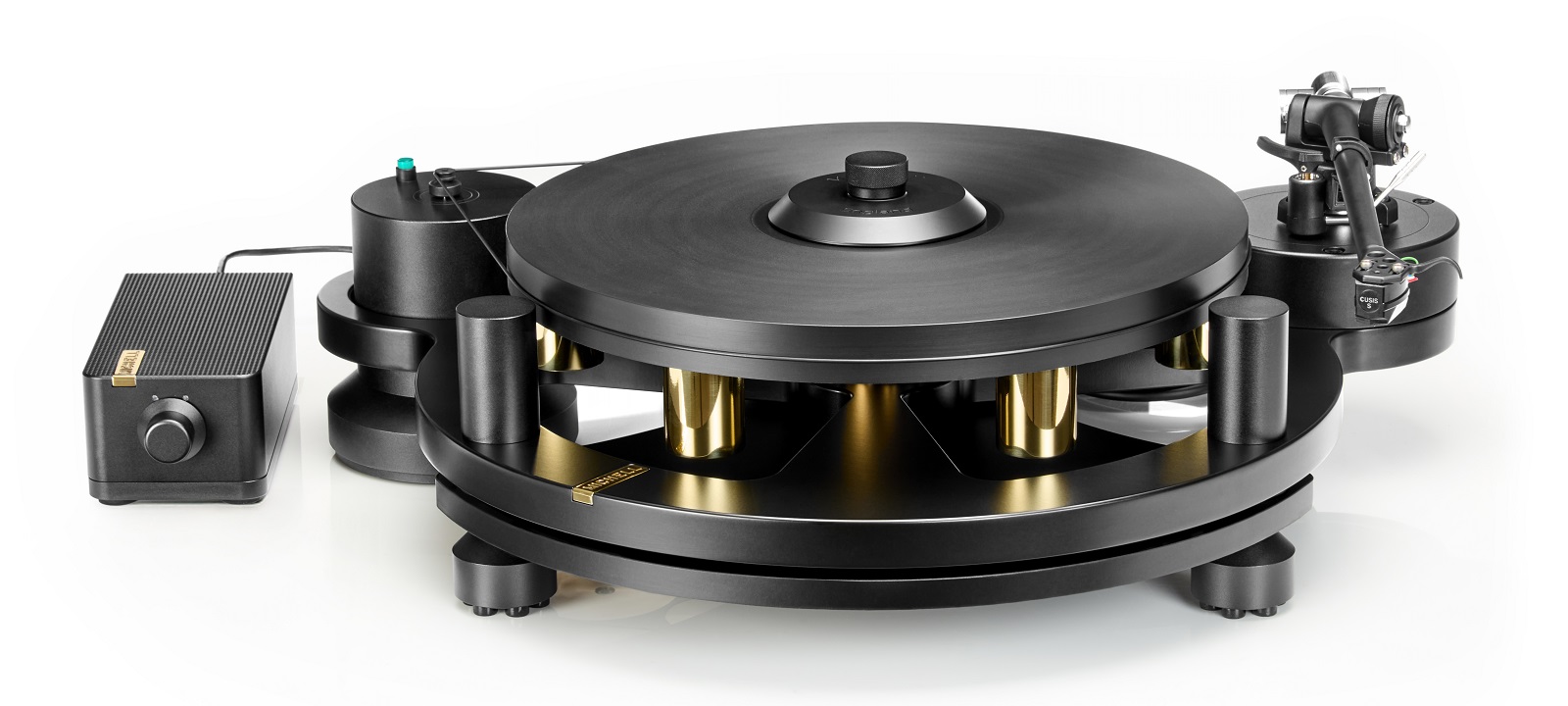
The Gyro has always been associated with a distinctive suspended design, visible mechanical architecture, and a platter that looks unlike most conventional turntables. The latest version keeps that recognisable identity, but Michell has concentrated much of its redesign on the structure, suspension, bearing, motor system, and vibration control. That matters because turntables are mechanical devices first: the way energy is stored, drained, isolated, and controlled has a direct influence on how consistently the cartridge can trace a record groove.
One of the most important changes is the move from a cast aluminum chassis to a precision-milled, solid, 19-millimeter-thick aerospace-grade aluminum chassis. A milled solid structure gives Michell tighter control over uniformity than a cast part, and the company presents this as a way to make the mechanical behaviour of the chassis more predictable. For a prospective owner, the practical attraction is not the material alone, but the design intention behind it: a more stable platform for the bearing and tonearm, with more controlled energy flow away from sensitive parts of the playback system.
Computer-aided refinement of suspension and resonance control
Michell says the new Gyro was developed with advanced analysis tools including finite element analysis and AI-assisted simulation. In a turntable context, that is useful because apparently small design decisions can affect how vibration travels through the chassis, suspension, tonearm mount, and bearing assembly. By using simulation to examine mass distribution and damping zones, Michell has aimed to reduce resonance and improve vibration management before those decisions become fixed in metal.
The company has also revised the Gyro’s familiar three-point suspension. The suspension frequency has been reduced from 4.5 Hz to 3.5 Hz through a self-centering mechanism called Equilibria. A lower, better-controlled suspension frequency is intended to help the deck reject unwanted mechanical energy while maintaining stable behaviour. Michell links this to improved control over low frequencies, timing, and pitch accuracy. The value for the user is that the suspension is not merely a visual or heritage feature; it has been treated as an active part of the turntable’s performance architecture.
Feet, base, and platter details with practical consequences
The new Gyro also gains custom Sorbothane composite feet, each using six points of contact rather than a single-point puck. Sorbothane is commonly used for damping because it can absorb and dissipate vibrational energy. Michell’s six-point approach is intended to improve isolation from external vibration and give the turntable a quieter mechanical environment in which to work. For owners placing a turntable in a real room, on real furniture, this kind of isolation strategy can be just as important as the more visible parts of the deck.
The base has also changed. Michell has replaced the previous lightweight acrylic spider frame with a solid aluminum base. The stated benefit is reduced flex and increased mass, which should make the suspension and legs behave more predictably. This is a good example of a design choice that is not mainly about ornamentation: the base becomes part of the turntable’s mechanical reference system. A stiffer, heavier base can help the deck maintain geometry and reduce unwanted movement within the support structure.
The Delrin platter has been visually refined as well. It now has a grooveless, precision-turned edge, with the belt groove hidden through a self-leveling arrangement. Michell notes this is an aesthetic change rather than a performance upgrade, but it still matters to the ownership experience. The Gyro is a turntable many people will leave on display, and the cleaner platter edge gives the design a more minimalist, integrated appearance while retaining the model’s established visual character.

Bearing and motor updates aimed at consistency
The Gyro’s helical oil pump bearing has been updated to a double-helix design. According to Michell, this doubles the oil flow used to lubricate the reverse bearing, reducing friction. In a turntable, the bearing is one of the most important mechanical systems because it supports platter rotation over long periods. A design that prioritizes consistent lubrication and low friction is relevant not only to playback stability, but also to durability and long-term ownership.
The new motor is shielded, grounded, and provides electronic speed selection for 33.3 and 45 rpm. This gives users a more convenient way to change between standard LP and single/12-inch speeds without manually moving a belt. The shielding and grounding are also significant because turntables combine mechanical and electrical sensitivities: keeping motor noise and electromagnetic interference under control helps protect the low-level signal generated by the cartridge.

Revolv: a new model shaped by Gyro thinking
The Revolv broadens Michell’s range by taking engineering ideas associated with the Gyro and applying them to a model positioned between the minimalist TecnoDec and the new Gyro. Its role is important: it is not presented as a replacement for the Gyro, but as a way of bringing some of Michell’s more developed mechanical thinking into a different product tier.
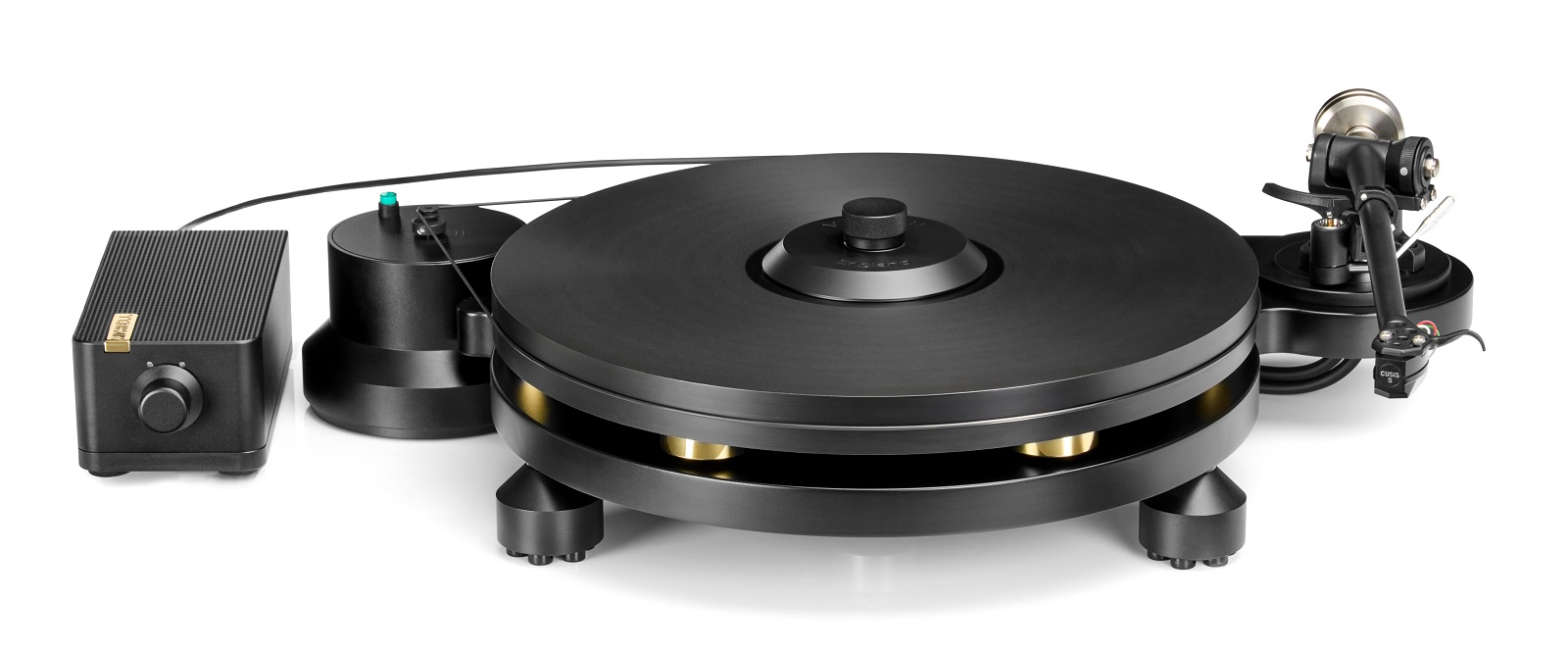
Like the new Gyro, the Revolv uses a 19-millimeter aerospace-grade aluminum chassis milled from a single block. Michell describes this as an inert, high-mass structure that provides direct mechanical grounding. The tonearm mount is firmly coupled to the chassis, which is intended to improve energy transfer and cartridge stability. For a prospective owner, this points to a turntable that prioritizes rigidity and grounding over elaborate isolation architecture. It is a more direct mechanical concept than the suspended Gyro, but it is still clearly based on controlling vibration and maintaining a stable relationship between record, platter, bearing, and tonearm.
Gyro-derived features in a simpler architecture
One of the most significant features adopted by the Revolv is Michell’s inverted bearing concept. In the Revolv, a mono-helical groove circulates oil to the pressure point and bearing walls, with the aim of maintaining low-friction rotation and reducing wear. The appeal here is straightforward: a bearing designed for stable lubrication and long service life suits a product intended for years of use rather than short-term novelty.
The Revolv also uses a Delrin platter, a material Michell selected for vibration damping and for boundary impedance characteristics that closely match vinyl. The platter carries the brand’s characteristic solid lathed brass weights, which add mass and increase rotational momentum. Michell links this to improved speed stability and very low wow and flutter. While the exact measurements are not provided, the design principle is clear: increased platter inertia can help maintain steadier rotation once the platter is up to speed.
Isolation is handled through feet that each incorporate six custom Sorbothane damping points. This mirrors the attention given to vibration control on the Gyro, though within a different overall design. The Revolv also uses a new isolated, freestanding motor and a highly regulated power supply with grounding and electromagnetic shielding. Electronic switching between 33.3 and 45 rpm makes the deck more convenient to use, while the separate, shielded motor supply reflects Michell’s focus on keeping electrical and mechanical noise away from the cartridge system.
Design, ownership, and upgrade appeal
Both turntables are designed and manufactured in the UK, and both show Michell’s preference for visible engineering rather than concealing the mechanism inside a plain rectangular plinth. The Gyro leans into that identity most strongly, with its suspended architecture and iconic platter treatment. The Revolv is more minimalist, but it still carries the brand’s mechanical aesthetic through its milled chassis, separate motor approach, and brass-weighted Delrin platter.
The Revolv is also described as upgrade-ready and easy to assemble and convert. That is a meaningful ownership point, especially for analogue listeners who may change tonearms, cartridges, support furniture, or phono stages over time. A turntable that can grow with a system has a different appeal from one conceived as a closed, fixed-format product. Michell’s emphasis on long-lasting engineering also suggests that the Revolv is intended to be a stable platform rather than an entry-level stepping stone with a short service horizon.
Conclusion
The new Michell Gyro and Revolv are most suitable for analogue listeners who value visible mechanical engineering, long-term build philosophy, and careful vibration control. The Gyro is the more distinctive choice for those drawn to Michell’s suspended design heritage and its extensive redesign, including the milled aluminum chassis, Equilibria suspension, double-helix bearing, shielded motor, and refined aluminum base. The Revolv will likely appeal to listeners who want a simpler, rigid architecture that still carries important Gyro-derived ideas, including an inverted bearing, Delrin platter with brass weights, Sorbothane isolation, and a regulated shielded motor supply. Together, they show Michell developing its established turntable language in two complementary directions: one as a deeply revised icon, the other as a new platform built to make the company’s engineering approach available to a broader range of vinyl-focused systems.