

An amplifier is the control centre of a hi-fi system, but the right choice is rarely just the model with the highest wattage.
Power supply design, current delivery, speaker matching, input flexibility and the way the amplifier handles volume and signal routing can all matter as much as the headline power figure.
This guide focuses on amplifier-related recommendations from the supplied Stereoindex source set: integrated amplifiers, a hybrid preamplifier, a compact Bluetooth amplifier, a fully digital network amplifier and a practical buying primer. A few adjacent components are included because they affect amplifier choice in real systems, but they are identified clearly rather than treated as speaker-driving amplifiers. The result is an evergreen shortlist for readers comparing different amplifier approaches: analogue Class AB, Class D, fully digital amplification, hybrid tube preamplification and feature-rich integrated designs with DACs, phono stages, Bluetooth or TV-friendly connectivity.

1. Copland CSA-150: A must-have for building a solid home system
Copland CSA-150 integrated amplifier, notable for combining amplification, digital inputs, MM phono support and optional Bluetooth aptX.
The Copland CSA-150 stands out as a highly flexible integrated amplifier for listeners who want fewer separate boxes without giving up source options.
Its onboard digital-to-analog converter is based on the design of Copland’s DAC215 and uses an ESS Technology Saber ES 9018 reference chip with four output cells paralleled per stereo channel.
The source also notes asynchronous USB support for PCM up to 384 kHz at 32-bit and DSD up to 5.6 MHz, plus coaxial and two optical digital inputs. Add the built-in MM phono stage, optional Bluetooth aptX module and 6922 dual-triode preamplifier stage, and the CSA-150 reads as a serious hub for mixed analogue and digital systems.
Best for: Versatile one-box systems
- Built-in DAC based on Copland DAC215 design
- USB input supports PCM up to 384 kHz/32-bit and DSD128
- Built-in RIAA stage for MM cartridges
- Optional Bluetooth aptX module plus coaxial and optical inputs
Verdict: A strong choice for building a broad home system around one integrated amplifier with digital, phono and optional wireless capability.
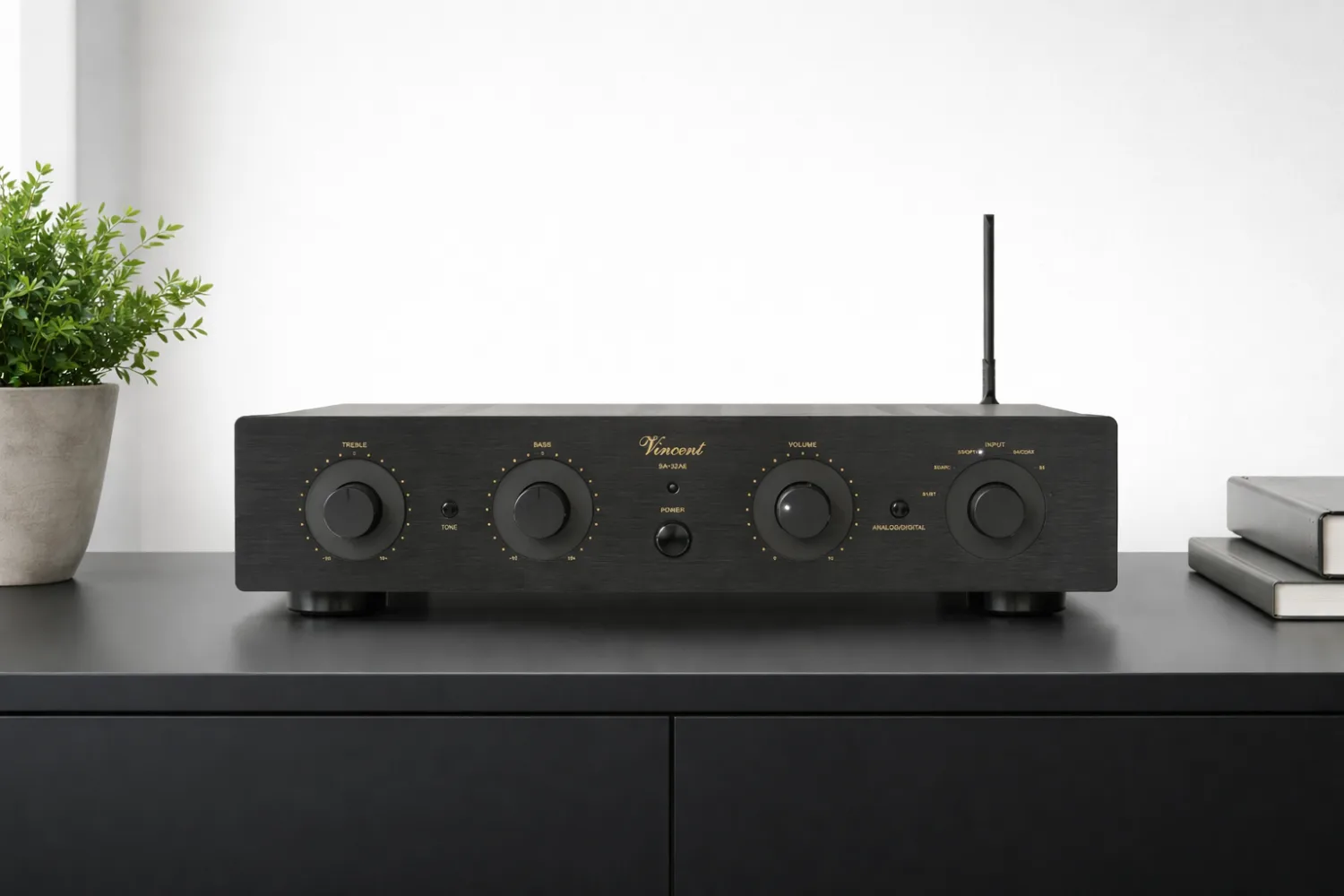
2. Vincent SA-32 AE: 30th Anniversary Hybrid Tube Preamplifier with HDMI ARC
Vincent SA-32 AE hybrid tube preamplifier, updated with HDMI ARC and expanded digital connectivity.
The Vincent SA-32 AE is not an integrated amplifier but a hybrid stereo preamplifier, and that distinction matters: it is designed for systems with separate downstream amplification.
Its appeal lies in combining valve-based circuitry with modern connection options.
The anniversary edition adds HDMI ARC alongside Bluetooth, coaxial and optical inputs, making television integration easier in a dedicated hi-fi setup. Vincent also revised the tube complement, using two 12AU7 tubes immediately after the inputs and two ECC88 tubes in the tone-control stage as phase splitters. With production limited to 200 units worldwide, the SA-32 AE is a specialist preamp rather than a universal amplifier recommendation.
Best for: Separate systems with TV integration
- Hybrid tube stereo preamplifier design
- HDMI ARC for integrating a television into a hi-fi system
- Bluetooth, coaxial and optical inputs included
- Uses 12AU7 and ECC88 tubes in distinct circuit roles
Verdict: A distinctive hybrid preamplifier for listeners who already have, or plan to use, separate power amplification.

3. Cambridge Audio Azur 851A: Class XD signature integrated amplifier
Cambridge Audio Azur 851A integrated amplifier with Class XD circuitry, dual transformer layout and front-panel display.
The Cambridge Audio Azur 851A is an integrated amplifier built around Cambridge’s Class XD circuit concept, described in the source as a design that dynamically shifts the switching zone to provide Class A operation at low levels while reducing the crossover distortion associated with conventional Class B operation.
It is rated at 120 watts and uses two toroidal mains transformers: one for the preamplification circuits and another for the output stages.
Separate transformer windings for the stereo channels support a dual-mono-style circuit approach. Practical details include a custom balanced volume potentiometer with 1 dB steps, an adjustable blue display, defeatable tone control and a front-panel headphone jack.
Best for: Powerful integrated amplification
- Class XD amplifier circuit concept
- Rated at 120 watts
- Two toroidal transformers with separate roles
- Volume adjustment in 1 dB steps
Verdict: A technically distinctive integrated amplifier for listeners who value Cambridge’s Class XD approach and robust power-supply architecture.
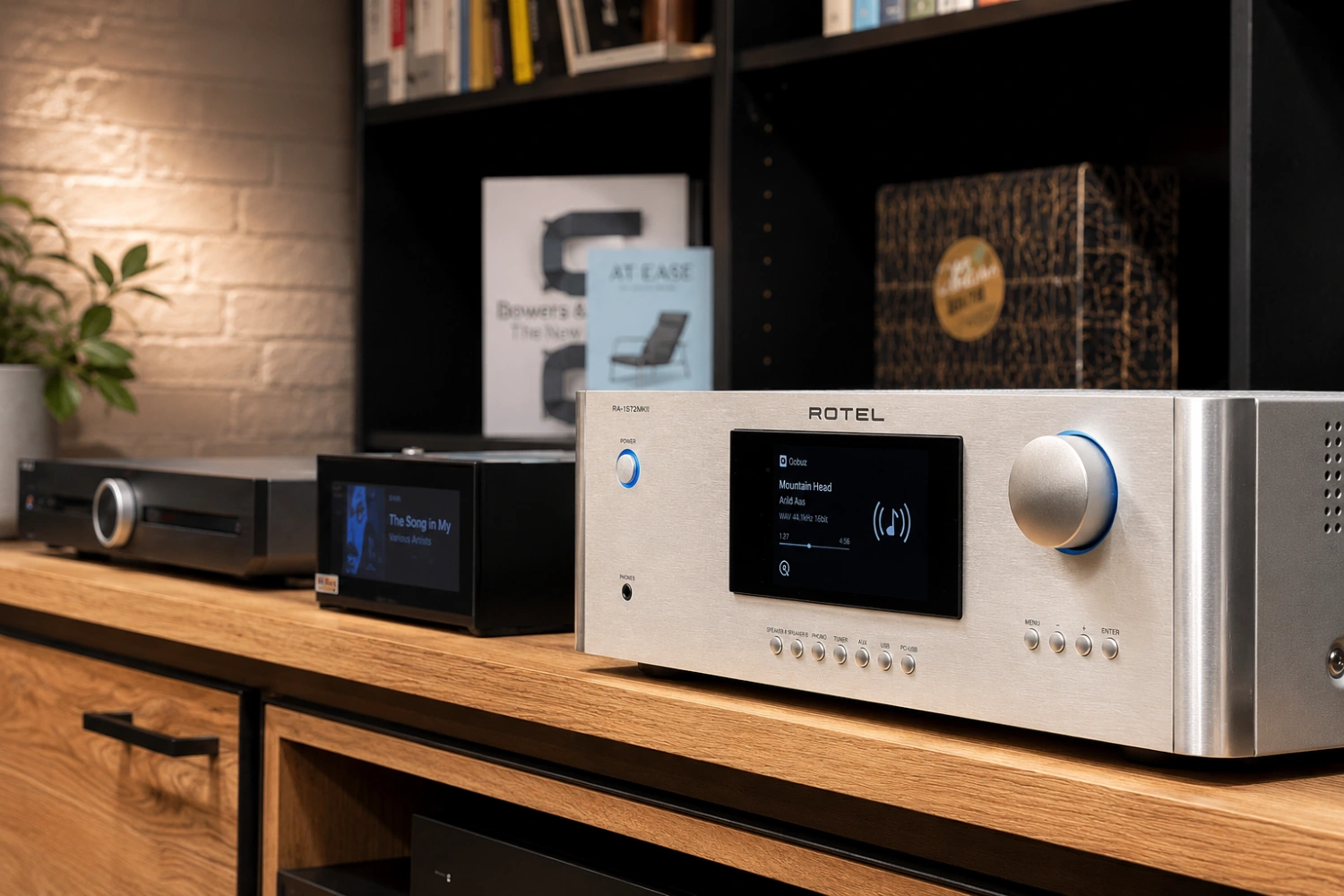
4. Hi-Fi Amplifier Buying Tips Every Audiophile Should Know
Amplifier buying guidance focused on system matching, speaker control, power supply design and real-world performance factors.
This article is buying guidance rather than a product, but it belongs in an amplifier shortlist because it frames the decisions that prevent poor system matching.
Its central point is that wattage alone is not enough.
The source highlights current delivery, damping factor, load stability and power supply design as factors that influence how confidently an amplifier controls speakers. It also explains the amplifier’s role between source components and loudspeakers, shaping control, timing, tonal balance and long-term listening comfort. For anyone comparing the models in this guide, this primer is the most practical place to start.
Best for: First-step buying guidance
- Explains why wattage is only part of amplifier choice
- Highlights current delivery, damping factor and load stability
- Connects amplifier matching with bass control and listening comfort
- Useful before comparing different amplifier topologies
Verdict: A practical reference for understanding amplifier matching before focusing on brand, topology or power figures.

5. 1MII B08+: Class D amplifier with Bluetooth 5.0
1MII B08+ Class D Bluetooth amplifier with RCA input, tone controls and speaker-terminal outputs.
The 1MII B08+ is the compact, affordable end of this amplifier selection: a Class D amplifier with built-in Bluetooth 5.0 and a stereo RCA input.
Its amplifier stage is specified at 2 x 50 watts into 4 ohms, which the source describes as ideal for accompanying small passive bookshelf speakers.
The Bluetooth section uses an ATS 2853 chip with AAC and SBC codec support, and the antenna-equipped design is specified for transmission up to 30 metres without obstacles. Front-panel controls cover volume, bass and treble, while speaker terminals provide the passive-speaker connection. It is a simple, small-system amplifier rather than a full-scale hi-fi control centre.
Best for: Small passive bookshelf speakers
- Bluetooth 5.0 built in
- Stereo RCA input included
- Specified at 2 x 50 watts into 4 ohms
- Front controls for volume, bass and treble
Verdict: A compact Bluetooth amplifier suited to simple desktop, secondary-room or small-speaker setups.

6. Lyngdorf TDAI-2210: Fully Digital Network Amplifier from Denmark
Lyngdorf TDAI-2210 network integrated amplifier with fully digital architecture and expandable input options.
The Lyngdorf TDAI-2210 is a network integrated amplifier built around Lyngdorf’s True Digital Amplifier Integrated concept.
According to the source, it operates entirely in the digital domain up to the speaker terminals, with volume handled by modifying gain in the output chain rather than passing through multiple analogue stages.
It includes analogue and digital inputs, streaming capability and support for optional modules. The rated output is 105 watts per channel into 8 ohms and 210 watts into 4 ohms. Positioned between Lyngdorf’s TDAI-3400 and TDAI-1120, the TDAI-2210 is aimed at systems where digital architecture, network functionality and expandable configuration are central priorities.
Best for: Digital and network-based systems
- Fully digital operation up to the speaker terminals
- Includes analogue and digital inputs plus streaming capability
- Supports optional functionality modules
- Rated at 105 watts into 8 ohms and 210 watts into 4 ohms
Verdict: A modern integrated amplifier for listeners who want Lyngdorf’s fully digital signal path with streaming and modular flexibility.

7. Wilson Audio Sasha V Officially Presented
Wilson Audio Sasha V loudspeaker system, included as speaker-matching context rather than as an amplifier.
The Wilson Audio Sasha V is not an amplifier; it is a high-end loudspeaker system.
Its inclusion here is useful only as system context, because loudspeaker choice strongly affects amplifier selection even when the source article does not provide impedance or sensitivity figures.
The Sasha V replaces the Sasha DAW and uses a two-section modular construction with low-frequency drivers in the lower module and midrange and high-frequency drivers in the upper enclosure. The source describes proprietary X-Material, S-Material and V-Material construction, a Convergent Synergy Carbon tweeter and a 7-inch Wilson AlNiCo QuadraMag midrange driver. Treat it as a reminder that demanding loudspeakers deserve careful amplifier matching.
Best for: High-end speaker matching context
- Two-section modular speaker construction
- Uses Wilson Audio X-Material, S-Material and V-Material
- Convergent Synergy Carbon tweeter
- 7-inch Wilson AlNiCo QuadraMag midrange driver
Verdict: Not an amplifier recommendation, but a useful reminder that speaker design should guide amplifier choice.

8. Dense Home Smart Audio Amplifier: Compact D-Class Integrated Amplifier with Corian Finish
Dense Home Smart Audio compact Class D integrated amplifier with Corian top panel, DAC functions and Bluetooth input.
Dense Home Smart Audio is a compact Class D integrated amplifier with an onboard DAC and a distinctive enclosure topped with Corian acrylic stone.
The source notes that it fits within the footprint of an A4 sheet of paper and receives digital signal through two USB-C connectors on an ESS chipset.
It also accepts Bluetooth and analogue RCA input, while USB-to-HDMI conversion is presented as useful for television partnering. Output is specified at 35 watts per stereo channel or 70 watts in bridged mode, with Dense StereoConnect allowing two amplifiers to be used for a double-power stereo arrangement. Headphone-amplifier functionality further broadens its role in a compact system.
Best for: Compact TV and desktop systems
- Compact Class D integrated design
- Onboard DAC with two USB-C connectors
- Bluetooth and analogue RCA input
- 35 watts per channel or 70 watts bridged
Verdict: A space-saving integrated amplifier with DAC, Bluetooth, headphone use and bridging options for flexible small-system layouts.

9. What is it like to listen to music on the Astell&Kern SP3000?
Astell&Kern A&ultima SP3000 digital audio player, relevant as a portable source and headphone device rather than a speaker amplifier.
The Astell&Kern A&ultima SP3000 is not a speaker amplifier; it is a flagship digital audio player and headphone source.
It is relevant here only for readers considering how a portable source or headphone front end might fit beside a main amplifier system.
The source describes four AKM AK4499EX DACs and two AKM AK4191 delta-sigma modulators, with separate DAC allocation for balanced and unbalanced headphone outputs. It supports balanced headphone connections via 2.5 mm or 4 mm jacks and unbalanced headphones through a 3.5 mm jack. Astell&Kern also claims separation of digital and analogue signal processing and a signal-to-noise ratio of 130 dB.
Best for: Portable source and headphone listening
- Uses four AKM AK4499EX DACs
- Balanced 2.5 mm and 4 mm headphone outputs
- Unbalanced 3.5 mm headphone output
- Astell&Kern claims 130 dB signal-to-noise ratio
Verdict: A source-first component rather than an amplifier for passive speakers, best considered for headphone use or as part of a wider digital playback chain.

10. Leema Acoustics i85 & iD85: British Integrated Amplifiers With Serious Intent
Leema Acoustics i85 and iD85 integrated amplifiers, differentiated by analogue-only operation or added DAC and digital inputs.
Leema Acoustics’ i85 and iD85 are integrated amplifiers in the company’s 100 series, with the i85 keeping signal processing exclusively analogue and the iD85 adding digital-to-analog conversion.
The i85 provides four RCA inputs, an MM-compatible turntable input, subwoofer output, preamp output and recording-device output.
It operates in Class AB and is specified at 85 watts per channel into 8 ohms, with a large toroidal transformer and 27,000 uF of smoothing capacitance per channel. The iD85 carries over the i85’s core feature set but adds a DAC on a separate power line, plus two coaxial RCA inputs, two optical inputs and asynchronous USB-B. Available information is limited, but the distinction between the two models is clear.
Best for: Analogue-first or DAC-equipped integrated systems
- Choice of analogue-only i85 or DAC-equipped iD85
- MM phono input included on the i85 feature set
- Class AB operation with 85 watts per channel into 8 ohms
- iD85 adds coaxial, optical and asynchronous USB-B digital inputs
Verdict: A pair of integrated amplifiers that let buyers choose between a purist analogue layout and a digital-input version built on the same core platform.
Quick comparison
These entries differ less by ranking than by system role.
Some are conventional integrated amplifiers, one is a preamplifier, one is a buying guide, and two are adjacent source or speaker products included for amplifier-matching context.
| Product | Best for | Verdict |
|---|---|---|
| Copland CSA-150 | Versatile one-box systems | Integrated amplification with DAC, MM phono stage, multiple digital inputs and optional Bluetooth aptX. |
| Vincent SA-32 AE | Separate systems with TV integration | Hybrid tube preamplifier with HDMI ARC, Bluetooth and digital inputs, requiring separate downstream amplification. |
| Cambridge Audio Azur 851A | Powerful integrated amplification | Class XD integrated amplifier with 120-watt rating, dual transformers and precise 1 dB volume adjustment. |
| Hi-Fi Amplifier Buying Tips Every Audiophile Should Know | First-step buying guidance | Practical amplifier-matching advice focused on factors beyond wattage. |
| 1MII B08+ | Small passive bookshelf speakers | Compact Class D Bluetooth amplifier with RCA input, tone controls and 2 x 50-watt specification into 4 ohms. |
| Lyngdorf TDAI-2210 | Digital and network-based systems | Fully digital network integrated amplifier with analogue and digital inputs, streaming and optional modules. |
| Wilson Audio Sasha V | High-end speaker matching context | A loudspeaker rather than an amplifier, useful here as a reminder that speaker design affects amplifier choice. |
| Dense Home Smart Audio Amplifier | Compact TV and desktop systems | Small Class D integrated amplifier with DAC, USB-C, Bluetooth, RCA input, headphone use and bridged operation. |
| Astell&Kern A&ultima SP3000 | Portable source and headphone listening | A digital audio player and headphone source, not an amplifier for passive loudspeakers. |
| Leema Acoustics i85 & iD85 | Analogue-first or DAC-equipped integrated systems | Integrated amplifier pair offering either analogue-only operation or added DAC and digital inputs. |
Frequently asked questions
Should I choose an amplifier mainly by wattage?
No.
Power output matters, but the supplied buying guidance stresses that wattage alone does not describe how well an amplifier controls speakers.
Current delivery, damping factor, stability under load and power supply design are also important. The range here shows why: the 1MII B08+ is aimed at small passive bookshelf speakers, while the Lyngdorf TDAI-2210 and Cambridge Audio Azur 851A occupy more ambitious integrated-amplifier territory.
What is the difference between an integrated amplifier and a preamplifier?
An integrated amplifier combines source control and speaker amplification in one component.
Examples here include the Copland CSA-150, Cambridge Audio Azur 851A, Lyngdorf TDAI-2210, Dense Home Smart Audio, 1MII B08+ and Leema i85/iD85.
The Vincent SA-32 AE is a preamplifier, so it is intended for a system with separate power amplification or another downstream amplification stage.
Which inputs should I prioritise when buying an amplifier?
Match the amplifier to the sources you actually use.
Turntable users should look for a phono input such as the MM stages noted on the Copland CSA-150 and Leema i85.
TV integration may favour HDMI ARC, as on the Vincent SA-32 AE. Computer or digital-source users may value USB, coaxial or optical inputs, while Bluetooth is relevant on products such as the 1MII B08+, Dense Home Smart Audio and Vincent SA-32 AE.
Are digital or Class D amplifiers automatically better than analogue Class AB designs?
The supplied material does not support that kind of blanket conclusion.
The Lyngdorf TDAI-2210 uses a fully digital architecture, the Dense and 1MII models use Class D amplification, the Leema i85 operates in Class AB, and the Cambridge Audio Azur 851A uses Cambridge’s Class XD concept.
The better choice depends on speaker matching, required inputs, system size and the role the amplifier needs to play.
How to Choose from This Amplifier Shortlist
Start with system role.
If you want one serious component to handle analogue and digital sources, the Copland CSA-150 is the most broadly equipped integrated amplifier in this source set, thanks to its DAC, MM phono stage, digital inputs and optional Bluetooth aptX.
If your system is built around network playback and you want Lyngdorf’s fully digital approach, the TDAI-2210 is the clearest fit. For a more traditional high-power integrated amplifier with Cambridge’s Class XD circuit design, the Azur 851A remains the relevant option. Smaller systems have different needs. The 1MII B08+ is best understood as a compact Bluetooth amplifier for small passive bookshelf speakers, while Dense Home Smart Audio adds a more design-led compact integrated format with DAC functionality, Bluetooth, USB-C, headphone use and bridged operation. Leema’s i85 and iD85 create a useful fork in the road: choose the analogue-only i85 if you do not need onboard digital conversion, or the iD85 if coaxial, optical and USB-B inputs matter. Be careful with component type. The Vincent SA-32 AE is a hybrid tube preamplifier, not an integrated amplifier, so it needs separate amplification after it. The Wilson Audio Sasha V and Astell&Kern SP3000 are not amplifier recommendations at all; they are included as system context, the former for speaker-matching awareness and the latter as a portable digital player and headphone source. The most reliable buying approach is to work backwards from your speakers and sources. Identify the inputs you need, check whether you require phono, DAC, Bluetooth, streaming or TV connectivity, then consider whether the amplifier’s design and power supply are appropriate for your loudspeakers. A well-matched amplifier should make the whole system feel composed rather than merely impressive on a specification sheet.