
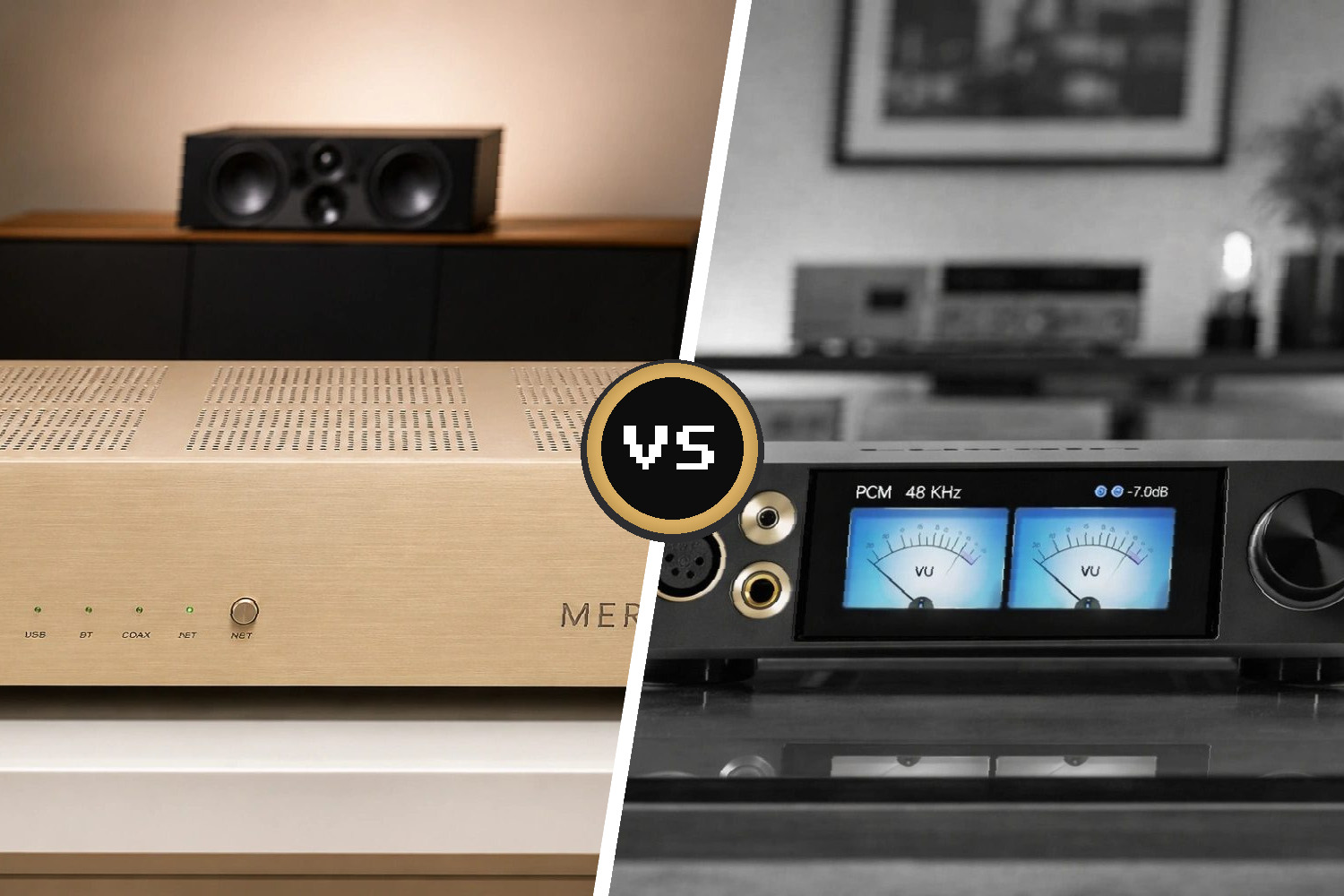
The Merason DAC 2 and Luxsin X8 both sit in the digital front end category, but they are built around almost opposite ideas of what a modern DAC should be. The Merason is a dedicated Swiss digital-to-analog converter with no volume control, no headphone amplifier and no attempt to become a complete desktop hub. The Luxsin X8 is a DAC/amp built around an eight-DAC architecture, high-output headphone amplification, real-time processing and AI-assisted EQ.
That makes this a useful comparison precisely because the two products are not chasing the same buyer. The Merason DAC 2 is for a component-based hi-fi system where a preamplifier or integrated amplifier already handles control and gain. The Luxsin X8 is for listeners who want conversion, headphone drive and deep sound personalization in one desktop component.
The key question is not simply which is “better.” It is whether your system benefits more from Merason’s stripped-back, fixed-output conversion philosophy or Luxsin’s integrated hardware-and-software platform. One prioritizes separation and specialization; the other prioritizes power, adaptability and daily interaction.
Merason DAC 2: Dedicated conversion with a deliberately narrow brief
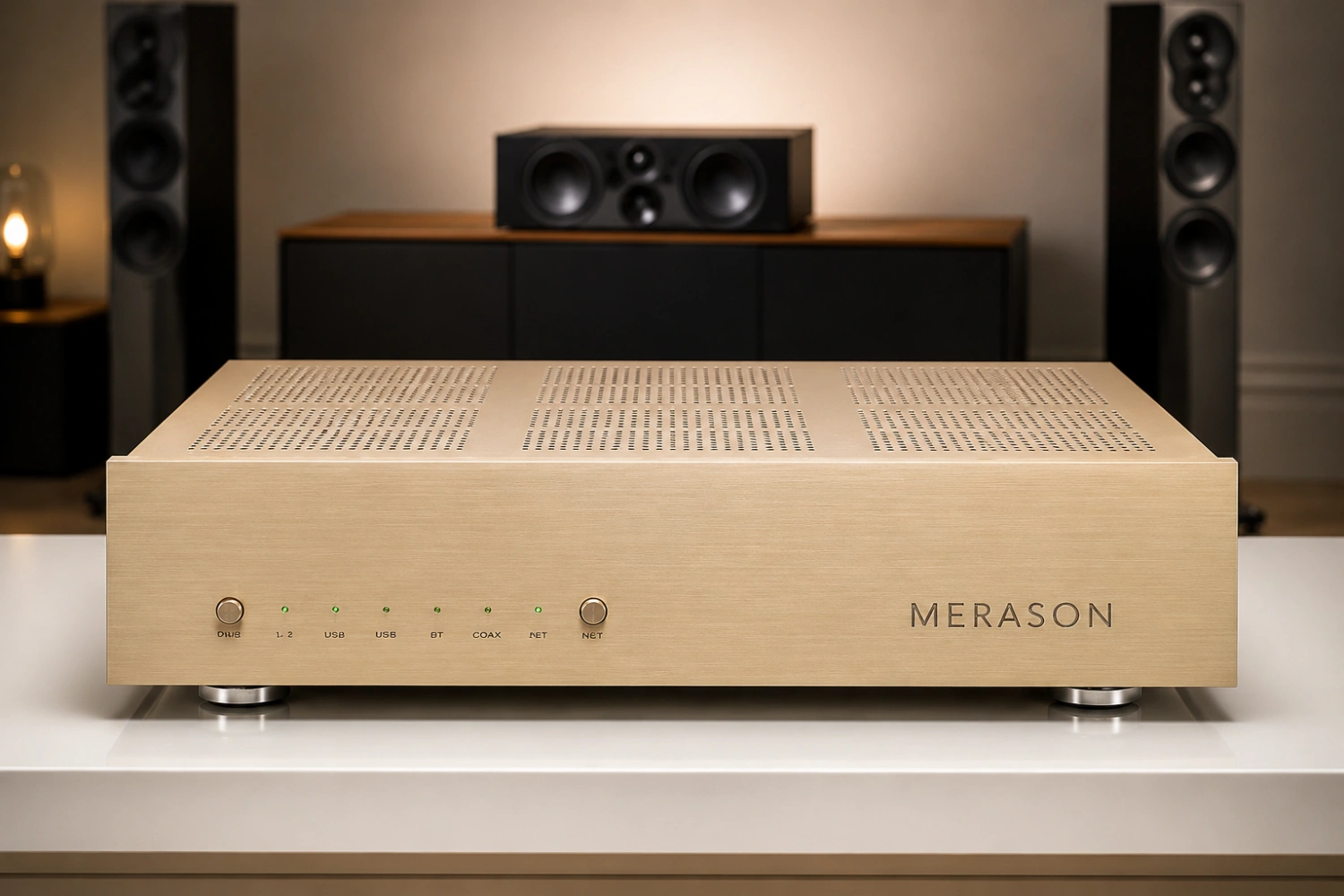
The Merason DAC 2 is positioned between the company’s DAC 1 Mk2 and flagship Mountain DAC. Its role in the range is very clear: it brings a more advanced standalone converter option without turning into a preamplifier, headphone station or streamer-style control product. Merason has kept the DAC 2 focused on digital-to-analog conversion and left the rest of the system to separate components.
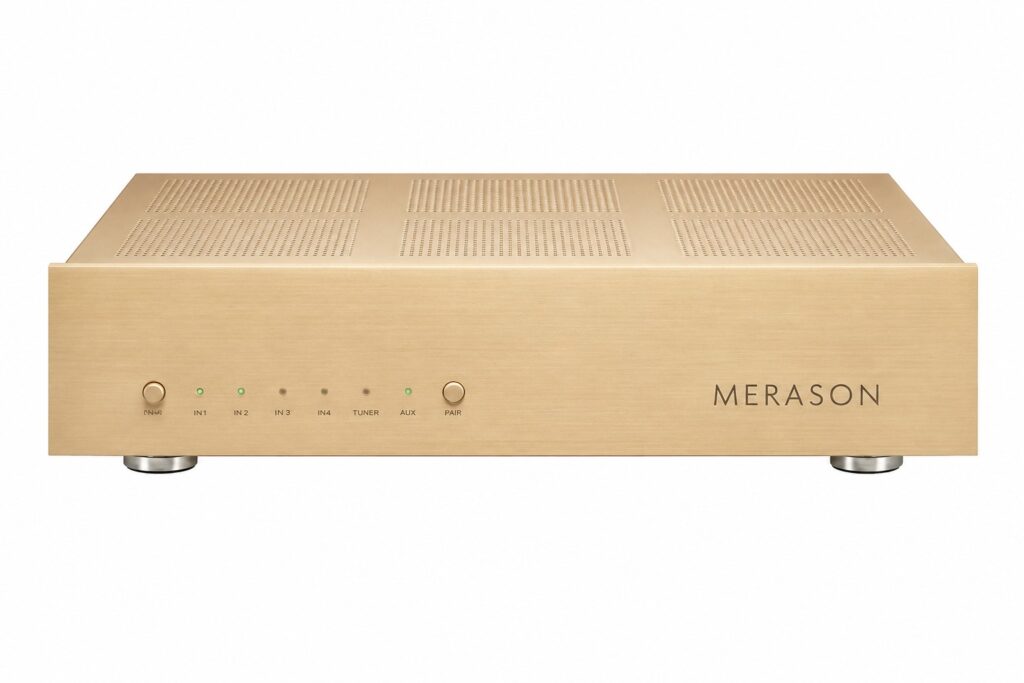
That design choice shapes everything about the product. There is no volume control, so the DAC 2 is not intended to drive a power amplifier directly unless volume is handled elsewhere. There is no integrated headphone amplifier, so it is not a desktop listening solution on its own. Instead, it is a source component designed to feed an external preamplifier or integrated amplifier in a conventional hi-fi chain.
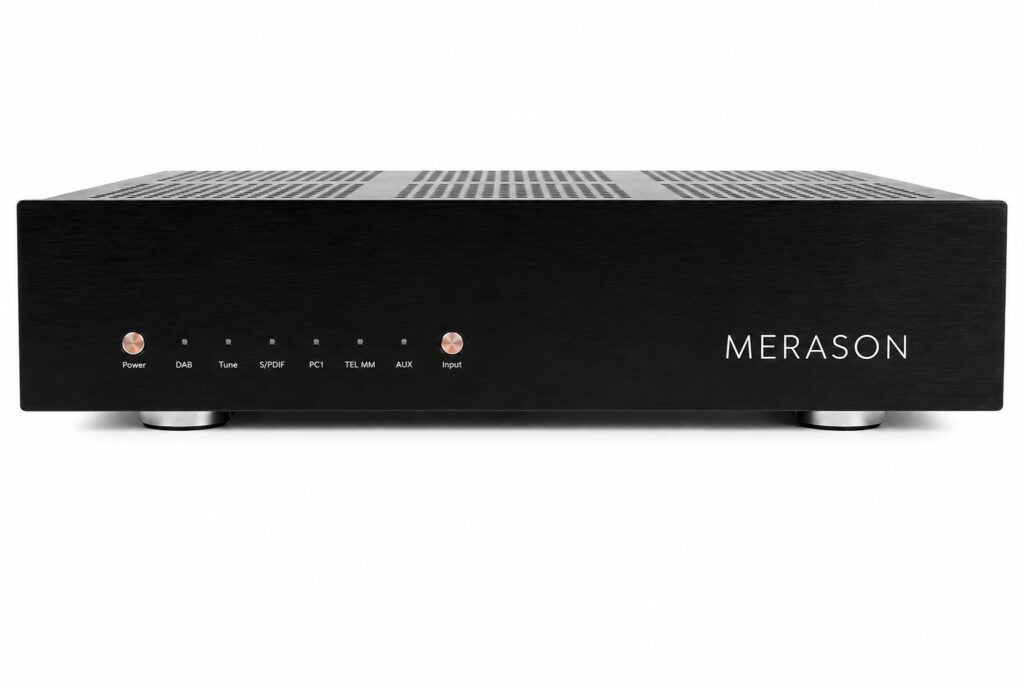
At the core are two Burr-Brown PCM1794A converter chips used in a fully differential configuration. Rather than relying on one chip to handle both stereo channels, Merason gives the design dedicated conversion hardware within a differential signal path. The intent is to support channel separation, control distortion and maintain a balanced topology through the conversion stage.
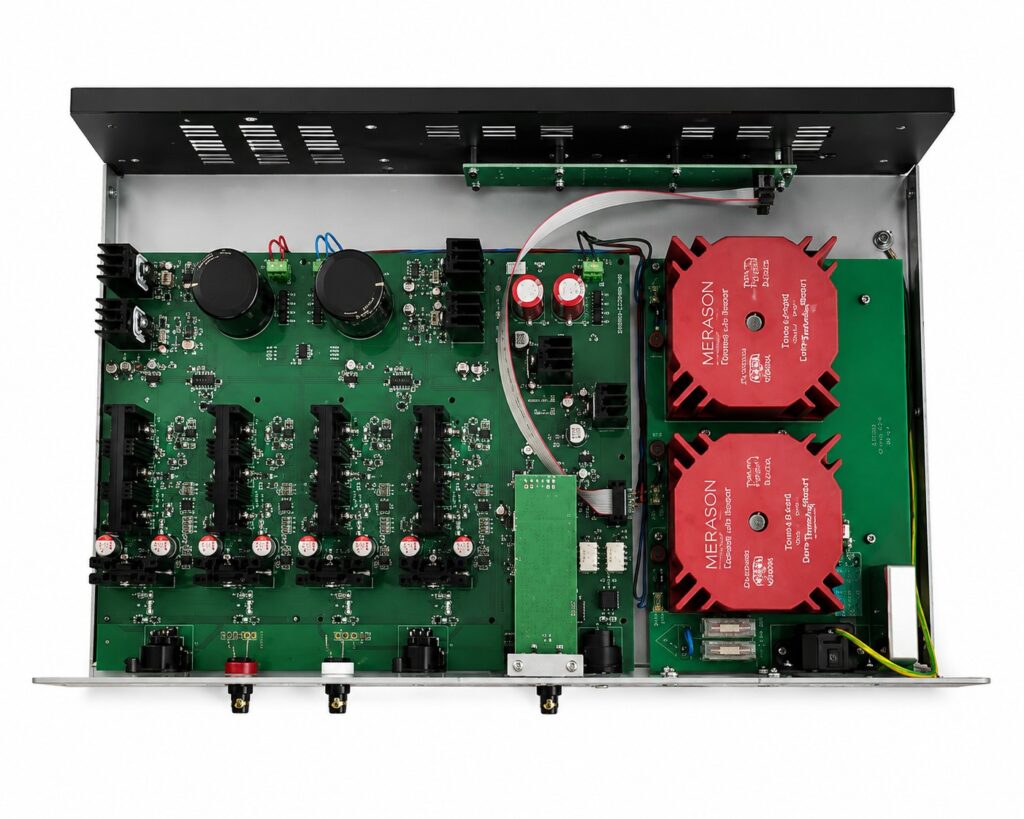
Merason’s approach is notable because it does not lean on feature accumulation. The company is not presenting the DAC 2 as a box that replaces several other products. Its value lies in concentration: conversion hardware, differential implementation and a system role that is easy to understand. In a world of DACs that often double as preamps, headphone amps and digital processors, the DAC 2 is intentionally restrained.
Pros
- Dedicated DAC architecture with no volume control or headphone amplifier adding complexity to the signal path.
- Dual Burr-Brown PCM1794A conversion in a fully differential design.
- Clear fit for component-based systems using a separate preamplifier or integrated amplifier.
- Sits between the DAC 1 Mk2 and Mountain DAC for buyers who want a step within Merason’s dedicated converter range.
- Avoids feature bloat and focuses its design brief on fixed-source digital-to-analog conversion.
Cons
- Not suitable as a standalone desktop DAC/amp or headphone solution.
- Requires separate volume control and amplification elsewhere in the system.
- No supported details here on digital input selection, format handling or streaming functions.
- Listeners wanting EQ, headphone profiles or integrated system control will need other components.
- Its value cannot be judged by bundled functionality because it is deliberately not a multifunction device.
Best for: The Merason DAC 2 is best for listeners building a separates-based hi-fi system who want a dedicated fixed-output DAC feeding an external preamplifier or integrated amplifier, and who prefer focused conversion architecture over onboard headphone drive, EQ or system-control features.
Read the original Stereoindex article →
Luxsin X8: Eight-DAC desktop platform with power and personalization
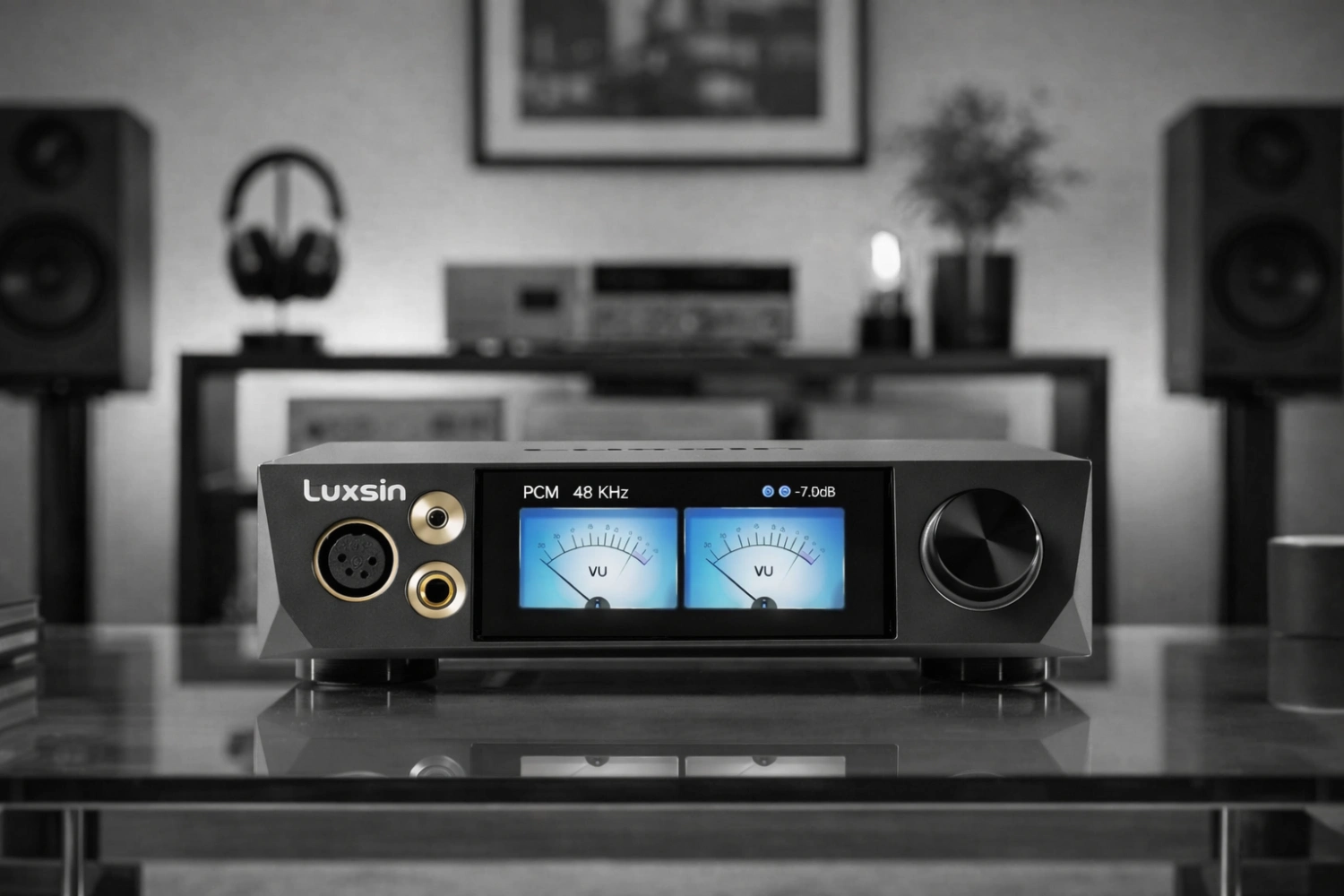
The Luxsin X8 takes the opposite path from the Merason. It is not just a converter; it is a DAC/amp built as a complete desktop audio platform. Its headline hardware includes eight Cirrus Logic CS43198 DAC chips, high-output headphone amplification, a separated linear power supply and a proprietary Digital Audio Core for real-time processing.
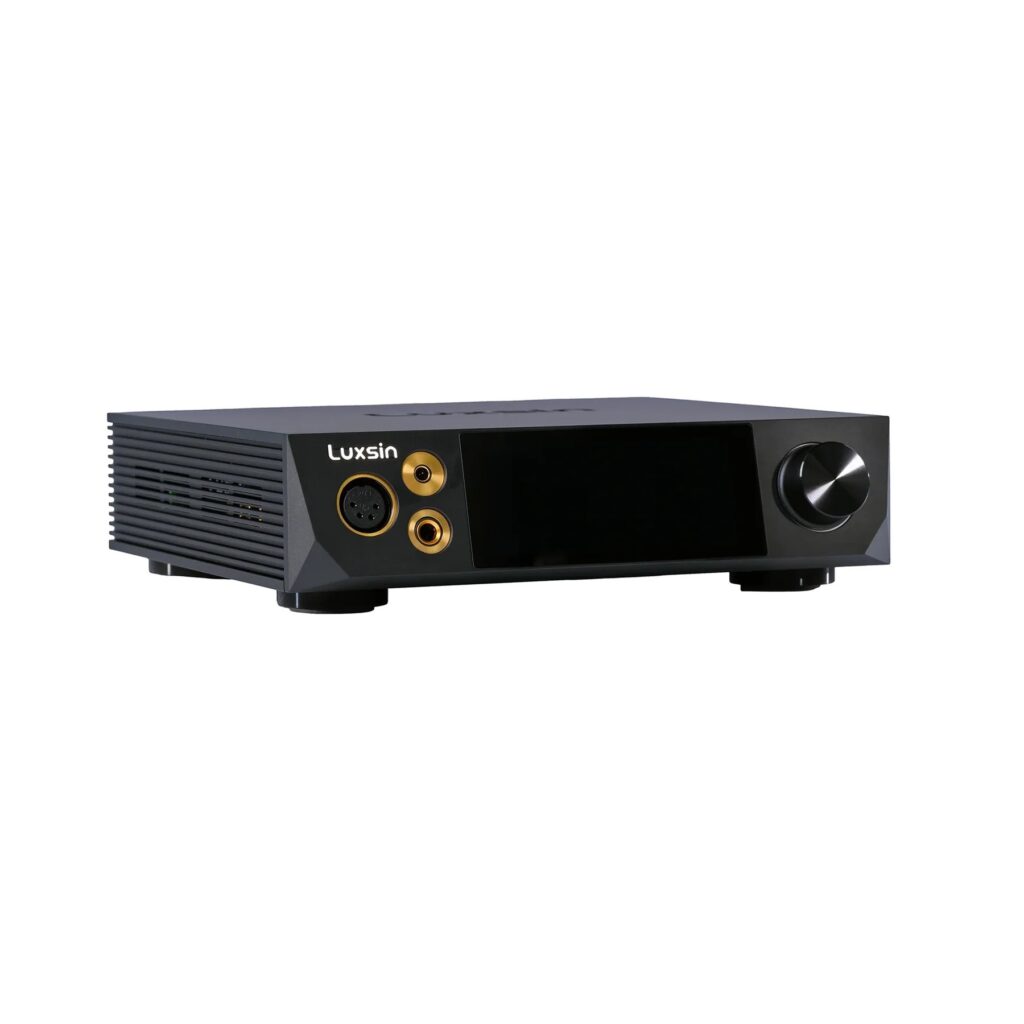
The DAC section uses a true dual-mono parallel architecture, with four CS43198 chips per channel operating in sync. The summed analog output is designed to reduce noise and improve low-level resolution. Luxsin also separates left and right channels physically and electrically, with independent power delivery and signal paths. A dedicated buffering and clock distribution system keeps the DACs locked to the same timing reference, while individual DAC shielding is used to support electrical isolation and thermal consistency.
The X8’s processing platform is central to its identity. Its Digital Audio Core is built around a dual-core HiFi-5 DSP and ARM architecture running at over 500 MHz with substantial on-chip memory. That gives the unit the processing headroom for advanced EQ, headphone compensation and firmware-driven feature expansion. This is not a passive fixed-function DAC; it is designed around real-time control.
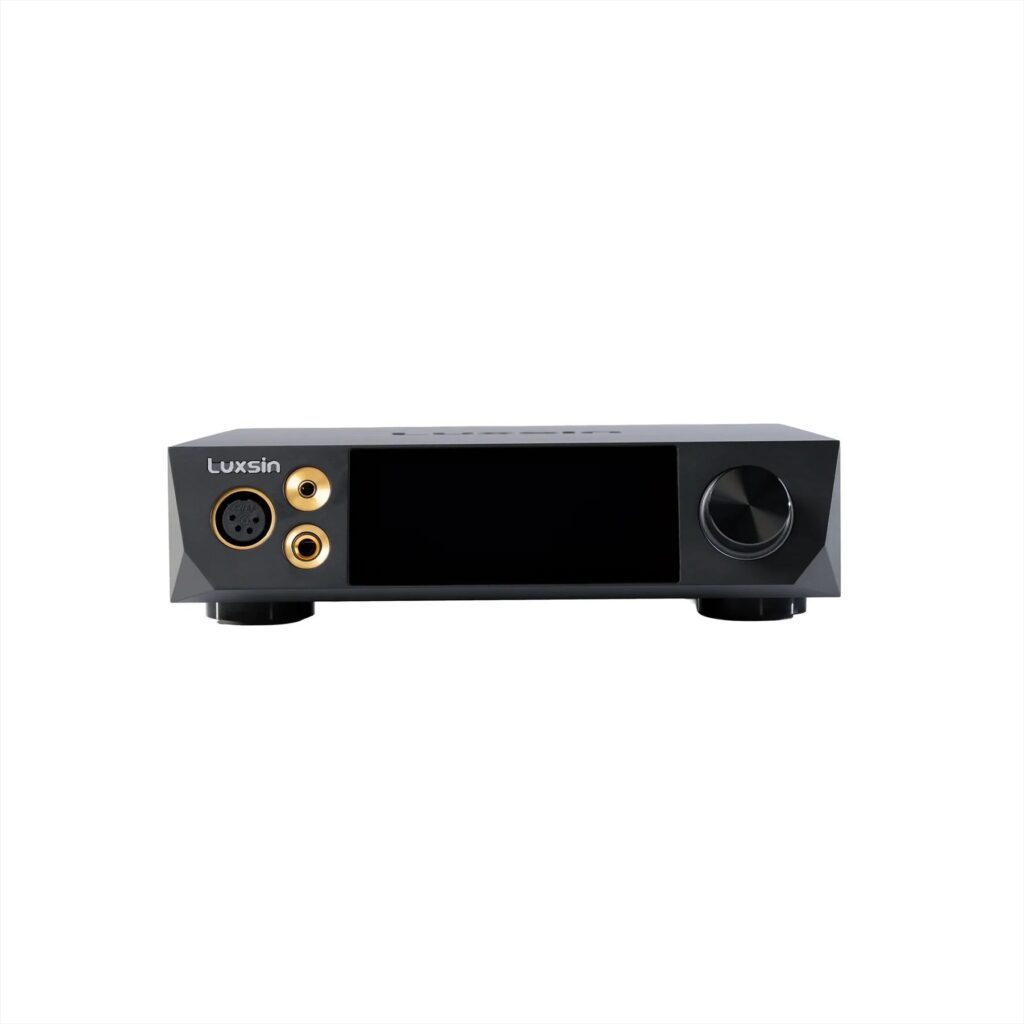
The most distinctive feature is Luxsin’s AI-assisted EQ system. Instead of requiring users to manually adjust parametric EQ bands, the system allows sound preferences to be described in ordinary terms, such as more warmth, tighter bass or clearer vocals. It integrates with Luxsin’s HP-EQ platform, which includes a database of more than 2,500 headphone models, supports target curves such as Harman and stores up to 50 headphone profiles.
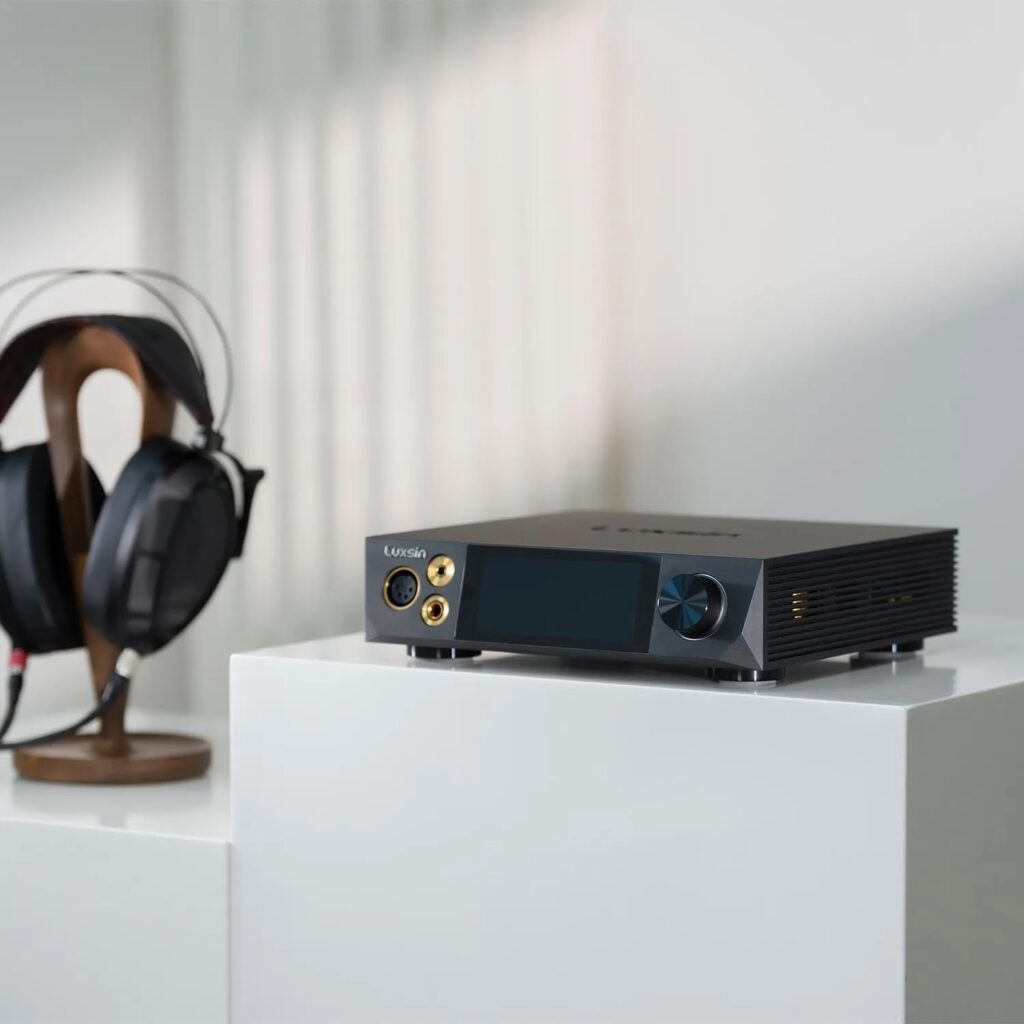
Amplification is another major part of the X8’s appeal. Luxsin specifies up to 4800mW per channel, using OPA1612 op-amps and TPA6120A2 high-current drivers. The design is aimed at maintaining low distortion and high linearity under load, with enough output for a wide range of headphones from sensitive IEMs to demanding full-size models. XLR4, 4.4mm and 6.35mm headphone outputs are supported, and an upgraded impedance detection system automatically identifies connected headphones and adjusts gain accordingly.
Pros
- Eight Cirrus Logic CS43198 DAC chips in a dual-mono parallel architecture.
- Integrated headphone amplification rated up to 4800mW per channel.
- AI-assisted EQ and HP-EQ headphone compensation with more than 2,500 headphone models.
- Stores up to 50 headphone profiles for fast switching between setups.
- XLR4, 4.4mm and 6.35mm headphone outputs with automatic impedance detection and gain adjustment.
- Separated linear power supply, independent channel paths and real-time voltage/current monitoring.
Cons
- Its broad processing and headphone feature set may be unnecessary in a traditional speaker-based separates system.
- Not a minimalist fixed-output DAC in the same sense as the Merason DAC 2.
- Users who do not want EQ, headphone compensation or profile management may not use much of what makes it distinctive.
- The product’s appeal depends heavily on comfort with a more interactive, software-driven listening workflow.
- Its value proposition is tied to integrated functionality rather than pure separation of DAC, preamp and headphone amplification.
Best for: The Luxsin X8 is best for desktop listeners and headphone users who want one component to handle conversion, powerful headphone drive, automatic gain behavior, headphone correction and personalized EQ without building a chain of separate boxes.
Read the original Stereoindex article →
Merason DAC 2 vs Luxsin X8: The real differences
The Merason DAC 2 and Luxsin X8 begin from different assumptions. Merason assumes the listener already owns the rest of the hi-fi chain and wants a specialist converter to slot into it. Luxsin assumes the listener wants the DAC to become the active center of a desktop system, complete with amplification and sound-shaping intelligence.
In design and construction terms, the Merason is defined by subtraction. It removes volume control, headphone amplification and secondary functions so the conversion and analog signal stages do not have to share the chassis with unrelated circuitry. The Luxsin is defined by integration. It combines a large DAC array, headphone amplifier, DSP platform, impedance detection, profile storage and an elaborate power architecture in one unit.
The core DAC technologies are also different. Merason uses two Burr-Brown PCM1794A chips in a fully differential configuration. The emphasis is on a balanced signal topology, channel separation and controlled distortion through dedicated conversion resources. Luxsin uses eight Cirrus Logic CS43198 chips, arranged as four DACs per channel in a true dual-mono parallel design. The X8’s DAC implementation is explicitly linked to noise reduction, low-level resolution and stable stereo behavior through synchronized clocking and channel separation.
Amplification is the starkest practical divide. The DAC 2 has none. That is not a weakness if your system already includes a suitable preamp or integrated amplifier; it is part of the product’s purpose. The X8, by contrast, is built to drive headphones directly, with up to 4800mW per channel and outputs on XLR4, 4.4mm and 6.35mm connections. It is therefore far more complete for personal listening, while the Merason is cleaner conceptually for a separates-based speaker system.
Setup expectations differ as much as hardware. With the Merason, compatibility is about system architecture: you need digital source equipment, then external volume control and amplification after the DAC. With the Luxsin, setup revolves around headphone connection, gain behavior, EQ choices, compensation profiles and possibly storing multiple headphone configurations. One asks you to own the surrounding hi-fi chain; the other invites you to tailor the listening chain from the front panel or software layer.
Formats and connectivity are not the main documented battleground here. Neither product is defined by a long list of supported file types in the available product descriptions. The meaningful supported connectivity detail belongs to the Luxsin’s headphone side: XLR4, 4.4mm and 6.35mm outputs with automatic impedance detection. The Merason’s described connectivity role is fixed-source output into an external preamplifier or integrated amplifier, rather than direct headphone or variable-output use.
System matching should therefore guide the decision. The Merason belongs with owners who already care about component separation and want the DAC to do one job. It is likely to make the most sense in a rack with dedicated amplification and source switching elsewhere. The Luxsin belongs on a desk, in a headphone-first setup or anywhere its combination of DAC, amp and sound personalization replaces several separate functions.
Value positioning follows the same logic. The DAC 2 offers value through focus: you are not paying for headphone outputs, profile databases or onboard sound tuning. The X8 offers value through concentration of features: eight-DAC conversion, high-power headphone amplification, EQ, headphone compensation, storage for many profiles and automated gain behavior in a single desktop device. The stronger buy is the one whose feature set you will actually use.
| Category | Merason DAC 2 Strips Digital Conversion Back to Essentials | Luxsin X8: DAC/amp with AI-driven sound and 8-DAC architecture | Edge |
|---|---|---|---|
| Product type | Dedicated fixed-output DAC | Desktop DAC/headphone amplifier with processing | Depends on system role |
| Conversion hardware | Two Burr-Brown PCM1794A chips | Eight Cirrus Logic CS43198 chips | Different design philosophies |
| DAC topology | Fully differential configuration | True dual-mono parallel architecture with four DACs per channel | Depends on implementation priorities |
| Amplification | No integrated headphone amplifier or volume control | Up to 4800mW per channel headphone output | Luxsin X8 for headphones |
| Sound tuning | No EQ or processing features described | AI-assisted EQ, HP-EQ headphone compensation and profile storage | Luxsin X8 |
| Headphone support | Not a headphone device | XLR4, 4.4mm and 6.35mm outputs with impedance detection | Luxsin X8 |
| System matching | Best with external preamp or integrated amplifier | Best as an all-in-one desktop/headphone hub | Depends on system |
| Design philosophy | Purposeful simplicity and separation | Integrated hardware, amplification and real-time processing | Personal preference |
| Power architecture | Additional circuits are avoided to reduce demands and interference risks | Separated linear power supply, selectable voltage rails and monitoring sensors | Different approaches |
| Ideal buyer | Separable hi-fi system owner seeking a focused DAC | Headphone listener seeking power and personalization | No single winner |
Verdict: Choose the architecture that matches your listening life
The Merason DAC 2 is the purist in this battle, but not in a vague marketing sense. Its entire identity is built around refusing jobs that belong elsewhere. No volume control. No headphone amplifier. No effort to become a desktop control center. Instead, it uses dual Burr-Brown PCM1794A conversion in a fully differential design and aims to serve as a dedicated source component inside a larger hi-fi system.
That makes it the more appropriate choice if your system already has a preamplifier or integrated amplifier you like. It also makes sense if you prefer a DAC that can be judged on conversion architecture rather than on menus, profiles or ancillary features. The DAC 2 is not trying to simplify ownership by replacing other components; it is trying to keep its own job cleanly defined.
The Luxsin X8 is the more complete product for headphone and desktop listening. Its eight-CS43198 DAC array, dual-mono parallel architecture, serious headphone output, automatic impedance detection and extensive sound-personalization platform make it a far more self-contained solution. It is especially compelling for users with multiple headphones, because the HP-EQ database, target-curve support and storage for up to 50 profiles turn the X8 into a practical hub rather than just a DAC with an amp attached.
There is no honest reason to force one universal winner. The Merason DAC 2 is the stronger conceptual fit for separates-based hi-fi systems where conversion should remain a dedicated task. The Luxsin X8 is the stronger practical fit for desktop listeners who want power, flexibility and headphone-specific tuning in one chassis.
If you want a fixed DAC to feed serious downstream amplification, look at the Merason. If you want an ambitious desktop DAC/amp that can drive headphones and adapt to them, the Luxsin is the obvious match. The better product is the one that solves your actual system problem.
Frequently asked questions
Is the Merason DAC 2 a DAC/amp?
No. The Merason DAC 2 is a dedicated DAC. It has no integrated headphone amplifier and no volume control, so it should be used with a separate preamplifier, integrated amplifier or other component that handles level control and amplification.
Does the Luxsin X8 replace a separate headphone amplifier?
For many headphone systems, yes. The X8 includes headphone amplification rated up to 4800mW per channel, with XLR4, 4.4mm and 6.35mm outputs, automatic impedance detection and gain adjustment.
Which product is better for a speaker-based hi-fi system?
The Merason DAC 2 is the more natural fit for a traditional separates-based speaker system because it is designed as a fixed-output DAC feeding external amplification. The Luxsin X8 can be attractive if its DAC/amp and processing features suit your setup, but its strongest documented advantages are headphone-focused.
Which one is better for headphones?
The Luxsin X8 is clearly the headphone-focused product. It includes high-power amplification, multiple headphone outputs, impedance detection, AI-assisted EQ, HP-EQ headphone compensation and storage for up to 50 headphone profiles. The Merason DAC 2 does not include a headphone amplifier.
What DAC chips do they use?
The Merason DAC 2 uses two Burr-Brown PCM1794A chips in a fully differential configuration. The Luxsin X8 uses eight Cirrus Logic CS43198 chips in a true dual-mono parallel architecture, with four DACs assigned to each channel.
Does either product include streaming?
Streaming functionality is not part of the described feature set for either product. The comparison here is centered on DAC architecture, amplification, processing, system role and headphone support.
Pure DAC or Desktop Powerhouse? Merason DAC 2 vs Luxsin X8
Two products. One winner. You decide.
Merason DAC 2 Strips Digital Conversion Back to Essentials